

Shanghai, July 17, 2026 — The Ethics Review Agent System “Mirror” officially launched its 2.0 version at the forum titled “Global AI Governance and Sustainable Development: Challenges and Responses,” held during the 2026 World Artificial Intelligence Conference and High-Level Meeting on Global AI Governance (WAIC 2026).
Mirror 2.0 was jointly developed under the leadership of the China Association for Science and Technology–Fudan University Institute for Science and Technology Ethics and Human Futures the team led by Professor Guoyu Wang from Fudan University’s School of Philosophy; and the teams led by Professors Yu-Gang Jiang and Xingjun Ma from Fudan University’s Institute for Trustworthy Embodied Intelligence. The team led by Professor Yajun Yang from Fudan University’s School of Life Sciences and other interdisciplinary teams also contributed to its development.
Zhongshan Hospital, Fudan University, provided essential support for calibrating ethics review rules and validating the system in clinical scenarios. Professor Jianying Gu, Party Secretary of Zhongshan Hospital and Director of the National Pilot Base for Artificial Intelligence Applications in Healthcare, attended the launch ceremony. The release was also covered by CCTV News (CCTV-13).
The system has now been successfully deployed and put into operation at both the National Pilot Base and Fudan University, providing explainable, traceable, and reviewable intelligent assistance for responsible innovation. Drawing on Fudan University’s multidisciplinary strengths, the project has established an interdisciplinary innovation framework integrating artificial intelligence with ethics governance.
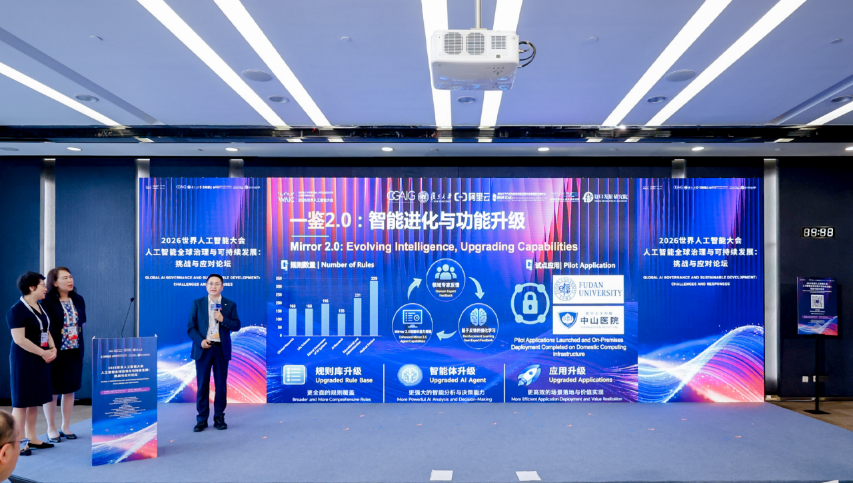
Launch Ceremony of the Ethics Review Agent “Mirror” 2.0
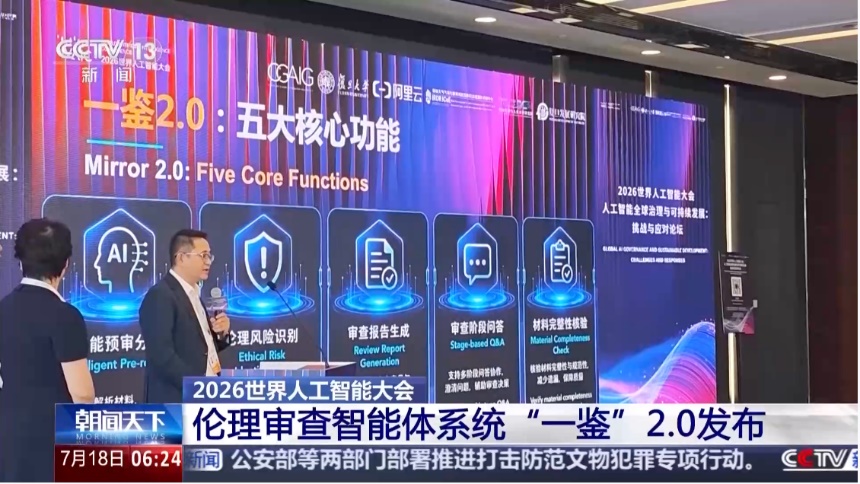
CCTV News Coverage of the Launch
From 1.0 to 2.0: Expanding Ethics Review from Fundamental Research to New Scenarios in Medical AI
Unveiled in 2025, “Mirror” 1.0 was the world’s first AI agent system specifically designed for science and technology ethics review. It primarily focused on the ethical review of fundamental research projects, providing basic review support in areas such as participant protection, informed consent, privacy and data security, data use, and risk–benefit assessment.
Released one year later, “Mirror” 2.0 represents a comprehensive expansion of the original system. Its review scope has grown from fundamental research to six major areas: life sciences, biomedicine, medical devices, organ transplantation, ethics review for journal publications, and medical AI. Medical AI is the central focus of this upgrade, responding to the governance requirements set out in the Measures for the Ethics Review and Services of Artificial Intelligence Science and Technology (Trial) across the development, service provision, and application of AI technologies.
At the core of “Mirror” 2.0 is a domain-specific large language model built for vertical tasks in science and technology ethics review. Trained and calibrated using authoritative guidelines, domain-specific rules, and expert feedback, the model can understand lengthy research documents, identify ethical risks, match relevant regulatory and ethical requirements, and generate review recommendations.
The name “Mirror” is inspired by the classical Chinese verse, “A half-acre square pond opens like a mirror, where light and drifting clouds are reflected.” It symbolizes the use of technology as a mirror to reveal potential risks, safeguard the ethical boundaries of scientific innovation, and protect human dignity and the public interest.
In 2025, “Mirror” 1.0 made its debut at the World Artificial Intelligence Conference as the world’s first ethics review agent, pioneering a Fudan approach to AI-enabled ethics review. The launch of “Mirror” 2.0 marks a new stage in this exploration, advancing toward greater intelligence, standardization, and internationalization.
Accelerating Technological Innovation Ushers Ethics Governance into a New Intelligent Era
In recent years, the Chinese government has placed great emphasis on science and technology ethics governance and has continued to strengthen a three-tier ethics review system at the national, regional or professional, and institutional levels. The National Science and Technology Ethics Committee and its specialized subcommittees provide overall coordination, regional and professional ethics review centers enhance cross-institutional collaboration, and ethics committees within universities, research institutions, healthcare organizations, and enterprises assume primary responsibility for implementation.
Ethics committees constitute an important institutional mechanism for promoting responsible research and responsible innovation. In the era of AI for Science, artificial intelligence is becoming deeply integrated into scientific discovery, medical research, and social governance. At the same time, it is introducing new ethical risks, regulatory conflicts, and uncertainties over the boundaries of responsibility.
“Mirror” 2.0: Coordinated Upgrades Across the Rule Base, AI Agents, and Applications
Rule Base Upgrade: Building a Scenario-Oriented Intelligent Ethics Review Framework.The rule base has been enhanced for two calibrated scenarios: fundamental research and medical AI. Life sciences, biomedicine, medical devices, organ transplantation, and ethics review for journal publications are being developed as areas for knowledge accumulation and rule refinement. The system also supports customizable rules and continuous iteration.
AI Agent Upgrade: Enhancing Professional Review Capabilities through Reinforcement Learning from Expert Feedback.The system is aligned with the review priorities, evaluation criteria, and professional language of experts in fundamental research and medical AI, enabling its review capabilities to improve continuously.
Application Upgrade: Advancing the Intelligent and Standardized Transformation of Ethics Review Processes.“Mirror” 2.0 provides five core functions: intelligent preliminary review, ethical risk identification, review report generation, question answering throughout the review process, and document completeness verification. It also supports customizable rules, adaptation to domestically developed computing infrastructure, and private deployment. Pilot applications have been launched at the Science and Technology Research Institute of Fudan University and the National Pilot Base for Artificial Intelligence Applications led by Zhongshan Hospital, Fudan University.
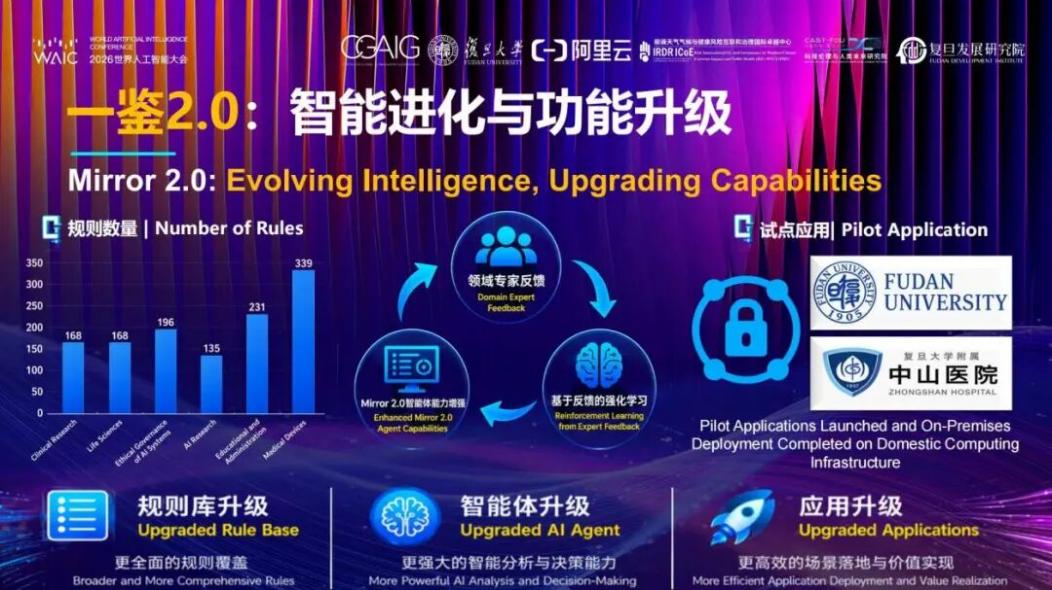
“Mirror” 2.0: Three Major Upgrades to the Rule Base, AI Agent, and Applications
Traceable, Reviewable, and Verifiable: Exploring a New Paradigm for Science and Technology Ethics Governance
“Mirror” 2.0 advances ethics review from experience-based assistance toward a new model in which the supporting evidence is traceable, the review process is open to re-examination, and system capabilities can be independently validated.
Rather than replacing ethics committees, the system assists researchers and experts in identifying risks more efficiently, matching applicable rules more precisely, and clearly explaining the basis for review recommendations. Local and private deployment also helps safeguard sensitive research, medical, and ethics review data.
Looking ahead, “Mirror” will continue to strengthen its professional review capabilities, broaden its global perspective on science and technology ethics governance, promote international exchange and collaboration, and develop an integrated platform combining ethics review, consultation, and education. Through these efforts, it aims to contribute a “Fudan solution” and Chinese wisdom to global science and technology ethics governance.
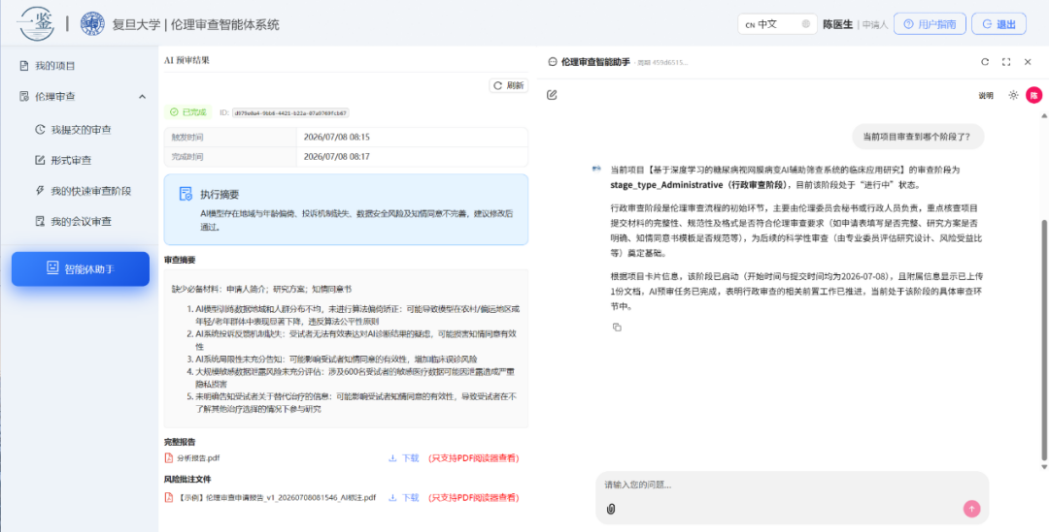
“Mirror 2.0” System Interface