

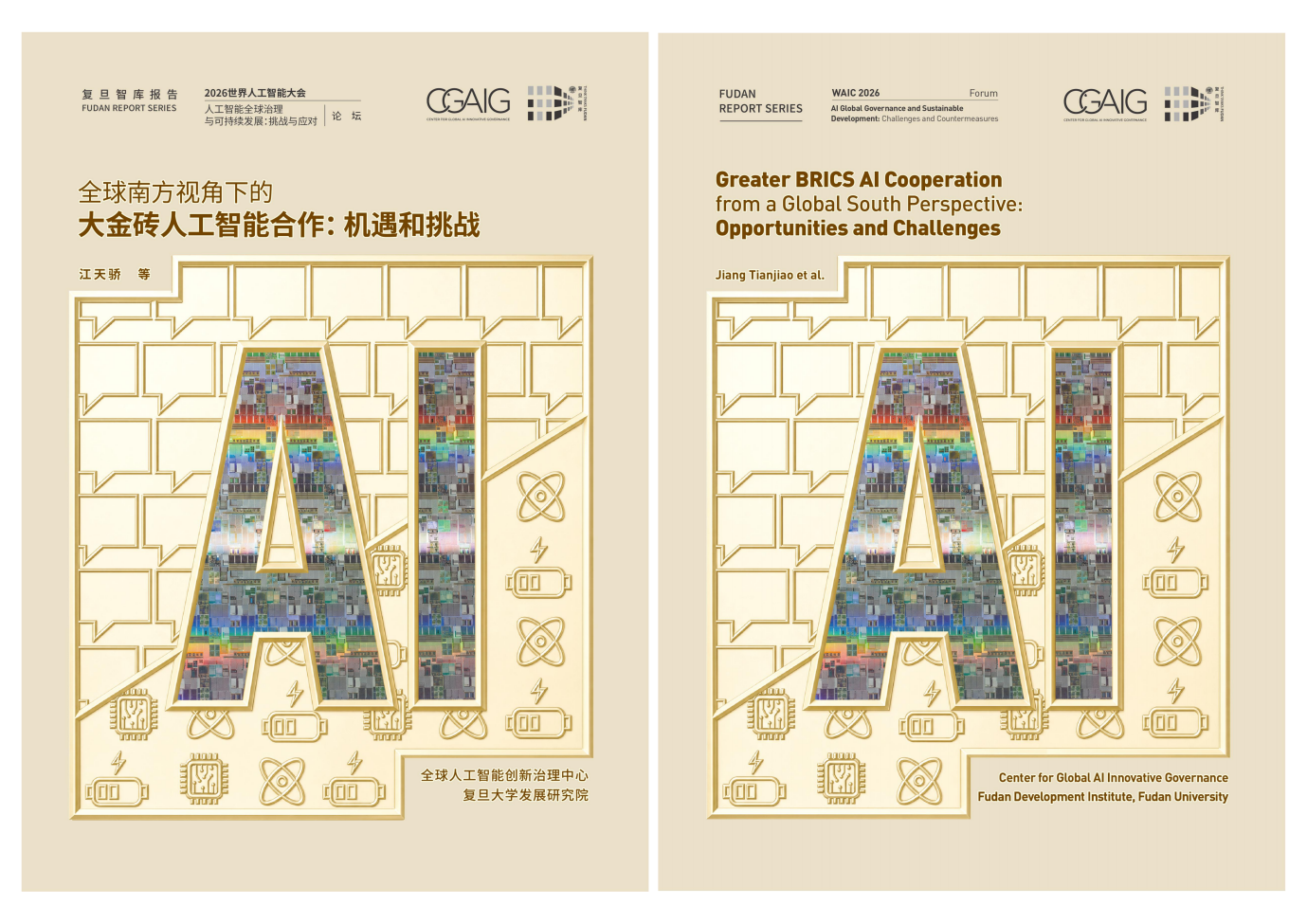
On July 17, 2026, the Fudan Think Tank Report "Greater BRICS AI Cooperation from a Global South Perspective: Opportunities and Challenges" (hereinafter referred to as "the Report") was officially released at the forum "Global AI Governance and Sustainable Development: Challenges and Responses" of the 2026 World Artificial Intelligence Conference (WAIC 2026).
The Report is jointly released by the Center for Global AI Innovative Governance and the Fudan Development Institute. The project is led by Jiang Tianjiao, Research Fellow at the Center for Global AI Innovative Governance, Deputy Director and Associate Professor of Center for BRICS studies at Fudan Development Institute. Co-authors include Yao Xu, Secretary-General of the Center for Global AI Innovative Governance and Associate Professor at Fudan Development Institute; Xin Yanyan, Deputy Secretary-General of the Center for Global AI Innovative Governance and Assistant Research Fellow at Fudan Development Institute; and multiple graduate students from the School of International Relations and Public Affairs at Fudan University.
The Report notes that the number of BRICS member states has reached 11, with a total population of approximately 3.8 billion, accounting for nearly half of the global population; their combined GDP totals approximately $29.2 trillion, accounting for nearly one-third of global GDP, giving BRICS an increasingly important position in the global political, economic, and technological landscape. BRICS countries have identified AI development and governance as a key area of cooperation. Accordingly, the Report provides a systematic analysis of drivers of development, opportunities for cooperation, challenges and divergences, and the India AI Impact Summit as a case study, and proposes recommendations on advancing AI cooperation among BRICS countries.
First, regarding drivers of development, the Report identifies threefold motivations for BRICS countries to engage in AI development and governance: development needs—namely, promoting industrial upgrading and building development safeguards; the need to shape global discourse—strengthening and expanding global influence and giving voice to the Global South; and security needs—breaking free from technological containment and regulatory monopolies of developed countries.
Second, regarding opportunities for cooperation, the Report presents the practical foundations for BRICS AI cooperation across six dimensions: member states generally emphasize national strategic planning, focus on infrastructure cooperation, address issues such as data, ethics, and standards, prioritize AI development and application in key sectors including agriculture, healthcare, finance, and energy, prioritize talent development, and propose global governance cooperation agendas.
Third, regarding challenges and divergences, the Report argues that the greater BRICS objectively faces greater diversity and higher coordination costs, and analyzes these from eight aspects: the AI divide among BRICS members; differing national positioning; varying approaches to legislation and regulation; differing degrees of technological dependence on and cooperative relationships with Western countries; constraints imposed by some developed countries on AI development; differing perceptions and practices regarding UN and regional multilateral governance frameworks; insufficient participation in global AI governance; and differing understandings of digital and AI sovereignty. The Report emphasizes that a deep understanding of these issues is key to further advancing BRICS AI cooperation and achieving high-quality development.
The Report also takes the India AI Impact Summit held in February 2026 as a case study, further noting that the agency of the Global South in the global AI governance agenda is gradually strengthening, its governance voice is rising, and a "development-first" AI pathway is taking shape. However, the global AI power structure continues to constrain the development of the Global South. Countries of the Global South still need to proceed steadily from a solid technological foundation and pragmatic domestic governance.
On this basis, the Report proposes recommendations for advancing BRICS AI cooperation at three levels: governance, industry, and international. At the governance level, it recommends establishing a BRICS AI strategic dialogue and mutual trust mechanism, and improving the BRICS AI regulatory and data coordination framework. At the industry level, it recommends advancing the construction of a BRICS computing infrastructure cooperation network, implementing a joint BRICS AI talent development program, building a BRICS AI investment and financing platform cooperation mechanism, launching joint demonstration projects in key sectors, and building differentiated cooperation frameworks based on each country's degree of external technological dependence and cooperative relationships. At the international level, it recommends further leveraging the role of international development cooperation strategies such as the Belt and Road Initiative, coordinating BRICS members to jointly promote inclusive and equitable AI development globally, accelerating BRICS cooperation in global AI governance, and amplifying the "BRICS voice" on the international stage.
As part of the Fudan Think Tank Report series, the Report takes a Global South perspective, systematically examines the opportunities and challenges of Greater BRICS AI cooperation, and aims to provide a reference for promoting practical BRICS AI cooperation, bridging the AI divide, and improving global AI governance.
Original link:
 Greater BRICS AI Cooperation from a Global South Perspective.pdf