


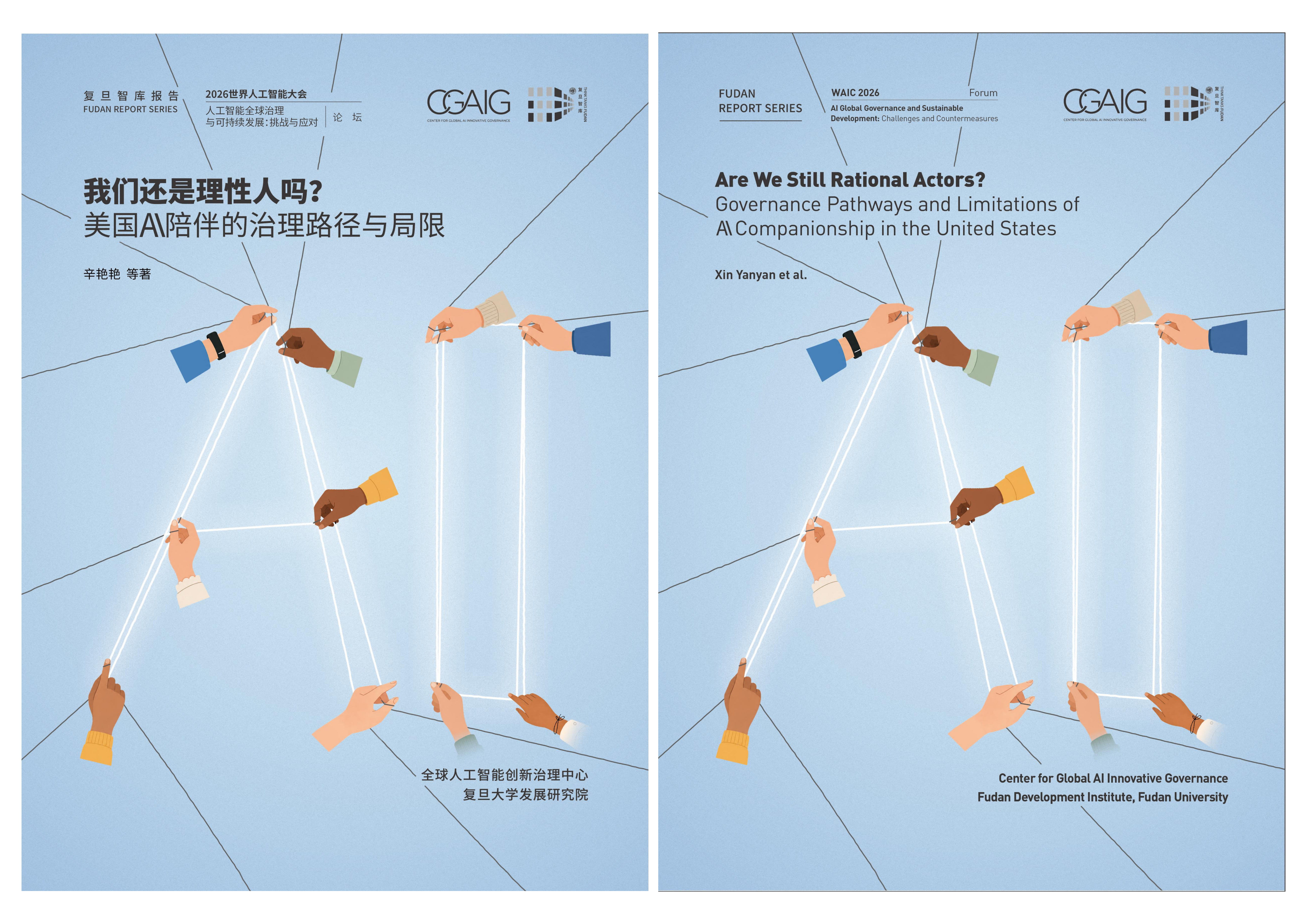
On July 17, 2026, at the forum Global AI Governance and Sustainable Development: Challenges and Responses of the 2026 World Artificial Intelligence Conference (WAIC 2026), the research report Are We Still Rational Actors? Governance Pathways and Limitations of AI Companionship in the United States (hereinafter referred to as “the Report”) was officially released by the Center for Global AI Innovative Governance.
The Report points out that as anthropomorphic AI interaction technologies rapidly proliferate, the associated risks, including emotional dependence and even manipulation, have become increasingly prominent, creating an urgent need for governance. The United States, as a frontier market for related technological innovation and commercial application, often frames anthropomorphic AI interaction as a positive form of AI companionship. However, two landmark lawsuits, Garcia v. Character.AI and Raine v. OpenAI, have revealed systemic deficiencies in so-called AI companion applications, including a lack of safeguards against predatory anthropomorphic design, insufficient age protection mechanisms, and failures in safety risk monitoring. To regulate the associated risks, the U.S.states of New York and California successively enacted relevant legislation in2025, marking the beginning of substantive regulation of anthropomorphic AI interactionat the global level.
By comparing the two states’ legislative approaches, the Report finds that both states have established transparency disclosure, crisis intervention, and the protection of minors as their institutional foundations, while exhibiting certain differences in their specific accountability pathways. At the same time, the legislative process has also revealed that U.S. society’s current approach to regulating human-machine emotional addiction and deep intervention for all users remains significantly constrained by constitutional frameworks and industry dynamics.The deficiencies in the relevant legislative texts further raise the corequestion of this Report: if so-called AI companion applications can, through the dynamic guidance of anthropomorphic contexts, relational reinforcement, and choice architecture, continuously erode users’ decision-making autonomy, doesthe “rational actor” assumption upon which traditional internet governance relies still hold?
In response, the Report argues that the risks in AI companion scenarios are procedural, relational, and cumulative in nature, necessitating a shift from one-off information disclosure to a vulnerability governance paradigm encompassing relational risk identification, procedural protection, protective friction, and correctable design, so as to better address the profound challenges that AI companion applications pose to users’ rationality, autonomy, and psychological safety.
Research Team Members
Xin Yanyan
Research Fellow, Center for Global AI Innovative Governance
Assistant Research Fellow, Fudan Development Institute
Shen Qi
Project Director, Center for Global AI Innovative Governance
Luo Haoyue
Project Director, Center for Global AI Innovative Governance
Sa Na
Research Assistant, Center for Global AI Innovative Governance
Jin Yukai
Research Assistant, Center for Global AI Innovative Governance
Yu Yue
Research Assistant, Center for Global AI Innovative Governance
Zhong Yifei
Research Assistant, Center for Global AI Innovative Governance
Qin Yuan
Research Assistant, Center for Global AI Innovative Governance
Original link: Are We Still Rational Actors? Governance Pathways and Limitations of AI Companionship in the United States.pdf