

People’s Daily Headlines丨Steering AI Toward Good and Strengthening the Foundations of Global Governance
Huang Xiaohui
Center for Global AI Innovative Governance
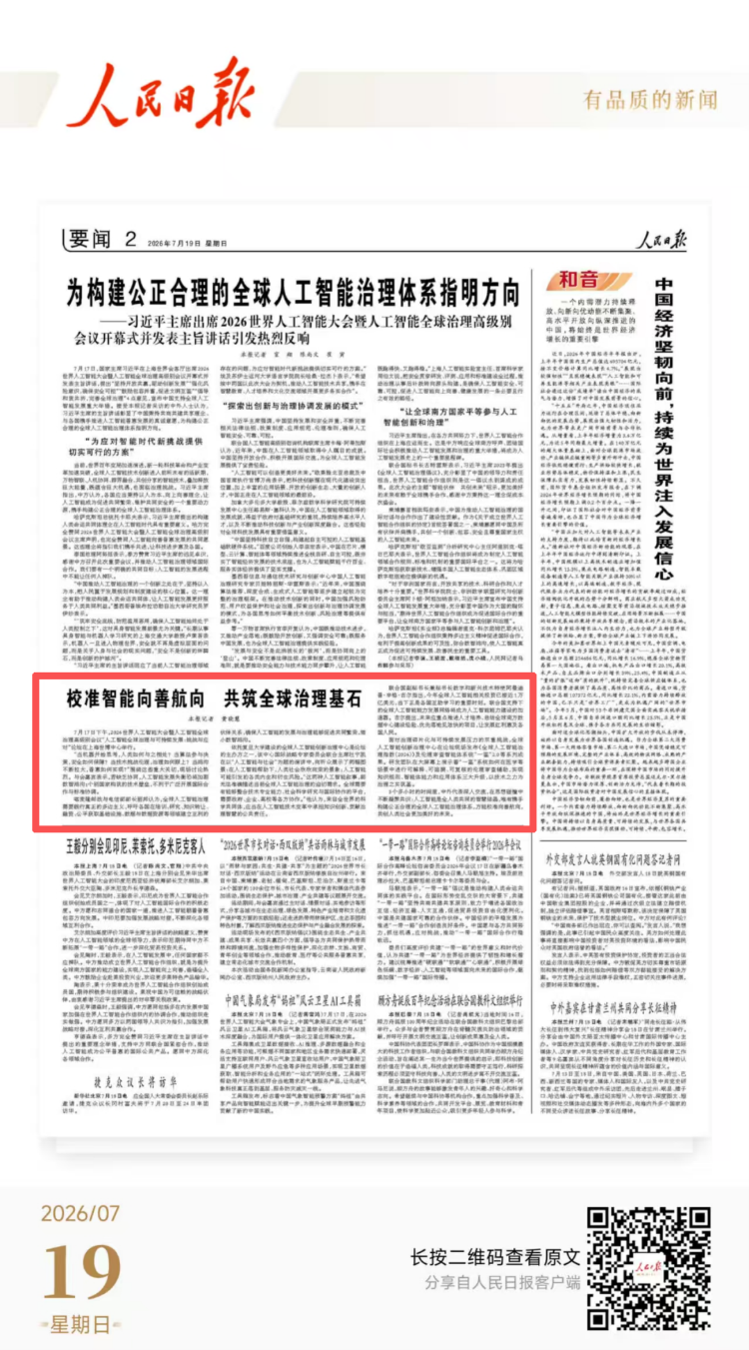
Image Source: People’s Daily
On the afternoon of July 17, the forum titled “Global AI Governance and Sustainable Development: Challenges and Responses” was held at the Shanghai World Expo Center as part of the 2026 World Artificial Intelligence Conference (WAIC) and High-Level Meeting on Global AI Governance.
“When machines begin to think, how should human beings coexist with them? When algorithms participate in decision-making, how can security be ensured? When technology challenges ethics, how can governance keep pace? When the divide continues to widen, how can inclusiveness be achieved?” Centering on these major concerns, participants engaged in lively discussions at the event. The participating guests stated that without coordination, unbalanced development of artificial intelligence may further intensify the digital and intelligent divide. Technological barriers erected by some countries are not conducive to extensive international cooperation and the coordination of standards.
Mrs. Libom Li Likeng, Minister of Posts and Telecommunications of the Republic of Cameroon, stressed that global AI governance requires the practice of genuine multilateralism. She called on countries to establish mutually beneficial partnerships in areas such as training, research, knowledge transfer, financing, and equitable access to digital infrastructure, data, and data resources, ensuring that the development and governance of artificial intelligence can promote shared prosperity and narrow the digital and intelligent divide.
The Center for Global AI Innovative Governance, established with the support of Fudan University, was one of the organizers of the forum. Nicholas B. Dirks, Co-Chair of the International Advisory Board of the Center, delivered a speech titled “Artificial Intelligence and Society”, in which he presented two scenarios to the audience: one depicting a thriving human society with the assistance of artificial intelligence, and the other illustrating the wide range of risks that AI may create or amplify. “Neither of these narratives adequately captures the urgent challenges facing global AI governance today. The world needs platforms capable of integrating technological expertise, social science research, and international cooperation. Governments, enterprises, universities, and other parties need to work together,” he said. He believes that the scientific community from around the world should assume the public responsibility of promoting knowledge innovation and contributing governance wisdom amid the technological transformation brought about by artificial intelligence.
Amandeep Singh Gill, United Nations Under-Secretary-General and Special Envoy for Digital and Emerging Technologies, pointed out that global investment related in AI has approached US$1 trillion this year. Now is an important moment for countries to learn from and support one another. The Global AI Capacity Development Network, supported by the United Nations, will become an accelerator for artificial intelligence capacity building. Gill proposed that future efforts should focus on promoting talent cultivation, drawing on the experience of building data centers across the Global South, and prioritizing projects that can achieve rapid and effective results, so that the benefits of development can reach people in all countries.
Facing the dual challenges of fragmented governance and pressures for sustainable development, the Center for Global AI Innovative Governance released the Global AI Governance Index (2026) and a series of research outputs, including the intelligent ethical review agent system Mirror 2.0, at the forum. The research team demonstrated on a large screen how the Mirror system conducts explainable, traceable, and verifiable ethical review assistance in scenarios such as medicine. The system has achieved three major upgrades in knowledge base, intelligent agent capabilities, and application systems, providing technological support for more effective AI governance.
Over the course of more than three hours, Chinese and foreign representatives engaged in in-depth exchanges and continuously built consensus through the collision of ideas: Artificial intelligence is a shared achievement of human ingenuity of human wisdom. Only by jointly building a fair and reasonable global AI governance system can we steer artificial intelligence toward good, and create a better future for human society together.
Original URL:https://mp.weixin.qq.com/s/VoSvmRfJVYJFCKZQSMYNBg