

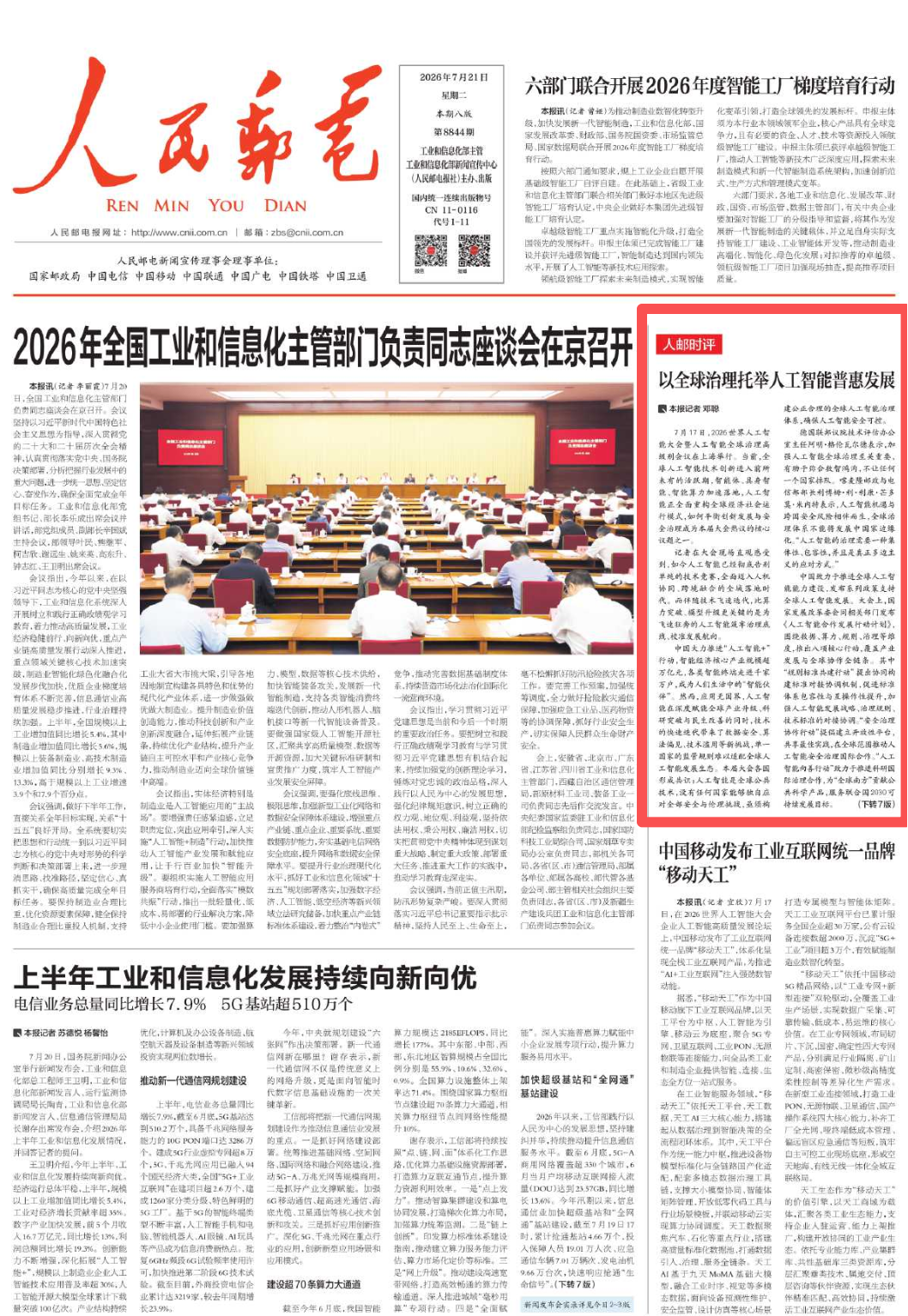
The 2026 World Artificial Intelligence Conference and the High-Level Meeting on Global Governance of Artificial Intelligence were held in Shanghai on 17 July. Global innovation in artificial intelligence has entered an unprecedentedly dynamic phase, with AI agents, embodied intelligence, and intelligent computing capabilities rapidly moving from conceptual development to practical deployment. As artificial intelligence continues to profoundly transform the functioning of the global economy and society, striking a balance between innovation-driven development and security governance has emerged as one of the key issues under discussion at this year’s conference.
At the conference venue, observers noted that artificial intelligence has moved beyond a phase defined solely by technological competition and entered an era of widespread application characterized byhuman–machine collaboration and cross-border integration. As AI technologies continue to evolve at an accelerating pace, establishing robust governance safeguards and providing clear direction for AI development have become even more essential than advances in computing power or upgrades in AI models.
China has vigorously advanced the “AI Plus” initiative. The core industries of the intelligent economy have exceeded a scale of one trillion yuan, while various intelligent terminals have entered households across the country and become increasingly integrated into people’s daily livesas “intelligent companions.”
However, the application of artificial intelligence transcends national borders. While AI is generating profound benefits by advancing industrial transformation, accelerating scientific breakthroughs, and improving people’s well-being worldwide, rapid technological evolution has also created new challenges, including data security risks, algorithmic bias, and the misuse of technology. Regulatory frameworks established by individual countries alone are increasingly insufficient to address the complexities of the global AI ecosystem.
Participants at the conference reached a broad consensus that artificial intelligence should be regarded as a global public technology. No country can independently address the full spectrum of security and ethical challenges associated with AI. It is therefore imperative to establish a fair, inclusive, and effective global AI governance framework to ensure that artificial intelligence develops in a safe, secure, and responsible manner.
Armin Grunwald, Director of the Office of Technology Assessment at the German Bundestag, stated that strengthening global AI governance is of critical importance, as it can help bridge the digital and intelligent technology divide and ensure that no country is left behind. LIBOM LI LIKENG née MENDOMO Minette, Minister of Posts and Telecommunications of Cameroon, noted that opportunities brought by artificial intelligence are accompanied by transnational security risks. The global governance system must not marginalize developing countries. “AI governance requires a collective, inclusive, and genuinely multilateral approach.”
China is committed to advancing global capacity building inartificial intelligence and has introduced a series of policy initiatives to support the development of AI worldwide.
At the conference, the National Development and Reform Commission, together with relevant government departments, released the Action Plan on Artificial Intelligence Cooperation and Development. Focusing on key areas including data, computing capacity, rules, and governance, the Action Plan sets out eight major initiatives covering the entire spectrum of AI development, from industrial advancement to global cooperation.
Among these initiatives, the “Joint Development of Rules and Standards Initiative” proposes the establishment of collaborative mechanisms for standards alignment and coordination. It aims to enhance the inclusiveness and interoperability of AI-related standards systems while strengthening coordination among AI development strategies, governance frameworks, and technical standards. The “Security Governance Cooperation Initiative” advocates the establishment of open platforms for sharing best practices and promoting international cooperation on AI safety governance worldwide. The “AI for Good Initiative” seeks to advance international cooperation on research governance, contribute public scientific goods to the Global South, and support the achievement of the United Nations 2030 Agenda for Sustainable Development.
The Ministry of Industry and Information Technology, together with relevant stakeholders, guided the development and release of the Action Plan for International Artificial Intelligence Ethical Governance. Focusing on areas including lifecycle-based ethical governance of AI, risk classification and tiered prevention and control, the establishment of agile governance mechanisms, the development of collaborative industrial ecosystems, and the creation of a supportive social environment, the Action Plan calls on countries to take proactive measures in accordance with their own circumstances. Guided by the principles of extensive consultation, joint contribution, and shared benefits, it provides an action-oriented framework for global AI governance that combines both normative principles and practical applicability.
Sri Lankan Deputy Minister of Digital Economy Eranga Weeraratne stated that global AI development is advancing at extraordinary speed, while various factors have contributed to the emergence of a digital and intelligent technology divide between developed and developing countries. “The importance of global AI governance has become increasingly evident. Governance mechanisms are needed to narrow the development gap between the Global North and the Global South, enabling economies worldwide to achieve sustainable and sound economic development within a safe and controllable environment.”
Houlin Zhao, former Secretary-General of the International Telecommunication Union (ITU), stated at the forum titled “Global AI Governance and Sustainable Development: Challenges and Responses” held during the 2026 World Artificial Intelligence Conference that AI governance should build trust for innovation, establish safeguards for development, and create enabling conditions for cooperation.
He highlighted three key concepts: “Connectivity, Standards,and Partnership.” These concepts represent the need to establish a shared foundation for the intelligent era through inclusive connectivity, build cross-border and cross-platform trust through open standards, and translate shared governance commitments into sustainable development outcomes through genuine partnerships.
Zhao Houlin emphasized the need to continue promoting universal and meaningful connectivity, increase investment in broadband infrastructure, electricity supply, cloud computing, edge computing, and public digital infrastructure, and strengthen digital skills development and AI talent cultivation. These efforts should ensure that teachers, healthcare professionals, farmers, small and medium-sized enterprises, and young people can effectively access and utilize artificial intelligence. He stressed that developing countries should not remain merely consumers of technology, recipients of rules, or bearers of risks. Instead, they should become active participants in innovation, co-creators of governance frameworks, and equal beneficiaries of the outcomes generated by AI development.
Amandeep Singh Gill, United Nations Under-Secretary-General and the Secretary-General’s Envoy on Technology, noted that global investment related to artificial intelligence is approaching one trillion US dollars in 2026, with substantial funding being directed toward infrastructure development. He emphasized that this represents a critical moment for countries to learn from one another and strengthen international cooperation.
He identified three priority areas for future action. First, efforts should focus on strengthening talent development and leveraging human resources to enhance capacity across multiple fields. Second, experiences gained by Global South countries in developing data centers should be systematically summarized to establish replicable models. These models can help stakeholders make informed decisions regarding budgeting, technological approaches, suppliers, and consulting services. Third, priority should be given to projects capable of delivering tangible outcomes in the near term, such as “MAZU,” an early disaster warning tool provided by China, so that the benefits of technological development can reach communities across countries.
The conference conveyed a clear message: the ultimate valueof artificial intelligence is determined not solely by technological capabilities, but also by the foundation of open, collaborative, and inclusive global governance. In addressing shared challenges such as data security and algorithmic ethics, only through joint efforts to establish a fair and equitable global AI governance system, and through multilateral governance mechanisms to guide the future direction of AI development, can the benefits of artificial intelligence be shared by communities across every region of the world.
Source: People's Posts and Telecommunications News
Author: Deng Cong, reporter of People's Post and Telecommunications
Original Link: https://rmydb.cnii.com.cn/html/2026/20260721/20260721_001/20260721_001_03_1733.html