

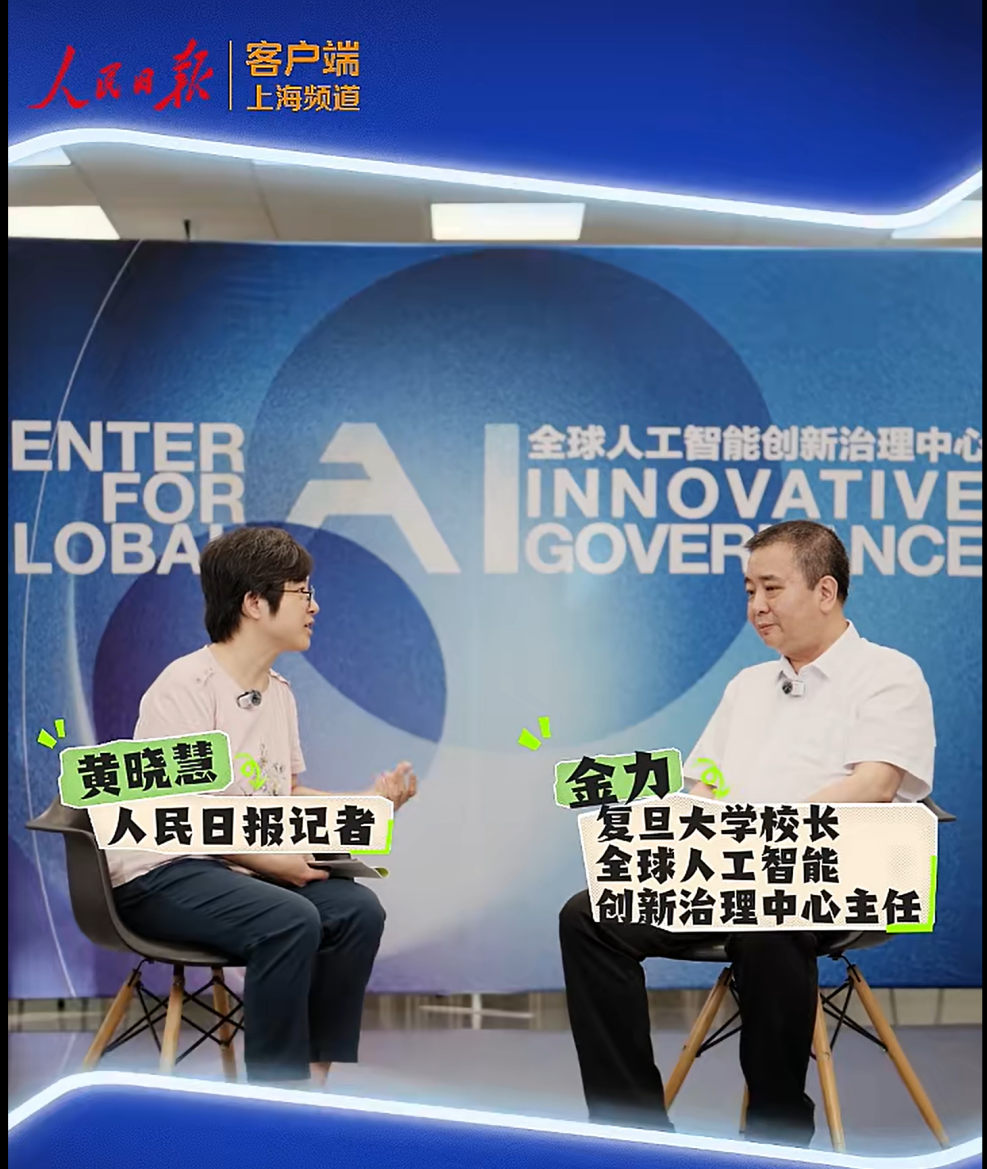
At a time when technological iteration is increasingly intertwined with geopolitics, how is Fudan University, a century-old institution, contributing to global AI governance on behalf of China? How can a university think tank leverage global expertise to generate policy solutions for AI governance? As a driving force behind higher education reform, how does he view the transformative impact of artificial intelligence on university education? On July 15, ahead of the opening of the 2026 World Artificial Intelligence Conference (WAIC), Jin Li, President of Fudan University, Academician of the Chinese Academy of Sciences, and Director of the Center for Global AI Innovative Governance (CGAIG), gave an exclusive interview to Dajiangdong Studio, offering an in-depth assessment of the latest developments in global AI governance.
At the opening ceremony of the 2025 World Artificial Intelligence Conference (WAIC), the Center for Global AI Innovative Governance (hereinafter referred to as “the Center”) was officially announced and established at Fudan University, with Jin Li, President of Fudan University and Academician of the Chinese Academy of Sciences, serving as its Director. On July 5, 2026, the inauguration ceremony of the Global Network of Centers for Exchange and Cooperation on AI Capacity Building (Global AI Capacity Development Network, AICDN)—established with the support of the United Nations—was held in Geneva, Switzerland. The Center was entrusted with leading key responsibilities, including serving as the interim secretariat and drafting the network’s statutes and rules of procedure. Representing the Chinese member institution, Jin Li officially signed the agreement to join the network.
01
Countries Face Different AI Anxieties, Why Has China’s Initiative Resonated So Widely?
Dajiangdong: How would you characterize the current state of global AI governance? What are its most pressing challenges? How has China’s Global AI Governance Initiative been received by the international community?
Jin Li: Over the past year, global AI governance has been marked by two parallel trends: the rapid acceleration of technological advancement alongside mounting risks and challenges, and intensifying international competition accompanied by deeper multilateral cooperation. Three major challenges stand out: First, AI infrastructure and innovation resources remain unevenly distributed. Critical resources including computing power, foundation models, and high-level talent continue to be concentrated in a handful of countries and leading companies. Countries of the Global South remain disadvantaged in terms of computing capacity, data resources, and human capital, confronting what has increasingly been described as the “intelligence divide.” Second, balancing security and development remains difficult. Regulatory approaches vary significantly across jurisdictions, making cross-border coordination both complex and costly. Third, multilateral governance mechanisms are still under construction, and a broadly accepted global governance framework has yet to emerge.
At the inauguration ceremony of the AICDN, remarks made by representatives from several Global South countries left a particularly deep impression on me. They expressed a strong desire to embrace AI more fully and hoped to receive greater support in strengthening their AI capabilities. At the same time, they voiced concerns that the widening intelligence divide could create new forms of global inequality.
For countries that have already entered the AI era, technological progress is advancing at an extraordinary pace. The sweeping application of AI is reshaping every aspect of society, affecting virtually every individual and every sector. The uncertainty surrounding technological development inevitably raises fundamental questions: Which human skills will AI replace? Where is AI ultimately heading?
It should be recognized that countries face very different AI-related concerns. Global AI governance must not only address how to mitigate risks, but also answer how more countries can gain access to AI and harness it effectively. Only by enabling countries at different stages of development to participate in and benefit from AI can the international community establish a broader and more sustainable foundation for cooperation.
Guided by the principles of “people-centered approach, AI for good, multilateralism, and fairness and inclusiveness”, China proposed the Global AI Governance Initiative in 2023. The Initiative has received broad recognition and resonance in multilateral settings, including the United Nations and the recent inauguration ceremony of the AICDN. The Center’s participation in AICDN, where it serves as a co-leading institution alongside organizations from countries such as Senegal, represents a concrete step toward translating the Initiative into concrete action.

On July 5 (local time), at the headquarters of the World Trade Organization in Geneva, Switzerland, Jin Li (first from right) joined representatives from participating countries in signing the agreement to become members of the AICDN.
Dajiangdong: In your view, what gives Shanghai its unique advantages in building itself into a key node city for global AI governance? How can the Center use the “Shanghai experience” to demonstrate China’s vision?
Jin Li: First and foremost, Shanghai is home to a concentration of leading universities, research institutions, and AI enterprises. It has developed a comprehensive innovation ecosystem spanning fundamental research, technological development, industrial application, and end products. This provides a strong foundation for joint research, talent cultivation, scenario-based validation, and product development. Shanghai’s rich application scenarios in manufacturing, healthcare, finance, transportation, urban governance, and many other fields offer real-world environments for testing AI technologies and refining governance frameworks.
Second, Shanghai has long served as China’s gateway to the outside world and a major center for international exchange. It enjoys notable advantages in attracting international organizations, hosting global conferences, and bringing together international talent. The continued hosting of the World Artificial Intelligence Conference (WAIC) in Shanghai, together with the decision to locate the headquarters of the World AI Cooperation Organization in the city, reflects international recognition of these strengths.
Shanghai also possesses extensive practical experience in governance. It has accumulated systematic expertise in digital transformation and smart governance through initiatives such as “One-stop online government services” and “An integrated network for urban operations”. These pioneering efforts provide large-scale practical examples of integrating AI into public services and urban operations. In addition, Shanghai has already accumulated valuable experience in applying AI to areas including healthcare and meteorological disaster early warning.
We hope the Center can better fulfill its role as a bridge connecting China and the world by expanding international cooperation networks while achieving the “three transformations”: transforming Shanghai’s practical experience into governance knowledge that can be understood and applied internationally; transforming Shanghai’s platform advantages into substantive international cooperation capacity; and transforming Shanghai’s innovation resources into tangible support for practical international collaboration.
02
Governance Rules Must Not Become Unilateral Barriers Imposed by Technologically Advanced Countries
Dajiangdong: The Center has now been in operation for one year. As its Director, how would you evaluate the team’s performance during its first year? What do you consider its most significant achievements?
Jin Li: The Center’s core mission over the past year has been to begin playing a meaningful role in advancing global AI governance. Overall, I believe we have delivered a strong start.
Three achievements stand out.
First, we have participated deeply in the development of the global AI governance architecture under the framework of the United Nations. As one of the founding members of AICDN, the Center joined a network that now includes member institutions from 19 countries and organizations across four continents.
Second, we have supported AI governance through high-quality academic research. One representative achievement is the release of the Mirror Ethical Review Agent System, which provides intelligent support for AI ethics review.
Third, we have steadily advanced capacity building and talent exchange initiatives for the Global South. The first cohort of visiting scholars from countries including Spain, Ecuador, and India has completed its fellowship program and established long-term collaborative relationships with research teams both within and beyond Fudan University.
These three accomplishments embody the Center’s guiding philosophy: “rooted in Chinese practices while engaging global wisdom.”

In July 2025, Jin Li (first from right) met with Amandeep Singh Gill, United Nations Under-Secretary-General and Special Envoy for Digital and Emerging Technologies.
Dajiangdong: During the Center’s operation, have you encountered bottlenecks in cross-cultural collaboration or resource alignment? More broadly, how do you determine whether a university-led international governance platform has truly taken root?
Jin Li: Countries are at different stages of AI development. They differ significantly in industrial foundations, governance capacity, and risk tolerance, which creates new challenges for balancing development and security in AI governance. Some countries are primarily concerned with gaining access to AI technologies, computing power, and data capabilities, placing development at the forefront. Others have already entered the stage of large-scale AI deployment and therefore focus more on regulatory frameworks, accountability, and risk management. Still others place greater emphasis on national security and technological competition.
These differences mean that global AI governance must begin with an understanding of each country’s practical circumstances. It requires finding an appropriate balance between shared governance principles and different development needs. In particular, governance rules must not become barriers unilaterally established by a small number of technologically advanced countries.
In my view, the success of a university-led international governance platform should not be measured simply by the number of conferences it organizes or agreements it signs. Rather, it should be judged by whether it can foster sustainable consensus among academia, industry, and policymakers through international scholarly collaboration.
Achieving this goal also requires more stable mechanisms for financial and institutional support. Many countries in the Global South have an urgent need for AI technologies, governance capabilities, and talent development. Yet they often lack the research resources, technological foundations, and channels for international engagement necessary to participate effectively in global governance processes. A university-led platform should therefore do more than invite these countries to join discussions. Through joint research, personnel training, technical assistance, and knowledge sharing, it should help strengthen their capacity for self-reliant AI governance.
Even more importantly, such a platform should cultivate a new generation of professionals who understand technology, possess strong theoretical foundations, are well versed in public policy, and can communicate effectively on the international stage. They should understand the operational logic of AI systems; possess the theoretical capacity to elevate specific technical issues into broader questions of public governance; be familiar with policymaking and industrial practice; and have the ability to engage in international dialogue and public communication. In the long run, nurturing such talent may prove far more valuable than completing a handful of short-term projects.
03
University Classrooms Are Being Transformed by AI, What I Worry About Most Is Students Losing Their “Human Capabilities.”
Dajiangdong: You have said that universities should not merely be producers of knowledge, but hubs of innovation ecosystems. How can universities fulfill this role?
Jin Li: The key is not simply bringing scientists, policymakers, and business leaders together in the same room. Rather, it is to build stable mechanisms for collaboration around shared challenges, transforming dispersed knowledge and resources into common agendas, joint projects, and shared outcomes. When we speak of a scientific community with shared responsibilities, we mean that every stakeholder should not only participate, but also assume clearly defined responsibilities. Scientists must accurately assess both technological capabilities and potential risks; Businesses must integrate safety and ethical considerations throughout the research, development, and deployment process; Policymakers should provide a clear, stable institutional environment that supports innovation. Universities, meanwhile, should offer an open platform that effectively connects these stakeholders, enabling their resources to evolve from simple coexistence into organizational collaboration.
Dajiangdong: Recently, Fudan University students made headlines after designing examination questions for AI. In the AI era, what changes are taking place in university classrooms? What capabilities are you most concerned students might lose?
Jin Li: I immediately gave that news story a like as soon as I saw it. It was an excellent experiment conducted in the context of the AI era. When it comes to talent cultivation in the age of AI, I believe lifelong learning and independent thinking are two abilities of paramount importance.
Our goal is not only to prepare students for employment, but also to enable them to become future leaders—individuals capable of confronting all the challenges the world may present, including those brought about by AI technologies.
With AI tools now widely available, students have access to far more channels for acquiring knowledge and a much richer variety of learning methods. We can no longer teach today’s students using textbooks from thirty or forty years ago without modification. We must reconsider which elements of the classics should be preserved, which new knowledge should be incorporated into the curriculum, and how classroom teaching can become more effective.
Consequently, teachers are no longer merely transmitters of knowledge. Instead, they must become designers of the learning process, more like directors, guiding students into meaningful learning experiences. Regardless of how teaching methods evolve, the ultimate objective remains unchanged: to improve learning effectiveness, enabling students to learn both faster and more deeply. Lifelong learning and independent thinking are fundamentally “human capabilities”—qualities that distinguish human beings from AI. What concerns me most is that students may lose these capabilities. AI technologies will continue to evolve at a rapid pace. Only by preserving these uniquely human capacities can individuals develop independent judgment and confidently meet the challenges of an AI-driven world.
Source: People's Daily
Planner: Wu Yan
Reporter: Huang Xiaohui
Intern: Yang Xinrui
Image: Provided by the interviewee
Produced by: Central Kitchen of People's Daily - Dajiangdong Studio
Responsible editor: Shen Wenmin
Original URL: https://mp.weixin.qq.com/s/vyINvv-ASlP9G7P_oRw5-g