

Every technological revolution has promised to transform humanity. The question posed by artificial intelligence is a sharper one: when the pace of change outstrips the pace of governance, can humanity still remain in control of its own future?
“If AI ultimately endangers humanity, it can hardly be called helpful. My approach to governance, accordingly, is caution first, steady progress second.” Speaking to Southern Finance Omnimedia Group and 21st Century Business Herald on the sidelines of the “Global AI Governance and Sustainable Development: Challenges and Responses” forum at WAIC 2026, Golestan Sally Radwan, Chief Digital Officer of the United Nations Environment Programme (UNEP), said a global consensus is gradually taking shape around the sustainable governance of AI — namely, the need to weigh both the opportunities and the risks AI poses for environmental sustainability.
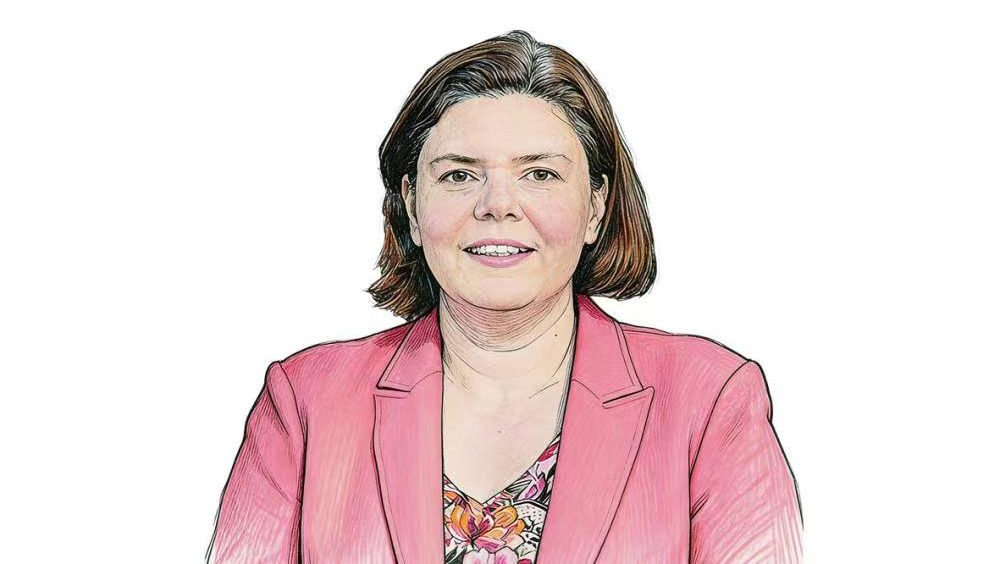
Golestan Sally Radwan. File photo.
For Radwan, sustainable AI comes down to a carefully calibrated “balance equation”: for each specific use case, the energy, water and critical minerals consumed, and the e-waste generated, must be weighed against the real-world social benefits delivered. “Only when those two sides are in balance can an AI model be considered sustainable.”
Radwan spoke highly of China’s efforts to make AI more inclusive, noting that China has shown that advancing AI need not come at prohibitive cost. High hardware prices remain one of the principal drivers of today’s global digital divide, and China’s work on cost-effective hardware and lightweight models offers invaluable lessons for inclusive AI development.
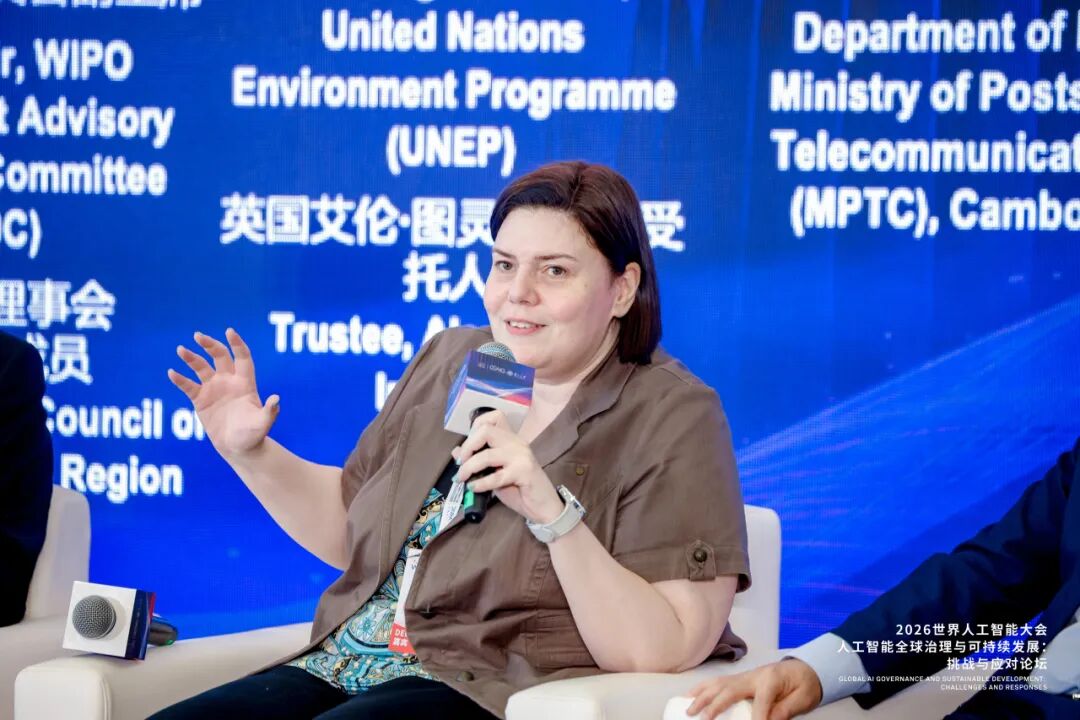
Radwan speaking at the roundtable of the “Global AI Governance and Sustainable Development” forum, WAIC 2026. Photo credit: CGAIG
Sustainable AI Requires Balancing Resource Use Against Social Benefit
SFC: What are your impressions of this year’s World AI Conference?
Radwan: The mood at this year’s conference has been upbeat and energetic, bringing together a diverse set of stakeholders from regulators, government, academia and industry. The fact that all these parties can gather to engage on AI is significant in its own right. What I particularly value is that this conference has placed AI governance at the center of the agenda, with industry representatives present, listening and actively taking part in the discussion — that matters a great deal.

Closing ceremony of WAIC 2026 and the High-Level Meeting on Global AI Governance. Photo credit: Xinhua News Agency.
SFC: On global AI governance, what are the biggest points of consensus and disagreement among countries?
Radwan: Let me start with the disagreements. Countries currently hold markedly different positions on both the necessity and the intensity of AI governance. Many are inclined to avoid over-constraining innovation, preferring to maximize the value AI applications can deliver. My own view is that if AI ultimately endangers humanity, it cannot be considered genuinely helpful — which is why my approach to governance puts caution first and favors steady, measured progress.
At the same time, a global consensus is gradually taking shape on sustainable AI governance. Take UNEP’s own work as an example: last December, member states adopted a resolution calling for an assessment of both the opportunities and the risks AI poses for environmental sustainability. Weighing benefits against risks in the same breath is, I think, a highly constructive approach.
At this stage, we treat sustainable AI development as a balance equation: tallying the environmental resources an AI system consumes against the overall benefits it generates. Only when the two sides balance can a given model of AI be called sustainable. I see this as both a priority for attention today and an area where the international community stands a genuine chance of building consensus going forward.
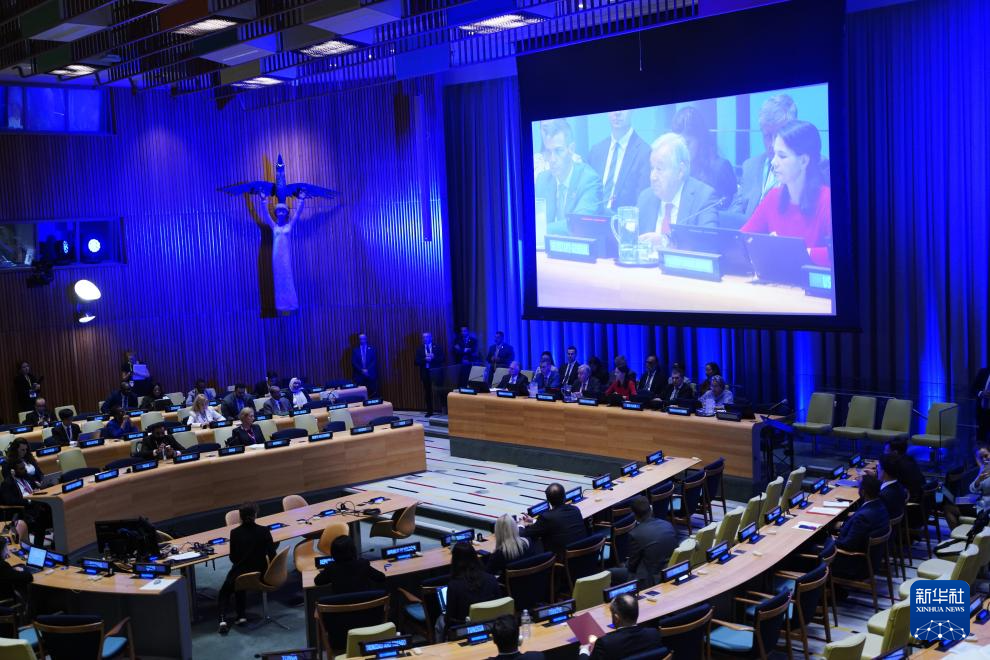
On September 25, 2025, the United Nations held a high-level meeting to launch the Global Dialogue on AI Governance. Photo credit: Xinhua News Agency.
SFC: Much of the current discussion centers on how AI can help address climate change and improve efficiency. Yet it’s undeniable that the AI industry itself is highly energy-intensive. How should the relationship between AI development and environmental protection be balanced?
Radwan: This is precisely why I keep returning to the “balance equation.” Striking that balance cannot rely on a single, one-size-fits-all standard — it requires granular measurement and assessment for each specific use case. Take climate-monitoring AI applications: one needs to tally the environmental costs involved — energy, water, critical minerals, and e-waste generated — and weigh them against the real benefits the application delivers. A scientifically grounded trade-off, arrived at through this kind of two-way data comparison, is the only viable way to reconcile AI development with environmental protection.
Of course, some AI applications should be prohibited outright, and others subjected to stricter oversight. But those judgments need to be made at the level of specific use cases, not through blanket rules applied indiscriminately across the entire AI industry or broad sectors.

Technicians monitor computing operations and environmental data on a large display screen. Photo credit: Xinhua News Agency.
SFC: Among the UN’s various initiatives on AI governance and sustainable development, could you share some of the most representative and far-reaching projects?
Radwan: The resolution I mentioned earlier is a good starting point. It was endorsed by every member state and explicitly launched research into the sustainable development of AI. Countries still disagree on the finer points — some, for instance, prefer to emphasize opportunities over risks — but this shared consensus lays important groundwork for advancing green AI governance in a coordinated way worldwide.
We have also partnered with Fudan University to launch the AISUS+ international cooperation initiative, which explores new ways AI can strengthen urban climate resilience — reducing air pollution, improving livability and mitigating the effects of climate change. The project has built a global network of cities that exchange data, share governance experience and pool AI application models. This model of cooperation is highly valuable, and we hope it can serve as a reference point and practical basis for global AI governance more broadly.

Photo credit: Xinhua News Agency.
China’s Approach Advances Inclusive Access to AI
SFC: What role can China play in global AI governance?
Radwan: China offers invaluable practical experience for making AI development more inclusive worldwide, demonstrating that advancing AI need not depend on prohibitive cost. One of the principal drivers of today’s uneven global digital development is the persistently high cost of AI hardware. Building on China’s experience — continuing to develop more cost-effective hardware, building scalable infrastructure, creating lightweight models, and reducing the data volumes required for training — could meaningfully lower the barriers to using AI, making it more inclusive and, in turn, more sustainable. I believe China has a great deal to contribute here. China can also play a key role in AI capacity-building. Today, only a handful of countries have mature AI capabilities, while most remain relatively behind. As a global leader in AI development, China has consistently taken an open, sharing approach — one that can help countries across the Global South close AI technology gaps, build industry knowledge and strengthen their application capabilities.
SFC: The World AI Cooperation Organization was formally established on July 16. What role do you think it can play in global AI governance?
Radwan: The organization’s founding is a vivid illustration of China’s role in enabling AI development globally. The AI industry as a whole is currently struggling to scale, and that difficulty in achieving economies of scale is holding back the sector’s overall development worldwide. The World AI Cooperation Organization currently counts 29 member states, and I expect more will join over time; I also hope the United Nations will be able to participate and lend its support. Through this platform, member states can work together to develop AI solutions capable of scaling, generating economies of scale while helping to foster a fairer international development environment for AI.
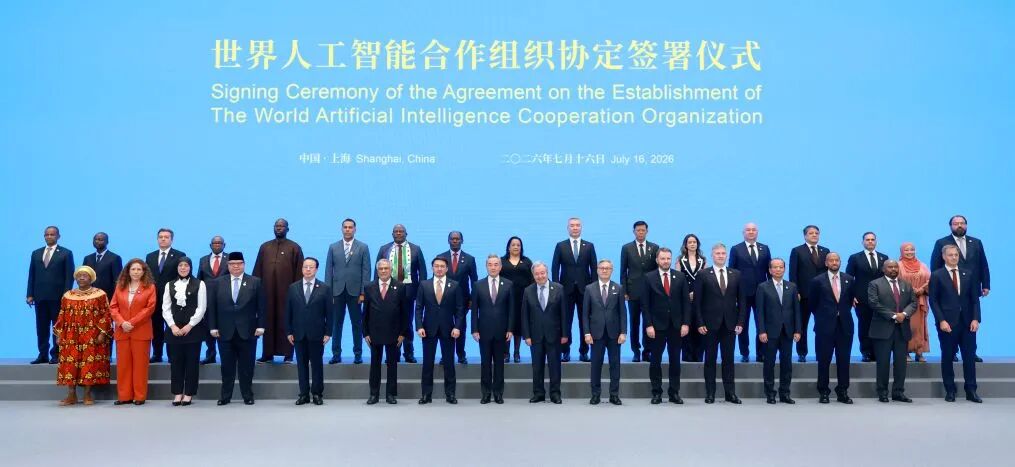
Signing ceremony for the agreement establishing the World AI Cooperation Organization. Photo credit: Xinhua News Agency.
SFC: How do you envision the future of global AI governance?
Radwan: I hope global AI governance can move beyond the level of principles, aspirational vision and shared values, and advance to a stage that is genuinely quantifiable and data-driven. At that point, we should be able to judge whether a given AI solution is sustainable against clear, defined standards — and use those standards to draw the boundaries of regulation, distinguishing which specific scenarios require constraint or oversight. That work of refinement needs to be carried down to the regional, sub-regional and even sector-specific level. This is the same approach we have taken in advancing governance in the environmental field, and I believe every area of governance calls for this kind of in-depth deliberation.