

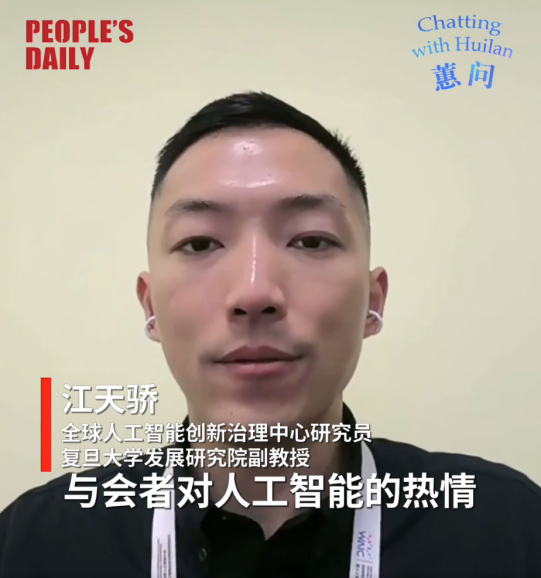
The 2026 World Artificial Intelligence Conference and High-Level Meeting on Global AI Governance was held in Shanghai from July 17 to 20. In an interview with People's Daily, Jiang Tianjiao — Research Fellow at the Center for Global Artificial Intelligence Governance (CGAIG) and Associate Professor at Fudan University's Institute for Development Studies — noted that amid pressing challenges such as the fragmentation of global AI governance and the widening AI divide, China's approach to advancing inclusive AI development reflects the responsibility befitting a major power.
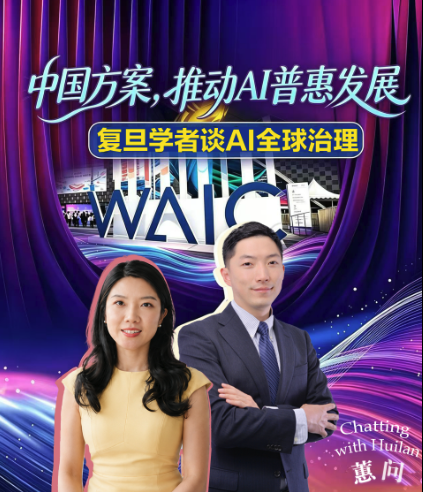
Interviewer: My feed has been completely packed with updates from the 2026 World AI Conference. Alongside the flashy tech reviews, some of the most interesting discussions focused on international AI governance and where we go from here. I caught up with a professor from Fudan University who has been deeply involved in the event to see what that future might look like. WAIC 2026 has brought together a high-level gathering of global leaders from politics, academia, and industry. It has also generated huge attention on social media. As a participant, what is the vibe on the ground, and what are the most hot-button topics there?
Jiang Tianjiao: I think the atmosphere on site was electric. I could truly feel the participants’ enthusiasm for artificial intelligence, with everyone brimming with curiosity about the future of the intelligent era. For example, will AI ever possess wisdom like humans? How can it better empower various industries and help us deepen our understanding of science?
Interviewer: With the signing of the World AI Cooperation Organization agreement and the launch of some new action plans, where do we stand right now in terms of global AI governance? How would you evaluate the progress made at this conference?
Jiang Tianjiao: The establishment of WAICO responds to the pressing challenges facing global AI governance today. In fact, in recent years, global AI governance has been fragmented, while the intelligence divide has continued to widen. As a result, the development rights of countries in the Global South have been left insufficiently protected.
The launch of WAICO represents China’s approach to global AI governance. I think China insists on balancing security and development and advocates for AI ethics shaped by the common values of humanity. China also firmly supports the UN’s central role in global AI governance and seeks to build an inclusive platform for equal dialogue.
To provide AI public goods, China has also organized capacity-building training programs, established AI technology transfer centers for developing countries, and promoted the global application of the MAS as a weather forecasting and early-warning system. These efforts demonstrate China’s responsibility as a major country.
Interviewer: It is also very rare for the UN Secretary-General and multiple leaders of other countries to attend a tech conference in person. What signal does this send for global AI governance?
Jiang Tianjiao: I think this reflects a high level of international recognition and a positive response to China’s AI governance proposals. WAICO offers a new paradigm that balances innovation and security while upholding multilateralism and inclusive development. I think China’s approach also goes beyond ideas and principles by emphasizing pragmatic cooperation.
Interviewer: What is the common ground for pragmatic cooperation? What is the common ground for global cooperation on AI governance?
Jiang Tianjiao: The common ground for our cooperation stems from our shared pursuit of development and the need to safeguard digital sovereignty. I think every nation would like to have equal access to technology and achieve digital modernization.
Original URL:
https://www.peopleapp.com/column/30052728675-500007611943