

Inside the exhibition hall of a Shanghai-based artificial intelligence research institute, an ink-wash map covered an entire wall, immediately drawing your attention.
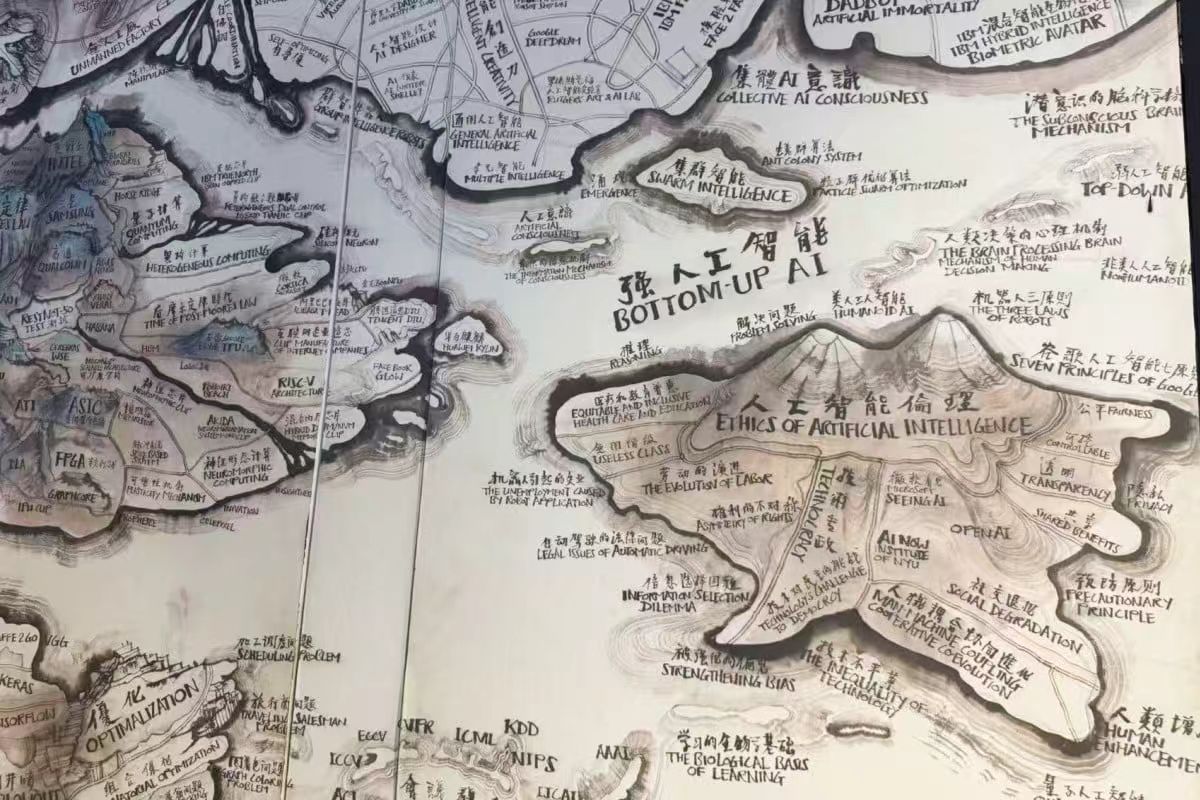
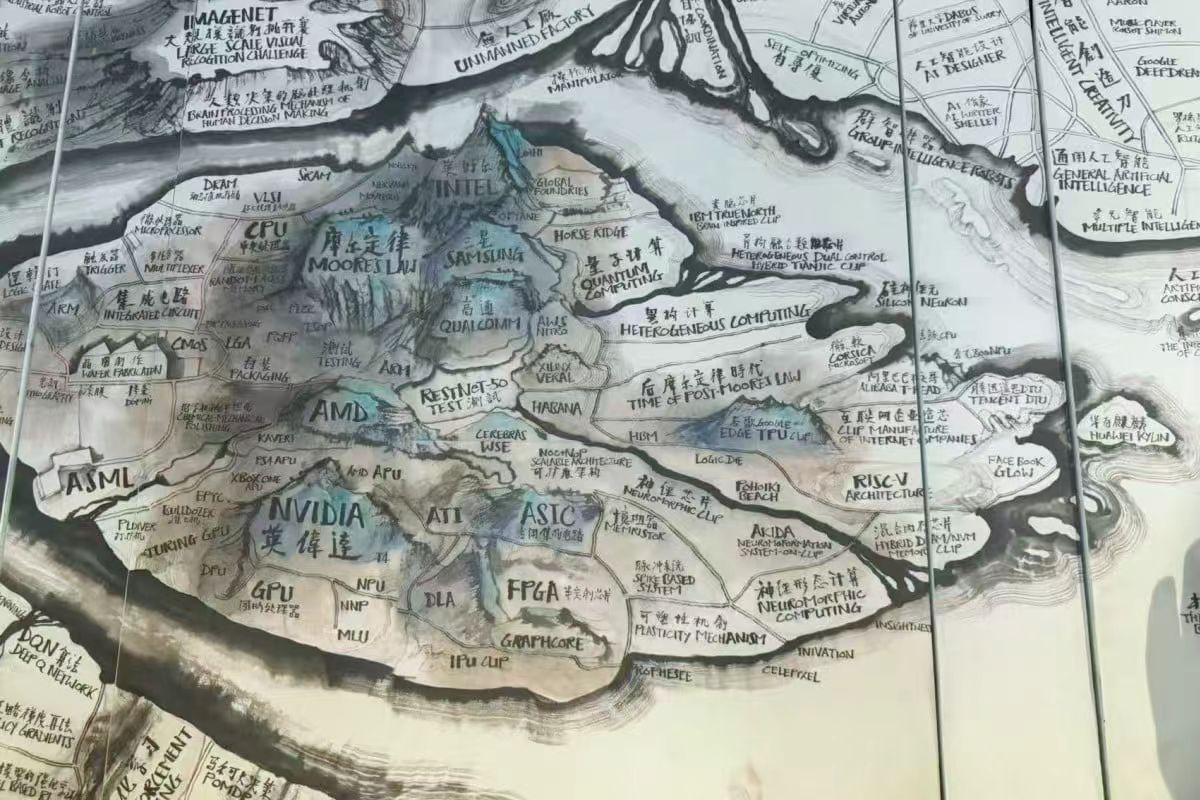
It was a cartography of AI: chipmakers were rendered as mountains on islands and algorithms as jagged mountain ranges, while questions of privacy, fairness and machine consciousness drifted at the edges like uncharted islands.
Foreign guests and I leaned in, tracing the brushstrokes.
“Why is Huawei’s chip placed right at the estuary?” someone asked.“And why are AI ethics drawn as twin peaks?”
A staffer reminded us, more than once, that it was art – not an official statement of facts.
The institute, a local government-backed incubator in Shanghai designed to bridge academic research and commercial application, seemed to embrace this sense of theatre. Even its entrance made a statement: to open the doors, visitors pressed their palms against a giant silicon chip that glowed as the panels slid apart.
Yet during my recent tour of labs, tech firms and think tanks across Shanghai and Hangzhou, that ink-wash atlas felt less like artistic whim and more like an expression of ambition.
The China-US technology contest has evolved far beyond a race for chips, models and benchmark scores; it is now a struggle over soft power. The ultimate prize is not just owning cutting-edge technology, but the power to dictate its rules, frame its ethics and command global influence.
In short, it is a battle over who gets to draw the map.
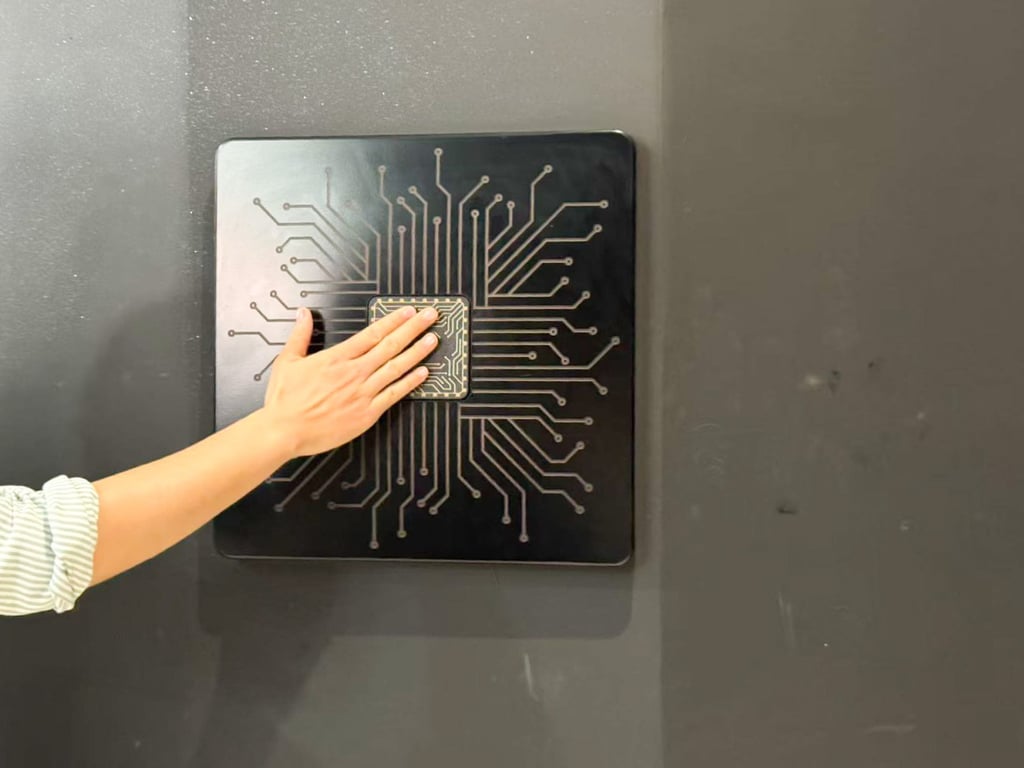
A ‘silicon chip’ unlocks the door at a Shanghai AI research institute. Photo: Wency Chen
Around the same time, Beijing-based Moonshot AI released Kimi K3 – a massive 2.8-trillion-parameter open-weight model – reigniting fierce debate in Washington over open-source security risks.
As the superpowers lock horns, researchers on the ground are left navigating the divides.
“Openness is not the fundamental aspect of AI risk,” said Dai Jiarun, an assistant professor at Fudan University and cofounder of Nuwa Frontier AI Safety Lab.
What mattered more, he argued, was what a model could do, how costly it was to deploy and what access it received. The lab is building third-party evaluation infrastructure.
Large open-weight models still required expensive computing systems to run, Dai noted, while malicious actors could still exploit powerful closed models through APIs.
Yet as cross-border data controls tighten and model access is restricted, the lack of collaboration is becoming the default setting – with serious consequences. Researchers at Nuwa warned that fracturing the global AI community eroded the shared standards, benchmarks and empirical evidence needed to govern the technology safely.

Ant Group is expanding into AI healthcare with its AQ medical assistant. Photo: Wency Chen
The impact on top talent is equally clear. At another university, an renowned professor who spent much of his career overseas said he returned to China partly because his Chinese PhD candidates were facing increasing visa denials in the West. Academic visits between American and Chinese scholars had become “tricky and sensitive”.
High-level dialogue remains sporadic. While Washington and Beijing were expected to hold formal AI talks in September, according to US President Donald Trump, China’s foreign ministry, responding in familiar diplomatic rhetoric, said that Beijing was willing to work with Washington to “implement the important consensus reached by the two presidents” on AI.
While navigating external tensions, China is rapidly assembling its own internal regulatory scaffolding. Academia, industry and state authorities are working closely together, trying to move as fast as the technology itself.
“China’s policymaking process isn’t a black box,” said Yao Xu, secretary-general of the Center for Global AI Innovative Governance (CGAIG), a Fudan-based think tank. He noted that policymakers actively consult industry experts and players before drafting rules, with think tanks serving as bridges.
At Ant Group’s sprawling Hangzhou campus, where the fintech giant is deploying AI in payments and healthcare, that pragmatism takes a concrete form.
“We govern through development, and develop through governance,” said Wang Weiqiang, head of Ant’s model safety team, pointing to the strict risk controls demanded by the financial and medical sectors.
Ant is an affiliate of Alibaba Group Holding, owner of the South China Morning Post.
An industry representative who sat in on AI standard-setting meetings described rooms breaking out into heated debates. A reassuring sign, I think, that the process was being taken seriously.
Original URL: