

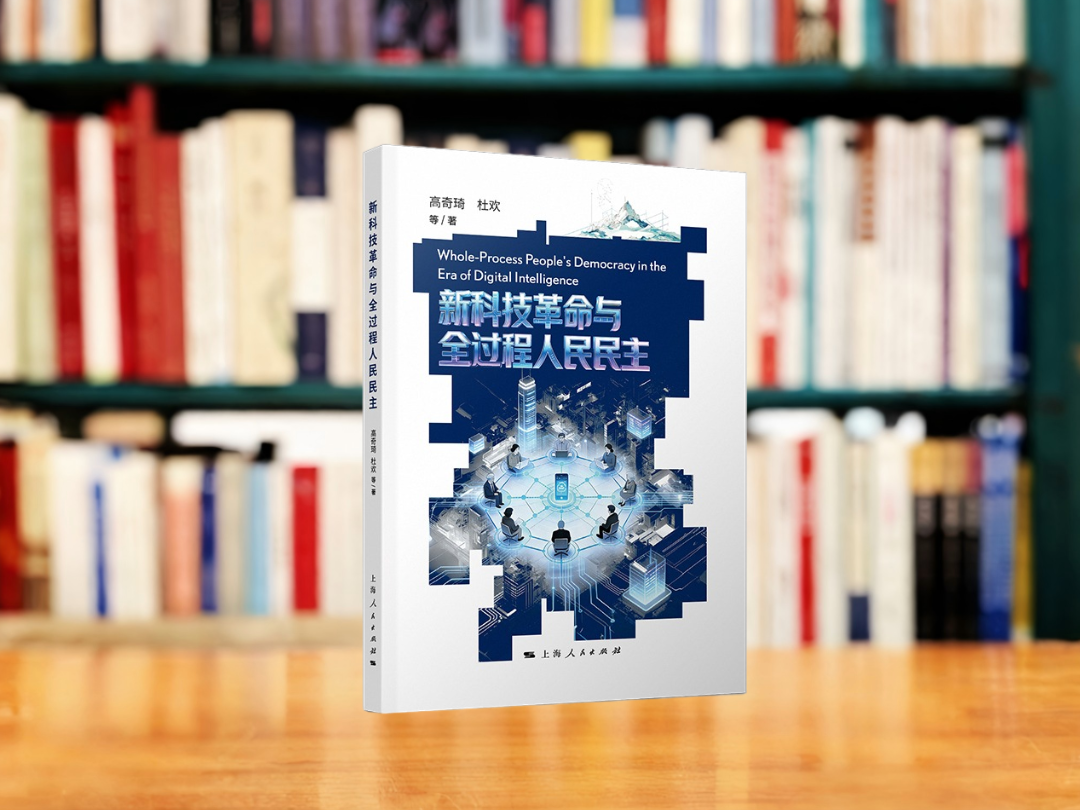
Published by Shanghai People's Publishing House in May 2026
Whole-process people's democracy is not only the latest theoretical synthesis of socialist democracy with Chinese characteristics, but also an undertaking that calls for innovative exploration at multiple levels and across all dimensions of democratic practice.
Taking an innovative perspective on the relationship between technology and democracy, this book examines the multifaceted impact of digital technologies, represented by artificial intelligence, on democratic politics. It offers an in-depth exploration of the technological foundations, theoretical implications, and institutional development of whole-process people's democracy and its specific forms of practice.
The book argues that the current wave of technological revolution is both a defining issue confronting humanity as a whole and an important technological condition for investigating the laws governing the development of democratic politics and the direction of democratic practice. In this sense, advancing whole-process people's democracy requires close attention to the significant impact of the new technological revolution. Under its influence, practical forms of whole-process people's democracy—including consultative democracy, electoral democracy, and democracy at the primary level—face new opportunities and challenges. Meanwhile, under the new technological conditions, Western democracy is also confronting challenges and crises exemplified by algorithmic populism, offering important comparative lessons for the development of democracy in China. In response to these new technological conditions, further efforts should begin with democracy's technological foundations and operational practices, and explore institutional pathways for improving socialist democracy throughout the entire process, in all dimensions, and across the full spectrum.
About the Authors
Gao Qiqi is a Research Fellow at the Center for Global AI Innovative Governance (CGAIG) and Professor and Doctoral Supervisor at the School of International Relations and Public Affairs, Fudan University. He is also a member of the National New Generation AI Governance Committee, a State Council Special Government Allowance Expert, and a Shanghai Leading Talent. His long-term research focuses on global governance, national governance, and the intelligent revolution. He has published more than 30 articles in leading journals, including Social Sciences in China and CASS Journal of Political Science, and has twice received the First Prize of the Shanghai Philosophy and Social Sciences Outstanding Achievement Award. He initiated and led the development of the Global Governance Index (SPIGG) and the National Governance Index (NGI). Previously, he served as Dean of the Institute of Political Science and Dean of the Artificial Intelligence and Big Data Index Research Institute at East China University of Political Science and Law.
Du Huan is a Lecturer and Master's Supervisor in the Department of Political Science, School of Government Management, East China University of Political Science and Law. Her main research interests include the theory and practice of whole-process people's democracy, Party building and primary-level governance, and digital technology and political development. She leads the Shanghai Philosophy and Social Sciences Planning Youth Project, Theoretical Development and Institutional Practice of Whole-Process Democracy: A Perspective Based on the Modernization of National Governance.