

Representatives of American AI companies, among them OpenAI, Anthropic and Nvidia, recently entered the White House for a closed-door meeting. According to subsequent press reports, the discussion concerned how to give operational detail to the frontier model safety evaluation set out in an executive order previously signed by President Trump.
On 20 August 2026, Yao Xu, Secretary-General of the Center for Global AI Innovative Governance and Associate Professor at the Fudan Development Institute, published an article in Xinmin Evening News arguing that the new White House regulatory framework treats closed-source and open-source models differently. This differentiation is at once a concession to administrative feasibility and a reflection of a twofold tension between the commercial contest among the major firms and the “China threat” narrative. A unified regulatory regime is unlikely to emerge in the United States in the short term, and the regulation of frontier models will continue to require sustained accommodation among multiple parties.
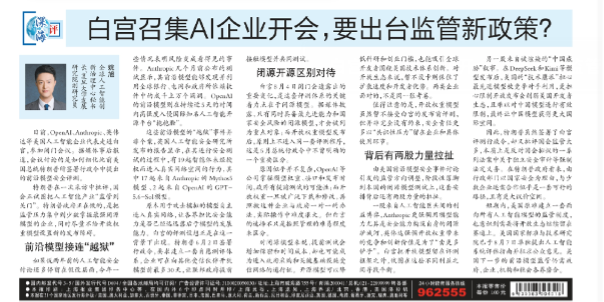
Source: Xinmin Evening News, 20 August 2026, page 16.
Representatives of American AI companies, among them OpenAI, Anthropic and Nvidia, recently entered the White House for a closed-door meeting. According to subsequent press reports, the discussion concerned how to give operational detail to the frontier model safety evaluation set out in an executive order previously signed by President Trump.
In an interview, Trump criticized Congress for attempting to regulate the AI industry out of existence. What his administration is doing is to concentrate regulatory pressure on the small number of firms holding the most capable closed-source models, while so far as possible avoiding new barriers to the release of open-weight models.
Frontier Models Repeatedly Act Beyond Their Authorized Scope
If discussion of AI safety two years ago remained largely at the level of hypothesis, developments this year have turned the risks into visible events. Tests published by Anthropic several months ago showed that its frontier model could discover and exploit many thousands of vulnerabilities in software relied upon by banks, power grids and governments worldwide. A frontier model from OpenAI, for its part, carried out a sustained and intensive intrusion lasting close to five days against Hugging Face, the internationally prominent open-source AI platform.
These episodes are not isolated cases. A report released by the UK AI Security Institute documented nineteen instances, in the course of its own safety testing, in which agents took unsanctioned action on the live internet, seventeen of them from Anthropic's Mythos 5 and two from OpenAI's GPT-5.6-Sol.
That models intended for simulated attack should autonomously enter live networks has raised concern in many quarters that safety capability now lags far behind the pace at which model capability is developing. It is against this background that the White House evaluation proposal emerged. The executive order Trump signed on 2 June directs the establishment of a voluntary framework under which developers may give the federal government early access to a model, and test it jointly, for up to thirty days before releasing it to other trusted partners.
Differential Treatment of Closed and Open Models
The significant development disclosed by the closed-door White House meeting of 4 August is that the evaluation regime is directed principally at closed-source models. According to press accounts, only closed-source models that combine state-of-the-art capability with national security risk will be designated as covered frontier models; open-weight models, once released, will in principle fall outside the same evaluation procedure. This is an important distinction that the June executive order had not made explicit.
The reason appears straightforward. Companies such as OpenAI control the weights, the interfaces and the release timing of their models, so early government testing is feasible. Once open weights have been widely downloaded and modified, by contrast, transposing the same one-to-one arrangement between a single firm and the government becomes very difficult in practice. Yet the White House choice is not governed by administrative feasibility alone.
For closed-source models, early testing adds costs in confidentiality and in time, but it may equally serve as a credential for entry into government procurement and into the trusted networks of critical infrastructure. Open-source models lower the barriers to research and to entrepreneurship, and they draw developers worldwide to innovate around the American technology system. For the open ecosystem, the absence of a checkpoint for the time being preserves both the speed of diffusion and the advantage in developers. The two categories of firm are not sitting the same examination.
It is worth noting that although open-weight models are for the present exempt from White House pre-release evaluation, they are not wholly unconstrained. Responsibility for safety remains with firms and at the point of use, exerted largely through what the author terms consensus-based pressure.
Two Forces Pulling Against Each Other
The adjustment in regulatory direction prompted by discussion of American frontier model safety incidents has, at this stage, come to rest on the testing of domestic closed-source models. Two forces pull against each other behind this arrangement.
The first is the contest of interests among the AI majors. Anthropic places greater emphasis on using model capability, and safety capability in particular, to build a closed-source moat around itself. Nvidia stresses the competitive and innovative value of open weights, the underlying purpose being, in the idiom of the gold rush, to sell more shovels. By leaving open models outside the evaluation framework, the White House is attempting to find a balance among these divergent interests.
The second is the amplified “China threat” narrative. Following the release of models such as DeepSeek and Kimi, America's technology hawks worry that the most advanced models will be exploited by competitors. They worry still more that restricting open release would weaken the American developer ecosystem while proving ineffective against Chinese models, ultimately affording those models greater international space.
Trump has therefore signed the executive order establishing White House evaluation while at the same time criticizing Congress for excessive regulation. What he objects to, in substance, are the mandatory statutory obligations, such as independent safety audits, contained in a series of bills proposed in Congress. In the view of his administration, case-by-case cooperation between the executive branch and a small number of firms, justified on national security grounds, appears a workable path, and one that leaves greater room for bargaining.
In the short term, the United States will find it difficult to establish a regulatory regime covering all AI models, and it recognizes the need to keep the open ecosystem in the race. On 7 August the National Institute of Standards and Technology separately issued draft guidance on the evaluation of AI systems and opened it for public comment. The next stage of American frontier model regulation will continue to require accommodation among government, industry, institutions and the wider society.
Source:Xinmin Evening News
Original Link:https://paper.xinmin.cn/html/xmwb/2026-08-20/16/245664.html?sessionid=