

On August 20, the theory page of People's Daily published an article titled "Leading Global AI Governance by Expanding the Supply of International Public Goods" by Professor Xue Lan, member of the International Advisory Board of the Center for Global AI Innovative Governance (CGAIG) and Dean of Schwarzman College, Tsinghua University, and Chen Ying, Special Research Fellow at the Research Center for Xi Jinping Thought on Socialism with Chinese Characteristics for a New Era of the Chinese Academy of Social Sciences (CASS). The article is reproduced here for our readers.
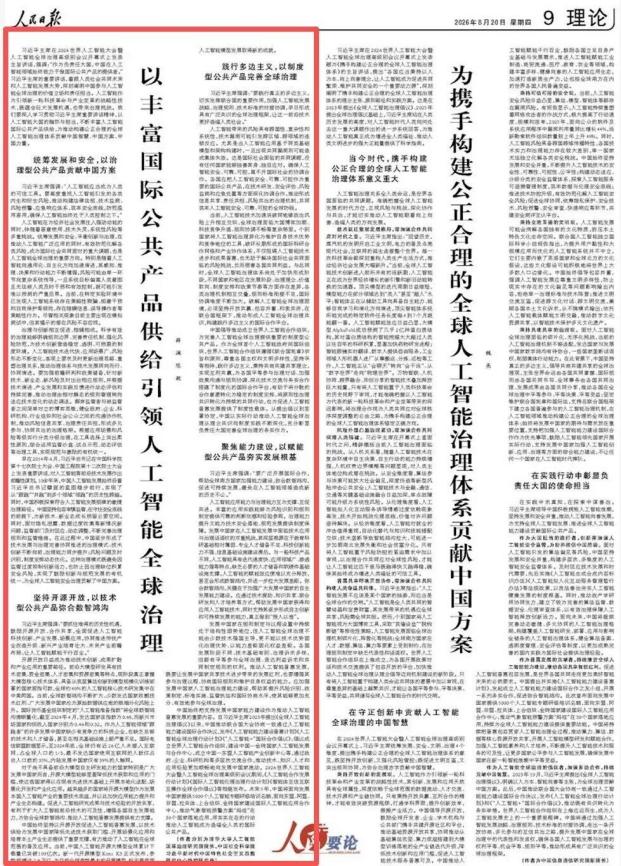
People's Daily, August 20, 2026, Page 09
At the opening ceremony of the 2026 World Artificial Intelligence Conference and High-Level Meeting on Global AI Governance, President Xi Jinping delivered a keynote speech emphasizing: "As a responsible major country, China has always been committed to acting as a provider of international public goods in the field of artificial intelligence." President Xi's important speech focuses on the shared future of human society and the overarching trends in AI development, profoundly clarifying China's value stance, responsibilities, and mission in participating in global AI governance. As a strategic technology leading a new round of scientific and technological revolution and industrial transformation, artificial intelligence contains immense development opportunities while simultaneously bringing governance challenges. We must thoroughly study and implement the spirit of President Xi Jinping's important speech, demonstrate the broad horizon and sense of responsibility of a major AI country, continuously enrich the supply of international public goods for artificial intelligence, and contribute Chinese wisdom, Chinese approaches, and Chinese strength to building a fair and reasonable global AI governance system.
I. Coordinating Development and Security: Contributing the Chinese Approach Through Governance-Oriented Public Goods
President Xi Jinping emphasized: "Artificial intelligence should become a trustworthy tool for humanity. We must attach great importance to the various endogenous and derivative risks triggered by AI, promote the construction of legal and regulatory systems, technical monitoring, risk early warning, and emergency response systems, consolidate the security baseline, prevent misuse and malicious use, and ensure that AI remains under human control."
While injecting strong momentum into economic and social development, artificial intelligence is accompanied by multiple challenges, including malicious use, technological failure, and systemic risks. Coordinating development and security, balancing innovation and governance, and effectively preventing and resolving various risks while promoting the widespread application of AI have become major issues facing the international community and crucial directions for global AI governance. Particularly as AI accelerates its evolution toward generalization and autonomy, its perception, reasoning, decision-making, and action capabilities continue to enhance. Risks may transmit from single links to complex systems; once system goals deviate from human intentions without timely intervention and effective control by humans, unpredictable and severe consequences may ensue. Currently, tendencies such as strategic deception, intervention evasion, and self-protection have been observed in AI systems within specific experimental environments, alongside strategic behaviors such as concealing information and misleading operators. Although these phenomena currently appear mainly in simulation tests, the potential risks they reveal cannot be ignored.
Governance and innovation are mutually reinforcing and complementary. Scientific and effective governance can clarify rule boundaries, improve accountability mechanisms, and strengthen risk prevention, thereby fostering a stable, transparent, and predictable institutional environment for technological innovation. The rapid iteration of AI technology, wide application scenarios, and constantly changing risk profiles objectively require the timely renewal of governance concepts and the reshaping of governance relations, driving governance systems and technological development to move in the same direction and evolve collaboratively. It is imperative to strengthen forward-looking research, judgment, and policy reserves, promptly issue corresponding rules targeting new technologies, new formats, and new risks, and conduct dynamic evaluations and continuous improvements based on technological evolution, industrial development, and practical feedback—shifting governance from relatively static rule management to dynamic adaptation responsive to technological changes. We must abandon the simplistic opposing zero-sum mindset between regulators and the regulated, improve communication and collaboration mechanisms among governments, enterprises, research institutions, industry organizations, and the public, promote risk information sharing and shared governance responsibilities, and form a multi-actor collaborative governance pattern. Tiered and clssified governanceshould be implemented according to application scenarios and risk levels, highlighting a flexible principle in tool selection and comprehensively employing regulatory sandboxes, pilot demonstrations, and dynamic evaluations to achieve the organic unity of regulation and incentives.
As early as June 2014, in an important speech at the 17th Academician Conference of the Chinese Academy of Sciences and the 12th Academician Conference of the Chinese Academy of Engineering, General Secretary Xi Jinping made forward-looking plans for the development of cutting-edge technologies such as AI. Over the past decade and more, China's AI development has steadily advanced along the blueprint charted by General Secretary Xi, achieving a historic leap from "running alongside" and "matching" to "leading" in multiple fields. Concurrently, China has actively explored agile governance paths compliant with the laws of AI development. China adheres to inclusive and prudent regulation, reserving necessary space for the growth of new technologies and business formats while guarding the security baseline. Meanwhile, in response to new conditions and problems such as privacy leaks and excessive data collection, regulatory authorities have responded promptly and adjusted dynamically, continuously improving governance rules and regulatory measures. Through this process, China has gradually formed a collaborative governance model featuring the synergistic advancement of technological development and governance refinement: technological innovation moves forward continuously while governance capabilities improve synchronously; risk issues are identified promptly and institutional arrangements are optimized dynamically. This model avoids suppressing innovation vitality through over-regulation while preventing the accumulation of security risks due to governance absence, achieving an organic unity of encouraging innovation and standardized development, and contributing a Chinese solution to global AI security governance.
II. Adhering to Open Source and Openness: Bridging the Digital and Intelligent Divide Through Technology-Oriented Public Goods
President Xi Jinping emphasized: "We must seize rare historical opportunities, encourage open source and openness, cooperation and sharing, and comprehensively promote scientific and technological innovation, industrial development, and scenario applications in artificial intelligence. We must synergistically advance the transformation and upgrading of traditional industries, the cultivation and expansion of emerging industries, and the forward-looking layout of future industries, empowering all sectors of the economy and society with AI."
Open source and openness have increasingly become important pathways for driving technological innovation, diffusion of achievements, and industrial application. The research and development of cutting-edge large models are characterized by technology-intensive, capital-intensive, talent-intensive, and resource-intensive features. At this stage, countries truly mastering the core technological systems of large models—possessing capabilities ranging from underlying algorithmic innovation to model-scale training and deployment—can be counted on one hand, with core technology R&D globally concentrated primarily in China and the United States. Currently, the global digital and intelligent divide continues to widen, with an escalating risk of extreme polarization where a few developed countries harvest technological dividends while vast numbers of developing countries are relegated to raw data suppliers. The "AI Preparedness Index" formulated by the International Monetary Fund clearly quantifies the global digital divide: as of April 2024, the index stood at 0.68 for developed countries, compared to 0.46 for emerging markets and 0.32 for low-income countries. Many developing countries, acting as "followers" in the AI field, lack competitive tech enterprises, sufficient technical and talent reserves, and suffer from severe inadequacies in relevant infrastructure. According to International Telecommunication Union data, nearly 2.6 billion people globally remained unconnected to the internet by the end of 2024, accounting for one-third of the global population. Internet penetration stood at only 35% in least developed countries and 39% in landlocked developing countries.
For countries—especially developing countries—that lack the independent R&D capacity for cutting-edge large models, open-source large models can significantly lower the threshold for technology acquisition and application, enabling these countries to carry out localized adaptation, scenario-based development, and industrial applications based on existing advanced technologies. An increasing number of countries are adopting open-source large models as vital technological foundations for developing their domestic AI industries, using them to accelerate capability enhancement and industrial ecosystem construction. Promoting the open sharing of AI research achievements and technological experiences helps expand the accessibility of cutting-edge AI technologies, enhances countries' independent development capabilities, and provides robust support for bridging the global digital divide and promoting inclusive AI development.
China has consistently adhered to promoting inclusive AI development through open source and openness, providing vital support for developing countries to lower the threshold for acquiring advanced technologies, carry out scenario-based applications, and cultivate local industrial ecosystems through technology supply, powerfully promoting the widespread adoption of AI globally. Currently, cumulative global downloads of China's open-source AI large models have surpassed 10 billion. The next-generation open-source model Kimi K3 was officially released with a parameter scale of 2.8 trillion, making it currently the largest open-source model globally and marking a new achievement in China's AI model development.
III. Practicing Multilateralism: Improving Global Governance Through Institutional-Type Public Goods
President Xi Jinping emphasized: "We must practice true multilateralism, effectively play the important role of the United Nations, strengthen the alignment and coordination of AI development strategies, governance rules, and technological standards, and formulate a global governance framework with broad consensus at an early date, so that this cutting-edge technology can better benefit human society."
The risks brought by artificial intelligence are transnational, complex, and systemic; technological vulnerabilities may trigger cross-regional and cross-domain chain reactions. Especially when AI applications are built upon similar foundation models and architectures, common vulnerabilities can trigger collective failure. This is a common issue faced by the international community, and no country can stand aloof or cope with it alone. Ensuring that AI is safe, reliable, and controllableis inseparable from international coordination and cooperation. All nations should treat AI security, reliability, and control as vital international public goods, deepen coordination and cooperation in technology R&D, security assessment, risk monitoring, and emergency response, promote the formation of governance mechanisms featuring information sharing, shared responsibility, and risk co-governance, and jointly build global defense lines for safe, reliable, and controllable AI.
Currently, accelerated breakthroughs in AI technology are intertwined with rising geopolitical risks. Global governance faces a complex landscape marked by intensifying major-country competition, rising technological rivalry, and inadequate rule coordination. Certain countries have turned AI governance into a tool to safeguard their own technological advantages and competitive positions, disrupting long-standing international scientific research cooperation networks and industrial collaboration systems. This not only hinders technological progress and the universal sharing of achievements in AI, but also fails to resolve shared risk challenges faced by the international community, ultimately damaging the common interests of all countries. Meanwhile, the global AI governance system is still in the phase of accelerated formation; different countries and regions exhibit disparities in development stages, governance philosophies, value orientations, institutional arrangements, and policy paces. Various governance mechanisms overlap, rule standards lack sufficient alignment, and the difficulty of international coordination continues to mount. To resolve the dilemmas of global AI governance, we must uphold openness, win-win cooperation, inclusiveness, mutual learning, and solidarity. Under the UN framework, we must foster global governance consensus on AI and build international cooperation platforms that practice multilateralism.
China advocates promoting the establishment of the World Artificial Intelligence Cooperation Organization (WAICO), providing an important institutional public good for improving global AI governance. As the world's first intergovernmental international organization for AI, WAICO follows the purposes and principles of the Charter of the United Nations, respects national sovereignty and civilizational diversity, upholds equality, practices multilateralism, and adheres to the principles of extensive consultation, joint contribution, and shared benefits to achieve win-win results. It builds an institutionalized international cooperation platform for all nations to equally participate in governance dialogues, strengthen policy communication and rule coordination, and deepen technological exchange and practical cooperation. This helps transform scattered cooperative willingness into stable institutional arrangements, turns principled governance consensus into sustained joint action, and provides an institutional vehicle for promoting inclusive AI development. From putting forward initiatives to signing agreements, China has used practical actions to propel global AI governance from ideological consensus to continuous institutional practice, fully demonstrating the pragmatic actions of a responsible major country in improving global governance.
IV. Focusing on Capacity Building: Solidifying Development Foundations Through Empowering-Type Public Goods
President Xi Jinping emphasized: "We must carry out extensive international cooperation, help Global South countries strengthen capacity building, bridge the digital and intelligent divide, promote sustainable development, and avoid creating new historical injustices in the field of AI."
AI application capabilities and governance capabilities support and reinforce each other. Abundant application practices provide reliable judgment bases and empirical references for risk identification and rule formulation, while enhanced governance capabilities provide institutional guarantees for the secure landing and regulated development of technology. Developing countries face dual challenges in AI development regarding a greater say in governance. The root causes lie in relatively weak foundations in education and scientific research, insufficient professional talent reserves, weak technological innovation capabilities, and lagging information infrastructure construction. Unlike general technology products, artificial intelligence is characterized by rapid iteration, wide application fields, and strong penetration capabilities. Without necessary talent reserves and software/hardware infrastructure support, the empowering effects of AI cannot be fully unleashed; instead, it risks widening the digital divide and further aggravating development disparities. Bridging the digital divide hinges onstrengthening the independent development capacities of vast developing countries. Developing countries should be assisted in acquiring and applying AI technologies through technical assistance, knowledge sharing, joint R&D, and talent cultivation, while supporting them in gradually forming independent innovation and sustainable development capabilities to truly "give a man a fish and teach him how to fish."
Developing countries have continuously occupied a structural disadvantage in rule-making and agenda-setting. However, global AI governance must not be dominated by a handful of technologically powerful nations, nor should governance advantages be solidified by technological advantages, or rights and interests solidified by capability gaps. Countries differ in development stages, technological foundations, and governance demands, but all share the equal right to participate in global governance, express their interest demands, and jointly formulate rules. Promoting inclusive AI development requires allowing developing countries to share the developmental dividends brought by technological progress while enhancing their capacity to participate in governance agendas, negotiate international rules, and safeguard their own rights and interests. Efforts should be made to strengthen AI governance capacity building in developing countries, helping them elevate their levels of risk identification, policymaking, standard implementation, regulatory enforcement, and international consultation so that they can participate more fully and effectively in global governance.
China has consistently treated supporting capacity building in developing countries as an essential component of promoting inclusive AI development. Since President Xi Jinping put forward the Global AI Governance Initiative in 2023, China has promoted the UN General Assembly's adoption by consensus of resolutions on international cooperation in AI capacity building, releasedthe AI Capacity Building Action Plan for Good and for All, the Global AI Governance Action Plan, and the "AI+" International Cooperation Initiative, and advocated for the establishment of the World Artificial Intelligence Cooperation Organization, the China-BRICS Artificial Intelligence Development and Cooperation Center, and the China-ASEAN AI Industry Innovation Center. Through multi-level exchanges and cooperation involving governments, enterprises, and research institutions, China has promoted the smoother flow of technology, knowledge, talent, and application experience toward developing countries. During the 2026 World Artificial Intelligence Conference and High-Level Meeting on Global AI Governance, the Action Plan for AI Cooperative Development, the International Action Plan for AI Ethical Governance, and the Global Cooperation Initiative on Interoperability and Mutual Trust for Intelligent Agents were successively released. Over the next five years, China will provide 5,000 training slots for AI specialized training programs for developing countries, construct international AI application cooperation centers targeting ASEAN, the Arab League, the African Union, CELAC, the SCO, and BRICS, and promote the implementation and application of the meteorological intelligent early-warning solution "Mazu" in 30 countries. Through concrete actions, China is driving AI to become an international public good that benefits all of humankind.