

From April 24 to 26, 2026, the Annual Conference of Shanghai Forum 2026 was held at The Grand Halls. Under the theme “An Era of Reconstruction: Innovation and Co-governance,” this year’s forum brought together nearly 400 guests from over 50 countries and regions worldwide. During the conference, the Fudan think tank report, Smart Contract Ethics: Bridging the Gap Between Superintelligence and Future Humanity, was officially released. The report was jointly authored by the Center for Global AI Innovative Governance (CGAIG) and Institute of Technology Ethics for Human Future of Fudan University.
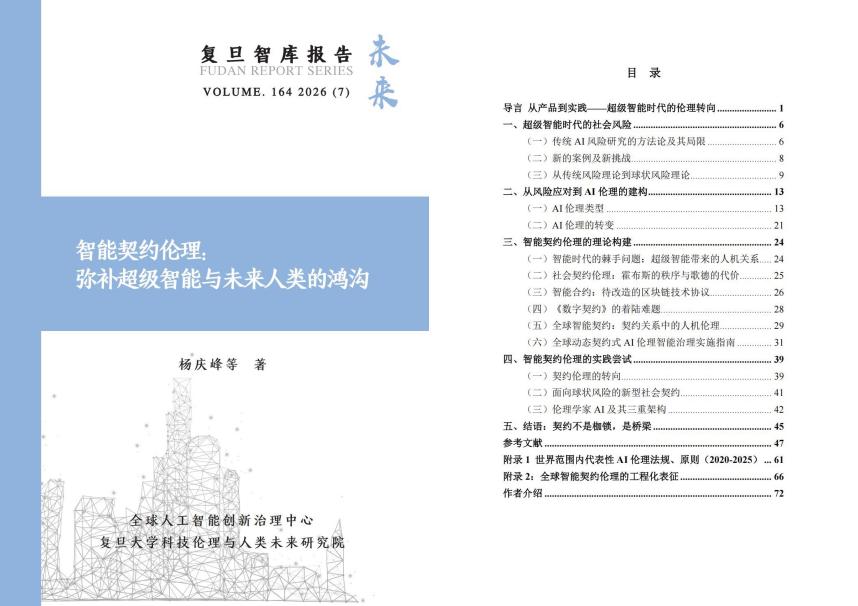
Cover (left) and Table of Contents (right) of the report Smart Contract Ethics: Bridging the Gap Between Superintelligence and Future Humanity
On April 25, during the sub-forum titled “Building Inclusive and Equitable Human-Machine Coupling: Risks and Collaborative Governance of Everyday Urban Intelligent Communication,” Professor Yang Qingfeng, the report’s lead author and a researcher at theCGAIG Center for Global Governance of Artificial Intelligence, delivered a keynote speech on the newly released report. He pointed out that the 2026 report is an elevation and advancement from the 2025 report, Superintelligence: A Minority Report. The 2025 report emphasized that superintelligence is no longer a distant imagination, but a realistic issue that must be seriously confronted; whereas the 2026 report goes a step further by proposing ethical responses to the risks of superintelligence.
The report points out that as superintelligence transitions from technical imagination to reality, traditional approaches that treat AI risks as identifiable and quantifiable “problem lists” are becoming obsolete. The core risks in superintelligence scenarios stem more from deep-seated structural changes in the relationship between humans and intelligent agents. Borrowing philosopher Peter Sloterdijk’s “sphere theory,” the report categorizes this type of risk—endogenous to human-machine coexistence—as “spherical risk.” Based on this, it puts forward its core proposition: “Smart Contract Ethics.” It argues that we should move from social contracts to smart contracts, establishing a negotiable, revisable, and sustainably adjustable contractual relationship between humans and machines.
The report suggests that the significance of the smart contract lies in its capacity to be perpetually renegotiated on equal terms by all parties. It is not a shackle binding the human-machine relationship, but a bridge connecting superintelligence with future humanity. In addressing the challenges of human-machine relationships in the era of superintelligence, this report also represents a new milestone in Center for Global AI Innovative Governance’s ongoing exploration of frontier issues in AI governance.