

From August 20 to 21, 2026, the third convening in the United Nations Global Dialogue on Artificial Intelligence and Human Developmentwas held in Xi’an, Shaanxi Province. Professor Chen Zhimin, Executive Director of Center for Global AI Innovative Governance and Vice President of Fudan University, was invited to attend. He shared his insights on how embodied AI and cutting-edge artificial intelligence technologies impact education, employment, and sustainable development.
The event was convened by UN Deputy Secretary-General Amina Mohammed, organized by the United Nations Office for Partnerships, and co-hosted in cooperation with the Chinese government and the UN Secretariat. Previous sessions of this dialogue series were held in Cairo and Mexico City. Bringing together policymakers, technology experts, academics, and cultural figures, this dialogue focused on how artificial intelligence is reshaping human civilization and the trajectory of development. The insights and recommendations generated from the dialogue will be compiled into a thematic report to serve as a milestone deliverable during the 81st session of the United Nations General Assembly. Furthermore, the discussions will advance the implementation of the Pact for the Future and the Global Digital Compact, providing critical reference points for the UN Independent International Scientific Panel on AI and the Global Dialogue on AI Governance.
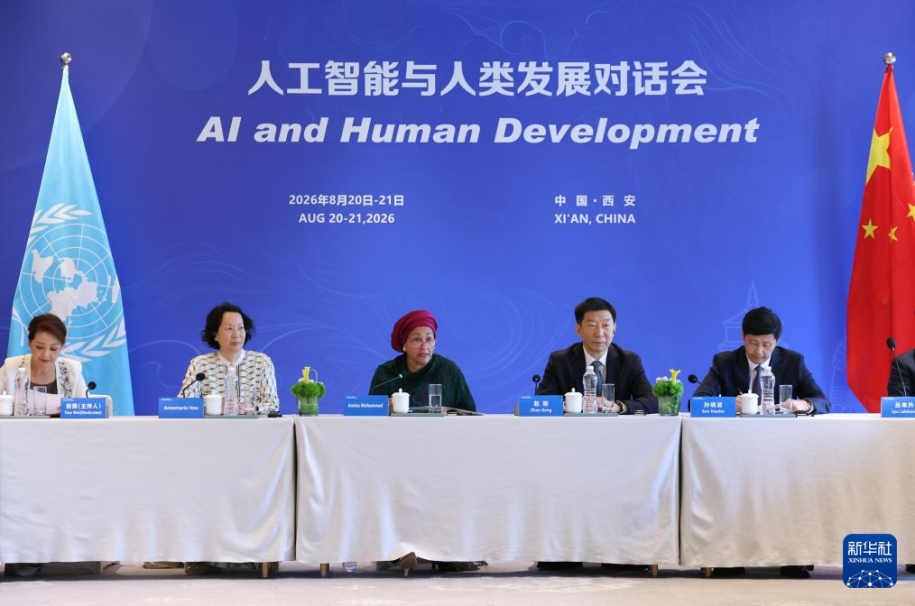
On August 21, the UN Global Dialogue on Artificial Intelligence and Human Development was held in Xi’an, Shaanxi Province. (Photo by Xinhua News Agency reporter Li Yibo)
In her opening remarks, UN Deputy Secretary-General Amina Mohammed stated that China is setting the pace for global AI development. Through the AI Capacity-Building Action Plan proposed for the Global South, China has extended this vision to a broader sphere, advocating for equal opportunities for all nations under jointly formulated rules. She noted that the United Nations looks forward to learning from China's experience and collaborating to extend the capabilities cultivated within China beyond its borders, thereby fostering development and progress for all humankind.
Sun Xiaobo, Coordinator for AI Affairs of Ministry of Foreign Affairs of the People’s Republic of China, emphasized in his speech that the United Nations is the most universal, representative, and authoritative intergovernmental organization, and that the UN-centered international system plays an irreplaceable role. China consistently and actively supports the UN in playing a primary channel role in global AI governance, genuinely enhancing the representation and voice of developing countries, and establishing universally accepted international rules and coordination mechanisms to ensure that all nations can participate, make decisions, and benefit on an equal footing. He stressed the imperative to embrace multilateralism rather than reverting to the law of the jungle, which would allow a few countries and a handful of enterprises to monopolize AI resources indefinitely.
During the interactive session, Professor Chen Zhimin noted that in response to the profound impacts of embodied intelligence on higher education and learning paradigms, Fudan University is continuously advancing “stem cell-style” talent cultivation. The university promotes “X + AI” dual-degree programs, highlights cross-disciplinary integration, and cultivates students’ abilities to pose insightful questions and engage in cross-boundary innovation.

On August 21, Professor Chen Zhimin (left), Executive Director of the Center for Global AI Innovative Governance (CGAIG) and Vice President of Fudan University, delivered a speech at the UN Global Dialogue on Artificial Intelligence and Human Development
From Cairo and Mexico City to Xi’an, each event location was carefully selected for its profound historical heritage and cultural value, providing a conducive platform for stakeholders to examine the intrinsic connections between technological transformation, social development, institutional building, human values, and interpersonal relationships. As the eastern starting point of the ancient Silk Road, Xi’an bears witness to mutual learning among diverse civilizations. The consensus reached by participating parties here is that the future of artificial intelligence must not be defined unilaterally by any single entity; rather, it should be jointly written by diverse civilizations.
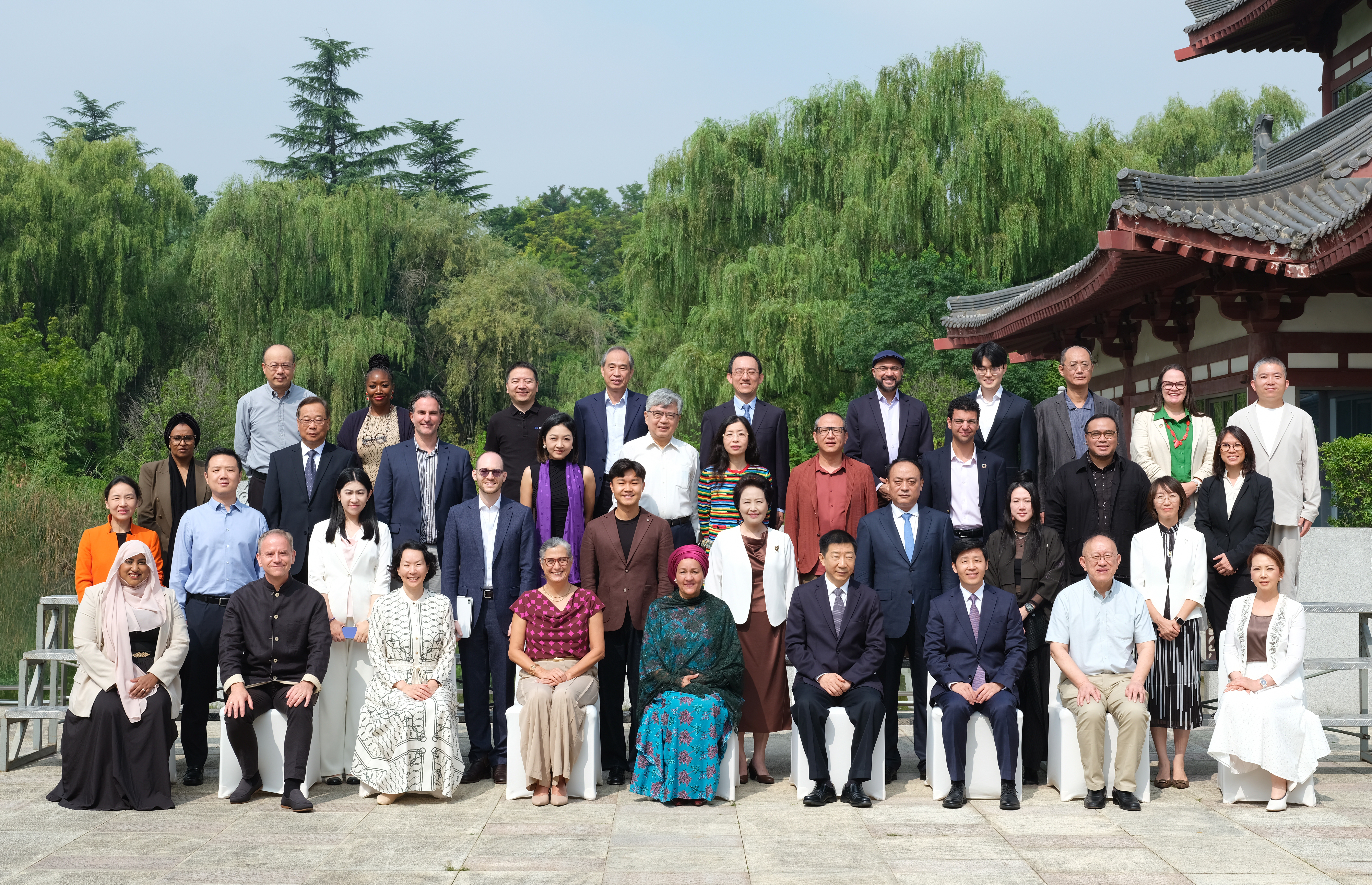
On August 21, participants of the UN Global Dialogue on Artificial Intelligence and Human Development gathered for a group photo