

As generative AI accelerates its penetration into everyday information-seeking and consumption decisions, how a brand is understood and credited by AI has become a new question for brand management. How can a brand's health within the digital ecosystem be assessed objectively? And what systematic tools and long-term mechanisms are needed to manage brand health in the age of intelligence?

On August 9 2026, the “Symposium on Brand Health and Management Innovation in the Age of AI” hosted by the Fudan University Center for the Study of Communication and National Governance was held in Shanghai, releasing the Report on Brand Health and Management Innovation in the AI Era (hereafter “the Report”). The Report offers a systematic account of the structural changes, opportunities and trends facing brand health management in the age of AI, and, on the basis of data drawn from a global sample of 200 brands, puts forward for the first time a quantifiable AI Brand Health Index together with a “C-B-A three-tier framework,” providing a guide for enterprises seeking to build long-term digital cognitive assets and a system of health governance. At the symposium, experts from academia, the media and industry engaged in an in-depth discussion of brand health management in the age of intelligence.

The Information Ecosystem in Upheaval:Why Brands Need a New Check-Up
“In the age of AI, the underlying mechanics of information dissemination are changing profoundly, and brand health management faces new structural challenges.” Professor Zhang Zhian, moderator of the Report and Director of the Fudan University Center for the Study of Communication and National Governance, identifies five main challenges: user information entry points are migrating toward intelligent Q&A and AI aggregation platforms, so that brand competition is extending from a contest of “visibility” to one of “cognitive quality”; the scale of content supply is expanding sharply, making genuine, professional and verifiable sources of information scarcer still; the threshold for producing false and misleading information is falling, driving up the cost to companies of verification and correction; the visibility of mainstream media within intelligent distribution is being diluted, challenging the reach of authoritative sources; and traditional methods of brand management are proving newly inadequate in terms of control, stability and measurability.
Zhang's reflections on brand management drew a strong response from the assembled experts. Drawing on frontline industry observation, Li Fengrong, Co-President of Midu Technology, reinterpreted these challenges as forms of invisibility across the attack surface, the reasoning process, dialogue scenarios, the decision chain and cognitive assets: what is now being monitored is the cognitive weight assigned within the model itself, and the semantic generation that occurs within private, closed conversations. She further observed that the traditional, linear model of brand management has already ceased to work: a brand no longer deals only with the media, but must now contend with algorithms, sentiment and countless nodes of dissemination.
You Chunjie, Director of the Shanghai Observer Think Tank at Jiefang Daily, acknowledged candidly in her remarks that traditional media face an urgent task of systemic transformation in the age of AI. “The competitor traditional media now faces is AI itself, yet traditional media's grasp of data is in fact very weak, and their capacity to serve users faces enormous challenges.” In her view, the value weight assigned to genuinely scarce, high-quality content is rising, but the mechanism that determines visibility has shifted from editors to algorithms, and has become still less transparent in the age of AI — a fundamental problem that enterprises and media alike must confront together.
The other side of the challenge is opportunity. The research team led by Zhang Zhian points out that optimizing the quality with which a brand is presented in AI recommendation contexts helps amplify the “primacy effect” and shorten the user's decision path; building digital cognitive assets that AI will credit can produce a unified brand impression across platforms while lowering the marginal cost of long-term brand maintenance; AI-optimized brand exposure costs less than traditional search optimization, creating growth opportunities for smaller brands in particular; and AI technology itself can raise the efficiency of public-opinion response, helping companies identify potential hazards and issue risk warnings more promptly. A number of brands have already taken an early position in Generative Engine Optimization (GEO) to raise their visibility within AI models, offering a useful reference point for the industry.
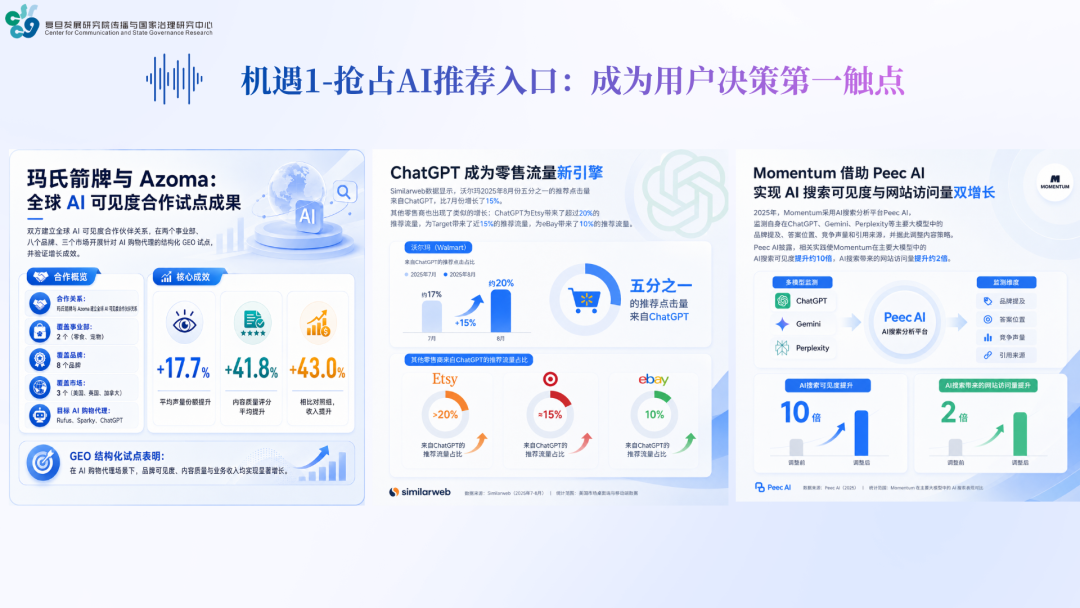
In practice, however, GEO has also exposed a disorderly pattern of what is termed “AI poisoning.” Some operators mass-produce commercially oriented content designed to interfere with how large models crawl, cite and recommend, creating a mismatch between a brand's exposure and the truthfulness of the information behind it. In response, the Report offers, for the first time, a systematic evaluation tool spanning multiple dimensions of measurement, intended to reverse the short-termist fixation on exposure numbers alone and encourage enterprises to build health-management mechanisms that are traceable, correctable and sustainable.
The AI Brand Health Index Is Released:Brand Health Now Has a Quantitative Diagnostic Tool
In response to the core pain point that conventional tools such as opinion monitoring and SEO performance assessment cannot clearly answer the question of “how AI understands and presents a brand,” the Fudan research team has put forward, for the first time, an AI Brand Health Index. As the principal highlight of the Report, the index also represents a milestone achievement of the team's work in both theoretical innovation and practical exploration.
Around the AI Brand Health Index, the Report constructs, at the theoretical level, a bottom-up “C-B-A three-tier framework,” intended to realize a practical closed loop of “assessment, diagnosis, improvement and governance.” Tier C is asset health, measuring the completeness, consistency and verifiability of an enterprise's publicly available digital assets — the underlying foundation of a brand in the digital world. Tier B is mechanism health, assessing chiefly how well a brand's content structure is matched to the logic by which AI processes information, which bears on whether brand information can be effectively understood by AI. Tier A is performance health, used to measure how a brand actually appears across various AI endpoints, such as conversational search and intelligent Q&A tools. The recommended weighting among the three tiers is 2:3:5, though this may be adjusted appropriately according to the characteristics of different industries and the stage of an enterprise's development.
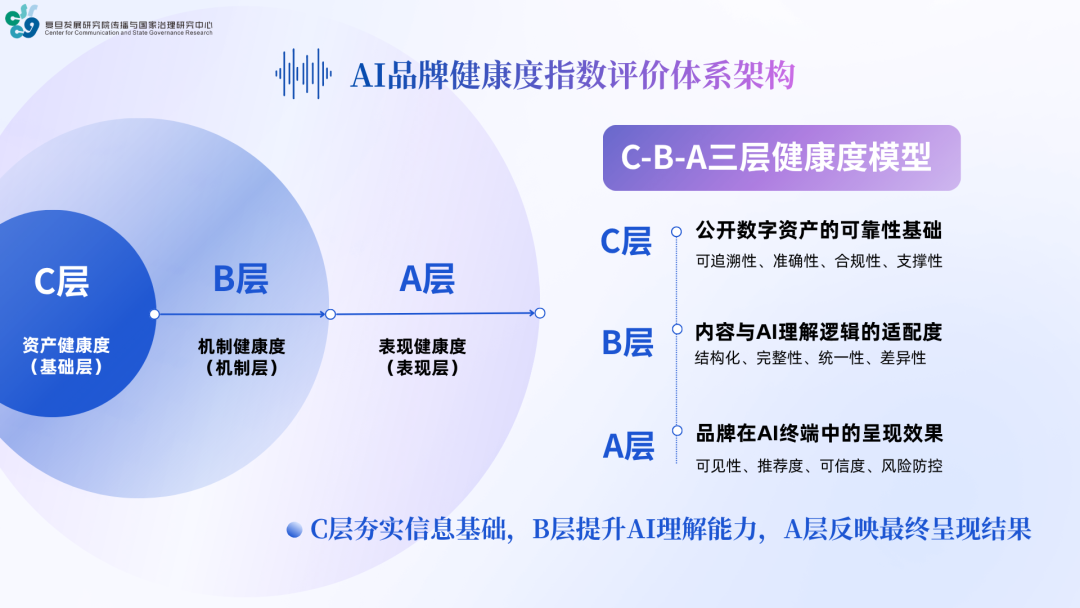
The research team's regression analysis of the global sample of 200 brands confirms that a strict, bottom-up causal chain runs through the C, B and A tiers, with the quality of the lower tier directly constraining the room for improvement at the tier above. This suggests that only by starting from the underlying digital assets and governing systematically from the bottom up can an enterprise build a complete closed loop running from diagnosis and improvement through to standing, routine inspection.
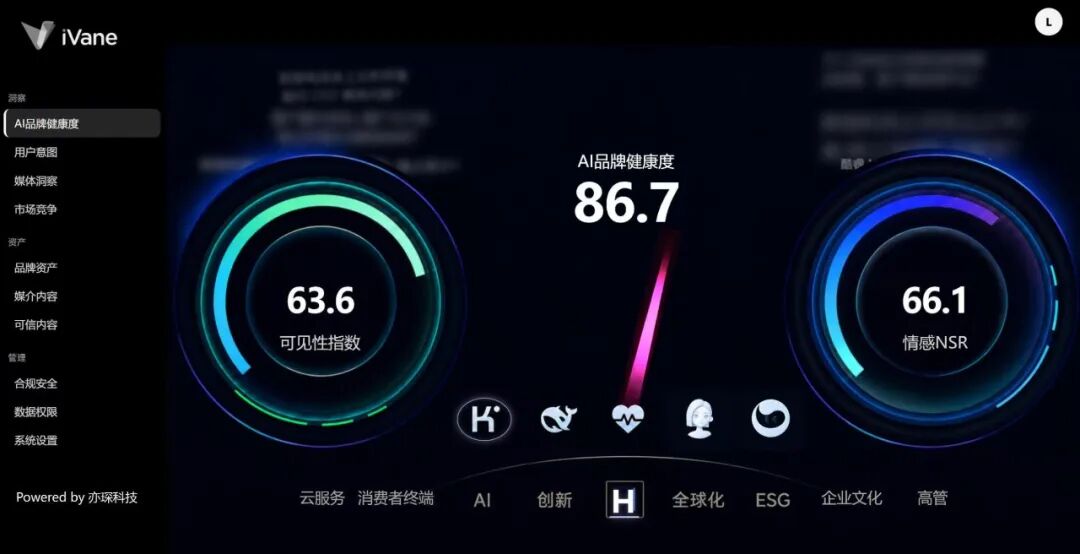
To help enterprises track and manage these indicators on a routine basis, the research team has worked closely with Shenzhen Yiqi Technology Co., Ltd. to simultaneously launch an AI Brand Health Index assessment system. Built on the three-tier evaluation model set out in the Report, the product lets enterprises enter brand information themselves and generate a health assessment report at the click of a button, and supports multi-dimensional comparative analysis across different large models, giving an intuitive view of how a brand's performance differs across major AI platforms and where improvement is needed. Huang Xiaojun, CEO of Yiqi Technology, observed that the migration of user habits, the probabilistic emergent behavior of LLMs, and the strongly ecosystem-driven character of China's domestic internet are compounding one another, and are accelerating the evolution of insight and marketing oriented toward AI platforms into an industry trend of high certainty.
The experts at the symposium spoke highly of the research team's work, holding that the theoretical framework the Report builds answers both the “is” and the “ought” of brand health in the age of AI — what the facts actually are, and what we should do about them. Lu Jiayin, Professor at the School of Journalism, Renmin University of China, said the Report perceptively captures the deep governance challenges brought by the intelligent transformation of platform ecosystems. Moving beyond conventional channel-based thinking, it offers, for the first time, a systematic account of how AI, as a new intermediary, is restructuring the logic of how brand information is produced, distributed and retained; the Report not only diagnoses real pain points such as the “loss of control” and the “escalation of distortion,” but shifts brand health management from a “contest over traffic” toward the “governance of cognitive assets,” offering a governance framework, with both theoretical depth and a practical path, for the sustainable development of enterprise health in the age of intelligent communication.
Associate Professor Li Yinsheng of the Fudan University College of Computer Science and Artificial Intelligence, speaking from an interdisciplinary perspective, observed that generative intelligence marks a digitalized, de-humanized turn in how knowledge-processing tools evolve, moving from recording and transmission toward generation, and that this will inevitably drive a disruptive transformation in the methods of production, circulation and governance that knowledge products involve. He affirmed the research team's efforts toward paradigm innovation: “The brand health index and the management system the Report proposes offer a systematic view of the ecological direction in which the productive forces, relations of production and superstructure of brand assets are evolving in the age of AI. It reshapes the underlying logic of brand communication, and provides a timely 'new solution' to the 'new problem' that AI cognition poses for brand management.”
After the Check-Up:The Path from “Checking the Numbers” to “Building Fitness”
Looking ahead, the Report summarizes three major evolving trends in brand health management in the age of AI. In competitive logic, brands are moving from short-term “traffic acquisition” toward long-term, structured “accumulation of cognitive assets.” In trust mechanisms, a “human-machine collaborative trust system” is taking shape, jointly participated in by brands, users, AI platforms and the media. And in management focus, the general trend is toward routine, standing health maintenance — shifting from “putting out fires after the fact” to “everyday immunity.”
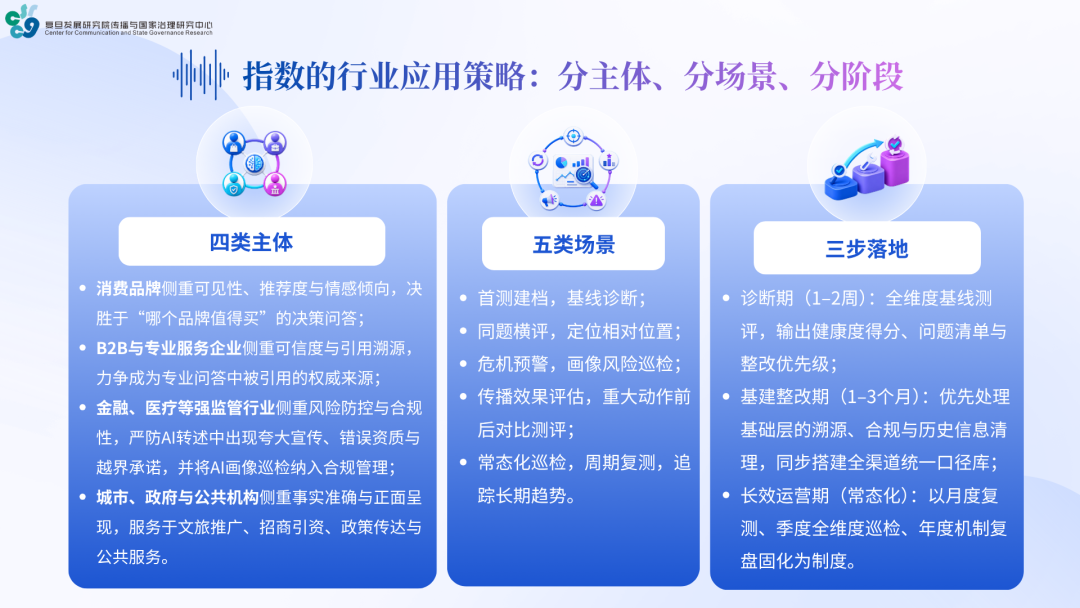
On putting the AI Brand Health Index into practice, the Report recommends distinguishing between industry scenarios and stages of enterprise development, and puts forward four overall pathways for building capability. On cognitive assets: build a unified, cross-channel repository of standard messaging, and continually build up high-weight sources. On ecosystem positioning: pursue platform presence and AI visibility along two parallel tracks, positioning differently for different models. On risk defense: bring multi-model inspection into the public-opinion monitoring system, and establish a closed loop of factual disclosure. On organizational capability: have senior leadership drive the effort, embedding brand health management into day-to-day operations.
The pathways above were also echoed by the experts present. Professor Bai Hongyi, Deputy Dean of the Fudan University School of Journalism, held that brand health in the age of AI is both a pressing practical problem and a topic at the research frontier, and expressed hope that the team's related achievements could support talent development in the school's professional master's program in strategic communication.
Shen Yang, a professor jointly appointed to the School of Journalism and Communication and the School of Artificial Intelligence at Tsinghua University, stressed that brand health management must give full weight to the self-evolution of AI. He noted that the explosive growth of generative AI has made “verification” the new core of brand management, and that brand health management is moving from static monitoring toward a dynamic, self-evolving closed loop spanning short, medium and long chains. To this end, enterprises should actively analyze which sources different AI platforms trust, bring multi-model inspection into routine management, and work hard to cultivate “super-individuals” within the organization, driving the co-evolution of brand and AI: “moving from self-evolution to co-evolution, and from human-machine symbiosis to the symbiosis of people and organizations.”
Liu Huabin, founder of Zitzo, said the existing achievements of the Report need to be pushed further toward the level of the “probable,” so that brand health management can truly take root in practice. He recommended building a multimodal, full-domain semantic insight system, establishing a dual-track content-production mechanism separately adapted to mass communication and large-model retrieval, and advancing the building of a “clean-water reservoir” of official, authoritative information to reinforce the reliability of the underlying information base. He noted in particular that “having algorithms converse with algorithms” is the key path to breaking open the closed data loop of large models and achieving active verification.