

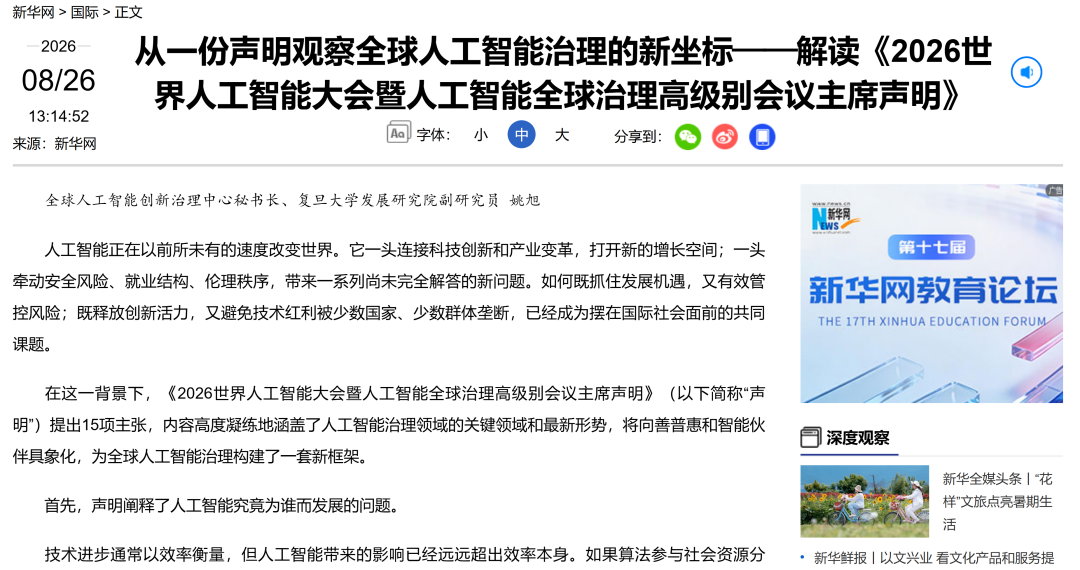
On 26 August 2026, Xinhua published an article by Yao Xu, Secretary-General of the Center for Global AI Innovative Governance and Associate Professor at the Fudan Development Institute, offering an in-depth reading of the Chair's Statement of the 2026 World AI Conference & High-Level Meeting on Global AI Governance. The article identifies fifteen propositions in the Statement that together build a new framework for global AI governance, and analyzes it across four dimensions: AI's value orientation, the balance between development and security, inclusive development and capacity building, and pathways for multilateral cooperation. It argues that the Statement grounds development in security, situates innovation within a direction of good, converts the dividends of technology into development capacity for more countries, and brings institutional differences into a multilateral framework for consultation. The article holds that the Statement's grounding in a people-centered approach, its orientation toward AI for good, its balancing of development and security, and its emphasis on AI capacity building and multilateral cooperation are both the key message the Statement conveys and the question of the age that global AI must answer if it is to move toward development that is truly healthy, sustainable and inclusive.
Source: Xinhuanet
AI is transforming the world at an unprecedented pace. On one side it connects to technological innovation and industrial transformation, opening new space for growth; on the other it bears on security risks, the structure of employment and ethical order, raising a series of new questions that remain only partly answered. How to seize the opportunities of development while effectively managing risk, and how to unleash the vitality of innovation while preventing the dividends of technology from being monopolized by a small number of countries or groups, have become a shared task confronting the international community.
Against this background, the Chair's Statement of the 2026 World AI Conference & High-Level Meeting on Global AI Governance (hereafter “the Statement”) puts forward fifteen propositions that offer a highly condensed account of the key areas and latest developments in AI governance, giving concrete form to the ideas of AI for good and inclusiveness and of intelligent partnership, and building a new framework for global AI governance.
First, the Statement clarifies the question of whom AI ultimately develops for.
Technological progress is usually measured by efficiency, but the effects of AI already extend far beyond efficiency alone. Where algorithms take part in the allocation of social resources, where agents possess ever-greater capacity to act, and where large models enter public domains such as education, healthcare and government services, the standard by which technological progress is judged can no longer be parameters, speed and commercial returns alone; it must also ask whether the technology advances human well-being and safeguards people's rights and dignity.
The Statement establishes people-centeredness, AI for good, fairness and inclusiveness, and collaborative governance as basic principles, setting the value coordinates for AI development. Its core meaning is that AI must always remain a tool that serves people, and must not be allowed to govern human choice in return; that the application of technology should improve social life, not come at the cost of security, fairness and dignity. Only by placing human interests above technological logic can AI development be kept from drifting away from the fundamental direction of benefiting humanity.
Second, the Statement embodies a governance approach that gives equal weight to development and security.
In the face of rapidly evolving new technology, two tendencies are worth guarding against: one that sees only risk and compresses the space for innovation through successive layers of restriction, and one that pursues only speed and leaves governance until after problems arise. The Statement does not treat innovation and regulation as an either-or choice; it both emphasizes cultivating an innovation ecosystem, promoting “AI Plus,” and building open-source communities, and calls for the construction of laws and regulations, technical monitoring, risk warning and emergency response systems.
Addressing new problems specific to large models, agents and the security of critical infrastructure in particular, the Statement calls for necessary guardrails, clear boundaries on decision-making authority and permissible action, and mechanisms for tracing conduct and issuing risk alerts. This shows that AI governance is moving from statements of principle toward more concrete objects and stages. Governance needs to keep pace with technology, yet it cannot bind continually changing innovation with fixed, unchanging rules. The risk-oriented approach, agile governance and tiered, category-based management that the Statement stresses are meant precisely to strike a dynamic balance between the two, so that AI has ample room to develop while always holding the line of security and control.
Third, the Statement gives particular emphasis to inclusive AI development and to capacity building.
At present, marked imbalance exists in global AI development. A small number of countries and large technology companies hold an absolute advantage in compute, data, models and talent, and a closed, monopolistic trend in technology, resources and voice has already begun to appear. Correspondingly, Global South countries as a whole continue to face real difficulties such as inadequate infrastructure, a shortage of specialist talent, and weak application capacity. Should this gap continue to widen, AI would not only fail to bridge the development divide but could instead accelerate the creation of new inequality.
The Statement therefore gives international cooperation on AI capacity-building a prominent place, stressing equal and inclusive participation and benefit. What Global South countries urgently need is not the use of ready-made technology products but the capacity to choose, apply and govern AI on their own terms. This process calls for close collaboration and open sharing among all countries. Only by moving from one-way technology export toward shared capacity building can the Global South be transformed from a passive recipient of AI rules into a participant, and even a contributor, to the development process.
China has put forward, and has persisted in advancing the implementation of, the U.N. General Assembly resolution on enhancing international cooperation on capacity-building of artificial intelligence, has carried out a series of widely implemented AI-for-good capacity-building initiatives, and has provided a diverse range of international public goods in AI to Global South countries. These measures have brought the broad advocacy down to the level of talent development, scenario-based cooperation and public services, carrying the effort to bridge the intelligence divide beyond a mere declaration of values and giving it the support of sustained, visible cooperative projects.
Finally, the Statement proposes a multilateral pathway for addressing the fragmentation of global AI governance.
The research and application of AI cross national borders, and the problems that governance must address at this level — data flows, cyberattacks, model risk and disruption to industrial chains — are likewise difficult to confine within any one country. Yet countries currently differ in their regulatory concepts, rules and standards, and levels of development, and global governance presents a fragmented picture of multiple parallel systems with insufficient coordinating mechanisms. Should countries go their own way, or even erect deliberate technological barriers, this would not only raise the cost of innovation but would further fracture global industrial chains and deepen the intelligence divide between nations.
The Statement stresses the United Nations' core role in global governance, and advances the exploration of international economic and trade rules along with the formulation, revision and mutual recognition of security, industrial and ethical standards. It also explicitly respects differences among countries in history, culture, social systems and forms of civilization — a point especially worth noting. Genuinely effective global governance does not require every country to replicate the same model; it seeks common ground on the basis of acknowledged difference, and forges new rules through continual coordination. AI should contribute to the diversity of world civilizations, and global AI governance must continually build new consensus on this foundation.
During the Conference, the Agreement on the Establishment of the World Artificial Intelligence Cooperation Organization was signed in Shanghai. The Statement offers a clear account of the organization's positioning, principles and objectives, stressing in particular that it is designed to support the Global South and to remain open to all countries — a concrete embodiment of the multilateralism, and of the vision of extensive consultation, joint contribution and shared benefit, to which most countries in the world remain committed. The critical significance of the organization's establishment lies in providing a standing platform for the communication of AI policy, the coordination of rules and cooperation on projects among countries, turning capacity building into a sustained, institutionalized undertaking.
The Statement does not treat AI simply as a technological race but examines it within the larger coordinates of human development, common security and international fairness. What it advocates is greater clarity of direction for innovation, the lowering of risk through shared rules and shared understanding, and a sustained effort to widen every country's opportunity to participate in AI development and to share in its dividends.
The future of AI depends not only on how far models can advance but, more fundamentally, on how broad a consensus humanity can build. Grounding development in security, situating innovation within a direction of good, converting the dividends of technology into development capacity for more countries, and bringing institutional differences into a multilateral framework for consultation: this is the key message the Statement conveys, and it is the question of the age that global AI must answer if it is to move toward development that is truly healthy, sustainable and inclusive.