

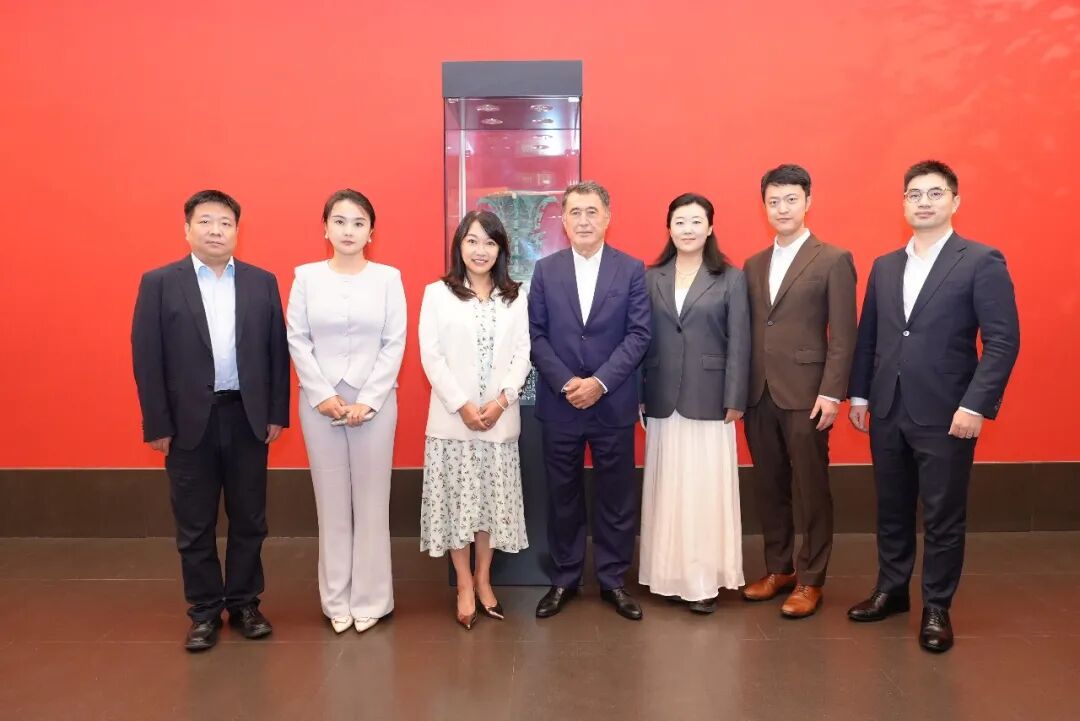
On 28 August, Vladimir Imamovich Norov, Chairman of the Central Asian AI Association and former Secretary-General of the Shanghai Cooperation Organisation (SCO), visited the Beijing Club for International Dialogue (Beijing Club) for in-depth exchanges with Chinese scholars on the AI development strategies and industrial landscape of Central Asian countries, the development of the World Artificial Intelligence Cooperation Organization (WAICO), and the outlook for China–Central Asia cooperation on AI. Yao Xu, Secretary-General of the Center for Global AI Innovative Governance (CGAIG) and Associate Research Fellow at the Fudan Development Institute, participated in the roundtable.

On the outlook for AI development in Central Asia, Norov said the region has clear strengths in resources and energy, population and education, geographic position, and market space, giving it substantial potential for AI development. By his estimate, Central Asia’s population could exceed that of Russia by 2050. Central Asian countries are currently pursuing reform and opening-up, with Uzbekistan and others continuing to step up policy support for AI. China and Central Asia have complementary strengths in AI: China can offer cost-competitive models, hardware, engineering capability and industrialisation experience, while Central Asia brings energy resources, minerals, linguistic diversity and a wealth of industry use cases, creating considerable scope for cooperation between the two sides.
Asked about the choices facing Central Asian states amid China–US technology competition, Norov said Central Asian countries will not simply “pick a side.” A more workable path, he argued, is to hold to a principle of “broad cooperation, limited dependence, tiered management of sensitive areas, and priority for local capability.” At the same time, Central Asia’s position linking east and west and connecting north and south, together with its relatively neutral stance, allows it to serve both as an important corridor for Chinese technology companies going global and as a platform for dialogue on global AI governance. Central Asian states are currently deepening ties with Azerbaijan and advancing construction of a corridor through Afghanistan connecting to Pakistan, further expanding the space for regional cooperation.
Norov spoke highly of China’s efforts to strengthen international dialogue, advance capacity-building, and champion “AI for good” through platforms such as the World Artificial Intelligence Conference (WAIC) and the United Nations. He suggested that the SCO’s experience of multilateral cooperation could offer a reference for initiatives such as WAICO. The Central Asian AI Association, he said, would continue to play a coordinating role among governments, universities, enterprises and international organisations, deepen cooperation with China, and work to advance AI development in step with effective, responsible and forward-looking governance.
On China–Central Asia AI cooperation, participating experts agreed that the two sides are complementary and that the potential for cooperation is substantial.China could draw on multilateral mechanisms such as WAICO and the SCO to share its experience of AI industrial development and governance with Central Asia. Beyond supplying technology and products, greater emphasis should be placed on “teaching them how to fish” — building capacity through skills training and leadership development for the AI era, so as to help Central Asian countries strengthen their own capacity for self-directed development.
Experts also pointed out that static, conventional legislative approaches alone can no longer keep pace with rapid advances in AI technology. They called for more dynamic and agile governance models and a stronger capacity to “use AI to govern AI”. Industry representatives noted that AI governance must address both institutional issues at the macro level and specific questions of technological ethics and practical implementation. Many of the challenges raised by AI ultimately reflect universal issues of human nature and society, highlighting the need for closer international dialogue and collaboration among industry, academia, research institutions and users of AI.
Participants in the roundtable included: Vladimir Imamovich Norov, Chairman of the Central Asian AI Association and former Secretary-General of the SCO; Han Hua, Co-founder and Secretary-General of Beijing Club; Gao Zihao, Ambassador of the Central Asian AI Association and a columnist for Beijing Club’s “Multipolar Perspectives”; Li Mengjiao, Executive Editor-in-Chief and Senior Director of Public Affairs at Meituan; Xiao Youdan, Research Fellow at the Institutes of Science and Development, Chinese Academy of Sciences, and Professor at the University of Chinese Academy of Sciences; Yao Xu, Secretary-General of the Center for Global AI Innovative Governance (CGAIG) and Associate Research Fellow at the Fudan Development Institute; and Zhang Linghan, Professor at the China University of Political Science and Law (CUPL) and Dean of its Institute for AI Law.
Original Link: https://mp.weixin.qq.com/s/O0uEG5-2m41Y8byRKw8A1Q?scene=25&click_id=683270153&sessionid=#wechat_redirect