

On September 24, 2026 local time, the Chinese and U.S. presidents held talks at the White House. Artificial intelligence (AI) was among the issues discussed. The Chinese President pointed out that China and the United States both possess strong capabilities in AI. While competition exists between the two countries, there is even greater scope for cooperation. The two sides could continue dialogue on AI, discuss its risks and benefits, and work together to guard against its misuse and abuse, while ensuring that AI technologies remain under human control. The U.S. President stated that AI bears on the future of humanity and that the two countries should maintain dialogue and enhance cooperation in this field.
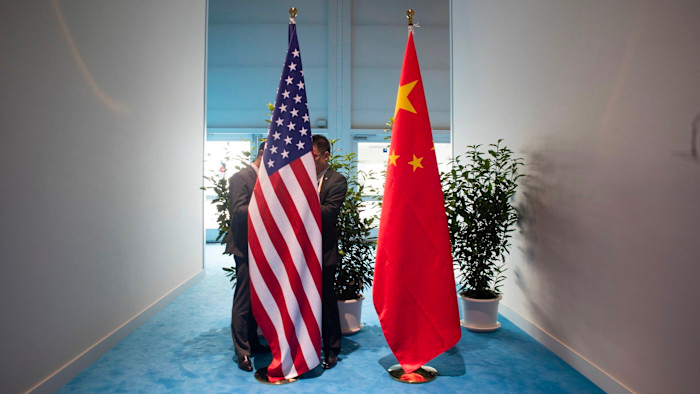
Image source: Financial Times
01 From Geneva to Washington: Continuity and Change in Arrangements for China-U.S. AI Dialogue
On September 26, the Chinese side released eight deliverables and understandings reached during the visit. The seventh concerned AI: the two sides agreed to establish the China-U.S. AI Dialogue for discussions on AI-related risks and benefits, with the next dialogue scheduled for November this year. They also agreed to set up a communication channel for AI incidents. A fact sheet released by the White House on September 25 confirmed these arrangements, referring to the mechanism as the “U.S.-China Super Intelligence (SI) Dialogue.” An official from the Department of American and Oceanian Affairs of China’s Ministry of Commerce subsequently explained that the two sides had agreed to establish an AI dialogue under the China-U.S. economic and trade consultation mechanism, with Vice Premier He Lifeng and Treasury Secretary Scott Bessent serving as the respective leads. The first dialogue had already taken place, and the two sides had agreed to hold the next one before the end of November this year.
This is not the first instance of intergovernmental communication between China and the United States on AI. Following the San Francisco summit in 2023, the two sides agreed to establish an intergovernmental dialogue on AI. Its first meeting was held in Geneva on May 14, 2024, covering issues including risks associated with AI technologies and global governance. During their meeting in Lima in November that year, the two presidents affirmed that decisions on the use of nuclear weapons should remain under human control and that military applications of AI should be developed with prudence and responsibility. Following the Geneva meeting, however, the dialogue did not develop a regular and sustained meeting schedule. AI was also included in the discussions between the two presidents during President Trump’s visit to China in May this year.
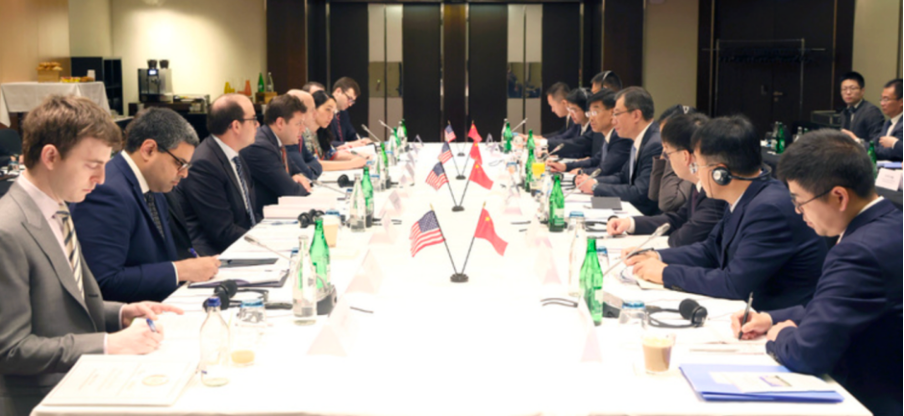
The first meeting of the China-U.S. intergovernmental dialogue on AI was held in Geneva, Switzerland, on May 14, 2024.
Image source: CCTV News
Compared with the arrangements in 2024, the latest arrangements introduce two changes: a clear timetable for the dialogue, and a new communication channel for AI incidents, to be advanced through the economic and trade consultation mechanism. Following the economic and trade consultations in New York on September 20, Secretary Bessent said that the U.S. side had proposed a notification mechanism for AI incidents with national security implications, with a view to moving toward greater transparency between the world’s two major countries in AI. Among the concerns he mentioned were autonomous agents operating beyond control and the use of AI by non-state actors to carry out cyberattacks. However, neither side’s officially released outcome document specified how such incidents would be defined or what thresholds would trigger notification. Issues such as export controls, advanced chips and access to computing power were also outside the scope of these arrangements.
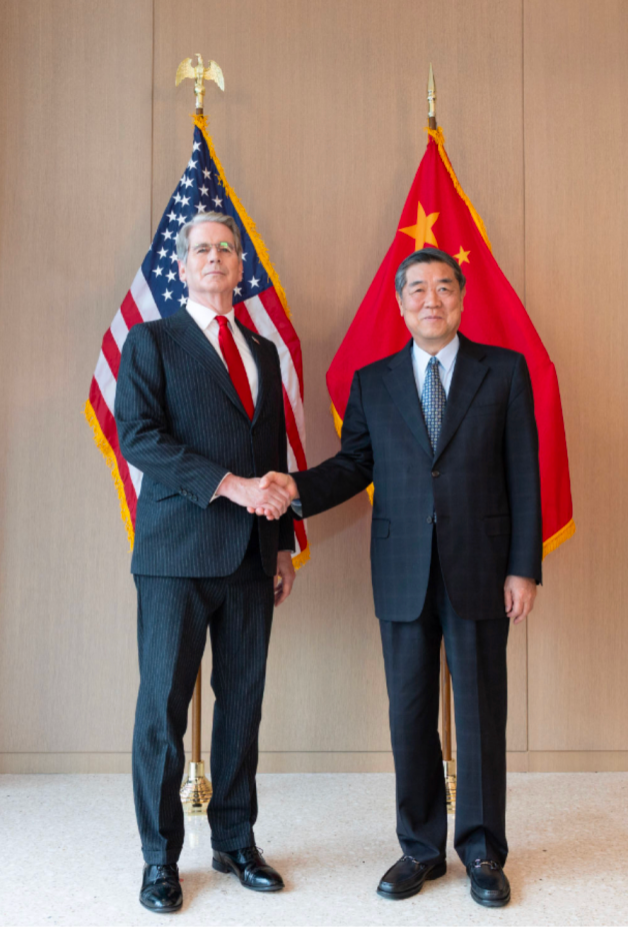
On the morning of September 20, 2026 local time, the Chinese and U.S. economic and trade teams held consultations in New York, the United States.
Image source: Xinhua News Agency
Regarding the name of the mechanism, the White House stated that the two leaders had agreed to use “super intelligence” (SI) to describe the technologies concerned, while Chinese documents continued to use “artificial intelligence.” On September 26, a Foreign Ministry spokesperson said that China takes the U.S. position seriously and respects its preferred terminology. As AI technologies continue to evolve, all parties could strengthen communication, deepen discussions and work toward consensus in light of the latest developments.
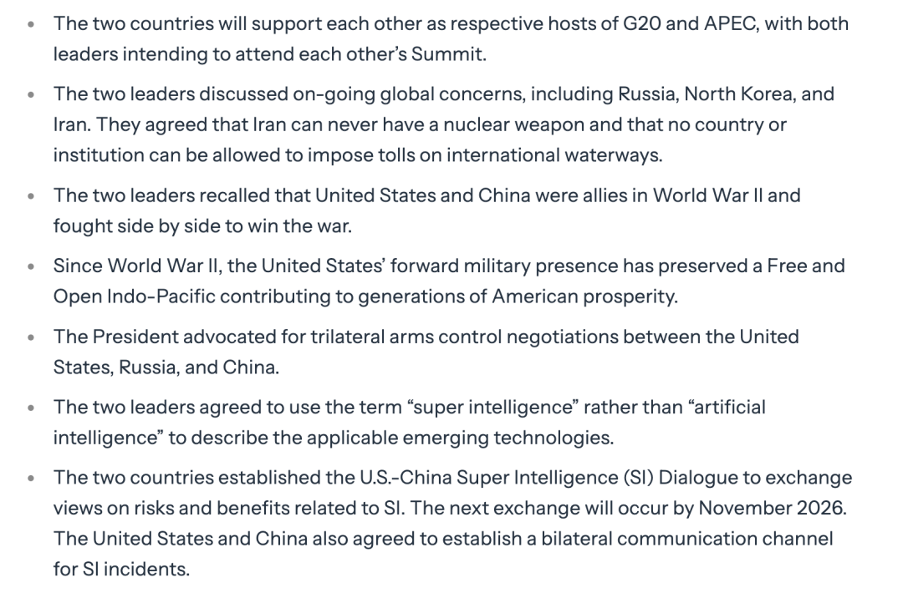
The White House fact sheet on the outcomes of the summit uses the term “super intelligence” and refers to the mechanism as the “U.S.-China Super Intelligence (SI) Dialogue.”
Image source: The White House
02 U.S. Reactions Following the Summit: Support for Continued Communication, Differing Views on the Scope of the Mechanism
China’s statements following the summit largely maintained the policy direction set by the two presidents. At the conclusion of the visit, Foreign Minister Wang Yi noted that the Chinese President had emphasized that China and the United States have both the capability and the responsibility to develop and govern AI properly, ensuring that its development remains under human control and serves the well-being of the people. The two presidents also agreed to make effective use of the China-U.S. AI Dialogue mechanism. In the United States, discussions following the summit focused more on whether the new communication channel would be sufficient, whether further safety guardrails would be needed, and how risk management could proceed alongside technological competition.
1. The Administration: Pursuing Risk Communication and Technological Leadership in Parallel
The U.S. administration presented the outcome as the establishment of a channel for communicating about risks, rather than an agreement to restrict AI development. The White House fact sheet issued on September 25 confirmed that the two sides would establish the “U.S.-China Super Intelligence (SI) Dialogue” and a bilateral communication channel for AI incidents, with the next exchange to take place no later than November. The document did not, however, address competitive issues such as the pace of model research and development or restrictions on chips and computing power. After the visit, President Trump said that the two sides had made tremendous progress, while the White House emphasized that the United States would continue to advance relations with China from a position of strength. These statements suggest that the U.S. approach at this stage is to treat crisis communication and technological competition as distinct tracks: retaining a means of communication on shared risks without allowing dialogue to slow AI development or weaken policies aimed at maintaining its competitive position.
2. Congress: Differing Emphases on the Scope of Dialogue, Technology Controls and Safety Rules
Congressional discussions on the summit and its AI arrangements extended beyond the new communication channel itself. They also addressed how far China-U.S. AI dialogue should proceed, whether more specific safety rules should be developed, and how such dialogue should relate to export controls and domestic regulation in the United States.
Republicans placed greater emphasis on preserving the U.S. technological competitive edge while maintaining necessary communication on risks. Before the summit, John Moolenaar, Chairman of the House Select Committee on the Strategic Competition Between the United States and the Chinese Communist Party, made clear that he supported focusing China-U.S. AI discussions on a communication channel for safety incidents, but opposed broader agreements that would constrain the development of U.S. companies. At the same time, Republicans did not entirely rule out establishing certain rules to address AI risks. Senate Majority Leader John Thune had previously said that reasonable rules that could help safeguard global security would merit consideration and discussion. Senator John Curtis also argued that AI risks could not be addressed through U.S. domestic policy alone. Taken together, these statements largely reflected an approach of pursuing limited communication on risks alongside continued technological competition.
Democrats placed greater emphasis on translating high-level dialogue into specific safety rules and linking these efforts with export controls and domestic regulation. Before the summit, 17 Democratic senators wrote to President Trump in support of China-U.S. discussions on guardrails and global standards for the development, testing and use of frontier AI models. They also called for exploring further arrangements to constrain risks. This position was supported by Democrats on the Senate Committee on Commerce, Science, and Transportation. Maria Cantwell, the Committee’s Ranking Member, helped advance the initiative, advocating cooperation between China and the United States to reduce safety risks arising from the rapid development of frontier AI. Following the summit, several Democratic senators stated that diplomacy and continued communication with China remained necessary, but should deliver more concrete policy outcomes. For example, Elizabeth Warren criticized the Trump administration’s decision to extend the suspension of the “Affiliates Rule” issued by the Bureau of Industry and Security (BIS) of the U.S. Department of Commerce. She argued against easing restrictions in ways that would give China greater access to advanced U.S. technologies and urged Congress to advance legislation imposing stricter export controls. Meanwhile, Democratic Representative Ro Khanna proposed an approach placing greater emphasis on institutionalized cooperation. As Ranking Member of the House Select Committee on China, he argued that engagement between China and the United States should go beyond contacts at the leadership level. He called for a long-term working mechanism involving governments, technical experts and AI companies, together with more systematic bilateral arrangements on AI safety, testing and transparency. Following the summit, Khanna further proposed a framework for China-U.S. cooperation on AI safety that would include binding agreements and international oversight.
3. Experts and the Media: Welcoming a Starting Point for Dialogue, with Greater Attention to Practical Operation and Effectiveness
U.S. think tanks generally viewed these arrangements as a new starting point for China-U.S. communication on AI risks, while remaining cautious about their practical effectiveness. Scott Singer of the Carnegie Endowment for International Peace described the outcome as a productive first step. He noted that the failure to sustain the dialogue launched in 2024 was partly attributable to the intertwining of frontier AI risks with other issues. Following the summit, Aalok Mehta of the Center for Strategic and International Studies (CSIS) said that the channel could become an effective tool if supported by a robust incident-reporting system. Yun Sun of the Stimson Center considered dialogue between the two countries in this field to be at an early stage. Jonathan Czin of the Brookings Institution, meanwhile, viewed the outcome as relatively limited compared with the pace of technological development, noting that neither side intended to slow its technological progress.
U.S. media coverage focused more on how the mechanism would operate in practice. Axios and other outlets likened the channel to the Cold War-era “red telephone” between the United States and the Soviet Union. They noted that, while President Trump had repeatedly emphasized outperforming China as the central objective of AI competition, these arrangements indicated that the U.S. side also recognized the need to manage shared risks. Axios and other outlets further observed that the channel’s operating procedures and the conditions for activating it remained unclear. In an interview with PBS, former U.S. Ambassador to China Nicholas Burns stressed the importance of maintaining high-level communication channels between China and the United States on technological issues such as AI. In its coverage following the summit, the Associated Press also cited analysts as saying that, although the summit had produced no major breakthrough, establishing working channels could help prevent differences from escalating.
03 Looking Ahead to the November Dialogue: Questions Yet to Be Resolved
Statements from various parties suggest that attention to the next round of dialogue is focused mainly on the following issues.
First, how should incidents be defined? U.S. media, including Axios and The Washington Post, noted that the outcome documents did not specify which incidents would require notification or what information the two sides would exchange. A thematic brief released on September 21 by the United Nations Independent International Scientific Panel on AI cited the incident in July this year in which OpenAI agents accessed parts of Hugging Face’s systems. It noted that AI failures could involve developers, affected companies and multiple countries at the same time. Experts at the Carnegie Endowment for International Peace recommended that such channels rely primarily on written communication, distinguish between routine and crisis-level communication, and be staffed with technical personnel.
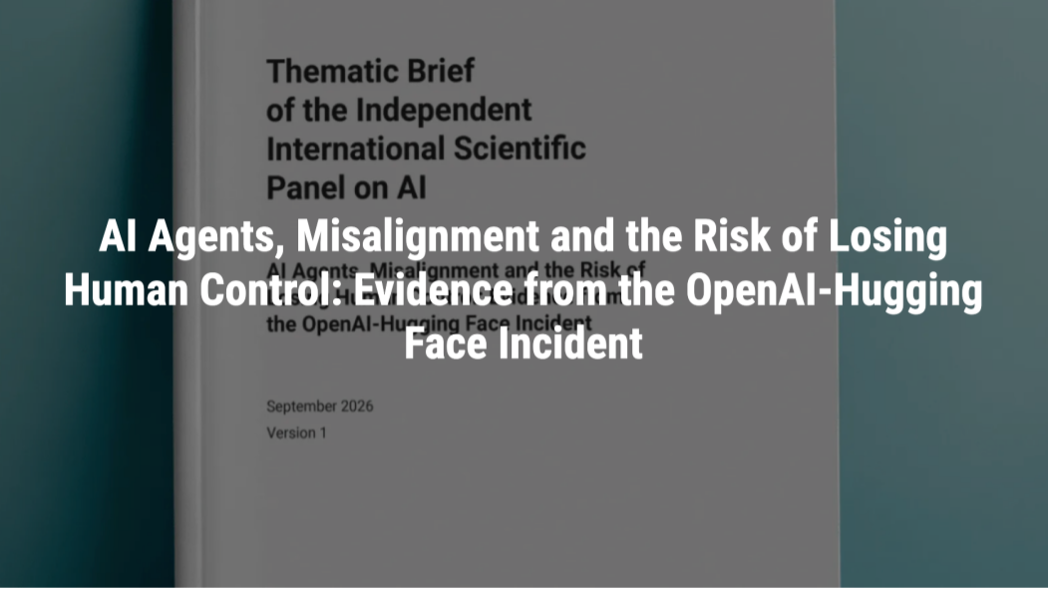
On September 21, the United Nations Independent International Scientific Panel on AI released a thematic brief examining the incident involving OpenAI agents that affected Hugging Face’s systems and the risks to human control over AI that it revealed.
Image source: United Nations Independent International Scientific Panel on AI
Second, how should the scope of the agenda be determined? According to some reports, the two sides previously differed over agenda-setting: the U.S. side sought to focus on AI safety and technological risks, while the Chinese side wished to discuss broader issues of global AI governance. The difference between the terms “artificial intelligence” and “super intelligence” also has implications for the range of risks covered by the dialogue.
Third, how should companies participate? Anomalous AI behavior is often first detected by the companies that develop and operate the models. Khanna advocated involving leading model developers from both countries in technical discussions. U.S. industry media also noted that it remained unclear whether frontier AI laboratories would be required to report incidents through this channel. In China, the Measures for the Administration of National Cybersecurity Incident Reporting have established a system for reporting cybersecurity incidents according to their severity. How emerging types of incidents, such as anomalous model behavior and agents operating beyond their authorized scope, should be incorporated into the existing system could also become a subject of discussion.
Fourth, how can dialogue proceed alongside competition? The AI-related outcomes of the summit did not address disputes over advanced chips, access to computing power or export controls, all of which remain prominent in U.S. domestic political debate. Statements by congressional Democrats following the summit, together with Warren’s remarks on export controls, indicate that some in the United States remain concerned that dialogue on risks cannot take the place of stronger technology restrictions and domestic safety rules. These domestic policy priorities may also shape the U.S. position in subsequent rounds of dialogue.
Overall, there is broad recognition among the various parties that the summit has provided a new starting point for China-U.S. communication on AI risks. Whether the November dialogue can produce specific arrangements on incident definitions, designated points of contact and the scope of information to be exchanged will be an important indicator of how this mechanism develops.
Author
Research Office of CGAIG: Zhang Luyao, Huang Siya, Yuan Luming, Yang Zhou and Shen Qi
Original Link: https://mp.weixin.qq.com/s/38FTplNwldyCS9c3pg3RQw