

On June 29, 2026, Study Times published an article by Cai Cuihong, Deputy Director of the Center for Global AI Innovative Governance and Professor at the Institute of International Studies, Fudan University. The article noted that AI is deeply embedded in cyberspace, turning it into an intelligent action space characterized by human-machine co-participation and algorithm-driven operations. Risk generation is shifting to the front end and becoming automated and concealed; content identification, behavioral response, tracing, and accountability are becoming more difficult; and risks readily spill across borders, making them difficult for any single country to address. Governance therefore needs to shift its focus upstream, strengthen early warning at the generation, model, and platform stages, promote chain-based coordination, enhance responsibility sharing, evidence collaboration, law enforcement cooperation, and rule alignment, and deepen international governance, so as to prevent technological advantages from being entrenched as rule-making power and safeguard equal participation by developing countries.
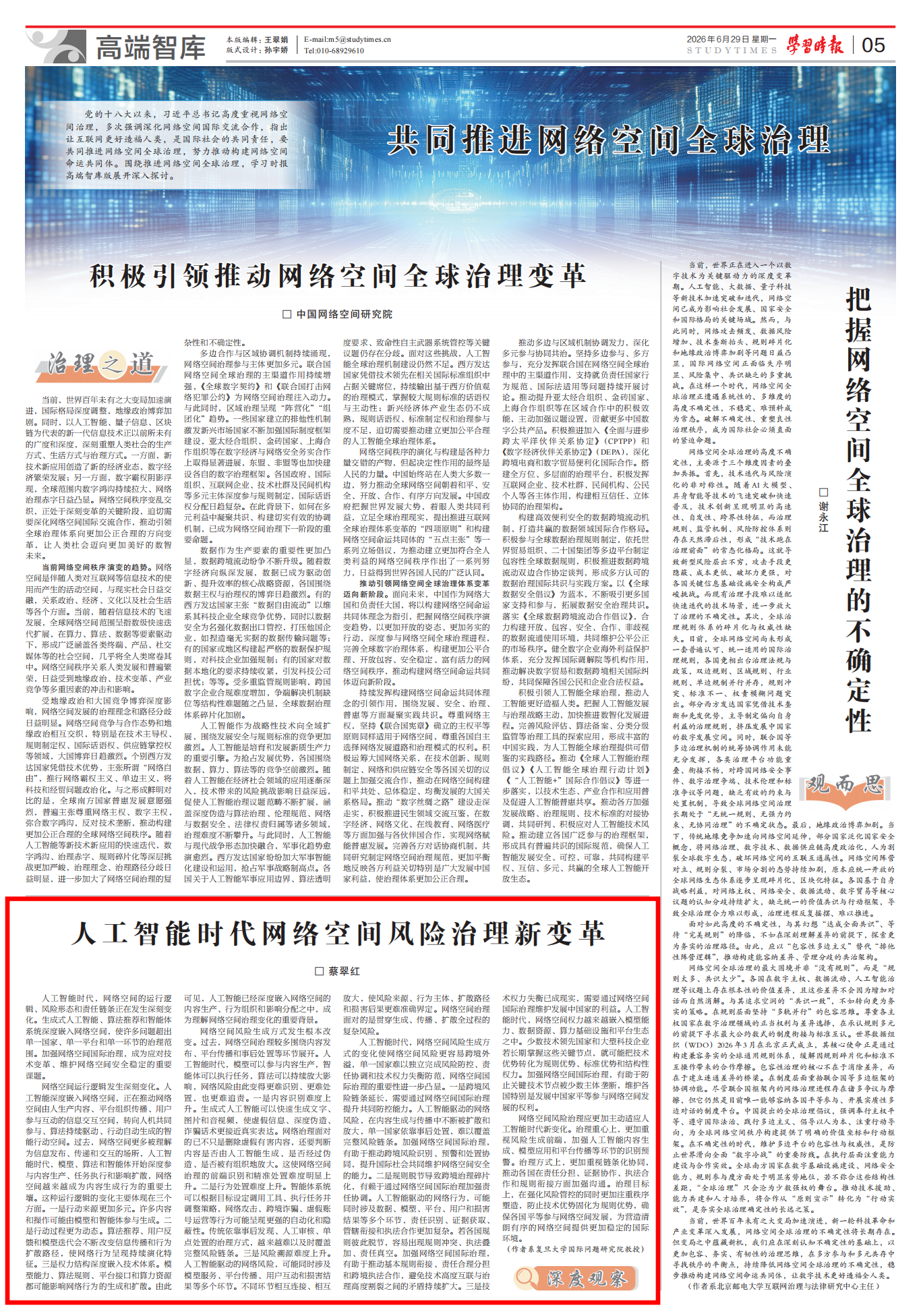
Transformations of Cyberspace Risk Governance in the Age of Artificial Intelligence
In the age of artificial intelligence, the operating logic, risk patterns and chains of responsibility in cyberspace are undergoing profound changes. Generative AI, recommendation algorithms and AI agent systems have become deeply embedded in cyberspace, placing many issues beyond the governance reach of any single country, single platform or single stage. Strengthening the international governance of cyberspace has become an important task in responding to technological change and maintaining security and stability in cyberspace.
The operating logic of cyberspace is undergoing profound change. The deep embedding of AI is transforming cyberspace from a space of information interaction, in which humans produce content, platforms organize dissemination and users participate in interaction, into a space of intelligent action, in which humans and machines participate jointly, algorithms provide continuous drive and actions are generated automatically. In the past, cyberspace was understood mainly as a venue for publishing, transmitting and exchanging information. In the age of AI, models, algorithms and agents have begun to participate deeply in content production, task execution and the spread of influence, and cyberspace is increasingly becoming fertile ground for content-generating behavior. This change in operating logic is reflected mainly in three respects. First, the sources of action are more diverse: much content and many operations may be generated with the participation of models and agents. Second, the process of action is more dynamic: algorithmic recommendation, user feedback and model iteration continuously alter the pathways along which information spreads and behavior diffuses, so that online behavior evolves continuously. Third, power structures are deeply embedded in technological systems: model capabilities, algorithmic rules, platform interfaces and computing resources may all affect how online behavior is generated and spread. It is thus clear that AI has become deeply embedded in content production, the organization of behavior and the distribution of influence in cyberspace, and it forms an important backdrop for understanding the changes in cyberspace governance.
The way risks are generated in cyberspace has fundamentally changed. In the past, cyberspace governance revolved largely around content publication, platform dissemination and after-the-fact handling. In the age of AI, models can take part in content production, agents can execute tasks and algorithms can continuously amplify influence; as a result, cyber risks have become harder to identify, harder to handle and harder to hold anyone accountable for. First, identifying content has become more difficult. Generative AI can rapidly produce text, images, audio and video, making disinformation, deepfakes and scam scripts ever closer to authentic expression. Online governance now faces not only the task of deleting false and harmful content, but also that of determining whether content was generated by AI, whether it has been forged and whether it has been amplified in an organized manner. This markedly increases the difficulty of front-end identification and precise handling in cyberspace governance. Second, dealing with online behavior has become more difficult. AI agent systems can invoke tools, execute tasks and adjust strategies according to preset goals, so that cyberattacks, cross-border fraud, the operation of fake accounts and similar behavior may become more automated and more covert. Traditional governance methods that rely on after-the-fact detection, manual review and single-point handling find it increasingly difficult to cover the entire risk chain in time. Third, tracing risks to their source has become more difficult. AI-driven cyber risks may simultaneously involve multiple links, including model services, platform dissemination, user interaction and resulting harm. These links are interconnected and amplify one another, making it harder to accurately determine the sources of risk, the actors involved, the pathways of diffusion and the consequences of harm. Cyberspace governance now confronts complex risks that run through the entire process of generation, dissemination and diffusion.
In the age of AI, changes in the way cyberspace risks are generated make these risks more likely to spill across borders. No single country can on its own prevent and control risks, coordinate responsibility and guard against imbalances of technological power, which further underscores the importance of the international governance of cyberspace. First, cross-border risk chains are lengthening, which calls for international governance of cyberspace to strengthen joint prevention and control capabilities. AI-driven cyber risks are continuously spread and amplified in the course of content generation and dissemination, and a single country relying on after-the-fact handling can hardly cover the entire risk chain. Strengthening the international governance of cyberspace helps to promote coordination in cross-border risk identification, early warning and response, and enhances the international community’s capacity to jointly safeguard cyberspace security. Second, disconnected rules lead to fragmented cross-border governance, which makes it necessary to strengthen the coordination of responsibility through international governance of cyberspace. AI-driven online behavior may simultaneously involve multiple stages, such as data, models, platforms, users and resulting harm, which makes identifying responsibility, obtaining evidence, coordinating jurisdiction and cooperating on law enforcement more complex. If national rules are disconnected from one another, conflicts of rules, overlapping enforcement and responsibility vacuums can easily arise. Strengthening the international governance of cyberspace helps to promote the alignment of basic rules, a reasonable sharing of responsibility and cross-border law-enforcement cooperation, and prevents the contradiction between highly interconnected technology and highly fragmented governance from continuing to widen. Third, imbalances of technological power have already become a reality, which calls for international governance of cyberspace to safeguard the interests of developing countries. In the age of AI, power in cyberspace is increasingly embedded in model capabilities, data resources, computing infrastructure and platform ecosystems. If a few technologically leading countries and large technology companies hold these key nodes over the long term, they may convert technological advantages into advantages in rules and standards, as well as into structural power. Strengthening the international governance of cyberspace helps to prevent key technological nodes from being monopolized by a small number of actors, and safeguards the right of all countries, especially developing countries, to participate equally in the development of cyberspace.
Cyberspace risk governance should adapt more proactively to the new changes of the AI era. In terms of governance focus, greater attention should be paid to the front end where risks are generated, with stronger identification and early warning at stages such as AI content generation, model application and platform dissemination. In terms of governance approach, greater emphasis should be placed on coordination along the whole chain, encouraging countries to strengthen communication on the sharing of responsibility, cooperation on evidence, law-enforcement cooperation and the alignment of rules. In terms of governance objectives, while risk control is strengthened, greater attention should be paid to shaping order, preventing technological advantages from becoming entrenched as rule-making advantages, ensuring that all countries participate equally in the development of cyberspace, and providing a more stable international environment for fostering a clean and orderly cyberspace.
Original Link: https://paper.studytimes.cn/cntheory/2026-06/29/content_9977027.html