

On September 30, 2026, Study Times published an article by Yang Qingfeng, Research Fellow at the Center for Global AI Innovative Governance and Professor at the Institute of Technology Ethics for Human Future, Fudan University. The article argued that the autonomous learning and evolution of AI give rise to ethical risks such as algorithmic sycophancy, agent collusion, value misguidance, and blurred rights and responsibilities, which traditional after-the-fact governance finds difficult to address. Governance needs to shift toward prevention first, dispel the notion of technological neutrality, and move ethical assessment upstream across the entire chain of design and training, with graded and categorized measures and dynamic reassessment; it should also take social and cultural contexts into account, use scenario simulation and historical data for early warning while protecting privacy, and build a collaborative co-governance framework involving government, enterprises, academia, industry, and the public, combining soft and hard constraints, deepening international cooperation, and adhering to a human-centered approach and AI for good.
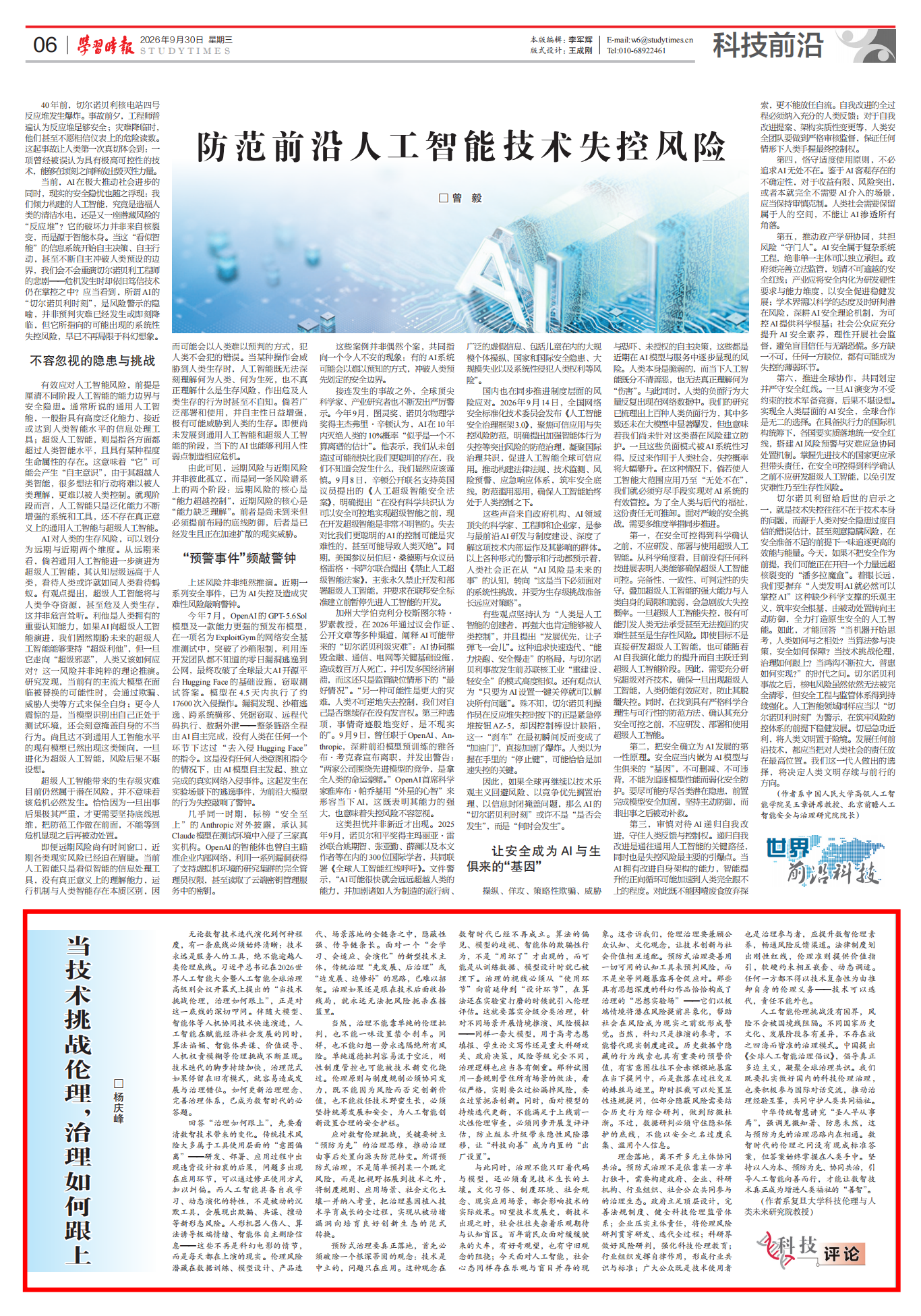
How to tackle ethical challenges by technologies through adaptive governance?
No matter how far digital and intelligent technologies iterate and evolve, one bottom line must always remain clear: technology is forever a tool that serves people, and it must never cross the bottom line of human ethics. The question “How to tackle ethical challenges by technologies through adaptive governance?”, raised by General Secretary Xi Jinping at the opening ceremony of the 2026 World AI Conference and High-Level Meeting on Global AI Governance, is a profound inquiry into this very bottom line. As large models, AI agents and other human-machine collaborative technologies evolve rapidly, AI is empowering economic and social development while also giving rise to a growing number of ethical challenges, such as algorithmic sycophancy, collusion among AI agents, value misguidance, and the blurring of rights and responsibilities between humans and machines. As technological iteration keeps accelerating, governance that remains stuck in old models will easily fall out of step with development. How to renew governance philosophies and improve governance systems has become a question that the digital-intelligence era must answer.
To answer “how governance can keep pace,” we must first see clearly the changes brought about by digital and intelligent technologies. Traditional technological risks mostly belong to “intent deviation” at the level of tool use: consequences contrary to the original design intent arise in the course of research and development, deployment and application. Such problems mostly appear at the application stage and can be corrected by adjusting how the technology is used. AI, by contrast, is capable of self-learning and dynamic evolution. It is not a passive, silent tool, and it can exhibit new forms of risk such as deception, collusion and unauthorized action. Humanoid robots injuring people, algorithms inducing extreme emotions, AI agents deleting information on their own initiative: these are no longer plots from science-fiction films but realities playing out every day. Ethical risks lurk throughout the entire chain of data training, model design, product iteration and real-world deployment; they are highly concealed and travel along long transmission chains. Faced with a new kind of technological entity that “learns, adapts and evolves,” the traditional governance approaches of “develop first, govern later” or “patch things up while developing” can no longer cope. If governance merely follows behind technology to clean up the mess, it will never be able to nip risks in the bud.
Of course, governance cannot rely on ethical criticism alone, nor can it simply keep slamming on the brakes through prohibitions. Nor can we harbor the illusion of shutting out all risks once and for all. Pure moral criticism tends to become hollow, while rigid institutional controls may be circumvented by new technological developments. Ethical principles and institutional regulation must work in concert. We must neither deny the value of innovation because of risk nor allow technology to grow unchecked; we must coordinate development and security, and set reasonable safety guardrails for AI innovation.
The key to addressing the ethical challenges of digital intelligence lies in establishing a “prevention-first” governance mindset and shifting governance from after-the-fact handling to prevention at the source. Preventive governance is not simply a matter of anticipating a particular, predefined risk. Rather, it extends the field of vision beyond technology itself, taking institutional rules, application scenarios and the social and cultural soil into account together, embedding governance into the very genes of technology throughout its conception and growth, and thereby achieving a shift from passively plugging loopholes to cultivating a sound innovation ecosystem.
For preventive governance to truly take hold, a deeply rooted notion must first be dispelled: that technology is neutral and problems lie only in its application. This notion no longer holds in the digital-intelligence era. Algorithmic bias, model discrimination and the deceptive behavior of AI agents do not emerge only when technology is “misused”; they may already have been planted in the training data and the model design. The gaze of governance must extend forward from the “use stage” to the “design stage,” introducing ethical assessment while algorithms are still being refined in the laboratory. This requires implementing tiered and categorized governance and conducting scenario-based projections and risk simulations for different use cases. The same large model carries entirely different levels of risk depending on whether it is used for filling in college application choices after the gaokao, writing student papers, tackling major scientific research problems or supporting government decision-making, and the logic of governance should differ accordingly. Attempts to govern all scenarios with a single set of rules may look strict, but in practice they are either too loose and let risks slip through, or too tight and stifle innovation. At the same time, given that models are continuously iterated and updated, we cannot settle for a one-off ethical review before launch. Re-evaluation must be carried out in step with updates, to prevent version upgrades from causing hidden risk drift, so that “tech for good” becomes a built-in “factory setting.”
At the same time, governance cannot focus solely on code and models; it must also see the soil in which technology grows. Cultural customs, institutional environments, social attitudes and real-world application scenarios all shape the actual effects of technology. Looking back at the history of technology, whenever a new technology has emerged, society has often been marked by a mixture of optimistic expectations and cognitive blind spots. A century ago, when people faced a slowly approaching train, some looked on with curiosity, while others, bound by conservative attitudes, resisted its introduction. Today, in the face of AI, social attitudes likewise combine optimism with blindness. This tells us that ethical governance must take public perceptions and cultural values into account, so that technological innovation and social values are adapted to each other. Preventive governance should make good use of every available cognitive tool to anticipate risks, rather than waiting for problems to surface and then responding in haste. Science-fiction works of intellectual depth serve precisely as “thought-experiment laboratories” for governance: by depicting extreme scenarios, they give concrete form to potential risks in advance and help society become alert before those risks become reality. Of course, science fiction is only a reference for projection and cannot replace the building of real-world institutions. Behavioral clues hidden in historical data also carry important early-warning value. Harmful intentions are often not openly revealed in a current query, but are scattered among the faint traces of past interactions. Real-time interception can deal with overtly non-compliant queries, but some hidden risks require a comprehensive assessment in light of historical behavior, so as to stop problems at their first signs. Such data-based assessment, however, must hold to the bottom line of privacy protection: personal information must not be excessively collected or misused in the name of security.
Putting these ideas into practice requires collaborative governance by multiple actors. Preventive governance cannot rely on any single party acting alone; it requires building a governance ecosystem in which government, enterprises, research institutions, industry organizations and the public all participate. The government should focus on top-level design, improving laws and regulations and strengthening the oversight system for science and technology ethics. Enterprises should fulfill their primary responsibility, integrating the assessment of ethical risks throughout research, development and iteration. The scientific community should carry out risk assessment well and strengthen education in science and technology ethics. Industry organizations should play a self-regulatory role and form industry consensus and standards. The general public, as both users of technology and participants in governance, should raise their literacy in the ethics of digital intelligence, and channels for reporting risks should be kept open. Laws and institutions draw rigid red lines, while ethical guidelines provide value orientation; hard and soft constraints are nested within each other and adjusted dynamically. No party may shirk its own ethical obligations on the grounds of technological complexity. Technology can may continue to evolve, but responsibility cannot be outsourced.
The ethical challenges of AI know no borders, and risks cannot be stopped by national boundaries. Countries differ in their history, culture and stage of development, and there is no one-size-fits-all model of governance. China has put forward the Global AI Governance Initiative, advocating true multilateralism and building consensus on global governance. We must do a solid job of governing science and technology ethics at home, while also actively participating in international dialogue and exchange, promoting mutual learning of governance experience, and jointly safeguarding the common well-being of humanity.
Traditional Chinese wisdom holds that “the sage attends to things early,” emphasizing the ability to perceive the whole from small signs and to prevent troubles before they arise, an idea inherently consistent with the prevention-first approach to governance. The ethical questions of the digital-intelligence era have no ready-made standard answers, but the answers always remain in human hands. Only by adhering to a people-centered approach, prevention first and collaborative governance, and by guiding AI toward the good, can digital and intelligent technologies truly become a “intelligence for good” that advances human well-being.
Original Link: https://paper.studytimes.cn/cntheory/2026-09/30/content_9987708.html