

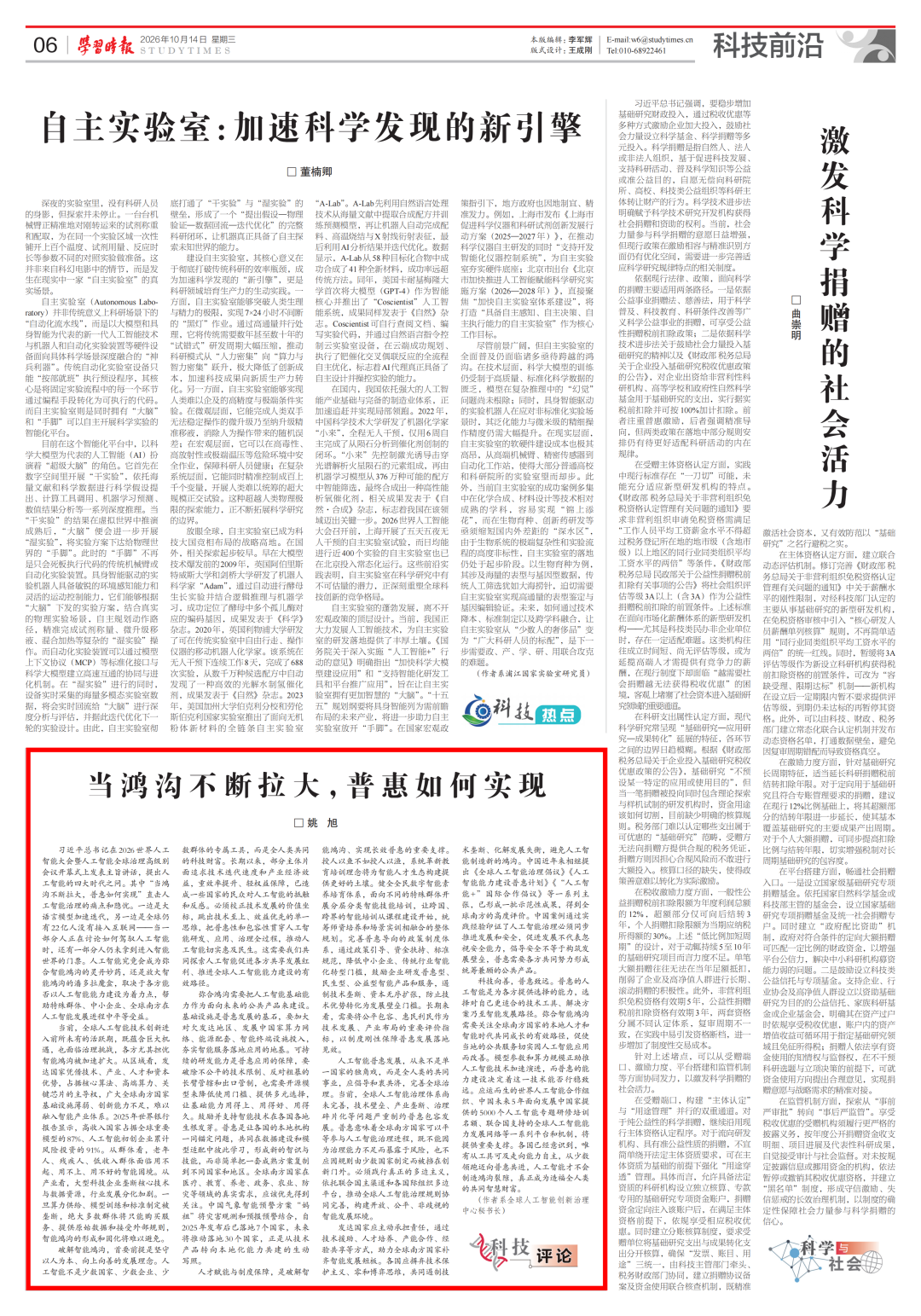
On 14 October 2026, Study Times, organized by the Central Party School, published an article authored by Yao Xu, Secretary-General of the Center for Global AI Innovative Governance, Associate Professor at the Fudan Development Institute. Yao argues that the key to bridging the intelligence divide lies in strengthening artificial intelligence capacity-building. To advance the inclusive development of AI, it is necessary not only to upgrade infrastructure and facilitate the sharing of technological resources to lower the barriers to AI adoption, but also to improve talent cultivation, skills training and institutional safeguards. Such measures will help states and social groups with diverse backgrounds better participate in AI development and share the dividends brought by technological progress, thereby enabling artificial intelligence to genuinely become a collective intellectual asset benefiting all humanity.
In his keynote speech at the opening ceremony of the 2026 World Artificial Intelligence Conference and High-Level Meeting on Global AI Governance, General Secretary Xi Jinping raised four questions of our times concerning artificial intelligence. One of them, “As the divide keeps widening, how can inclusive benefit be achieved?”, goes straight to a sore point and a lingering concern in AI governance. On one side, large language models are iterating at an accelerating pace; on the other, 2.2 billion people worldwide still have no access to the internet. While some people are discussing how to harness AI, others have yet to obtain a ticket into the intelligent world. Whether AI becomes a panacea for bridging the intelligence divide or a Pandora’s box that widens it depends on whether all parties can make AI capacity building their point of focus and help special groups, small and medium-sized enterprises and the Global South benefit equally from the development of AI.
Global AI innovation has entered an unprecedentedly active period, one that holds enormous opportunities but also poses governance challenges, and there is particular concern that the intelligence divide is widening at an accelerating rate. Regionally, developed countries, drawing on their advantages in technology, industry, talent and capital, dominate core algorithms, high-end computing power and key chips, while the vast majority of Global South countries, with weak infrastructure and insufficient innovation capacity, find it difficult to integrate into the intelligent industrial system. A 2025 World Bank report shows that high-income countries account for 87 percent of the world’s notable AI models and 91 percent of cumulative venture capital invested in AI start-ups. In terms of social groups, older people, persons with disabilities and low-income groups face an intelligence predicament: they cannot afford AI, cannot gain access to it, or cannot use it well. In terms of industry, large technology companies monopolize core technologies and data resources, deepening the divergence in industrial development. Once the supply of computing power, model training and standard-setting are monopolized, the vast majority of groups will be left only to purchase services, supply raw data and accept externally imposed rules, and the formation and entrenchment of the intelligence divide will be difficult to avoid.
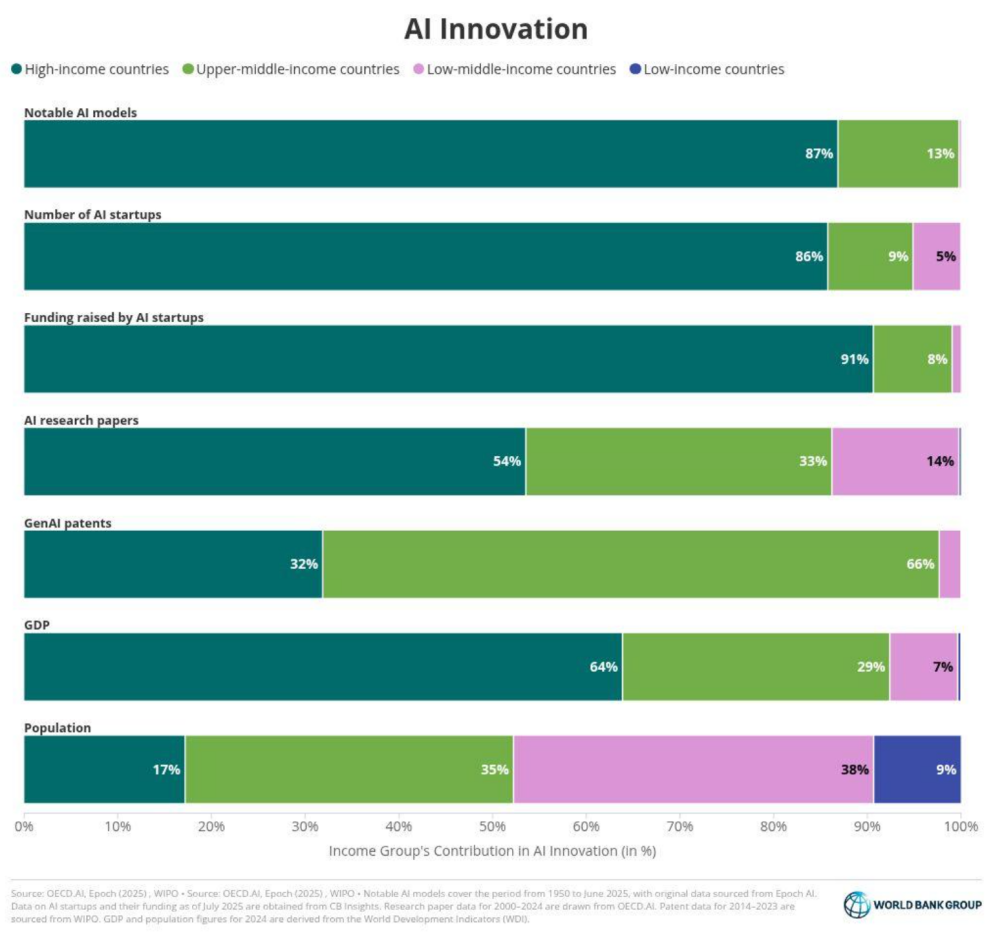
Artificial intelligence innovation resources are highly unevenly distributed across countries at different income levels.
Source: World Bank, Digital Progress and Trends Report 2025
The first precondition for bridging the intelligence divide is to adhere to a people-centered vision of development oriented toward progress and the common good. AI is not the exclusive tool of a few countries, a few companies or a few groups; it is the shared technological wealth of all humanity. For a long time, some actors have pursued the speed of technological iteration and industrial and economic returns in a one-sided way, emphasizing efficiency gains while neglecting the protection of rights and interests, which has already provoked resistance to and resentment of AI among the public in some countries. The value coordinates of technological development must be recalibrated. We must move beyond the narrow thinking of technology supremacy and efficiency first, integrate inclusiveness throughout the research and development, application and governance of AI, and ensure that AI genuinely benefits people’s livelihoods. This requires us to jointly explore effective ways for AI to help all parties share the dividends of development and to advance AI capacity building worldwide.
Bridging the divide requires building foundational AI capabilities as forward-looking public goods. Infrastructure is the cornerstone of inclusive development. Investment should be increased in computing networks, supporting energy facilities and smart terminal facilities in less developed regions and developing countries, laying a solid foundation for the delivery of intelligent services. Sustainable research and development capacity is the guarantee of inclusive application. Unfair technological restrictions must be removed, and heavy-handed long-arm jurisdiction and export controls opposed; open-source models are also needed to lower the threshold for use and provide diverse options, so that foundational capabilities are accessible, usable and durable. Intelligent technologies should be encouraged and supported to take root and grow in every country and region. Inclusive benefit means that local institutions in each country identify problems together, learn from one another in data development and model adaptation, and form new knowledge and skills, rather than simply copying a mature solution into different countries and regions. The real needs of Global South countries in fields such as healthcare, education, elderly care, government services, agriculture and disaster prevention should receive priority attention. China’s intelligent meteorological early-warning solution “Mazu” combines disaster observation with forecasting and early warning. Since its release in 2025, it has been deployed in seven countries and will be extended to 30 countries in the future, a vivid illustration of the shift from technology products to the joint building of localized capacity.
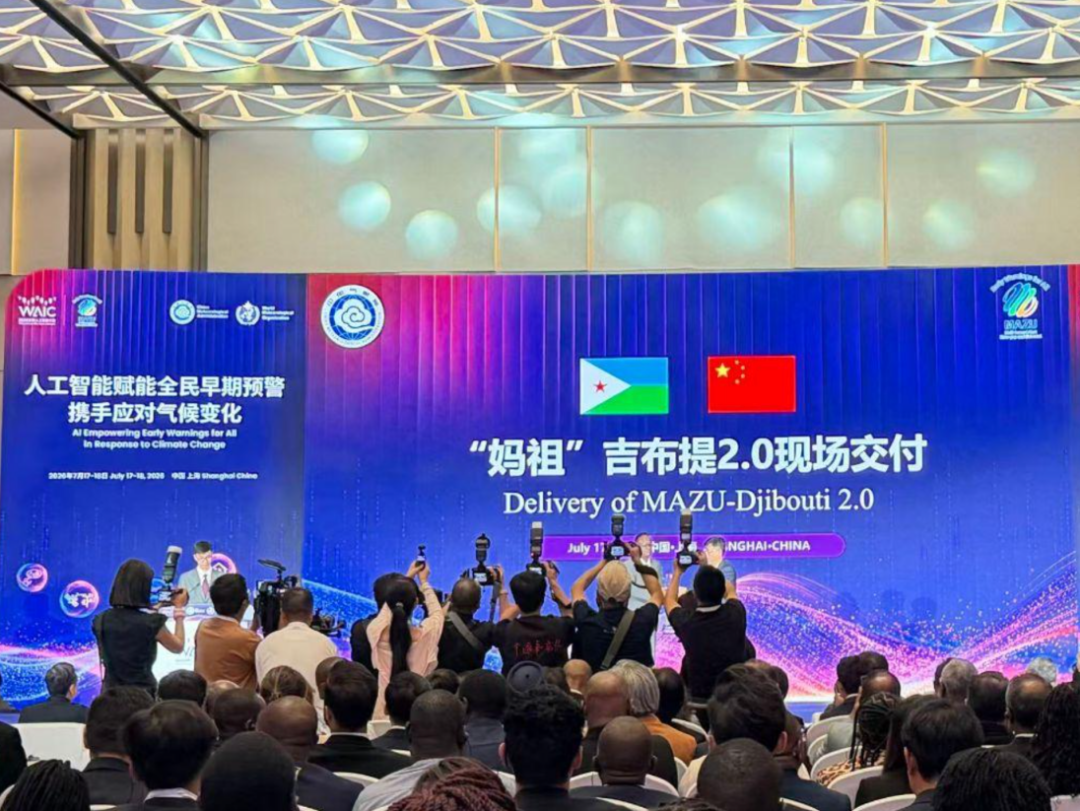
In July 2026, the MAZU–Djibouti 2.0 system was officially delivered in Shanghai.
Source: Xinhua News Agency
Talent empowerment and institutional safeguards are important supports for bridging the intelligence divide and achieving lasting inclusive benefit. Teaching people to fish is better than giving them fish, and a systematic renewal of the philosophy of education and training will provide better soil for building an ecosystem of AI talent. A system for cultivating digital and AI literacy among all citizens should be improved, with tiered and categorized AI skills training for different special groups. Cross-border and cross-sector AI training should begin with curriculum development, under an overall plan that integrates teacher training with hands-on training in real scenarios. A policy and institutional system oriented toward inclusiveness should be improved, using policy guidance, financial support and standards to lower the threshold for small and medium-sized enterprises and traditional industries to undergo intelligent transformation. Enterprises should be encouraged to develop inclusive, livelihood-oriented and public-interest AI products and services, while technological monopolies and the disorderly expansion of capital are curbed, so that technological advantages are not turned into barriers to development. In the long run, fairness, inclusiveness and benefit to the people should become important evaluation indicators for technological development and industrial layout, so that binding institutions ensure inclusive development delivers real results.
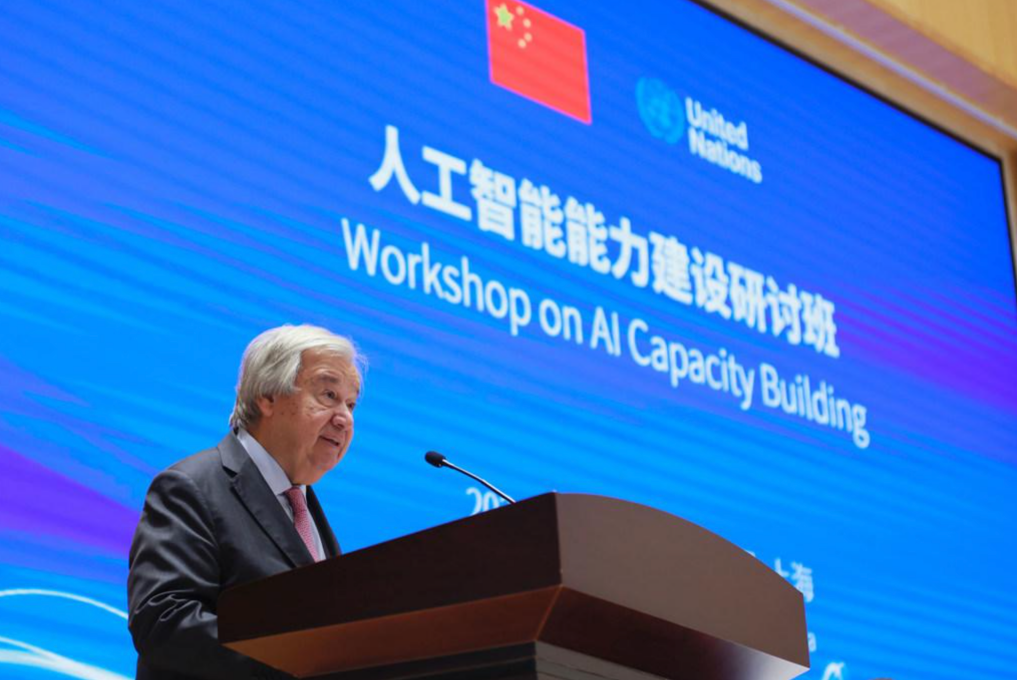
The China-United Nations Seminar on Artificial Intelligence Capacity-Building was held in Shanghai.
Source: United Nations
The inclusive development of AI has never been a one-country show; it is a common cause of all humanity. We should advocate working together in solidarity and improve global governance. At present, the global AI governance system remains incomplete, and problems such as technological barriers, industrial monopolies and fragmented governance seriously constrain inclusive development. Inclusive benefit means that Global South countries can participate equally in AI governance processes: they should neither be exposed to risks because of insufficient governance capacity nor be shut out of innovation because rules are made by a few countries. We must practice true multilateralism, relying on the United Nations as the main channel and on the multilateral platforms of international organizations, to promote the coordinated improvement of global AI governance rules and build an open, fair and non-discriminatory environment for AI development.
Developed countries should take the initiative to assume their responsibilities, helping Global South countries close the gaps in their AI development through technical assistance, talent training, industrial capacity cooperation and the sharing of experience. All countries should abandon technological protectionism and zero-sum thinking, work together to curb technological monopolies and resolve imbalances in development, and prevent AI from creating new divides. In recent years, China has put forward a series of proposals, including the Global AI Governance Initiative, the AI Capacity-Building Action Plan for Good and for All, and the “AI Plus” International Cooperation Initiative. These have produced a number of demonstration results and have been highly appraised by the Global South. China’s experience in practice confirms that AI governance must advance development and security in tandem: promoting development does not mean neglecting security capabilities, and advocating security does not mean erecting barriers to development. Inclusive benefit requires the joint efforts of all parties to form public goods that give due consideration to both.
Technology for good, inclusiveness for the long run. Inclusive AI gives all parties the capacity to choose: to choose the technological tools, solutions and even paths of AI development that suit them best. Bridging the intelligence divide requires attention to local talent in Global South countries and to effective ways for them to grow together with the intelligent era, so that local public services are genuinely improved through the application of AI. Model parameters and the scale of computing power are accelerating the evolution of AI technology, while inclusive capacity building will determine whether this technology can advance steadily and go far. A series of platforms and mechanisms will provide important support, including the newly established World AI Cooperation Organization, the 5,000 places in AI-themed seminars and training programs that China will offer to developing countries over the next five years, and the UN-supported Global AI Capacity Development Network. Countries have come to recognize that only by moving from access to tools toward autonomy in capabilities, and from a few frontrunners toward inclusive common progress, can AI avoid creating new divides and become a shared wealth of wisdom that benefits all humanity.
Original Link: https://paper.studytimes.cn/cntheory/2026-10/14/content_9987859.html