

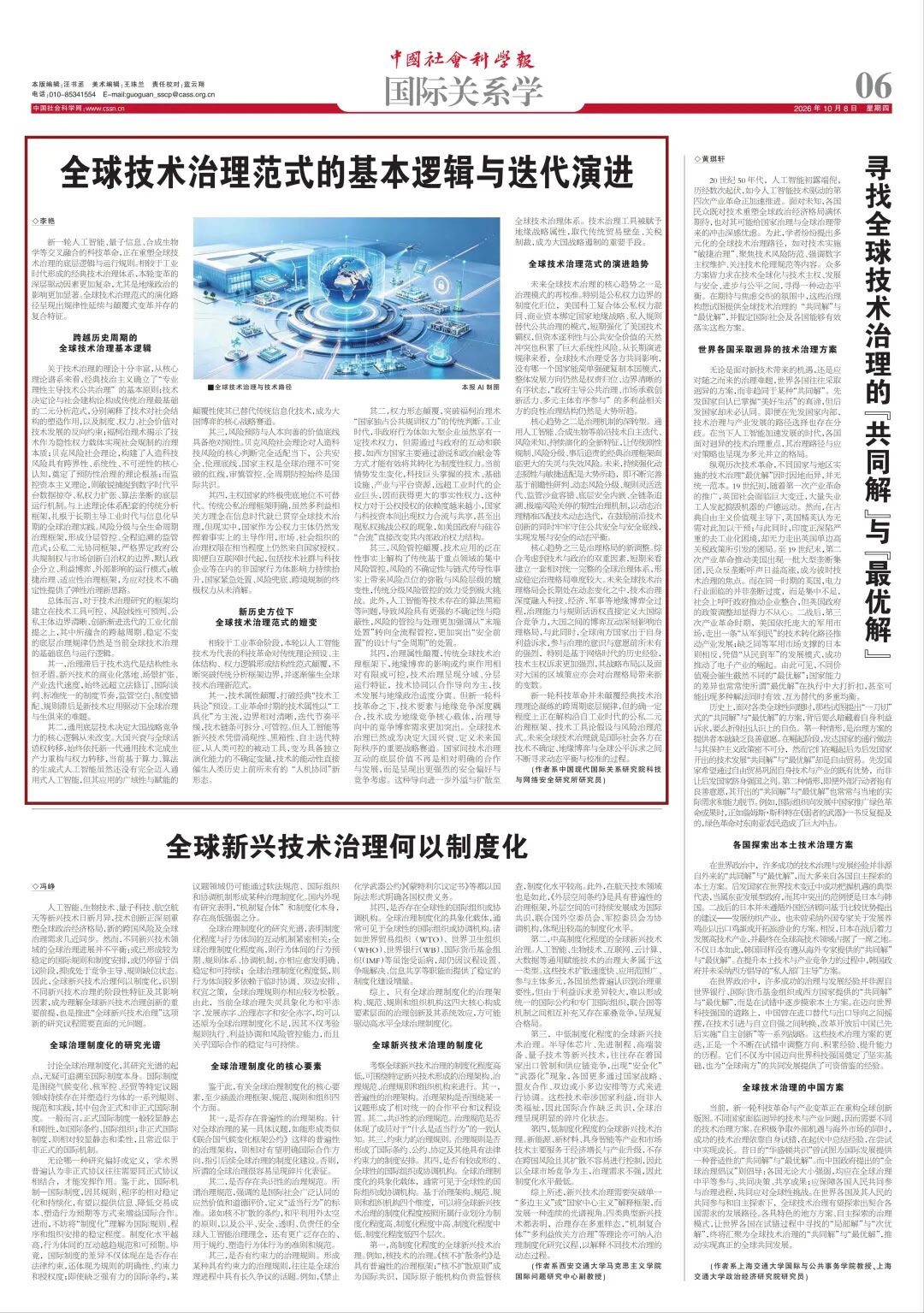
On October 8, 2026, Chinese Social Sciences Today published an article by Li Yan, Distinguished Research Fellow at the Center for Global AI Innovative Governance (CGAIG) and Director of the Institute of Science, Technology and Cybersecurity at the China Institutes of Contemporary International Relations (CICIR). The article argues that a new wave of technological revolution is reshaping the underlying logic and operational rules of global technology governance, posing challenges that no single country can address independently. The international community must strengthen dialogue and cooperation, seek consensus on core principles, and recognize the enduring dynamics of technology governance across historical cycles, including regulatory lag, strategic competition over foundational general-purpose technologies, risk prevention and human-centered development, and the indispensable role of sovereign states as ultimate guarantors. At the same time, it is essential to acknowledge the profound transformations in the nature of technology, the distribution of power, risk management, and governance itself. By accommodating countries at different stages of development and their diverse practical needs, the international community should work toward a more open, inclusive, and coordinated global technology governance system—one that combines government leadership, market-driven innovation, and multi-stakeholder participation with dynamic resilience and agile adaptation.
Overview
The persistent lag of governance behind technological innovation represents a structural and enduring contradiction, while foundational general-purpose technologies remain central to strategic competition among major powers. Drawing on major theoretical traditions, this article examines four fundamental disruptions that the current technological revolution poses to conventional governance frameworks and identifies three emerging trends: the recalibration of governance models, the profound transformation of governance mechanisms, and the reconfiguration of the global governance landscape. Understanding global technology governance is
The new technological revolution, characterized by the convergence of artificial intelligence, quantum information technologies, synthetic biology, and other emerging fields, is reshaping the underlying logic and operational rules of global technology governance. Compared with the classical system of technology governance developed during the industrial era, the driving forces behind the current transformation are more complex, with geopolitical considerations playing an increasingly prominent role. The evolution of global technology governance paradigms thus exhibits a combination of continuity in enduring principles and disruptive structural change.
I. The Enduring Logic of Global Technology Governance Across Historical Cycles
The theoretical foundations of technology governance are extensive and diverse. From the perspective of major theoretical traditions, classical technocracy established the fundamental principle that technical expertise and professional rationality should guide the public governance of technology. Technological determinism and social constructivism constitute the two foundational analytical paradigms of conventional governance, explaining, respectively, how technology shapes social structures and how institutions, power relations, and social values, in turn, constrain technological development. Foucault’s concept of governmentality reveals how technology functions as a vehicle of implicit power through which social regulation and discipline are exercised. Ulrich Beck's risk society theory established the understanding that human-made technological risks are transboundary, systemic, and potentially irreversible, thereby laying the theoretical foundation for precautionary governance. The theory of surveillance capitalism, meanwhile, identifies the underlying mechanisms of data extraction by digital platforms, the expansion of private power, and algorithmic monopolization in the digital age. Traditional analytical frameworks associated with these theoretical approaches are rooted in the governance practices that dominated the industrial era and the early information age. Risk-based classification and lifecycle governance frameworks established regulatory models centered on differentiated oversight and end-to-end traceability. Public–private governance frameworks delineated the boundaries between governmental regulatory authority and market autonomy in innovation, generally assuming a separation between public and private actors, competition among their interests, and external forms of influence. Agile and adaptive governance frameworks subsequently introduced more flexible approaches to addressing technological uncertainty.
Overall, these approaches to technology governance were developed on industrial-era assumptions: that technological tools are controllable, risks are relatively linear and predictable, the boundaries between public and private actors are clearly defined, and innovation proceeds through gradual iteration. Nevertheless, the enduring principles embedded in these frameworks continue to provide the foundational logic of contemporary global technology governance.
First, the lag of governance behind technological innovation is an enduring structural contradiction. The commercialization, expansion of applications, and industrial iteration of emerging technologies have consistently outpaced institutional processes such as legislative revision, international negotiations, and standards harmonization. Regulatory gaps, institutional mismatches, and outdated rules are therefore inherent challenges of global governance in an era of rapid technological advancement.
Second, foundational general-purpose technologies have consistently determined the strategic competitiveness of major powers. The rise and decline of great powers, along with shifts in global influence and agenda-setting authority, have historically depended on successive generations of general-purpose technologies that transform productive forces and redistribute power. Although contemporary generative AI, powered by computing resources and algorithms, has not yet fully evolved into artificial general intelligence (AGI), its broad applicability and transformative potential have already enabled it to supersede traditional information technologies as a central arena of strategic competition among major powers.
Third, risk prevention and human-centered, socially beneficial technological development remain non-negotiable normative principles. The core insights of Beck's risk society theory concerning human-made technological risks remain highly relevant today. Public safety, ethical principles, and national sovereignty constitute fundamental boundaries that global governance must not cross. Prudent regulation and lifecycle risk management therefore remain essential elements of international consensus.
Fourth, the ultimate responsibility of sovereign states remains irreplaceable. Traditional public–private governance frameworks recognize that, although the multi-stakeholder approach has been a prominent feature of global technology governance since the information age, states have continued to exercise de facto leadership as holders of public authority. The governance powers exercised by market actors and civil society organizations still derive, to a considerable extent, from state authorization. Even as non-state actors, including technical communities and technology companies, have gained increasing influence since the emergence of the internet, states have never relinquished their ultimate authority over emergency responses, risk management, and cross-border regulation.
II. The Transformation of Global Technology Governance Paradigms in a New Historical Juncture
Compared with the Industrial Revolution, the current wave of technological transformation, led by artificial intelligence, is bringing about structural disruptions to conventional theoretical assumptions, actor configurations, and the logic of power. These developments are increasingly pushing beyond the boundaries of traditional analytical frameworks and gradually giving rise to new paradigms of global technology governance.
First, the transformation in the nature of technology challenges the classical assumption of technology as a passive instrument. During the Industrial Revolution, technology was predominantly understood as a tool, with relatively clear boundaries, gradual cycles of innovation, and technological systems that could be divided into manageable and controllable components. Emerging technologies such as artificial intelligence, however, exhibit characteristics of emergent behavior, opacity, and autonomous iteration. Rather than remaining passive instruments under human control, they are becoming uncertain variables capable of evolving independently. This growing technological agency is giving rise to unprecedented forms of human–machine collaboration.
Second, the transformation of power relations challenges the traditional understanding of public disciplinary power as the exclusive domain of the state. During the industrial era, non-governmental actors such as large corporations possessed certain forms of technological power, but generally needed to interact with and establish connections to governments to translate that power into institutional influence. In Western countries, this typically occurred through mechanisms such as lobbying and political contributions. The contemporary situation is fundamentally different. Technology giants now control technological capabilities, infrastructure, industrial resources, and platforms on a scale far exceeding that of major corporations during the industrial era. As a result, they have acquired substantially greater de facto power, increasingly independent of formal authorization by public authorities. Power is becoming more closely intertwined and shared between states and technology capital, and private power can even challenge public authority. The convergence of the US government and Silicon Valley, for example, has directly influenced the configuration of domestic political power in the United States.
Third, the transformation of risk management is undermining traditional models of centralized, sector-specific risk control. The pervasive application of emerging technologies has effectively disrupted conventional approaches that concentrate risk management within designated high-priority sectors. The uncertainty and cascading transmission of technological risks have led to their diffusion across multiple domains and shifting levels of severity, substantially challenging the effectiveness of traditional risk-based classification systems. Moreover, the opacity of AI algorithms and other emerging technologies has made risks more uncertain and difficult to detect. Consequently, technological risk governance increasingly requires a transition from reactive, end-stage responses toward comprehensive process-based oversight, with greater emphasis on safety by design and lifecycle risk management.
Fourth, the transformation of governance itself is fundamentally altering the relationship between technology and geopolitics. Under conventional global technology governance frameworks, the influence and constraints of geopolitical competition were relatively limited or manageable. Technology governance generally operated through differentiated sectors and levels, while technological coordination was primarily cooperation-oriented. Technological development and geopolitical competition remained relatively separate. Under the new technological revolution, however, technological capabilities and geopolitical competition have become deeply intertwined, with technology emerging as a central instrument of strategic rivalry. Competitive considerations have consequently become increasingly prominent in governance priorities. Global technology governance has become a critical strategic arena shaping the rise and decline of major powers and defining the future international order. Interactions among states in technology governance are no longer primarily driven by relatively clear objectives of cooperation and development. Instead, they increasingly reflect security preferences and strategic competition. This shift is further spreading throughout the global technology governance system. Governance instruments themselves are acquiring geostrategic significance, increasingly replacing traditional trade barriers and tariff sanctions as important means of strategic containment among major powers.
III. Emerging Trends in Global Technology Governance
The first major trend is the recalibration of governance models. A particularly important dimension is the institutional restoration of clearer boundaries between public and private power. In the United States, the blurring of public and private authority within the science-technology-industrial complex, the alignment of commercial capital with national geopolitical strategies, and the substitution of private rules for public governance have strengthened US technological dominance in the short term. Yet the inherent tension between the profit-seeking nature of capital and the public interest in safety and security has also generated substantial systemic risks. From a long-term perspective, global technology governance is shaped by the interaction of multiple actors, and no single country can simply impose or replicate its domestic model through unilateral coercion. The broader direction of governance development will continue to favor a more orderly system characterized by clearly defined responsibilities and institutional boundaries. A sound multi-stakeholder governance structure—one in which governments lead public governance, markets drive innovation, and diverse stakeholders participate in an orderly manner—remains the prevailing long-term trend.
The second major trend is the profound transformation of governance mechanisms. Frontier technologies such as artificial general intelligence and synthetic biology possess new characteristics, including autonomous iteration, unknown risks, and continuous evolution. These developments increase the likelihood that conventional governance frameworks based on rigid regulation, static risk classification, and ex post accountability will become ineffective. Future governance will therefore increasingly emphasize dynamic resilience and agile adaptation. This requires the continuous development of resilient governance mechanisms built upon forward-looking assessments, dynamic risk classification, flexible regulatory updates, regulatory sandboxes that allow controlled experimentation, safety embedded in foundational system design, end-to-end traceability, and shutdown mechanisms for extreme risks. Such an approach seeks to align governance dynamically with technological evolution, while simultaneously encouraging frontier innovation and upholding essential public safety and security standards. Its ultimate objective is to achieve a dynamic balance between technological development and security.
The third major trend is the reconfiguration of the global governance landscape. Taking both technological and political factors into account, the establishment of a relatively unified and comprehensive global governance system, together with a stable governance order, will remain difficult in the short term. The global technology governance landscape is likely to remain in a state of continuous adjustment. Technology governance will become deeply integrated into geopolitical competition across technological, economic, military, and other domains. Governance capacity and influence over international rules will increasingly define the overall competitiveness of major powers, while strategic interactions among these powers will profoundly shape the global governance landscape. At the same time, countries of the Global South are demonstrating an unprecedented willingness to participate in global governance in pursuit of their own interests. Drawing particularly on their historical experiences during the internet era, these countries are placing greater emphasis on technological sovereignty. Their strategic choices, regional coordination, and responses to major-power competition will introduce new variables into the evolving global governance landscape. The new technological revolution has not overturned the enduring principles identified by classical theories of technology governance. Nevertheless, it is, to some extent, dismantling the traditional public–private governance framework, the instrumental conception of technology, and the risk governance paradigms inherited from the industrial era. The future of global technology governance will therefore be characterized by an ongoing process of dynamic balancing and recalibration among technological uncertainty, geopolitical competition, and global demands for fairness and equity.
Original article: https://mp.weixin.qq.com/s/y124dJXbt-4dvC2hKDvFkg?scene=1