

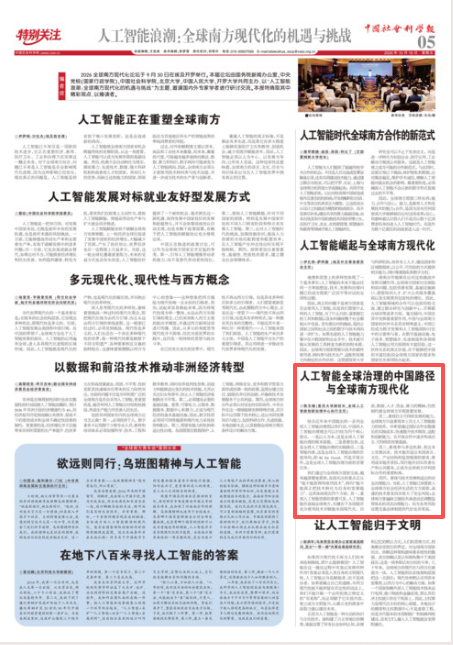
On October 16, 2026, Chinese Social Sciences Today published an article by Professor Chen Zhimin, Executive Director of the Center for Global AI Innovative Governance and Vice President of Fudan University. The article systematically explains China’s AI governance philosophy from four aspects: putting people first, inclusiveness and shared benefits, AI for Good, and openness and cooperation. Drawing on exchanges with Global South countries, Professor Chen also noted that the focus of Global South countries on artificial intelligence is shifting from access to and use of technology to how to transform technology into their own development capacity.
In light of a series of global AI governance initiatives and actions proposed by China in recent years, China’s AI governance philosophy can be summarized in four core points. First, putting people first is the fundamental premise of global AI governance. Second, inclusiveness and shared benefits are the practical pathway for global AI governance. Third, AI for Good is the value orientation of global AI governance. Fourth, openness and cooperation are the current primary task of global AI governance.
Through exchanges with Global South countries, we have increasingly clearly seen that the focus of countries is shifting from “whether they can obtain and use technology” to “whether they can truly transform technology into their own development capacity.” This is reflected in four specific aspects. First, they attach importance to the inclusive accessibility of AI resources. Whether AI can benefit the Global South depends on whether countries can fully use technology and empower their own modernization. At present, the scarcity of data, talent, funding, and computing power still constrains inclusive development in the Global South.
Second, they attach importance to the capacity for autonomous and sustainable development. The Global South is increasingly emphasizing the cultivation of indigenous autonomous AI capabilities and hopes to overcome the lengthy and costly process of practice through international cooperation, rapidly enhance technology absorption, adaptation, and innovation capabilities, and gradually build an autonomous and sustainable development foundation through open cooperation.
Third, they attach importance to participation in multilateral mechanisms and to articulating local development demands. Whether technology can adapt to the requirements of a country’s language, culture, industrial structure, and regulatory framework, whether usage costs are affordable, and whether projects can effectively improve production and public services are becoming important criteria for the Global South in evaluating international cooperation.
Fourth, they attach importance to security governance capacity commensurate with technological development. At present, AI is deeply embedded in every aspect of socioeconomic life in the Global South, and the rapid diffusion of technology has simultaneously amplified security risks. The Global South generally lacks the flexible governance capacity to dynamically adjust regulatory systems as technology evolves, and the cost of establishing comprehensive legal systems for all types of risks is also very high.
Original link: https://www.cssn.cn/skgz/bwyc/202610/t20261016_6073572.shtml?sessionid=