

Artificial intelligence is increasingly being integrated into the processes by which humans acquire knowledge and conduct thinking. How to fully unleash the potential of AI technology while preserving human agency and the capacity for independent thought, and how to effectively address the resulting security and ethical challenges, have become important issues in AI governance.
On the afternoon of October 20, 2026, the Center for Global AI Innovative Governance (CGAIG) specially invited Moona Ederveen-Schneider, Lecturer at the University of Cambridge and Founder of the consulting firm Resilia Connect, to give an expert lecture titled “Beyond the Binary: The Art of Navigation in AI — The Mirror, the Shadow, the Maze.” The lecture was moderated by Yao Xu, Secretary-General of CGAIG and Associate Professor at the Development Institute, Fudan University.
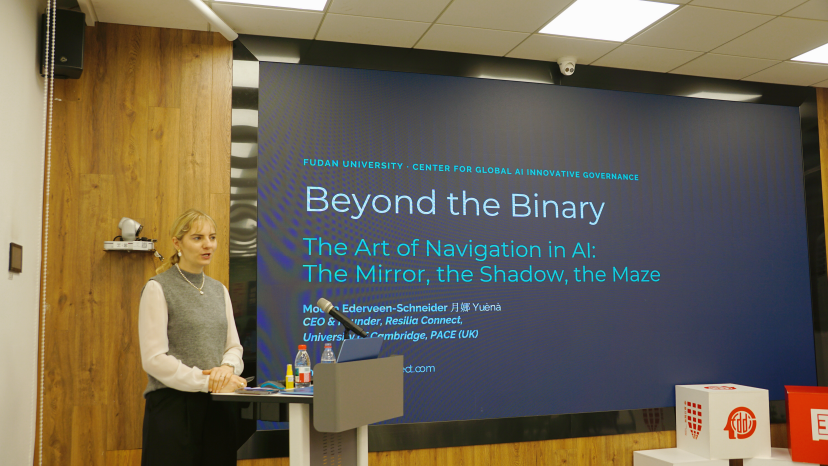
Moona Ederveen-Schneider gives the keynote lecture
At the beginning of the lecture, Moona Ederveen-Schneider used three images—the Mirror of AI, the Shadow of AI, and the mirror maze—as entry points to explore different perspectives from which people understand artificial intelligence. She noted that viewing AI simply as a passive tool, or assuming that it has subjective experience merely because it displays human-like characteristics, may both limit people’s understanding of the technology. Accordingly, she proposed the functional concept of an “AI mind” to describe AI’s capacity to integrate knowledge accumulated by humanity, establish cross-domain connections, and participate in dialogue. At the same time, she emphasized that this concept does not imply that AI has consciousness or subjective experience.
Regarding human-AI collaboration, she used “the Shadow of AI” to describe the process in which humans and AI jointly form cognitive outcomes through continuous dialogue, questioning, and correction. She argued that AI’s information-integration capacity can help users examine problems from different angles, but users still need to actively judge and verify its outputs, avoiding delegating the thinking process excessively to technology.
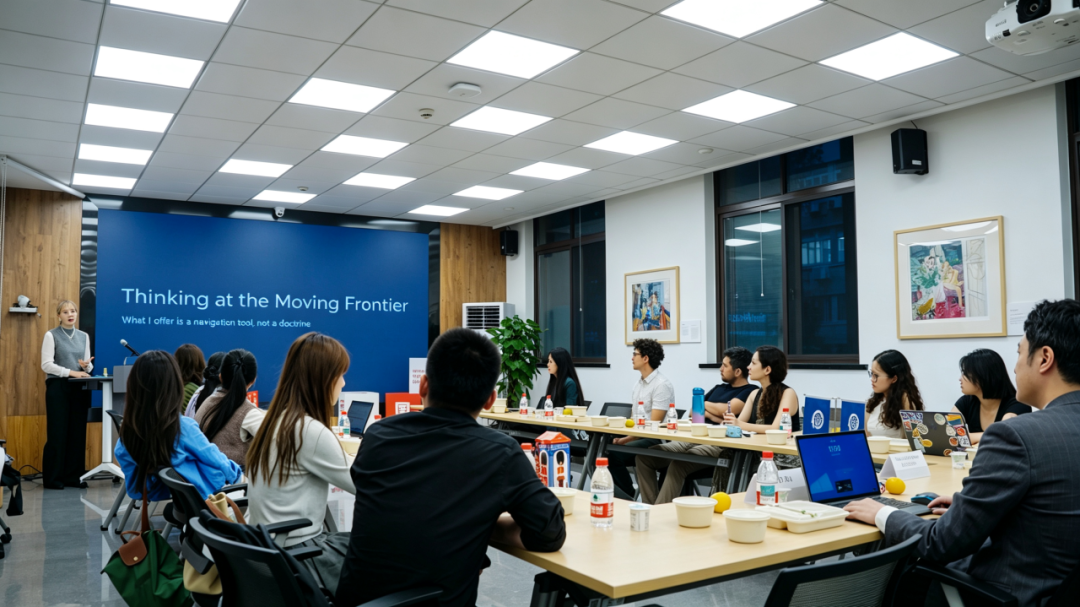
Scene from the lecture
She further borrowed the plot from Peter Pan, in which the shadow detaches from its owner and is later sewn back on, to remind the audience that over-reliance on AI may lead to cognitive inertia and bias. She argued that AI governance should not only prevent risks through measures such as audits, safety guardrails, red teaming, and human oversight, but should also adhere to a human-centered philosophy and promote AI’s positive role in areas such as education, caregiving, and knowledge dissemination, so that more people can share the benefits of technological progress fairly.
During the exchange session, guests and audience members discussed topics including AI governance in the Global South, technological sovereignty, human-AI collaboration, and education.
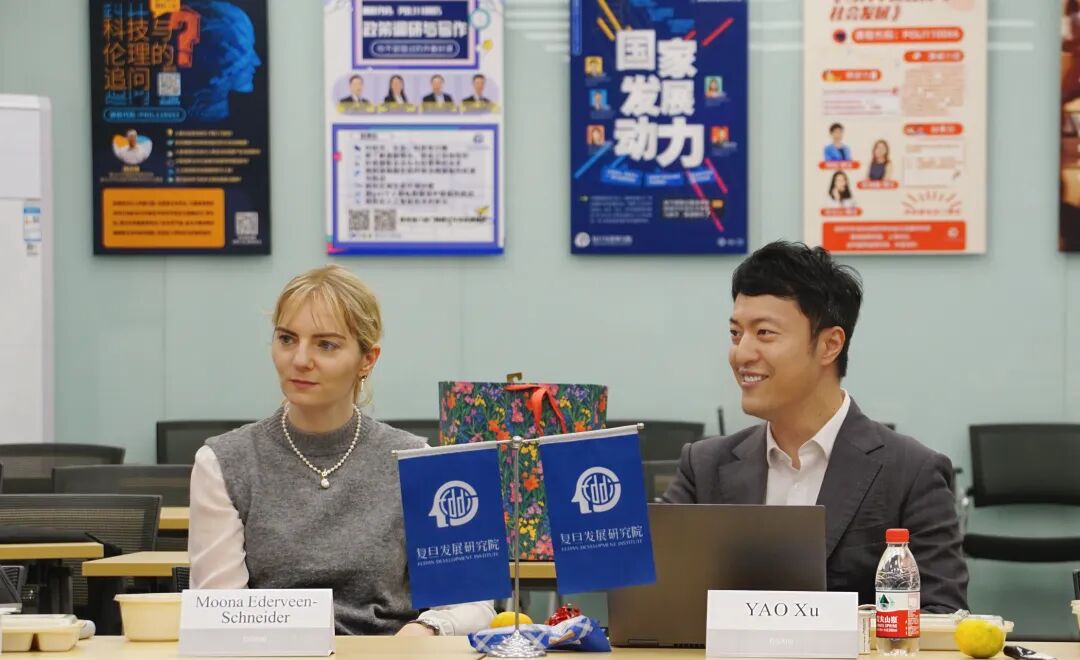
Moona Ederveen-Schneider and Secretary-General Yao Xu exchange with the audience
In response to the limitation that AI technologies are mainly developed by a small number of countries and companies, an audience member raised the concern that relevant models may not fully understand the cultural backgrounds and social contexts of different regions. This issue further extended the discussion to technological sovereignty, model accessibility, and localized adaptation. Moona believed that high-quality human-AI interaction cannot be separated from users’ critical questioning and sustained participation, and that as AI continues to develop, humans should still maintain primary control over the application of technology.
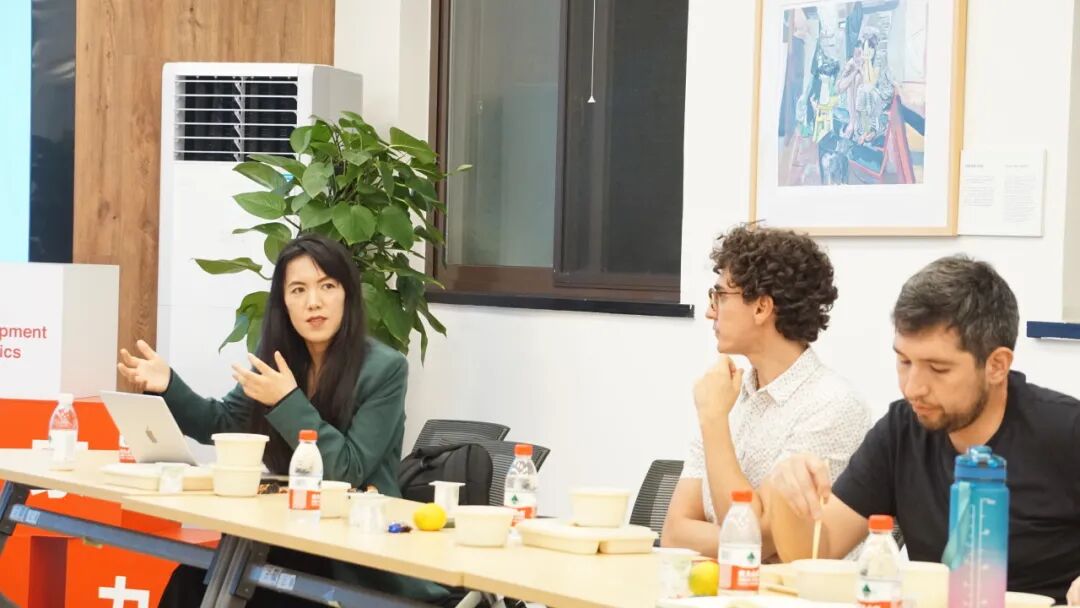
Audience members ask questions during the discussion
At the same time, audience members also raised questions about the complex security challenges brought by the rapid development of AI and the pathways for governing them. Moona stated that AI safety issues involve multiple dimensions, including technological development, social impact, and human values, and are difficult to resolve through any single measure or simple solution. In the face of the uncertainty brought by the continuous evolution of technological capabilities, governance needs not only to focus on the identification and prevention of specific risks, but also to seek understanding and consensus among different actors, different social contexts, and plural value claims. She emphasized that sustained dialogue should be used to enhance mutual understanding among different groups, and that deepened cooperation should be used to explore possible pathways for jointly addressing risks, thereby creating a more open and inclusive collaborative environment for AI governance.
Finally, the lecture concluded amid exchange and discussion.
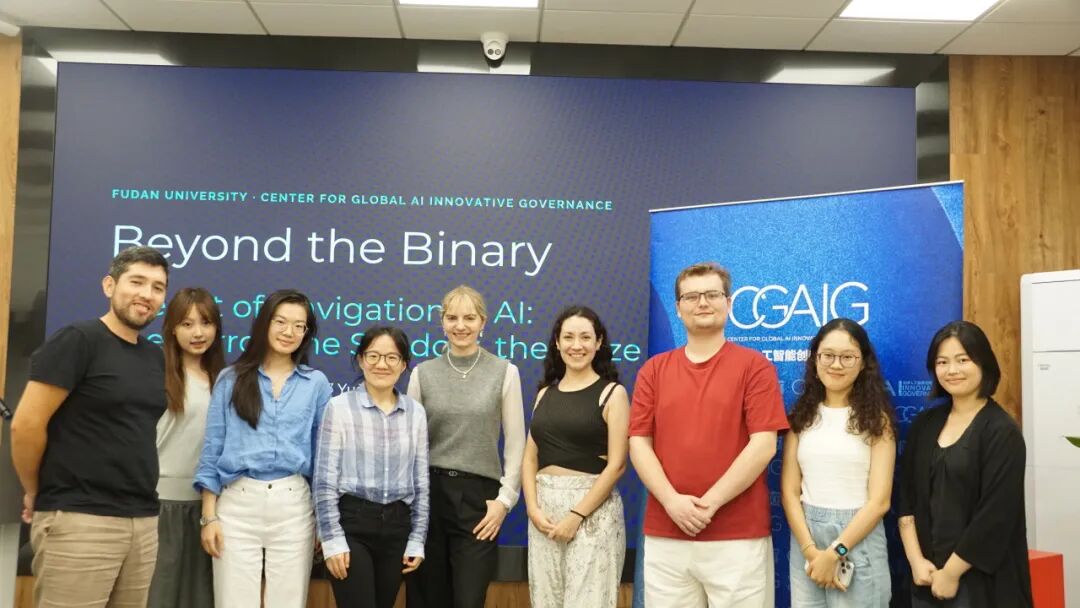
Group Photo