

This year marks the 80th anniversary of the United Nations. From September 22 to 30, 2025, the High-Level Week of the 78th Session of the UN General Assembly was held in New York, focusing on global concerns such as AI governance. The event attracted representatives from governments, international organizations, research institutions, and the business community, aiming to promote coordinated global development in the digital domain through multilateral dialogue.
From September 22 to 24, 2024, upon the invitation of the UN Office for Digital and Emerging Technology, a delegation from the Global AI Innovation and Governance Center visited the UN Headquarters in New York. The delegation was led by Professor Chen Zhimin, Executive Director of the Center and Vice President of Fudan University, and participated in a series of events on international AI standards and AI capacity building.
On September 22, the UN Office for Digital and Emerging Technology organized the UN Digital Cooperation Day, themed From Principles to Practice: One Year of the Global Digital Compact. During the event, professionals from governments, international organizations, the private sector, and research institutions worldwide engaged in panel discussions, roundtables, and launches addressing progress on the Global Digital Compact, covering topics such as the inclusive digital economy, AI governance, and digital public infrastructure. Professor Chen Zhimin, as the only invited Chinese speaker for the Digital Cooperation Day, participated in activities including exchanges on international AI standards.
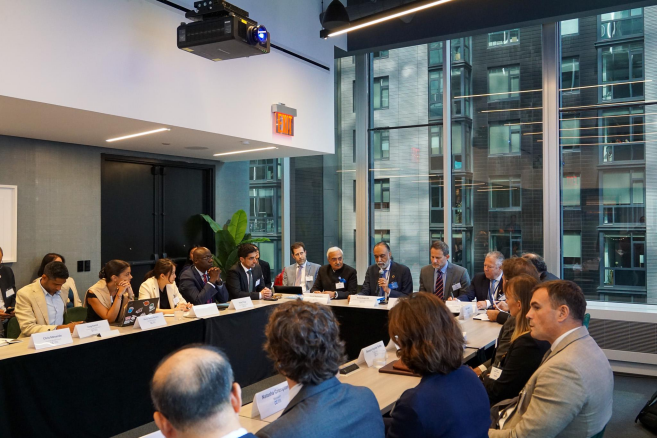
A closed-door discussion jointly organized on the same day by the Office for Digital and Emerging Technology, the International Telecommunication Union (ITU), the International Organization for Standardization (ISO), and the International Electrotechnical Commission (IEC) focused on Building Responsible AI through International Standards and Cooperation. The discussion emphasized creating trustworthy and interoperable AI through international standard-setting and capacity building, addressing priorities for AI standard collaboration, and sharing practical experiences from various countries.
Participants in this closed-door discussion included UN Under-Secretary-General and Envoy on Digital and Emerging Technology Amandeep Singh Gill; IEC Vice-President and Chair of the Standardization Management Board Vimal Mahendru; ISO Director for Standardization and Technical Policy Marco Rossi; and ITU Head of Strategy and Operations Frederic Werner. Dozens of AI experts from around the world also took part.
On September 23, the delegation attended the high-level meeting titled Empowering Nations for Inclusive Prosperity in the Era of Artificial Intelligence, co-hosted by the Kingdom of Saudi Arabia and the Republic of Kenya with support from the UN Office for Digital and Emerging Technology.
UN Under-Secretary-General and Envoy on Digital and Emerging Technology Amandeep Singh Gill and other senior UN officials delivered opening remarks. Attendees included representatives from government departments of China, Saudi Arabia, Kenya, Denmark, India, Kazakhstan, and others; international organizations such as the OECD; international bodies like the UNESCO International Centre for AI Research and Ethics (ICAIRE); and corporate representatives from companies including Oracle and Zindi.
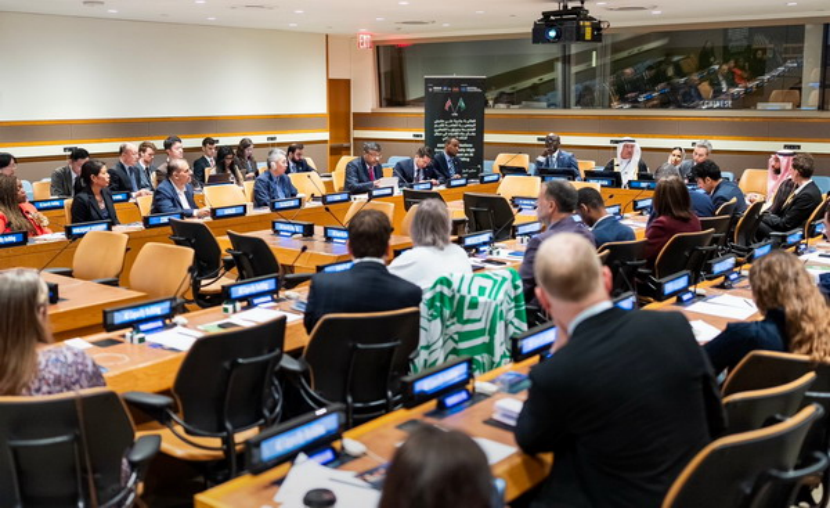
The meeting focused on specific issues regarding global AI capacity building, discussing topics such as advancing the AI Capacity Development Network within the UN framework and strengthening multilateral and South-South cooperation. Li Chijiang, Deputy Coordinator for AI Affairs at the Ministry of Foreign Affairs of China, delivered a speech introducing the concepts of the Global AI Governance Initiative. He stated that China actively advocates for and contributes to international cooperation on AI capacity building, assisting countries in accelerating digital transformation. China welcomes and supports UN efforts, such as establishing a capacity development network, and is willing to work with all parties to strengthen global AI governance and international cooperation, promoting fair and inclusive development.
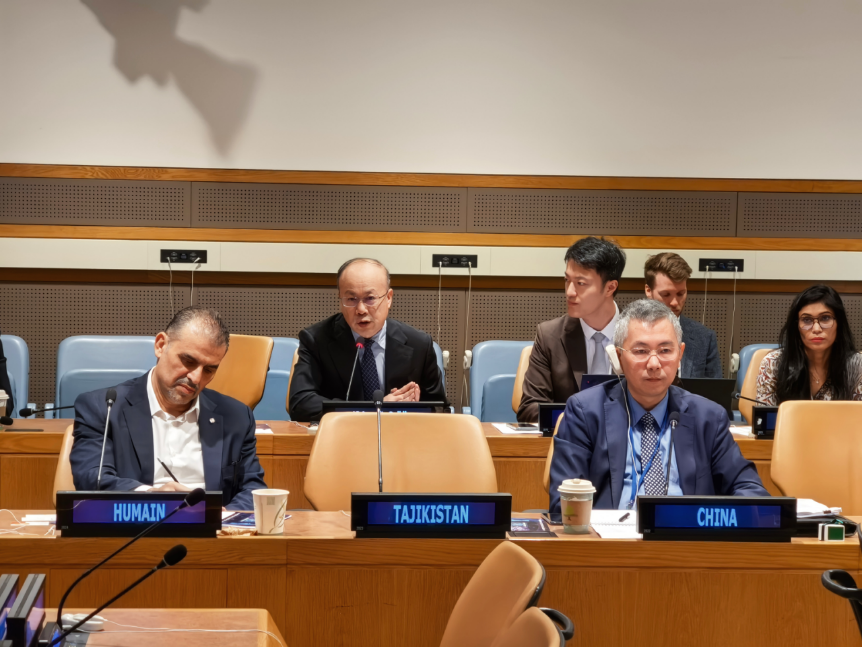
Professor Chen Zhimin, speaking on behalf of the Global AI Innovation and Governance Center, introduced the Center's working philosophy and expressed its vision for jointly building an inclusive and win-win AI governance framework. He emphasized the necessity of further advancing AI capacity building in the Global South and called on all parties to join hands in strengthening North-South cooperation and taking concrete actions to bridge the AI divide.On the same day, the Center's team participated in the Global Development Initiative (GDI) High-level Meeting held at the UN Headquarters in New York, themed Upholding the Founding Mission and Working Together for a Bright Future of Global Development. The meeting was a significant event convened on the occasion of the 80th anniversary of the UN and the 10th anniversary of the adoption of the 2030 Agenda for Sustainable Development. Attendees included UN Secretary-General António Guterres; Presidents Kassym-Jomart Tokayev of Kazakhstan, Abdul Latif Rashid of Iraq, and João Lourenço of Angola; Prime Ministers Gaston Browne of Antigua and Barbuda, Shehbaz Sharif of Pakistan, and Ali Lamine Zeine of Niger; ministerial-level officials from over 30 countries; and heads of international organizations. H.E. Li Qiang, Premier of the State Council of the People's Republic of China, attended and delivered a speech. During the meeting, Premier Li Qiang put forward the *AI+* International Cooperation Initiative. Focusing on five key areas—AI empowering people's wellbeing, scientific and technological progress, industrial application, cultural prosperity, and talent cultivation—the initiative calls on countries to actively promote *AI+* actions based on their national conditions and to strengthen policy exchanges and practical cooperation based on the principles of mutual respect and mutual benefit.
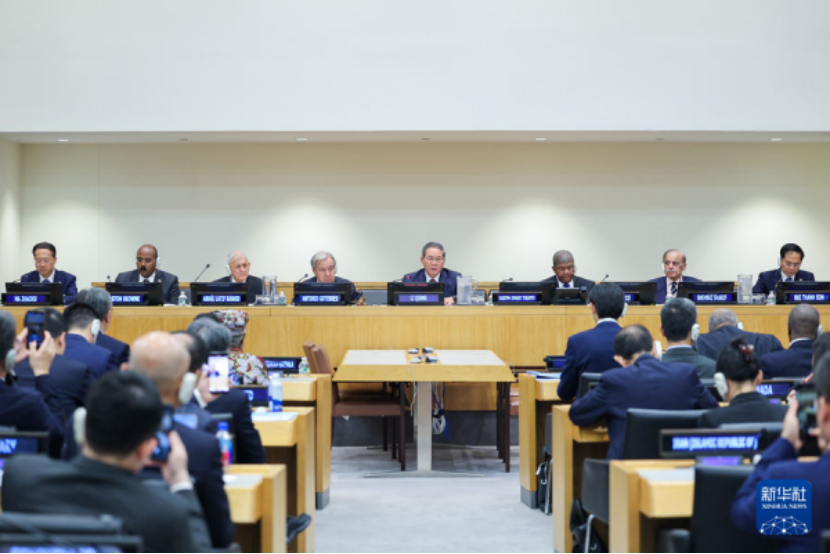
Image Source: Xinhua News Agency
On the morning of September 24, UN Under-Secretary-General and Envoy on Digital and Emerging Technology Amandeep Singh Gill held a discussion with the Center's delegation. They engaged in in-depth exchanges on specific practices for strengthening AI capacity building and reached a series of consensuses on future collaboration. During the aforementioned events, the delegation conducted extensive discussions with representatives from various governments, international organizations, and the industry on topics including global AI governance, capacity building cooperation, and academic and talent cultivation. The Global AI Innovation and Governance Center will continue to leverage its strengths as a think tank and platform, actively engage with relevant cooperation mechanisms under the UN framework, and work with all parties to advance global AI governance, standard-setting, and capacity building cooperation, contributing Chinese wisdom and solutions for inclusive prosperity.
On September 23, Professor Chen Zhimin, Vice President of Fudan University and Executive Director of the Global AI Innovation and Governance Center, was interviewed by Dragon Television at the United Nations Headquarters.