

Recently, the Center for Global AI Innovation and Governance released a research report titled Emerging Trends in Global AI Governance: Obervations Since the "Shanghai Declaration", which systematically summarizes the latest developments and trends in the field of global AI governance over the past year.
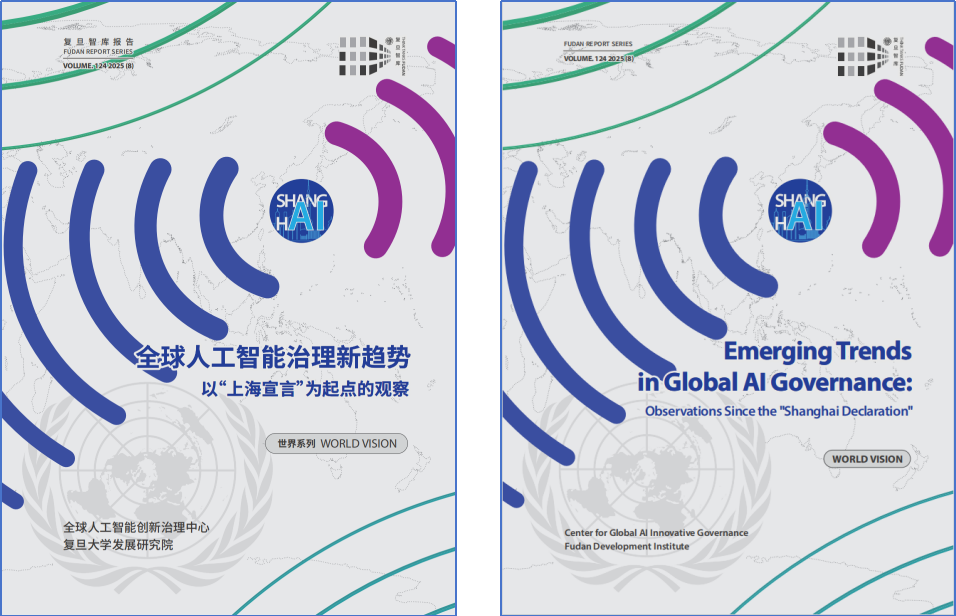
Chinese and English Versions of the Report
To gain a more comprehensive understanding of the complex landscape of global AI governance and to listen to more diverse, cross-sectoral, and cross-national voices, the project team contacted and interviewed authoritative experts and relevant practitioners in the field of AI governance from more than ten countries around the world. The respondents include not only those from the economically and technologically advanced Global North, but also representatives from emerging economies and developing countries in the Global South.
The Report consists of two main parts. The first part examines the emerging trends and new developments in global AI governance, and puts forward corresponding policy and actionable recommendations based on practical realities. The second part presents a wide range of perspectives on AI governance shared by experts from various countries, illustrating how specialists from different regions and sectors around the world assess the current state and future prospects of AI governance.
Part One of the Report notes that over the past year, the international community has reached a consensus on the strategic significance and urgency of advancing global AI governance, and has demonstrated a shared willingness to deepen the development of relevant mechanisms. First, the important role and central position of the UN system in global AI governance are receiving increasing attention. Second, the “AI divide” between countries and among different groups within nations has raised widespread concerns. Third, the fragmentation of global AI governance is at risk of intensification. Finally, various technical and security risks posed by AI remain inadequately addressed, creating obstacles to global governance cooperation.
In response to these emerging trends, the Report argues that strengthening multi-stakeholder cooperation under the United Nations framework is the primary pathway to enhancing AI capacity-building. It is essential to reconcile the interests and demands of developed and developing countries, promote in-depth collaboration between the public and private sectors, and foster a governance structure featuring the participation of multiple stakeholders. Enhancing strategic mutual trust and promoting the alignment and compatibility of AI governance rules and standards will be the central tasks of global AI governance in the future. To ensure that the global AI governance system is equitable and inclusive and that AI capacity-building benefits all, it is also necessary to strengthen resource sharing among Global South countries and unite them to speak with one voice in AI governance decision-making.
Part Two of the Report features insights from 12 experts and scholars from the United Nations, universities, research institutions, think tanks, and industry. These experts are from India, Indonesia, the Republic of Korea, Singapore, Viet Nam, the United Arab Emirates, Argentina, Brazil, Switzerland, the United Kingdom, the United States, and other countries. With diverse backgrounds, the experts have offered varied views on the priority issues, key risks, and development pathways of global AI governance. On the one hand, they share a strong consensus on strengthening international cooperation and reducing governance fragmentation. On the other hand, they have put forward forward-looking recommendations on the bottlenecks faced by Global South countries in data sovereignty, technology accessibility, and talent development, and express expectations for the adoption of supportive policies at all levels and increased investment in capacity-building.
Group Members
Yao Xu
Researcher at the Center for Global AI Innovation Governance
Associate Research Fellow at the Fudan Development Institute
Jiang Tianjiao
Researcher at the Center for Global AI Innovation Governance
Associate Director at the Center for BRICS Studies, Fudan Development Institute
Xing Yanyan
Researcher at the Center for Global AI Innovation Governance
Assistant Research Fellow at the Fudan Development Institute
Zhang Shuyan
Research Assistant at the Center for Global AI Innovation Governance
Yang Zhao
Research Assistant at the Center for Global AI Innovation Governance
Jiang Junji
Research Assistant at the Center for Global AI Innovation Governance
Wu Chenmiao
Research Assistant at the Center for Global AI Innovation Governance
Xiao Zehui
Research Assistant at the Center for Global AI Innovation Governance
 Emerging Trends in Global AI Governance.pdf