

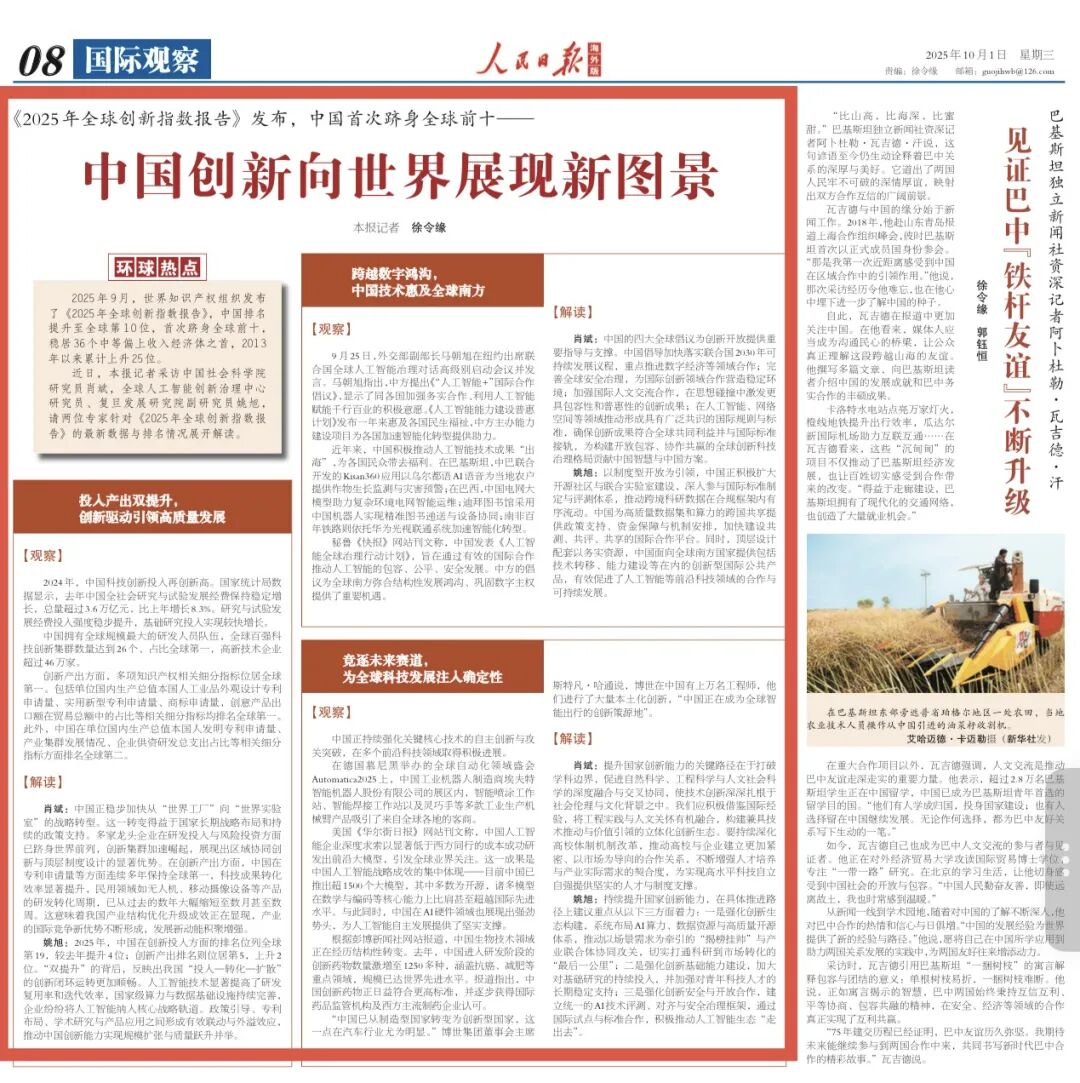
In September 2025, the World Intellectual Property Organization (WIPO) released the Global Innovation Index 2025 (GII 2025). China’s ranking rose to 10th globally, marking its first entry into the world's top ten. China firmly maintains the top position among 36 upper-middle-income economies, having climbed a total of 25 places since 2013.
Against this backdrop, Yao Xu, a researcher at the Center for Global AI Innovative Governance (CGAIG) and Associate Researcher at the Fudan Development Institute (FDDI), was interviewed by People's Daily Overseas Edition to interpret the latest data and rankings of the GII 2025.
01 Dual Improvements in Investment and Productivity:
Innovation-Driven High-Quality Growth
【Observation】
In 2024, China's investment in scientific and technological innovation reached a new record high. According to data from the National Bureau of Statistics of China, nationwide expenditure on research and experimental development (R&D) continued to grow steadily, exceeding 3.6 trillion RMB, an 8.3% increase over the previous year. The intensity of R&D investment has risen steadily, and investment in basic research achieved rapid growth.
China possesses the world's largest team of R&D personnel. The number of its science and technology innovation clusters among the global top 100 has reached 26, the highest share in the world, with more than 460,000 high-tech enterprises.
Regarding innovation output, multiple sub-indicators related to intellectual property rank first globally. These include the number of resident industrial design applications per unit of GDP, utility model applications, trademark applications, and the share of creative goods exports in total trade. Furthermore, China ranks second globally in sub-indicators such as resident patent applications per unit of GDP, industrial cluster development, and the share of total R&D expenditure funded by enterprises.
【Interpretation】
Yao Xu: In 2025, China's ranking in innovation input reached 19th globally, up 4 places from last year; innovation output ranked 5th, an increase of 2 places. Behind this double increase is the reflection that China's innovation closed-loop of input-transformation-diffusion is operating more smoothly. Artificial intelligence technology has significantly improved the reuse rate and iteration efficiency of R&D. National-level computing power and data infrastructure continue to improve, and enterprises are incorporating AI into their core strategic tracks. Effective linkage and spillover effects have formed between policy guidance, patent layout, academic research, and product application, driving China’s innovation capabilities toward simultaneous scale expansion and quality leaps.
02 Bridging the Digital Divide: Chinese Technology Benefiting the Global South
【Observation】
On September 25, Vice Foreign Minister Ma Zhaoxu attended the High-Level Launch Meeting of the UN Dialogue on Global AI Governance in New York and delivered a speech. He noted that China has put forward the AI+ International Cooperation Initiative, underscoring its willingness to deepen pragmatic cooperation with all countries and leverage AI to empower industries across the board. Since its release a year ago, the AI Capacity-Building Action Plan for Good and for All has benefited the livelihoods and well-being of people in various countries, and capacity-building projects hosted by China have assisted nations in accelerating their intelligent transformation.
In recent years, China has actively promoted the going global of AI technological achievements, bringing benefits to people worldwide. In Pakistan, the Kisan360 app, jointly developed by China and Pakistan, uses Urdu-language AI voice to provide local farmers with crop growth monitoring and disaster warnings. In Brazil, China's power grid large models assist in the intelligent operation and maintenance of grids in complex environments. Dubai libraries use Chinese robots for precise book delivery and equipment coordination, while South Africa's century-old railways rely on Huawei's optical vision networking system to accelerate intelligent transformation.
The Peruvian website Expreso published an article stating that China’s release of the Global AI Governance Action Plan to promote the inclusive, fair, and safe development of AI through effective international cooperation. China's initiatives provide significant opportunities for the Global South to bridge structural development gaps and consolidate digital sovereignty.
【Interpretation】
Yao Xu: Guided by institutional opening-up, China is actively expanding the construction of open-source communities and joint laboratories, deeply participating in the formulation of international standards and evaluation systems, and promoting the orderly flow of cross-border scientific research data within compliance frameworks. China provides policy support, financial guarantees, and institutional arrangements for the transnational sharing of high-quality datasets and computing power, accelerating the construction of international cooperation platforms for mutual testing, evaluation, and sharing. Meanwhile, top-level design is matched with pragmatic resources, as China provides innovative international public goods—including technology transfer and capacity building—to Global South countries, effectively promoting cooperation and sustainable development in frontier technology fields such as artificial intelligence.
03 Competing in Future Tracks:
Injecting Certainty into Global Technological Development
【Observation】
China is continuously strengthening independent innovation and breakthroughs in key core technologies, achieving positive progress in multiple frontier scientific and technological fields.
At Automatica 2025, a global event for the automation industry held in Munich, Germany, the exhibition area of the Chinese industrial robot manufacturer EFORT Intelligent Equipment Co., Ltd. featured smart spraying workstations, smart welding workstations, and dexterous hands. These industrial robotic arm products attracted business visitors from all over the world.
The website of the Wall Street Journal reported that the Chinese AI firm DeepSeek successfully developed frontier large models at a cost significantly lower than its Western counterparts, garnering global industry attention. This achievement is a concentrated reflection of the effectiveness of China's AI strategy—currently, China has launched over 1,500 large models, most of which are open-source, with many rivaling or even surpassing international advanced levels in core capabilities such as mathematics and coding. Simultaneously, China has shown strong momentum in the AI hardware field, providing solid support for the independent development of artificial intelligence.
According to Bloomberg News, China's biotechnology sector is undergoing a structural transformation. Last year, the number of innovative drugs entering the R&D stage in China surged to over 1,250, covering key areas such as anti-cancer and weight loss, reaching a scale that is among the most advanced in the world. The report noted that Chinese innovative drugs are increasingly meeting higher standards and are gradually gaining recognition from international drug regulatory agencies and mainstream Western pharmaceutical companies.
China has transformed from a manufacturing nation to an innovative nation, which is particularly evident in the automotive industry, said Stefan Hartung, Chairman of the Board of Management of the Bosch Group. He noted that Bosch has tens of thousands of engineers in China who have carried out extensive localized innovation, adding that China is becoming the source of innovation for global smart mobility.
【Interpretation】
Yao Xu: To continuously enhance national innovation capabilities, I suggest focusing on the following three areas in terms of specific implementation paths: First, strengthen the construction of the innovation ecosystem by systematically deploying AI computing power, data resources, and high-quality open-source systems. This involves promoting the open competition for selecting the best candidates (Jie Bang Gua Shuai) driven by scenario needs and collaborative research through industrial consortia to effectively bridge the last mile between scientific research and market transformation. Second, reinforce the building of foundational innovation capabilities by increasing sustained investment in basic research and strengthening long-term, stable support for young scientific and technological talents. Third, strengthen innovation security and open cooperation by establishing a unified framework for AI technical evaluation, alignment, and security governance. Through international pilots and standard cooperation, we should actively promote the going global of the AI ecosystem.
Original Link: https://world.people.com.cn/n1/2025/1001/c1002-40575756.html