

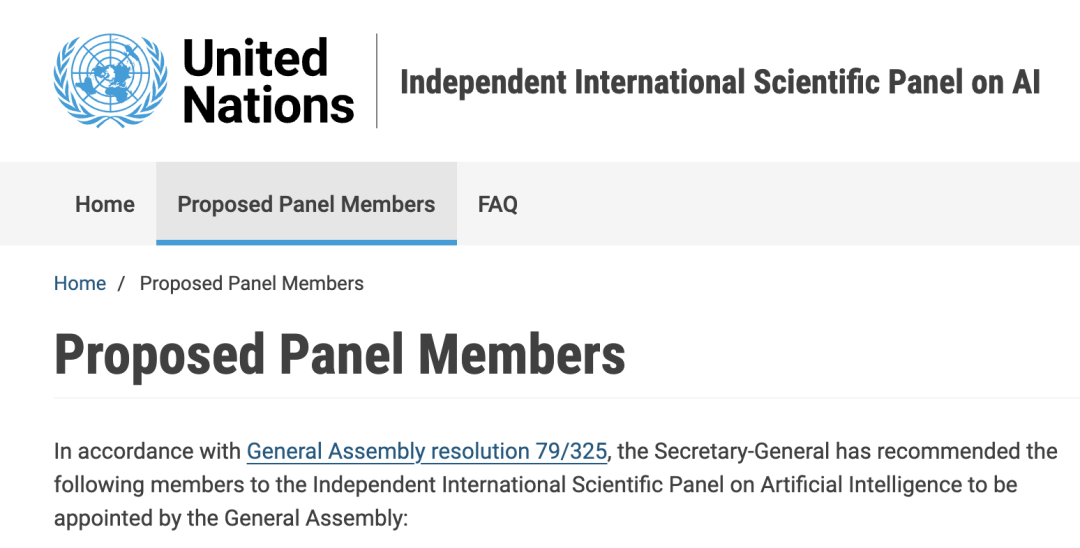
The United Nations has recently unveiled the list of 40 candidates for the Independent International Scientific Panel on AI. Among the nominees are two distinguished Chinese scientists: Song Haitao, President of the Shanghai Institute of AI, and Wang Jian, an academician of the Chinese Academy of Engineering.
UN Secretary-General António Guterres emphasized that as the first fully independent global scientific body dedicated to bridging AI knowledge gaps and assessing its real-world economic and social impacts, the panel will operate autonomously with UN support. The UN General Assembly is expected to make a final decision on membership by February 12, marking a crucial step in safeguarding AI development.
AI is advancing at the speed of light, Guterres stated, underscoring the urgency of regulating this transformative technology. We need to build consensus to erect effective guardrails, unleash innovation for humanity's benefit, and foster international cooperation. This panel will help the world distinguish truth from falsehood, science from pseudoscience.
An analysis of the 40 candidates' research backgrounds and regional representation reveals a notable shift toward diversification in global AI research. Developing nations across Asia, Africa, and South America are emerging as significant contributors to AI advancement, challenging the traditional dominance of European and North American institutions.
Furthermore, consensus is forming around three pillars of global AI governance: technology as the core, cross-disciplinary integration as the trend, and governance as an imperative. AI is no longer confined to computer science but is deeply converging with vertical domains including healthcare, environmental science, physics, and finance. Concurrently, research into AI ethics, responsible AI, and emerging technology governance is gaining momentum—reflecting global priorities for sustainable AI development.
Authors
Yao Xu, Secretary-General of CGAIG and Associate Professor at FDDI
Xin Yanyan, Deputy Secretary-General of CGAIG and Assistant Research Fellow at FDDI
Luo Haoyue, Research Assistant of CGAIG
Lv Chengle, Research Assistant of CGAIG
Wang Yibo, Research Assistant of CGAIG
Yuan Luming, Research Assistant of CGAIG
Wang Xinyu, Research Assistant of CGAIG
Liu Yihe, Research Assistant of CGAIG
Original Link:https://mp.weixin.qq.com/s/vbKzkrZ4SJPfYSbAbzqEpQ