

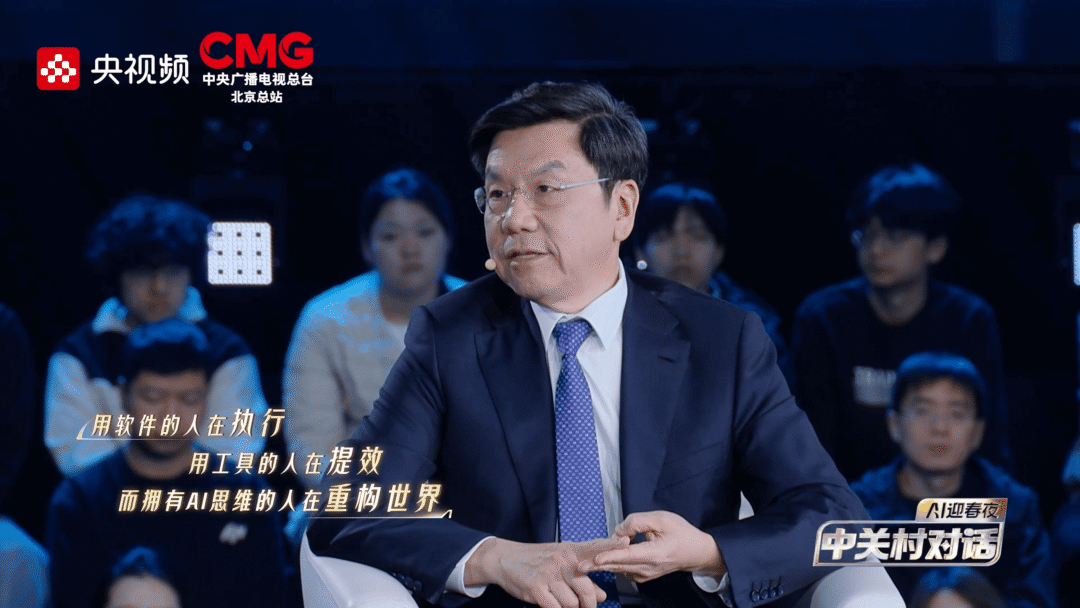
On February 4, 2026, at the program Zhongguancun Dialogue: AI Gala for Spring Festival launched by CMG Mobile, Dr. Kai-Fu Lee, CEO of LINGYI WANWU and Chairman of Sinovation Ventures, engaged in an on-site dialogue with Professor Jiang Changjian, Deputy Director of the Global AI Innovation Governance Center. They analyzed the cutting-edge trends in AI development, proposed the AI literacy that the younger generation should possess, and embraced the wave of AI together. The following is a reproduction of the dialogue content from Dr. Kai-Fu Lee’s official WeChat account. Reproduced with authorization, it is shared with all of you.
As we stand at the dawn of 2026—Year One of Multi-agent Deployment for Enterprises—and look back on the upheaval and transformation brought by AI 2.0 over the past year, my heart is filled with both the relief of seeing expectations met and the sobering clarity of unforeseen realizations.
Recently, I had an in-depth conversation with Mr. Jiang Changjian, a renowned host and scholar. As an exceptionally astute questioner, he voiced the shared anxieties and inquiries of numerous entrepreneurs, managers and even young students.

Our dialogue unfolded around the following core dimensions:
Multi-agents Restructuring Enterprises’ Core CompetitivenessThe most valuable application scenarios for multi-agents lie in the ToB sector. As 2026 ushers in the First Year of Multi-agent Deployment for Enterprises, how can businesses leverage proprietary data and multi-agents to build an unassailable moat and achieve genuine AI-driven transformation?
AI Driving the Restructuring of Social Productivity
Multi-agents are leading human society to evolve from a one-person, one-tool model to a one-person, one-team paradigm. When AI takes on 80% of programming and basic tasks, how can humans shift from being answer carriers to problem definers? Why will one-person unicorn companies become the norm in the near future?
Balancing Development with Safety and Ethics
Given the concerns over AI runaway risks raised by pioneers such as Turing Award laureate Geoffrey Hinton, how should we adopt a safety engineering mindset to establish a robust constraint framework for AI? Instead of lingering in fear, we should ensure that technology always serves humanity through AI explainability and sandbox mechanisms.
Future-oriented Education and Literacy
As AI becomes a powerful daily tool, traditional education assessment systems need to keep pace with the times. In an era of foundation model democratization, the most crucial capability for young people is not rote knowledge retention, but critical thinking skills that enable them to collaborate with AI and pose substantive questions.
2026 is merely the prologue. Greater era-defining opportunities lie deep within the technological wave of AI 2.0. There is no need to fear displacement; instead, we should ponder this question: when AI expands humanity’s overall value proposition a hundredfold, which part of it will you define?
Those who use software are executing tasks.
Those who use tools are boosting efficiency.
Those who possess an AI mindset are restructuring the world.
May this dialogue lift a little of the fog for you, helping you find your place in this dynamic era of AI 2.0.
We look forward to restructuring the world with AI, hand in hand with you.
Original link:
https://mp.weixin.qq.com/s/heDyXugAdCMw0jvsi_0lWA