


Authors: YaoXu, Secretary-General of CGAIG and Associate Professor at FDDI
Liu Qianhao, Research Assistant of CGAIG
Abstract: On February 23, 2026, a thought experiment entitled The 2028 Global Intelligence Crisis triggered intense discussion across global investment and policy communities. Authored by Citrini Research, a research partner of Turing Award laureate Yoshua Bengio, the essay took the form of a “macro memorandum from the future,” systematically projecting the potential economic and social chain reactions arising from the accelerated development of artificial intelligence.
The article constructed an extreme yet internally coherent “doomsday model.” In this scenario, the rapid diffusion of advanced AI systems generates what it terms “ghost GDP”: output continues to expand, yet wealth becomes concentrated in the hands of compute-capital owners and no longer circulates through wages and consumption into the real economy. The central warning of the thought experiment is clear: if the technological dividends of AI are not broadly shared, the dramatic liberation of productivity may ultimately undermine the economic system itself.
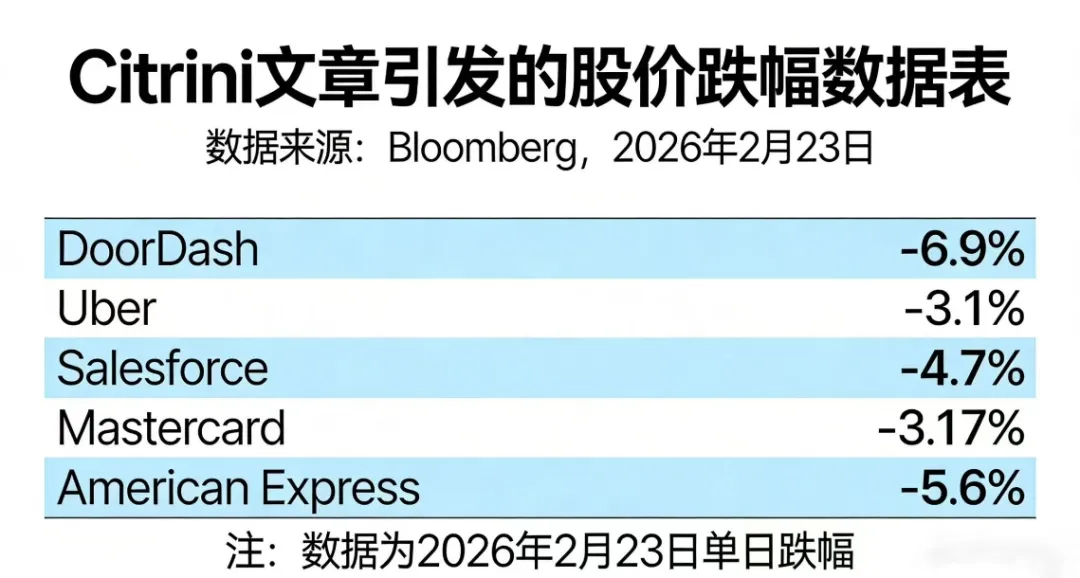
The rapid market response to this intellectual exercise reflects the fact that it touched upon structural risks that had not been fully priced in. On the day of publication, U.S. software and payments stocks declined sharply. DoorDash fell 6.9 percent, Salesforce dropped 4.7 percent, American Express declined 5.6 percent, and Visa fell 2.4 percent. Behind these movements lay a collective reassessment of what may be termed a “productivity paradox”: if AI-driven efficiency approaches its theoretical limits, could it erode the very foundation of modern economic systems—the consumption cycle?
Yet only two days later, a powerful countervailing signal emerged. Nvidia released a blockbuster fourth-quarter earnings report, substantially mitigating market anxieties. For the fiscal quarter ending January 31, 2026, Nvidia reported record revenue of $68.1 billion, representing a year-on-year increase of 73 percent. Its core data center segment generated $62.3 billion in revenue, up 75 percent year-on-year, both figures exceeding analyst expectations. Adjusted earnings per share rose by more than 80 percent, while gross margins climbed to 75.2 percent, the highest level in eighteen months. Perhaps more importantly, the midpoint of the company’s revenue guidance for the first quarter of fiscal year 2027 exceeded consensus estimates by 7.1 percent. CEO Jensen Huang also raised the previously stated $500 billion long-term chip revenue outlook.
This earnings report demonstrated that demand resilience for AI compute infrastructure is stronger than many had anticipated.
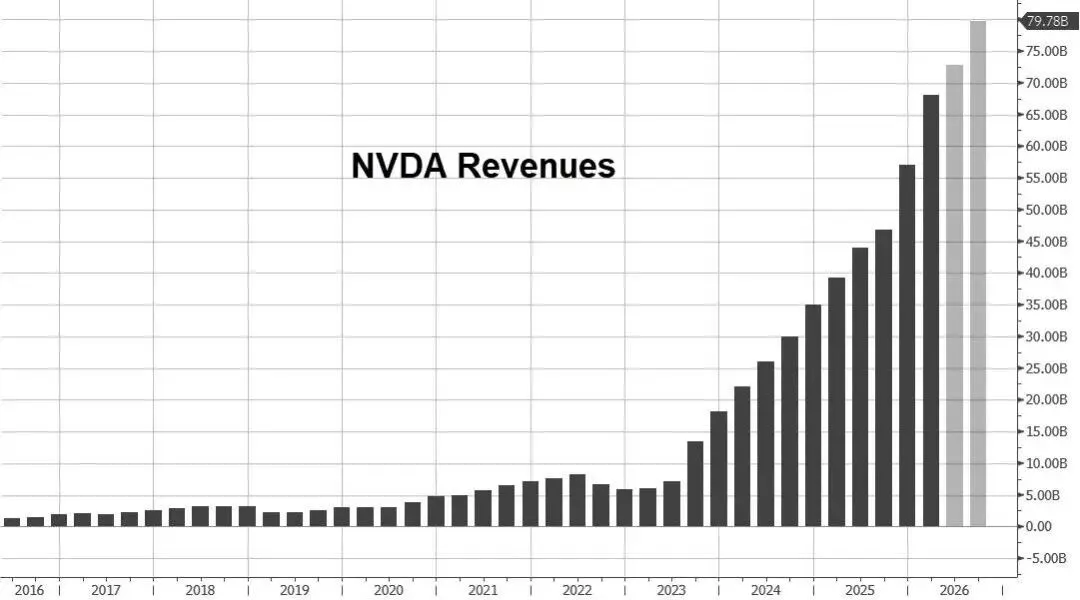
Data source: NVIDIA's Q4 2026 financial report. The chart shows that NVIDIA's revenue continued to increase in 2026.
The market turbulence sparked by a thought experiment reveals a deeper anxiety: the fear of unpriced tail risks in a scenario where AI achieves comprehensive success. However, the true challenge does not lie in whether AI will replace human labor. Rather, it concerns whether human societies can successfully accomplish a paradigm shift—from the industrial economy to an intelligent economy.
Key words: Artificial Intelligence (AI); Productivity Paradox; Substitution Risk; Intelligent Economy; Demographic Transition.
Original link: https://mp.weixin.qq.com/s/H3Mvu9w7JkQt_zR6RsLVvA