


On March 16, 2026, the International Trade Administration (ITA) of the U.S. Department of Commerce announced a new phase of the American AI Exports Program, inviting proposals from U.S. industry-led consortia for the export of full-stack AI technology packages. Against this backdrop, U.S. global AI strategy is shifting from a model centered primarily on export controls to a dual-track approach that tightens access to advanced computing chips through a tiered review mechanism while packaging and exporting U.S.-led technology stacks, infrastructure, and even security standards to global markets by means of institutionalized industry arrangements.
Previously, as disclosed in reports by Bloomberg, Reuters, and Axios, the Bureau of Industry and Security (BIS) under the U.S. Department of Commerce had been drafting an AI Chip Export Control Rule that featured a tiered review mechanism based on compute capacity. Although this effort ultimately failed to materialize, it nevertheless revealed, through its attempt to determine who would be eligible to purchase advanced AI chips, a tendency that caused deep alarm across segments of U.S. industry. The newly launched export program unveiled by the ITA adopts a more targeted organizational approach, further clarifying which actors would be authorized to export such AI technology packages. As a new framework for the global allocation of AI resources with the United States at its center begins to take shape, chips no longer function merely as commodities, nor does compute function merely as infrastructure. Instead, both are now drawn into broader geopolitical and geoeconomic competition, through which they are becoming strategic resources that can be allocated, exchanged, and even tied to political and economic alignment.
While the AI diffusion framework introduced at the end of the Biden administration was largely defensive, the export control and licensing measures advanced during Trump’s second term appear more aggressive and transactional. The United States seems to be moving toward a global licensing system centered on Washington, under which a country’s ability to build critical digital infrastructure or train its own frontier models may depend on approval granted by the White House.
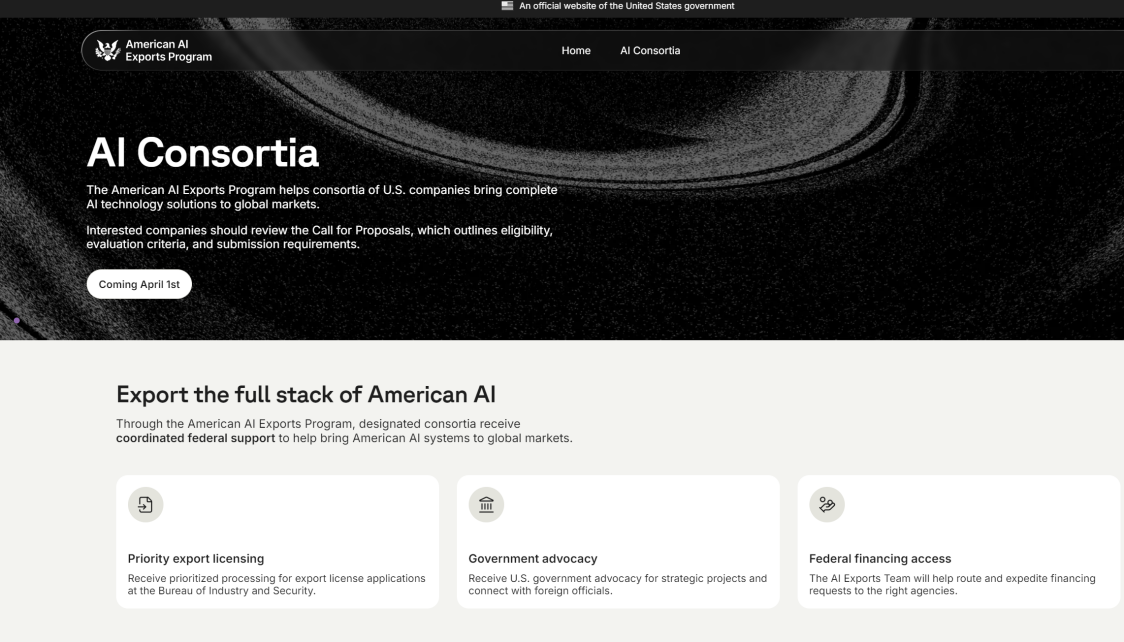
By the U.S. government’s own account, the American AI Exports Program further implements America’s AI Action Plan and the July 23, 2025 executive order “Promoting the Export of the American AI Technology Stack,” with the stated objective of strengthening U.S. leadership in global AI through the overseas deployment of full-stack American AI technology packages.
Source: AIEXPORTS.GOV
I. The Withdrawal of a Closely Watched BIS Export Control Rule
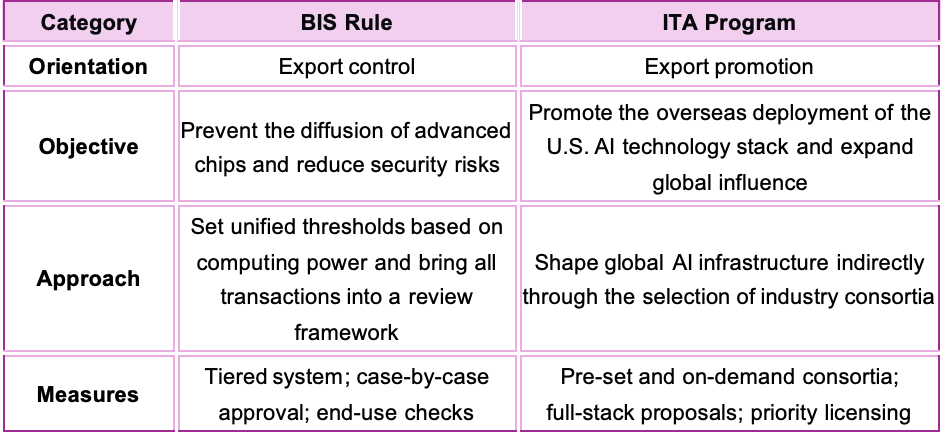
The AI Chip Export Control Rule reportedly under consideration by the Bureau of Industry and Security (BIS) of the U.S. Department of Commerce (hereinafter, the BIS rule) and the American AI Exports Program launched by the International Trade Administration (ITA) on March 16 (hereinafter, the ITA program) should be understood as two distinct but parallel policy initiatives, rather than successive steps within a single framework.
According to information disclosed by Bloomberg and other media outlets on March 5, BIS had been considering an export control framework for AI chips in which licensing decisions would depend on how much computing power a company intended to acquire. Although the proposal was withdrawn before being formally issued, the policy orientation reflected in its institutional design still provides an important point of reference for understanding how the United States is approaching AI export governance.
Based on the leaked information, the BIS rule would classify global demand for computing power into different tiers according to procurement scale. The first tier would apply to small-scale purchases, with the shipment ceiling reportedly set at fewer than 1,000 of NVIDIA GB300 graphics processing units (GPUs), or chips with equivalent computing capacity. This appeared to leave a limited exemption for small and medium-sized enterprises and research institutions. Under the U.S. Export Administration Regulations (EAR), however, such “exemptions” could still be subject to stringent compliance requirements.
First, these “exemptions” would most likely take the form of license exceptions,meaning that companies could not purchase such chips freely but would instead have to satisfy a series of stringent preconditions. BIS guidance makes clear that exporters and end users must complete highly detailed “know your customer” (KYC) due diligence. This includes, but is not limited to, demonstrating that the customer had an established business record before October 2022 in order to guard against shell companies, confirming the source of funds, and verifying whether the ultimate beneficial owner has any connection to countries in Country Group D:5, including embargoed destinations such as China.
Second, the U.S. side may require lifecycle-wide monitoring of how these 1,000 chips are used. In May 2025, the U.S. Senate and the U.S. House of Representatives introduced similar bills under the title Chip Security Act, both requiring controlled chips to incorporate location-verification mechanisms in order to prevent their diversion to sensitive destinations. If such a mechanism were made a precondition for obtaining a license exception, even research institutions in Europe or Asia could, in principle, find the location of their server deployments and the operational status of relevant chips brought within the traceable reach of the U.S. regulatory system. Should such equipment deviate from its authorized end use or approved location, a company could lose its exemption eligibility and may also trigger derivative liability under General Prohibition 10 (GP10).
GP10 is not a sector-specific or time-limited prohibition directed at a particular field or moment, but a broadly applicable rule of general scope that is not confined by geography or time. Under this rule, once a party knows, or has reason to know, that a violation involving an item subject to the EAR—such as a controlled chip—has occurred, is about to occur, or is intended to occur, that party is prohibited from participating in any transaction involving that item. Put simply, once GP10 is triggered, not only chip users but also service providers may face U.S. enforcement action, including significant civil penalties, business restrictions, and even criminal liability. Ostensibly, this layer of control lowers the threshold for small-volume chip transactions, but in practice it draws dispersed, low-end global demand for computing power into a comprehensive U.S. regulatory network.
Once chip purchases for a project exceed 1,000 units and the project enters the stage of building a medium-sized compute cluster, prior approval from the U.S. government would likely be required before an export license could be sought. The design of this step likely draws on the Validated End-User (VEU) mechanism, a familiar instrument in the United States’ extraterritorial regulatory practice, through which companies earn trust via compliance review and improve the stability and efficiency of their supply chains. Under the BIS rule, however, such review would become a largely one-way transparency requirement, as applicants would be required to disclose highly sensitive commercial information, including the specific purpose of the data center, the business model, the counterparties leasing compute capacity, and even the underlying model architecture.
Even more far-reaching is the routinization of End-Use Checks (EUCs), through which BIS verifies whether the end user, end use, and destination of items subject to the Export Administration Regulations (EAR), including hardware, software, and technology, comply with U.S. export control requirements. On that basis, the U.S. Department of Commerce may claim the authority to send officials into data centers located in other countries in order to inspect the physical deployment of servers and review operating logs, so as to ensure that the relevant computing resources have not been used for military purposes or leased onward to Chinese entities.
Such requirements directly challenge the host country’s judicial sovereignty and data security. For European and Southeast Asian countries seeking to build sovereign AI, this would leave them with digital infrastructure that remains physically on their own soil but is, in terms of managerial authority, increasingly treated as a U.S. “enclave.” A case in point is the British company Nscale, which has planned to provide Microsoft with compute capacity supported by 200,000 NVIDIA GB300 GPUs, yet every node it deploys in Europe would be subject to scrutiny from Washington under the BIS rule. In effect, such a mechanism would give the U.S. Department of Commerce decisive power over the global Infrastructure-as-a-Service (IaaS) market: if companies refuse to disclose customer information, they are unlikely to secure chip supply; if they do disclose it, they may forfeit commercial confidentiality and customer trust.
At the highest tier of the BIS rule are ultra-large compute projects involving more than 200,000 GB300 chips for a single entity. A compute deployment on this scale would be sufficient to train today’s most advanced foundation models and could thus be seen as a gateway to artificial general intelligence (AGI). At this level, the issue ceases to be merely technical and becomes explicitly political. According to media reports, U.S. approval for exports of this kind would be subject to two conditions, both of which would have to be met: the host government would have to intervene and provide stringent security assurances, and the recipient would also be required to make so-called “matching investment” in the U.S. artificial intelligence sector.
Earlier arrangements reached by the United States with the United Arab Emirates (UAE) and Saudi Arabia provide a useful point of reference. In 2025, the U.S. Commerce Department authorized exports of advanced AI chips equivalent to as many as 35,000 NVIDIA Blackwell chips to two companies in Saudi Arabia and the UAE. During the same period, the UAE not only accepted U.S. security and compliance conditions, including the removal of Huawei equipment, but also committed to invest approximately $1.4 trillion in U.S. energy and AI projects over the coming decade, a pattern the BIS rule seeks to extend more broadly on a global scale.
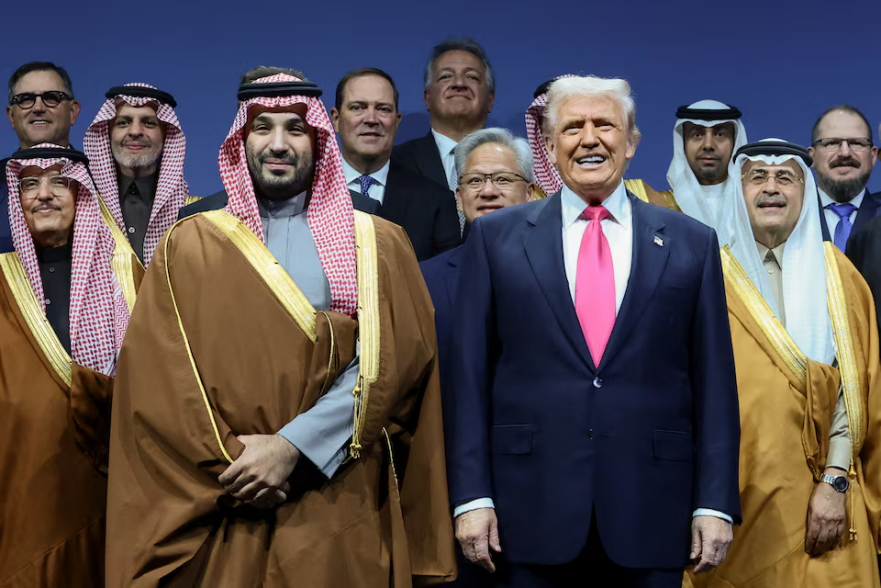
In November 2025, the U.S. Department of Commerce approved exports of up to 35,000 NVIDIA Blackwell chips to two companies in Saudi Arabia and the UAE.
Source: Reuters
“Matching investment” resembles a new form of conditional exchange. If countries wish to build top-tier computing centers of their own, they may be required to channel substantial capital back into the U.S. technology ecosystem, thereby reinforcing the United States’ capital advantage and tying other countries’ AI development more closely to it in economic terms through deeper forms of interdependence.
Moreover, for projects involving deployments on the order of 200,000 chips, security assurances would extend far beyond a formal pledge, as they could also require the disclosure of core sensitive information to the U.S. side. Requirements of this kind, given their highly asymmetrical nature, could force allied and partner countries to choose between digital sovereignty and access to advanced computing power. In practice, the United States is positioning itself as a gatekeeper of global AI infrastructure, determining which countries and firms may enter the high-end computing ecosystem.
Taken together, the three-tier review system forms a tightly integrated structure of control, with the lower tier monitoring flows through technical means, the middle tier gaining access to commercial secrets through compliance review, and the upper tier drawing in global capital through political linkage. In this way, the United States is working to reshape the global division of labor: it designs the chips, sets the rules, and captures the rents, while the rest of the world is left to use U.S.-made computing power only on terms set by the United States.
However, once the draft became public, it triggered a negative market response, with shares of chipmakers such as NVIDIA and AMD falling noticeably for a time, while media reports also pointed to sharp disagreement within the White House. According to those reports, multiple federal departments are proposing revisions to the details of the draft. Axios quoted a White House official as saying that the draft “does not reflect what President Trump has said on export controls nor does it reflect the direction of the Trump administration on encouraging export of the American AI stack.” The report also noted that the Trump team is considering additional measures to expand the reach of U.S. AI technologies in global markets, particularly in countries of the Global South. Another administration official described the proposal as “a very, very early set of ideas” and said that any final policy would be aligned with the White House’s AI action plan.

On the afternoon of March 5, 2026, a Bloomberg report sent shock waves through Wall Street, with NVIDIA shares falling 1.7 percent and AMD down 2 percent.
Source: Financial Times
There has also been criticism from the strategic policy community. Saif Khan, a former national security official in the Biden administration who is now at the Institute for Progress (IFP), a Washington think tank, agreed that the BIS rule could help prevent technological diffusion, but argued that, as he put it, “the license requirements are overly broad, applying globally, raising concerns that the administration intends to use the controls as negotiation leverage with allies rather than for security.”
In response to growing external concern, the Commerce Department said in a statement that it was considering new rules, but added that they would not resemble what it described as the Biden administration’s “burdensome, overreaching, and disastrous” framework.
On March 13, local time, the Office of Management and Budget (OMB) updated its website, indicating that the interagency review process for the rule had concluded and that the measure had been withdrawn. No further details were provided. Although the rule never reached implementation, its core ideas—including tiering based on computing power, end-to-end oversight, and the linkage of market access to investment commitments—still provide important clues for understanding the direction of subsequent adjustments in U.S. AI export policy.
II. The Department of Commerce’s Newly Introduced American AI Exports Program and Changes in Review Mechanisms
Unlike the BIS rule, which was withdrawn before implementation, the ITA program launched on March 16, 2026 adopts a more open stance toward the promotion of technology exports. It takes the external deployment of the U.S. AI technology ecosystem as an explicit objective and places particular emphasis on expanding the industry’s global reach.
According to the ITA announcement, U.S. industry-led consortia may submit proposals during the 90-day period beginning on April 1, 2026 for full-stack AI export packages covering the full AI technology stack, including AI-optimized computer hardware, data center storage, models, cybersecurity measures, and applications for various sectors. The Department of Commerce divides participating consortia into two categories. The first is the pre-set consortium, which demonstrates capabilities across all layers of the AI technology stack and maintains global offerings ready for ongoing deployment. The second is the on-demand consortium, which is formed in response to a specific opportunity identified by the Program and need only cover the layers of the stack required for a particular deal.
As Under Secretary of Commerce for International Trade William Kimmitt stated, “America’s continued global leadership in AI depends on our ability to export our AI to allies around the world.” He added, “We will continue to focus our resources to most effectively implement the President’s export directives and position America’s AI innovators and workers to win globally.”
Pre-set consortia are required to cover the full range of capabilities from underlying hardware to upper-layer applications and to provide deployable solutions on an ongoing basis. In effect, this would create a group of government-backed, national-level AI export providers. Once selected, their offerings would become standardized packages through which the United States provides AI infrastructure and services to foreign partners, thereby shifting AI exports from scattered firm-to-firm transactions toward coordinated, system-level delivery. For buyers, this model could significantly reduce decision complexity, as the object of procurement would no longer be a single vendor but an integrated technology package approved by the U.S. government.
By contrast, on-demand consortia serve as a more flexible complement. Built for a specific opportunity, it needs to cover only the capabilities required for that particular deal, making it possible for smaller firms to participate in the buildout of global AI infrastructure.
This combination of long-term standing providers and flexible, project-specific supplements reflects the tiered structure of the U.S. export strategy. The fact that all consortia, whether pre-set or on-demand, are designated through a selection process led by the Secretary of Commerce in consultation with the Secretaries of State and Energy, among others, further highlights that the mechanism has been elevated beyond a purely commercial arrangement into an instrument of national security and foreign policy.
Source: compiled by the authors
III. Between Withdrawal and Launch: The Trump Administration’s Approach to AI Export Controls
The withdrawal of the BIS rule and the rollout of the ITA program, taken together, reflect internal bargaining and strategic recalibration within the Trump administration. In its approach to AI export controls, the current administration places security and industrial returns on parallel footing, while using a more transactional logic to reinforce the United States’ global technological dominance.
First, the regulatory focus is shifting from broad-based restrictions to more flexible allocation. The earlier BIS rule attempted to use the scale of computing power as its central metric and to subject projects worldwide to a unified review process through tiered thresholds, with the aim of establishing a broadly applicable licensing system. The ITA program, however, embeds regulatory oversight in cooperative arrangements by selecting industry consortia and promoting the export of full-stack packages instead of emphasizing case-by-case control over every transaction. In effect, the United States is no longer trying to cover every individual project directly, but is prioritizing a controllable group of technology suppliers through which it can indirectly influence the global deployment of computing infrastructure.
Second, at the strategic level, the policy orientation is extending from risk control to the pursuit of broader industrial, economic, and strategic interests.Influenced in part by Silicon Valley investor-officials such as David Sacks, the White House’s AI and crypto czar, the Trump administration has moved away from the diffusion-control approach adopted under Biden, which was widely seen as procedurally cumbersome and hierarchically complex. Instead, it has prioritized strengthening the leadership of the U.S. AI industry while safeguarding national security interests and advancing broader national interests through technological strength. Officials of this type generally favor expanding the scale of technology exports so as to broaden the global use of the U.S. technology stack and reinforce the software-ecosystem advantages associated with CUDA, thereby improving the United States’ long-term competitive position.
Third, at the level of policy instruments, the linkage between technology and capital is becoming increasingly apparent. Although provisions such as “matching investment” in the BIS rule were never adopted, similar thinking remains present in policy discussions that tie technology access to investment, market access, and other conditions in ways that move AI infrastructure beyond a purely technical matter and place it within a broader framework of economic and industrial cooperation.
Finally, the current administration’s AI export controls still leave room for adjustment in implementation. On January 15, 2026, BIS issued a revised license review policy for chip exports to China, under which certain advanced computing commodities—such as NVIDIA H200 and AMD MI325X—may move from a presumption of denial to case-by-case review if specified conditions are met, in an effort to preserve restrictions while still leaving some market space for U.S. firms.
This policy adjustment has also prompted criticism from policy analysts. Maxwell Roberts of the Institute for AI Policy and Strategy (IAPS) argued that, given BIS’s difficulty in verifying how these chips are ultimately used and where they flow once they reach a competitor, the Trump administration’s decision to allow exports of advanced AI chips under stringent conditions—including non-military use restrictions, a 50 percent sales cap, and third-party testing—could still substantially expand a rival’s compute stockpile, accelerate both military modernization and AI industry development, and erode the global market share of U.S. products. Janet Egan and James Sanders of the Center for a New American Security (CNAS), for their part, criticized the Trump administration for making excessive concessions, warning that if the government were to allow exports of all chips newly made eligible under BIS’s revised licensing policy for semiconductor exports, it could, to some extent, narrow the technological gap between the United States and other countries.
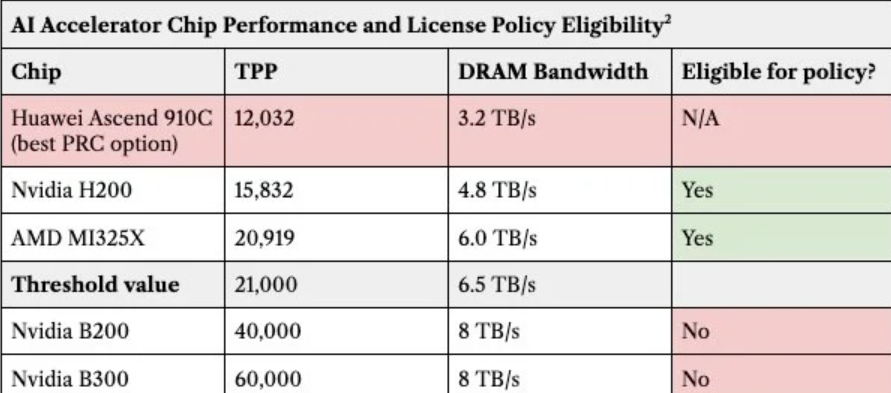
Eligible chips under the new BIS licensing policy
In early 2026, the BIS of the U.S. Department of Commerce revised its export license review policy, placing exports of certain commercially available advanced computing products to end users in mainland China and Macau under case-by-case review. Under the new policy, eligibility is defined by two technical thresholds: total processing performance must be below 21,000, and total DRAM bandwidth must be below 6,500 GB/s.
Source: IAPS
In light of this, the Trump administration is trying to strike a balance between constraining foreign chipmakers and preserving the export interests of U.S. semiconductor firms. A complete cutoff in supply could accelerate indigenous substitution by overseas competitors, whereas controlling shipment volumes and performance ceilings could keep them in a long-term follower position and, in practice, function as a more cost-effective form of competition.
That said, the shift from tight precautionary controls to a more flexible approach has been far from smooth, as Washington remains in the midst of an intense internal struggle over the direction of policy.
On one side, hard-line lawmakers in Congress, including Representatives Jim Banks and Raja Krishnamoorthi, have pushed for tighter legislative restrictions on advanced chip exports. The GAIN AI Act, or the Guaranteeing Access and Innovation for National Artificial Intelligence Act, would bar chipmakers from exporting high-end AI chips with total processing performance (TPP) above 4,800 to foreign entities until domestic U.S. demand has been met, and supporters have also sought to fold such restrictions into the annual National Defense Authorization Act (NDAA), requiring chipmakers to give priority to U.S. customers before exporting abroad. Meanwhile, the draft No Advanced Chips for the CCP Act of 2025 would go further by giving Congress a role in approving chip exports to particular countries through a dual-approval mechanism. If enacted, measures of this kind would reduce the executive branch’s flexibility by shifting more control into statute.
On the other side, the White House and the Commerce Department have taken a more commercially pragmatic position. President Trump, David Sacks, and others have favored preserving a degree of policy flexibility. The Semiconductor Industry Association (SIA) has also strongly opposed the tracking requirements proposed in the congressional Chip Security Act, arguing that they are impractical.
Seen from this perspective, the withdrawn BIS rule may be understood as an attempt to reconcile competing policy orientations. It would have preserved administrative flexibility in licensing while addressing security concerns through tighter oversight. But amid market pressure and coordination challenges, the proposal was dropped, and the more industry-oriented ITA program became the main vehicle for advancing the export agenda.
Overall, U.S. AI export policy remains in flux. The government continues to explore institutional ways to extend the reach of its technological advantages while also recalibrating the balance between control and market vitality. With the BIS rule withdrawn and the ITA program moving ahead, the United States is shifting from a rule enforcer to a more comprehensive actor that combines rule-shaping with technology exports, a transition that will continue to evolve under multiple policy pressures.
IV. The Cat-and-Mouse Game and the Growing Fragmentation of the Global AI Supply Chain
The extraterritorial reach of U.S. regulation is triggering a global cat-and-mouse game that is not only fueling a sizeable grey market, but also deepening the fragmentation of digital sovereignty worldwide.
Although the United States has sought to close every possible loophole through GP10, the Entity List, and the proposed Chip Security Act, workarounds at the margins of the supply chain continue to emerge under strong demand and profit incentives. In recent years, Southeast Asia has moved closer to the center of this technological contest, as Singapore and Malaysia, drawing on their mature electronics-manufacturing base and data-center infrastructure, have become key transit hubs for efforts to route around export restrictions. Media reports, for example, have described how firms such as Megaspeed procured chips through subsidiaries in Malaysia and deployed them in local data centers. They then remotely leased the resulting computing power to foreign customers, creating a business model in which the hardware remains offshore while the service is delivered onshore, thereby exploiting grey areas in U.S. export rules.

Founded in 2023, Megaspeed has, in under three years, become one of the largest single purchasers of NVIDIA chips across Southeast Asia.
Source: The New York Times
In response to this situation, the United States is broadening the scope of liability for chip exporters and related firms. BIS’s Industry Guidance to Prevent Diversion of Advanced Computing Integrated Circuits sets out as many as 11 red flags and calls on companies to conduct highly intensive due diligence on customers. The proposed Chip Security Act goes further still by calling for location-tracking functionality to be embedded at the hardware level. In practice, however, such technical monitoring faces serious limits. Even if a chip’s physical location can be verified, it remains difficult to prevent remote access to computing power through the cloud. As long as chips continue to operate in overseas data centers, cross-border access to computing power is unlikely to be fully cut off in physical terms, given the use of virtual private networks (VPNs) and complex routing.
U.S. AI export controls will also have far-reaching effects on both allies and the Global South. Allies such as Europe, Japan, and South Korea are becoming increasingly dependent on U.S. rules for AI infrastructure development, which leaves them less autonomy over digital sovereignty. Meanwhile, the Global South could be pushed into a less advantaged position within the global AI supply chain and face reduced access to the resources needed for technological development.
The Trump administration’s proposal for a global tiered review system governing AI computing power can be seen as a product of U.S. anxiety over relative decline.It seeks to convert technological advantage into political power and economic rents, thereby consolidating U.S. dominance in the AI sector. In the short term, such a policy may slow the advance of competitors and generate substantial economic gains for the United States.
Over the longer term, however, this approach could force global AI development to split more sharply into two distinct camps: a closed one centered on the United States and a non-U.S. one compelled to develop independently. Once the United States begins to act as a gatekeeper and charge the rest of the world for access, it risks losing the moral standing associated with providing global public goods and may ultimately prove counterproductive by constraining the diversity that sustains global innovation.
References
[1]“BIS Withdraws Draft AI Chip Export Control Rule”, Exports Compliance Daily, March 17, 2026, https://exportcompliancedaily.com/article/2026/03/17/bis-withdraws-draft-ai-chip-export-control-rule-2603160006?BC=bc_69b934dde0edb
[2]“Draft AI Chip Licensing Scheme Quashed”, Washington Trade & Tariff Letter, March 17, 2026, https://www.wttlonline.com/stories/ai-chip-licensing-scheme-quashed,14948
[3]“DEPARTMENT OF COMMERCE ANNOUNCES NEW AMERICAN AI EXPORTS PROGRAM PHASE”, International Trade Association, US Department of Commerce, March 16, 2026, https://www.trade.gov/press-release/department-commerce-announces-new-american-ai-exports-program-phase
[4]“Trump’s AI exports program moves to the next phase”, Axios, March 16, 2026, https://www.axios.com/2026/03/16/trump-ai-exports-program-next-phase
[5]“US Considers Requiring Permits for Nvidia, AMD Global AI Chip Sales”, Bloomberg, March 6, 2026, https://www.bloomberg.com/news/articles/2026-03-05/us-drafts-rules-for-sweeping-power-over-nvidia-s-global-sales
[6]“US Mulls Requiring Permits for Global Nvidia, AMD AI Chip Sales”, Bloomberg Law, March 6, 2026, https://news.bloomberglaw.com/international-trade/us-drafts-rules-for-sweeping-power-over-nvidias-global-sales
[7]“US mulls new rules for AI chip exports, including requiring US investments by foreign firms”, Reuters, March 6, 2026, https://www.reuters.com/world/us-mulls-new-rules-ai-chip-exports-including-requiring-investments-by-foreign-2026-03-05/
[8] “Draft AI chip regulations clash with the White House”, Axios, March 5, 2026, https://www.axios.com/2026/03/05/trump-ai-chip-clash-white-house
[9]“US reportedly considering sweeping new chip export controls”, Tech Crunch, March 5, 2026, https://techcrunch.com/2026/03/05/us-reportedly-considering-sweeping-new-chip-export-controls/
[10] “SIA Statement on Chip Security Act”, Semiconductor Industry Association, March 2, 2026, https://www.semiconductors.org/sia-statement-on-chip-security-act/
[11] “US Considers Capping Nvidia H200 Chips at 75,000 per Chinese Customer”, Bloomberg, March 2, 2026, https://www.bloomberg.com/news/articles/2026-03-02/us-mulls-capping-nvidia-h200-sales-at-75-000-per-chinese-customer
[12] “Trump’s CTO pushes plan to take U.S. AI abroad”, Axios, February 6, 2026, https://www.axios.com/2026/02/06/trump-us-ai-abroad-exports
[13] “New BIS Licensing Policy for H200s: Tough Guidelines, Weak Enforcement”, Institute for AI Policy and Strategy, January 16, 2026, https://www.iaps.ai/research/bis-licensing-policy-for-h200s
[14] “Unpacking the H200 Export Policy”, Center for a New American Security, January 16, 2026, https://www.cnas.org/publications/commentary/cnas-insights-unpacking-the-h200-export-policy
[15] “Nvidia’s Biggest Southeast Asian Partner Dogged by China Chip Smuggling Questions”, Bloomberg, December 22, 2025, https://www.bloomberg.com/news/features/2025-12-22/nvidia-partner-megaspeed-draws-china-chip-smuggling-concerns-in-us
[16] “China Firms Lobby For Nvidia’s H200 But Local Chips Remain Key”, Asia Financial, December 12, 2025, https://www.asiafinancial.com/china-firms-lobby-for-nvidias-h200-but-local-chips-remain-key
[17] “White House nixed proposal to tighten AI-chip exports to China”, Politico Pro, November 26, 2025, https://subscriber.politicopro.com/article/2025/11/white-house-nixed-proposal-to-tighten-ai-chip-exports-to-china-00669103
[18] “Senate Passes AI Chip Export Limits on Nvidia, AMD to China”, Bloomberg, October 10, 2025, https://www.bloomberg.com/news/articles/2025-10-10/senate-passes-ai-chip-export-limits-on-nvidia-amd-to-china
[19] “Trump’s AI Czar David Sacks Rebuffs Criticism of China Stance”, Bloomberg, October 7, 2025, https://www.bloomberg.com/news/articles/2025-10-06/trump-s-ai-czar-david-sacks-rebuffs-criticism-of-china-stance
[20] “House Democrats want to define what type of chips can be sent to China”, South China Morning Post, August 23, 2025, https://www.scmp.com/news/china/article/3322895/house-democrats-want-define-what-type-chips-can-be-sent-china
[21] “Department of Commerce Announces Rescission of Biden-Era Artificial Intelligence Diffusion Rule, Strengthens Chip-Related Export Controls”, Bureau of Industry & Security Office of Congressional and Public Affairs, May 13, 2025, https://www.bis.gov/press-release/department-commerce-announces-rescission-biden-era-artificial-intelligence-diffusion-rule-strengthens
Authors
Yao Xu, Secretary-General of CGAIG and Associate Professor at FDDI
Li Chenyao, Research Assistant of CGAIG
Original link: