

As powerful artificial general intelligence (AGI) models continue to evolve at a pace that continually resets our expectations, the year 2026 has already seen an increasingly polarized global debate over the trajectory and implications of AI, with one camp insisting on the imperative of rapid AI advancement and the other viewing AI as an existential threat. Yet these debates often obscure a more consequential question: amid the irreversible tide of technological change, what is the last strategic card that humanity must keep in reserve?
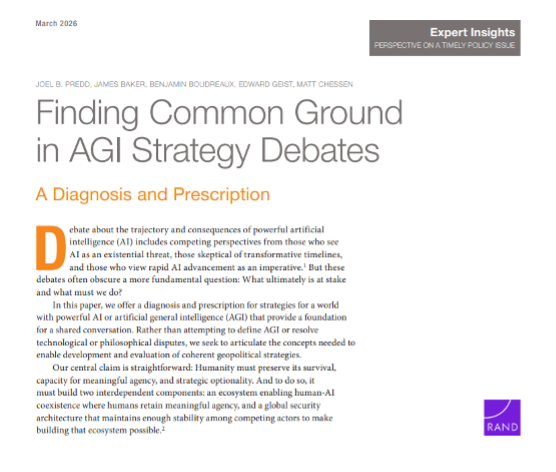
RAND’s recent report, Finding Common Ground in AGI Strategy Debates: A Diagnosis and Prescription, provides new insights into global governance at a moment of impasse. Rather than treating AGI as a matter of technical alignment alone, the report advances abroader strategic framework centered on agency and optionality. At its core is the argument that the challenge posed by AGI is ultimately a struggle to preserve humanity’s capacity to direct its own trajectory. That goal, in turn,requires both an ecosystem of human-AI coexistence and a global security architecture, so that humanity can retain meaningful agency over its future instead of becoming subject to technological forces.
What the editors find most striking about the report is that it identifies a limited but meaningful basis for cooperation in the context of intensifying geopolitical rivalry. Despite their profound differences, the United States and China share an interest in “avoiding futures where their capacity for self-determination is foreclosed.” In that sense, the report goes beyond strategic diagnosis by offering a prescription for coordinated action toward a shared future for humanity.
This article presents a Chinese academic compilation and translation of the report, with the aim of introducing its core arguments and policy insights to Chinese readers. In preparing this version, we have remained faithful to the logic of the original text while making the necessary editorial refinements and stylistic adjustments to meet the publication standards of think tank research.
The views expressed inthe translation are solely those of the original authors and do not represent the positions of the translators, editors, or the publishing platform.
Author
Yuan Luming, Research Assistant of CGAIG
Original link: