


Abstract
On March 24, OpenAI officially announced that it would shut down Sora, its once hugelypopular AI video-generation app. From its breakout debut in 2024, which helped fuelthe global AI video boom, to its eventual removal amid a broader strategicreset, Sora’s rise and fall reflects mounting pressure on multiple fronts:operating costs, intensifying competition, and shifting corporate priorities.Together, these forces pushed OpenAI to part ways with one of its most visibleproducts. Sora’s exit carries longer-term implications for the AI industry,suggesting that aggressive spending and broad-based expansion do notnecessarily translate into sustainable returns. To compete and survive in anincreasingly crowded and fast-moving market, AI companies will need toestablish themselves in a more demanding phase of the industry—one defined byclear business models, well-developed ecosystems, and efficient real-world deployment.
By Xin Yanyan, Zhang Ao, and Liang Ruoxuan from the Research Office of CGAIG
Ⅰ. Costs and Constraints: Sora’s Resource Disadvantage After a Strong Start
In early Q1 2025, OpenAI spearheaded a series of major initiatives, including the StargateProject. With plans running into the hundreds of billions of dollars, thecompany continued to drive up capital-market expectations and fuel the broaderAI boom. By the end of Q1 2026, however, OpenAI’s growth and expansion began togive way to a more pragmatic effort to streamline operations and refocuspriorities. As part of that shift, the company started a new round ofreorganization covering both its product lines and organizational structure. OnMarch 24, OpenAI announced that it would shut down Sora’s standalone app andAPI and remove its built-in video features from ChatGPT, effectively exitingthe consumer AI video-generation market.
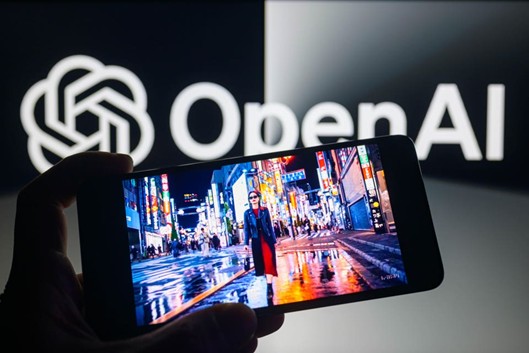
Sorahelped fuel the global AI video boom.
Source: Forbes
When Sora debuted in February 2024, its striking demos quickly triggered a wave ofstartup activity in AI video generation, and it was widely seen at the time assignaling the arrival of the era of multimodal AI models. But the initial surgein attention faded quickly. According to data from digital intelligence firmSensor Tower, Sora briefly rose to the top in Q4 2025 with more than 8 milliondownloads, yet user retention weakened rapidly: weekly downloads dropped from apeak of 1.39 million in mid-November to 326,800 by year-end. Itscommercialization also lagged. Nearly 10 months passed between Sora’s unveilingand its release to regular paying users, leaving valuable time for competitorsto gain ground. As Runway deepened its hold on the professional market, Lumapushed further into mass adoption, and Chinese rivals such as Kling, Vidu, andSeedance moved faster in product rollout and real-world deployment, Sora’searly lead came under increasing pressure over the past two years,narrowing its window of opportunity in AIvideo. Even after the release of Sora 2, the product remained tightlycontrolled and available mainly on an invitation-only basis tied to ChatGPT Proand Plus subscriptions. The lack of a standalone commercial model limitedSora’s ability to scale in the AI video market.
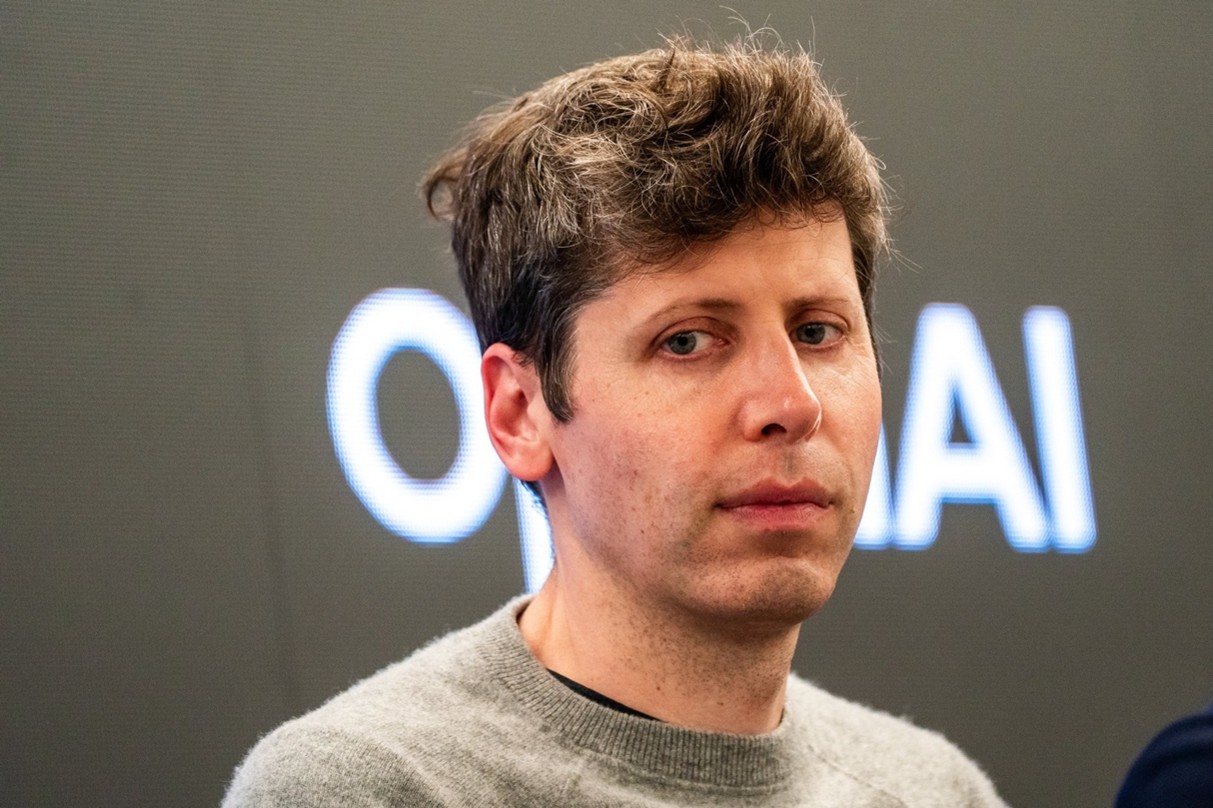
Sam Altman
Source: Bloomberg
Sora had long struggled to generate revenue and sustain profitability. In aninterview last year, Altman acknowledged that while Sora users were highlyactive in content creation, the target audience remained unclear and a clearpath to monetization had yet to take shape.In December 2025, OpenAI entered into a three-year content licensing agreementwith Disney and received a $1 billion equity investment, betting that theintroduction of major Disney characters and franchises would stimulate usercreativity. The results, however, fell short of expectations. For one thing,accounts producing AI-generated derivative content based on Disney charactersfailed to attract sizable followings, and related videos also drewdisappointing numbers of likes. At the same time, compliance risks surroundingAI-generated derivative works based on established characters and franchises,coupled with growing opposition from Hollywood creators, made the partnershipincreasingly difficult to advance. The partnership was terminated followingSora’s shutdown.
Sora was extremely compute-intensive, with a weak return on investment.Forbes estimated that since launch, it had incurred more than $5 billionin operating costs while generating only about $2.1 million in revenue. Onthe one hand, Sora lacked a dedicated source of computing power, leaving itless able to sustain a prolonged contest with rivals. Google’svideo-generation models, backed by in-house algorithms and chips, were betterable to reduce compute costs. ByteDance’s Seedance, by contrast, could leverageTikTok’s built-in distribution and platform advantages to connect both theproduction and output ends of video generation, making it easier to generateeconomies of scale. On the other hand, OpenAI was advancing multiple productlines at the same time, creating internal competition over how resources wereprioritized and allocated. In an internal note, OpenAI Chief ofApplications Fidji Simo acknowledged that “We realized we were spreading ourefforts across too many apps and stacks, and that we need to simplify ourefforts,” adding that the resulting fragmentation had been slowing the companydown and making it harder to meet its quality bar. Compared with text and code models,AI video generationdemandedfar more compute, storage, and moderation resources. That high-investment,low-return model placed a heavy strain on resources that could otherwise havesupported products such as ChatGPT and Codex, where the same level ofinvestment would likely have delivered steadier, larger, and more predictablereturns.
Ⅱ.Competitive Pressures: OpenAI Under Pressure from Its Core Business, Rivals,and Investors
a. Pressure on the Core Business
AI coding tools have now become one of the most commercially viable applicationsfor large language models. Compared withgeneral-purpose chatbots, coding tools are easier to embed into enterpriseworkflows and more likely to drive paid conversion, making them a key gatewayfor companies competing for business clients. Competition, accordingly, hasintensified. Anthropic currently holds a leading position in the coding marketthrough Claude Code, whose annualized revenue has reached about $2.5 billion,while OpenAI’s comparable product, Codex, has only recently crossed the $1billion mark. It is still too early to tell where the market is headed.
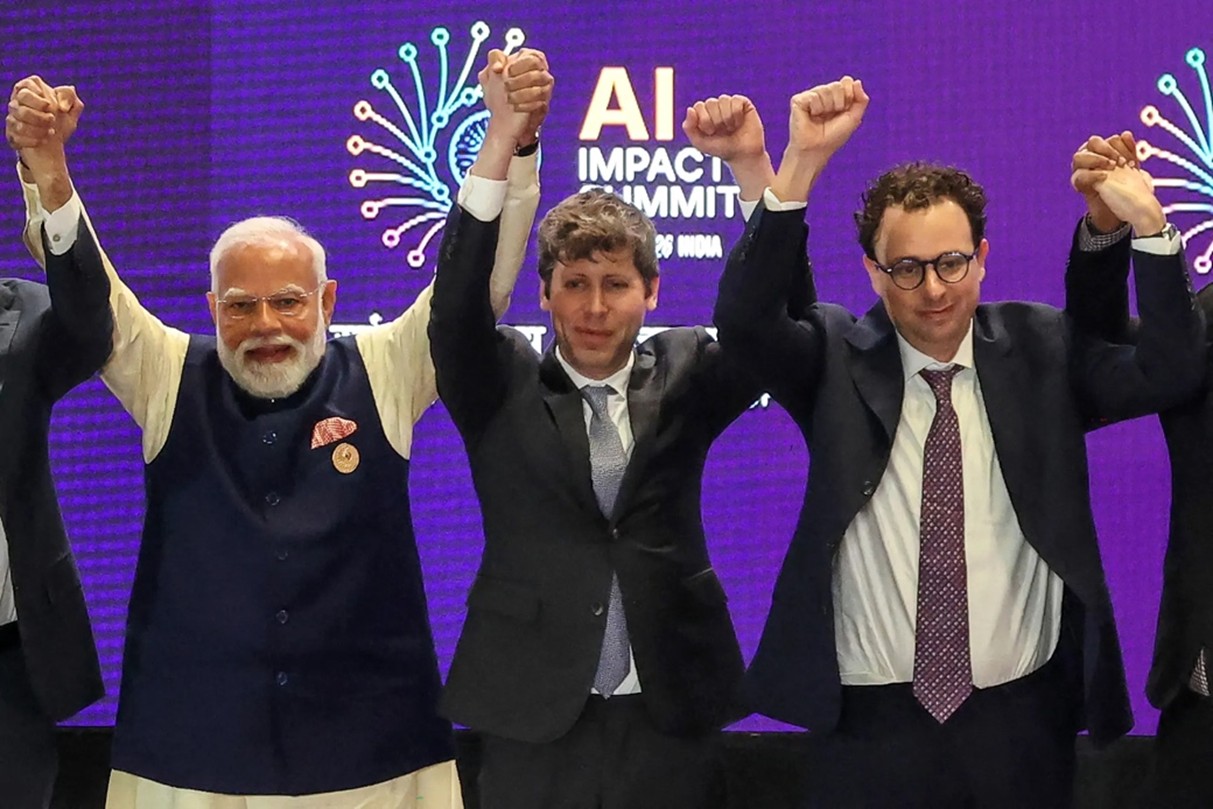
At the India AI Impact Summit in February 2026, OpenAI CEO Sam Altman andAnthropic CEO Dario Amodei declined to hold hands.
Source: Bloomberg
Unlike Anthropic, Google poses a different kind of competitive threat to OpenAIthrough Gemini; its advantage lies more in ecosystem integration and scale thanin any single product advantage. Apptopia data showthat Gemini’s share of the chatbot app market rose from 14.7% in January 2025to 25.2% in January 2026, while ChatGPT’s share fell from 69.1% to 45.3% overthe same period. In terms of monthly active users, Alphabet said on its Q4 2025earnings call that Gemini had surpassed 750 million monthly active users, upfrom 650 million in the previous quarter. By comparison, reports at the end of2025 put ChatGPT’s monthly active user base at around 810 million, indicatingthat the gap in user scale is narrowing quickly.
OpenAI is now under pressure at both ends of the market.On the consumer side, its share is being eroded by Google Gemini; on theenterprise side, it faces an expanding challenge from Anthropic. Menlo Venturesplaces Anthropic’s share of the enterprise market at roughly one-third,compared with about 25% for OpenAI and 20% for Google Gemini. Against thatbackdrop, OpenAI has little strategic choice but to pull back from non-corebusinesses such as Sora and focus its compute and R&D resources on codingtools and enterprise AI. At the same time, any further erosion in ChatGPT’sconsumer-market share could weaken investor confidence in its growth trajectoryand add to the uncertainty surrounding OpenAI’s eventual IPO.
b. Pressure from Rivals
When OpenAI launched Sora in February 2024, it sought to use the product’svideo-generation capabilities to build a TikTok-like content ecosystem duringthe early boom in AI video, hoping to attract and retain consumers by buildinga creator community. In practice, however,Sora struggled to make the leap from a generative tool to a content platform. Thenovelty of AI-generated video wore off quickly, and uneven content quality madeit difficult for Sora to build the kind of healthy, self-sustaining user interactionthat gives content platforms lasting appeal. Sora ran into this problem almostimmediately after launch, as the initial burst of interest quickly subsided.Sensor Tower found that Sora users spent about 13 minutes aday on the app, compared with roughly 90 minutes for TikTok. That shallow,try-it-and-leave pattern made it difficult for Sora to compete with establishedcontent platforms such as TikTok, YouTube, and Instagram.
Onthe other hand, Sora showed little meaningful advantage over rival AI videoproducts. What began as a clear head start quicklyeroded—and in some cases gave way to outright disadvantage—as rival productsmoved from showcase demos to market-ready products. At the product level, Sorahas faced pressure from multiple directions, including Runway, Kling, andGoogle Veo, yet has failed to show a clear advantage on key dimensions such asvideo length, resolution, pricing, and support for professional creative workflows.A detailed comparison published by Greek tech site OnOff.gr on February 19,2026, found that Sora supports videos of about 60 seconds at up to 1080p, andis priced through ChatGPT Plus at $20 per month or ChatGPT Pro at $200 permonth. By comparison, Sora offered only half of Kling’s video length, fellshort of Runway’s 4K resolution, and remained significantly more expensive thanits rivals. For professional creators, Runway’s 4K output and more cinematicvisual quality were likely to hold greater appeal. For ordinary users and thebroader Asian market, Kling’s free offering and much longer video duration madeit the more attractive choice.
Atthe technical level, the leading players in AI video each bring their ownstrengths and weaknesses. In a market that evolves this quickly, today’stechnical lead can be short-lived, and early momentum does not necessarilytranslate into market success. The bigger difference lay in productstrategy. Compared with its main rivals, OpenAI never defined Sora’s role inthe market as clearly. Competitors did not try to sell AI video as a standaloneproduct; instead, they incorporated it into broader multimodal offerings, usingvideo generation to strengthen the appeal and staying power of their widerproduct suites. Google’s Veo, for example, is deeply integrated intoGemini, allowing users to access video generation within conversation, search,and creation flows without switching products. ByteDance’s Seedance, backed byTikTok, can move smoothly from video generation into distribution, naturallylinking production and consumption. Runway, meanwhile, is designed forpost-production teams, placing video generation directly within professional creativepipelines. Embedded in larger ecosystems, these rival products do not have toprove their commercial value on a standalone basis.
When Sora first appeared, OpenAI invested it with a much bigger ambition: to exploreso-called “world simulators.” In its February 2024technical report, OpenAI argued that scaling video-generation models offered “apromising path towards building general purpose simulators of the physicalworld.” Yet from the perspective of many domain experts, tying Sora soclosely to the idea of world models risked overstating the case. YannLeCun, often described as a pioneer of convolutional neural networks,questioned this line of thinking as soon as Sora was released, writing on Xthat “modeling the world for action by generating pixels” was “a terribleidea.” As he argued, generating realistic-looking images from prompts does notmean a system understands the physical world. In his view, generation isfundamentally different from building a world model for causal prediction: thespace of plausible-looking images is vast, and an image generator only needs toproduce one convincing sample to succeed.
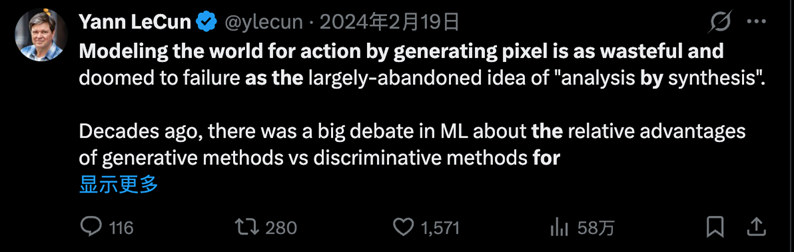
YannLeCun criticized Sora’s technical approach on social media soon after itslaunch.
Source: X
Over time, Sora also drew criticism for its limited handling of complex physics,often producing outputs that seemed convincing overall but broke down on closerinspection. Built on a Transformer architecture, Soracould steer video generation to a certain extent through natural-language prompts.But natural language alone is not precise enough to encode physical laws,leaving controllability as a persistent weakness: outputs were difficult tosteer with precision, object behavior could vary from frame to frame, andvideos required strict continuity checks. Runway’s GWM-1, however, reflectsa different line of thinking. It generates video frame by frame in realtime and supports multiple control inputs, including camera pose, robotcommands, and audio. GWM-1 is aimed not at ordinary content creators but atengineers and developers working in specialized scenarios. In that sense,Runway did not outperform Sora simply on the dimension of visual polish.Instead, it moved from the goal of generating more realistic images to that ofproviding a more controllable environment, allowing it to move beyond a head-onrace over visual quality and carve out a distinct position in AI video.

Familiesof deceased public figures, including Martin Luther King Jr., accused Sora ofenabling crude AI-generated fake videos.
Source: NPR
Beyond intensifying competition, Sora also came under heavy compliance pressure fromrepeated copyright disputes and litigation.In early October 2025, when Sora 2 was released, its opt-out copyrightpolicy—under which copyrighted characters could be used by default unlessrights holders actively chose to exclude them—triggered a fierce backlash fromthe film and television industry. OpenAI was then forced to reverse coursewithin three days, replacing the opt-out system with an opt-in model thatrequired explicit authorization from rights holders before such content couldbe used. Copyright risk was only part of the problem. Another major sourceof pressure came from the regulatory and social fallout surrounding deepfakes.From the moment Sora was launched, concerns persisted that AI video wouldaccelerate the spread of false and misleading content. Sora was also used togenerate fake videos of politicians, celebrities, and even ordinary users. Suchcontent spread rapidly across social media and caused significant social harm.More troubling still, some of these videos contained violent or racist content,making them easily exploitable for fraud, harassment, or the stoking of socialtensions. Although OpenAI later imposed tighter restrictions on copyrightedmaterial and generated content, those measures also narrowed the model’screative range, reducing output quality and contributing to further userattrition.
c. Pressure from Investors’ Strategic Priorities
Sora’s shutdown also reflected a strategic adjustment by OpenAI following its latestcapital raise. On February 27, 2026, the company announced anew $110 billion funding round at a post-money valuation of $730 billion. Thenew financing also brought a noticeable shift in investor priorities, withgreater attention now focused on how OpenAI plans to turn growth into profits.Market expectations likewise increasingly centered on the sustainability of itsbusiness model. Against that backdrop, projects likeSora—capital-intensive, slow to generate returns, and lacking a credible routeto monetization—came under closer scrutiny.
As OpenAI’s valuation continued to climb, investors placed greater weight onbusinesses with more dependable income streams, particularly enterpriseproducts and developer tools. The AI video market, by then, had become anincreasingly crowded field: technical gaps between products were narrowing,compute costs remained high, and large-scale revenue looked difficult toachieve in the near term. From a returns perspective, shifting resourcesfrom Sora to coding tools and enterprise-facing products was the more rationalchoice, as it was more likely to strengthen OpenAI’s broader earnings story.The market now widely expects OpenAI to go public in Q4 2026. At that stage,the company will need to present a clearer route to profitability topublic-market investors. At the same time, OpenAI has been pursuing aproduct-integration strategy aimed at turning ChatGPT, its Codex codingplatform, and browser capabilities into a desktop “super app,” streamlining theuser experience while scaling back side projects and concentrating resources oncore businesses with stronger commercial prospects.

Source: Financial Times
Another important factor behind OpenAI’s business reshuffle was the uncertaintysurrounding compute supply. As global demand forAI infrastructure surged and high-end chip supply tightened, access to computebecame a major constraint on expansion across the sector. At the same time,OpenAI’s capital and compute relationship with NVIDIA became lessstraightforward: an earlier plan for up to $100 billion in investment stalled,and although the two sides are now close to completing a new compute deal worthabout $30 billion, the scale is clearly below what had once been under discussion.The two companies are still working together, but less closely than before. Tocope with supply pressure, OpenAI has increasingly spread its bets, strikingdeals with AMD, Oracle, and Broadcom and building out compute commitmentsmeasured in the tens of gigawatts. That strategy helps diversifysupply-chain risk, but it also broadens the company’s cost exposure and raisesthe financial stakes. More importantly, this web of arrangements hasevolved beyond ordinary supplier relationships into a tightly interlockedcapital structure. Some industry observers have questioned whether such dealsblur the line between cross-holdings and reciprocal purchasing, warning that ifdemand falls short of expectations, pressure could ripple through the entirechain at once. For OpenAI, which is pushing toward an IPO, shutting down Sorawas not exactly a desperate attempt at self-preservation. It was, however, aform of strategic subtraction intended to relieve strain, slim the companydown, and keep resources focused on businesses the market is more likely toreward.
Ⅲ. Long-Term Considerations: Outlook and Implications
Sora’s discontinuation was not so much a failure of the product itself as the cost ofa broader strategic reset. The move has been read as an important step inOpenAI’s effort to streamline its business lines and reset corporate strategy. In its officialannouncement, OpenAI said it would concentrate compute resources onnext-generation AI models and agentic products, while CEO Sam Altman wouldshift more of his attention to fundraising and supply-chain management so thecompany could focus on building data-center capacity at unprecedented scale.According to The Information, the shutdown of Sora was widely seen internallyas the first step in clearing out the company’s “side quests.” As the need tostreamline the business, tighten coordination, and focus on more commerciallyviable and deployable products became more pressing, Sora increasingly came tobe seen as a burden. Its shutdown therefore signaled more than the end of asingle product: it reflected OpenAI’s broader shift away from expansion drivenmainly by heavy spending and ambitious narratives, and toward a moredisciplined and commercially grounded approach as competition in AI enters amore demanding phase.
Sora’s departure may prove catalytic for the AI video sector as a whole.Across the market, Sora came to represent a technical path centered on lifelikevisuals and advanced physical simulation, thereby setting an exceptionally highbar for cinematic quality, audiovisual coherence, and continuity. Yetexperience has shown that isolated advances in model capability, howeverstriking, are not enough on their own to sustain a product or secure lastingcommercial value. As video quality increasingly becomes a basic threshold acrossthe industry, the next phase of competition may be defined less by visualfidelity alone than by controllability and usability. For the leadingplayers in AI video, the challenge now is to deliver more efficient workflowsand more precise creative control, so that these tools can enhance not onlywhat creators are able to make, but also the overall productivity and creativecapacity of the industry.
Rather than closing the book on AI video, Sora’s shutdown has exposed some of thesector’s most persistent structural weaknesses, including the lawful sourcingof training data, the labeling of AI-generated content, and platform moderation. Notlong after Sora went offline, ByteDance was forced to suspend the plannedglobal rollout of Seedance 2.0 after copyright disputes with major Hollywoodstudios and streaming platforms, while Midjourney had already been sued byDisney and Universal on similar grounds. For AI video to mature over thelong term, the industry will need not only technically outstanding unicorns,but also firmer legal lines between innovation and rights protection, alongwith a fairer way of sharing value among creators, platforms, and copyrightholders. OpenAI may have to part ways with Sora, but the industry’s deeper needis for a durable content system built on well-defined limits and enforceableaccountability.
Authors
Xin Yanyan, Deputy Secretary-General of CGAIG and Assistant Research Fellow at FDDI
Zhang Ao, Research Assistant of CGAIG
Liang Ruoxuan, Research Assistant of CGAIG
OriginalURL: https://mp.weixin.qq.com/s/dLQ200WQ9fOkGGcnc2bIIg