

“AI is a nascent industry, and it is also an industry that belongs to young people.” During an inspection tour in Shanghai in April 2025, Xi Jinping, general secretary of the Communist Party of China (CPC) Central Committee, Chinese president and chairman of the Central Military Commission, noted that AI technologies are evolving rapidly and entering a phase of explosive growth. He urged Shanghai to summarize its successful experience in fields such as nurturing the AI industry through a large model industrial ecosystem, intensify exploration efforts, and strive to take the lead in every aspect of AI development and governance, thus setting an example for other regions.
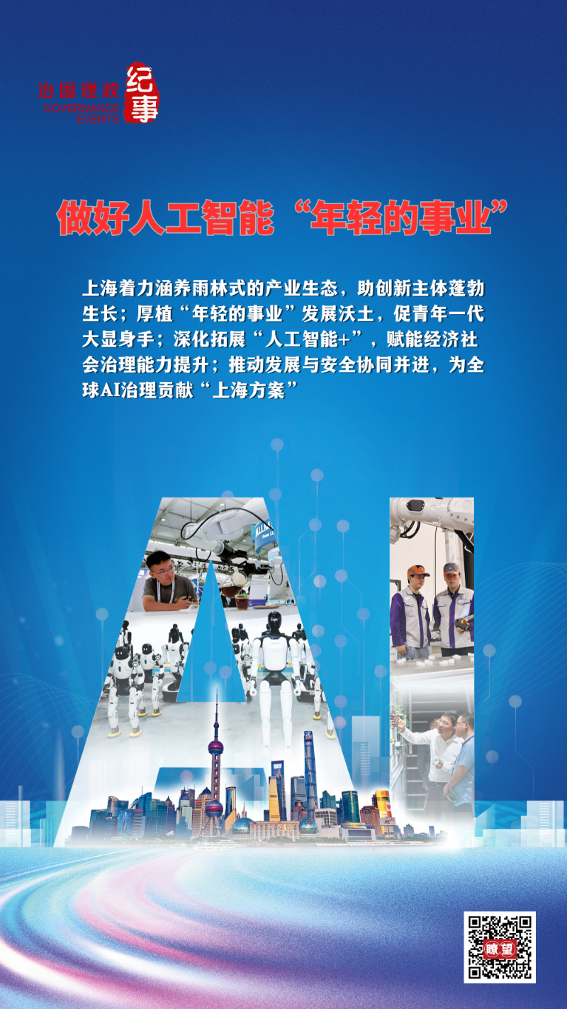
Shanghai is working to foster a vibrant and diverse AI industrial ecosystem for innovation, create fertile ground for the development of this nascent industry, further advance the AI Plus initiative, and coordinate development and security, thereby contributing a “Shanghai solution” to global AI governance.
The number of enterprises based in the Shanghai Foundation Model Innovation Center, a large model incubator in Xuhui District, has grown from more than 100 in 2024 to over 200. Among them are more than 20 potential unicorn enterprises with valuations exceeding 1 billion yuan, and more than 60 percent of Shanghai’s registered large-model enterprises are concentrated there.
To ensure that strong models have the computing power they need, robust applications have adequate corpora, and quality products have reliable access to chips, Shanghai has systematically strengthened support for key factors of production, promoted the coordinated development of high-performance intelligent computing chips, high-quality corpora, and high-efficiency intelligent computing clusters, and laid a solid foundation for upgrading large models and advancing embodied intelligence technologies toward maturity.
This year, through Shanghai Artificial Intelligence Research Institute’s AGI for Science Qomolangma Plan, or AGI4S Qomolangma Plan, Shanghai has fully opened channels for cooperation in computing power, data, models, platforms, application scenarios, projects, and talent, aiming to build a national hub for AI for Science (AI4S).
“In the past, we tended to choose promising saplings and pick ready fruit. Now, we are focused on cultivating seeds and seedlings and giving them the water and nutrients they need. We focus on early-stage, small-enterprise, hard-tech, and long-term investment, while allowing trial and error and tolerating failure,” said Chen Yong, deputy head of Xuhui District in Shanghai.
Shanghai is deeply implementing the AI Plus initiative, strengthening the integration of AI with industrial development, public services, and urban governance, aiming to take the lead in AI industrial applications and empower all sectors across the board.
By reporters of Outlook Weekly
Shanghai started early, planned broadly, and has delivered notable results in artificial intelligence (AI) development. The city accounts for nearly 10 percent of China’s intelligent computing supply capacity and is home to around one-third of the country’s AI talent. It operates China’s first public corpus service platform and has released more than 150 registered large models, while also leading the world in humanoid robot shipments and achieving breakthroughs in several intelligent chip technologies. In 2025, Shanghai’s 394 above-designated-size AI enterprises generated more than 637 billion yuan in industrial output, up 39.5 percent year on year.
“AI is a nascent industry, and it is also an industry that belongs to young people.” During an inspection tour in Shanghai in April 2025, Xi Jinping, general secretary of the Communist Party of China (CPC) Central Committee, Chinese president and chairman of the Central Military Commission, noted that AI technologies are evolving rapidly and entering a phase of explosive growth. He urged Shanghai to summarize its successful experience in fields such as nurturing the AI industry through a large model industrial ecosystem, intensify exploration efforts, and strive to take the lead in every aspect of AI development and governance, thus setting an example for other regions.
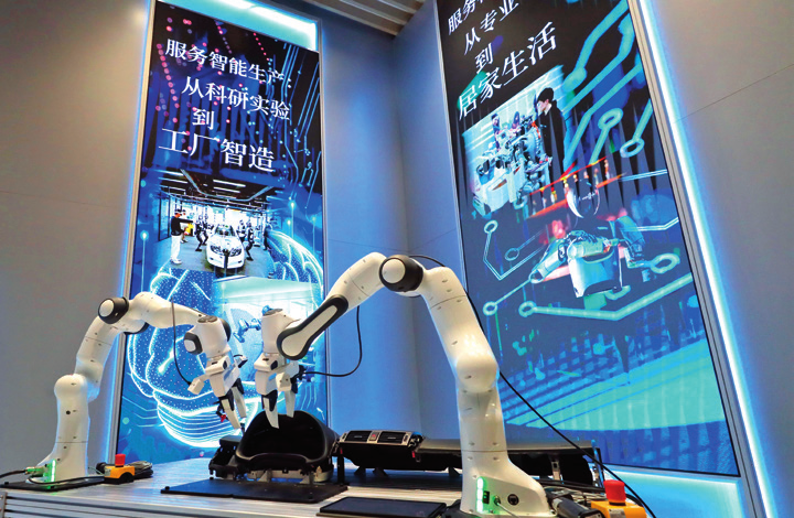
AI products displayed inside the Shanghai Foundation Model Innovation Center in Xuhui District, Shanghai, April 29, 2025.
Photo by Fang Zhe/Outlook Weekly
During his visit to the Shanghai Foundation Model Innovation Center, a large-model innovation ecosystem community in Xuhui District, Xi said China has abundant data resources, a complete industrial system and huge market potential, offering broad prospects for AI development. He emphasized the need to strengthen policy support and talent cultivation, and to strive for the creation of more high-quality, safe and reliable products.
These remarks have provided important guidance for Shanghai’s AI development.
Ministry-municipality coordination has provided strong support for Shanghai’s exploration of AI development and governance. The World Artificial Intelligence Conference (WAIC) is co-hosted by the National Development and Reform Commission and other departments and institutions, together with the Shanghai Municipal People’s Government. The Ministry of Industry and Information Technology has supported the establishment of a pilot zone for AI innovation and application in Pudong New Area, Shanghai; the Ministry of Science and Technology has supported Shanghai in building a national pilot zone for next-generation AI innovation and development; and the Ministry of Education and Shanghai have jointly supported the establishment of Shanghai Innovation Institute.
In 2025, building on earlier efforts to establish the Shanghai Artificial Intelligence Industry Investment Fund, promulgate China’s first provincial-level local regulation on the AI industry, the Regulations of Shanghai Municipality on Promoting the Development of the Artificial Intelligence Sector, and launch the “Modeling Shanghai” action plan, Shanghai issued a series of documents, including the Several Measures to Further Expand the Application of Artificial Intelligence in Shanghai and the Shanghai Implementation Plan for Accelerating “AI Plus Government Services” Reform and Promoting the “One-Stop Government Services” Initiative. These efforts aim to foster a vibrant and diverse AI industrial ecosystem for innovation, create fertile ground for the development of this nascent industry, further advance the AI Plus initiative, and coordinate development and security, thereby contributing a “Shanghai solution” to global AI governance.
A leading official of the CPC Shanghai Municipal Committee said, “Science and technology are a foundational and strategic pillar of Chinese modernization, and AI is a pioneering industry that Shanghai is prioritizing. We are coordinating development and security, advancing scientific and technological innovation and security governance in parallel and in the same direction, and striving to take the lead and set an example in all aspects of AI development and governance.”
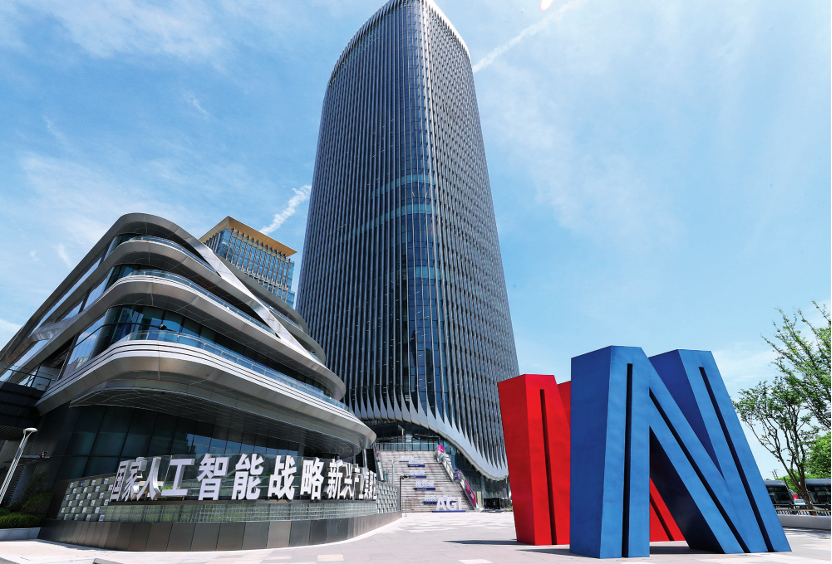
The Shanghai Foundation Model Innovation Center, a large model incubator in Xuhui District, Shanghai, April 29, 2025.
Photo by Fang Zhe/Outlook Weekly
Laying the Groundwork for Shanghai as an AI Hub
Humanoid robots sparred in boxing demonstrations, robotic dogs picked up litter on their own, students exchanged verses with large models, and start-up projects pitched directly to investors for targeted support in computing power, corpora and other resources. In July 2025, the eighth WAIC was held in Shanghai, offering a vivid display of the momentum behind the city’s AI industry.
In the view of Song Haitao, dean and president of the Shanghai Artificial Intelligence Research Institute, one reason AI remains a “nascent industry” is that it is now at a critical juncture in moving from the laboratory into production and everyday life. Technological iteration is being matched with real-world application, while technological pathways, industrial ecosystems and application models have yet to fully take shape. This is precisely where the opportunity lies. China and other countries are broadly running neck and neck, able to compete on the same stage and work together to create a new landscape.
China has built a vast industrial system covering all 41 major industrial categories, and the overall scale of its manufacturing sector has ranked first in the world for 16 consecutive years. In 2024, China’s data output reached 41.06 zettabytes, accounting for 26.67 percent of the global total. “China has a complete industrial system, massive data resources and a vast application market, giving it comparative advantages in supporting the full industrial chain and enabling full-scale digital transformation. This provides a solid foundation for AI to deeply empower industries,” said Wu Tongning, deputy director of the Artificial Intelligence Research Institute at the China Academy of Information and Communications Technology. He said advancing AI would help further translate China’s industrial, data and market strengths into competitive, developmental and national-strength advantages.
During the 14th Five-Year Plan period (2021–2025), Shanghai’s gross regional product grew at an average annual rate of 4.9 percent to reach 5.67 trillion yuan, placing the city among the world’s top five cities. As a frontier of China’s reform and opening up and an international metropolis deeply connected to the world, Shanghai has a solid industrial foundation, diverse consumption scenarios, abundant talent resources, a head start in institutional innovation, and efficient urban governance. It also shoulders the historic mission of building itself into an international science and technology innovation center. “In line with the laws of technological evolution, and by seizing this historic opportunity and serving national strategies, Shanghai is accelerating the building of an AI development hub. It has irreplaceable foundational strengths and an inescapable responsibility,” said Zhang Ying, deputy secretary-general of the Shanghai Municipal Government.
With comprehensive and effective policy support, precise and efficient allocation of key factors, and a spatial layout built on complementary strengths, Shanghai is treating AI development as a strategic long-term endeavor. It is building a complete ecosystem covering policies, funding, computing power, corpora and space, laying a solid foundation for AI as a nascent industry.
With forward-looking thinking, Shanghai is positioning itself in key areas and strengthening systematic planning through a combination of overall coordination and targeted measures. Focusing on basic research, technological breakthroughs, scenario-based applications, industrial clustering, the development of AI professionals and governance rules, the city has built a full-chain policy system, creating a fertile policy environment in which its industrial ecosystem can flourish.
Shanghai is targeting key areas for breakthroughs. It has focused precisely on large models, a key technological carrier and new type of infrastructure driving AI development. Through dedicated plans to support innovation, accelerate intelligent computing and promote demonstration applications for large models, the city is strengthening their innovation capacity, improving the supply of key innovation resources, and promoting their application in real-world scenarios.
Under the “Modeling Shanghai” action plan, Shanghai is working to build foundational platforms such as intelligent computing clusters, corpus supply systems, virtual-real integrated training grounds, and industry foundation large models. It is developing productivity tools in key areas including intelligent terminals, AI for Science (AI4S), the online new economy, autonomous driving, and embodied intelligence, while accelerating the use of AI to empower priority sectors such as finance, manufacturing, education, healthcare, culture and tourism, and urban governance.
Data released by the Cyberspace Affairs Commission Office of the Shanghai Municipal Party Committee on April 3 showed that the city had added seven registered generative AI services. Just over half a month after Shanghai announced its previous batch of registered services on March 16, the number had risen from 150 to 157.
Shanghai is making comprehensive breakthroughs through full-stack innovation. Through coordinated development between Pudong and Xuhui, two districts in the city’s east and west respectively, the city has created a differentiated layout and fostered an environment with low costs for innovation and a high concentration of expertise, promoting coordinated development across the full AI industrial chain. Pudong New Area is focusing on embodied intelligence and vertical applications, and has gathered nearly 200 upstream and downstream ecosystem companies in areas such as intelligent computing chips and smart terminals. Xuhui District is focusing its efforts on building a large-model industrial ecosystem. The number of enterprises based in the Shanghai Foundation Model Innovation Center, a large model incubator in Xuhui District, has grown from more than 100 in 2024 to over 200. Among them are more than 20 potential unicorn enterprises with valuations exceeding 1 billion yuan, and more than 60 percent of Shanghai’s registered large-model enterprises are concentrated there. At present, Xuhui District is home to more than 1,700 AI-related enterprises, including over 900 large-model enterprises.
Recently, Shanghai’s AI sector has reported a string of positive developments. Around the turn of the year, emerging chip companies such as MetaX, Biren Technology and Iluvatar CoreX were listed on the STAR Market, China’s Nasdaq-style science and technology innovation board, and the Hong Kong Stock Exchange. Soon after, large-model company MiniMax also went public in Hong Kong. On March 28, AGIBOT, a leading company in the embodied intelligence chain, saw its 10,000th general-purpose embodied robot, Expedition A3, roll off the production line, just over three months after its 5,000th unit did so.
“From underlying computing chips to upper-layer AI large models and embodied intelligence, Shanghai has kept its efforts aligned with national strategies, demonstrating strong momentum in full-stack innovation and comprehensive breakthroughs,” said Tang Wenkan, director of the Shanghai Municipal Commission of Economy and Informatization.
Shanghai is upgrading the supply of key factors through systematic thinking, creating a catalytic effect across the AI ecosystem. To ensure that strong models have the computing power they need, robust applications have adequate corpora, and quality products have reliable access to chips, Shanghai has systematically strengthened support for key factors of production, promoted the coordinated development of high-performance intelligent computing chips, high-quality corpora, and high-efficiency intelligent computing clusters, and laid a solid foundation for upgrading large models and advancing embodied intelligence technologies toward maturity.
To address the difficulty large enterprises face in accessing computing power and the high costs that keep small and medium-sized enterprises from using it, Shanghai has built China’s largest computing-power dispatch platform. The city provides 1 billion yuan in computing-power vouchers each year and, through a “use first, pay later” model and automatic access without application, helps enterprises quickly and affordably tap into the city’s heterogeneous computing resources with a combined capacity of 140,000 P, a peta-scale measure of computing power.
To meet the urgent need among companies developing large models for high-quality corpora, Shanghai has built China’s first corpus operation platform. Focusing on key areas such as AI4S, industrial manufacturing, and embodied intelligence, the platform has gathered 10,000 TB of datasets and connects 100,000 developers in China and abroad.
Shanghai has included skilled AI professionals in its special talent awards for key industrial sectors, and has listed “AI trainer” in the city’s catalog of urgently needed high-skilled occupations and priority-supported skilled occupations. In 2025, 16,300 people in Shanghai took part in AI trainer skills assessments, and 10,900 obtained vocational skill level certificates.
On the investment front, Shanghai is guided by the national AI fund and the municipal AI fund of funds. Focusing on key factors such as computing power and corpora, the city has established special-purpose sub-funds and linked them with district-level funds to build a financing support system covering the full lifecycle from seed-stage companies to mature companies. In January 2026, Shanghai-based large-model unicorn StepFun completed a Series B+ funding round of more than 5 billion yuan, marking the largest single fundraising round in China’s large-model sector over the previous 12 months.
In addition, Shanghai has been proactive in opening up application scenarios to empower AI enterprises. Recently, focusing on the core business needs of municipal state-owned enterprises, the Shanghai Municipal State-owned Assets Supervision and Administration Commission, or Shanghai SASAC, released 50 scenario-based challenges from eight key municipal SOEs, including Shanghai Electric and Shanghai International Port (Group) Co., Ltd. (SIPG). With genuinely open test environments and truly inclusive support in data, corpora and computing power, the initiative enables diverse innovative entities to enter real-world scenarios and helps close the loop between technology and commercialization.
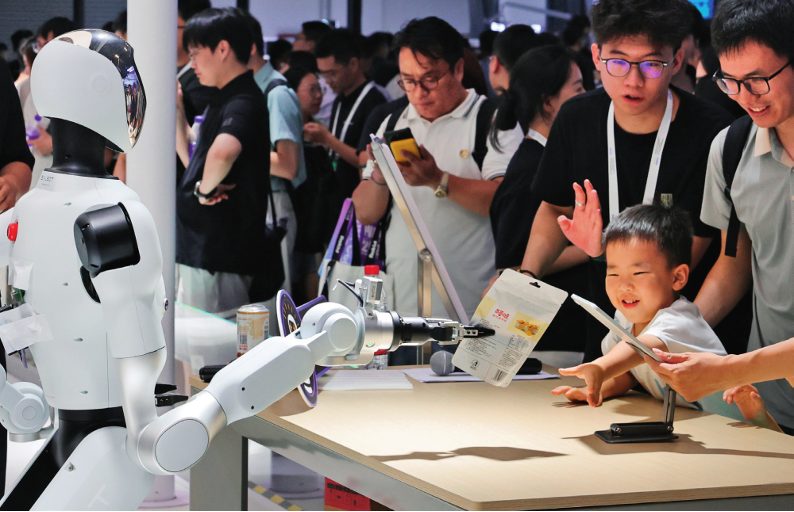
At the exhibition site of the 2025 World Artificial Intelligence Conference in Shanghai, a child receives a product he selected from the robotic hand of a service robot, July 26, 2025.
Photo by Fang Zhe/Outlook Weekly
Empowering Young People to Explore a Nascent Industry
During the 2026 Spring Festival holiday, DeepGen 1.0, a lightweight unified multimodal model led by Wang Dianyi, a direct-entry PhD student in the 2024 cohort at Shanghai Innovation Institute, topped the trending list on the open-source community Hugging Face.
“At the institute, papers are not the only measure of success. Impact comes from research, development, industry and society—for example, the number of downloads of models and datasets, and investment from leading funds. Every project is real-world practice,” Wang said.
Seizing the historic opportunities presented by AI development, Shanghai has systematically optimized its approach to developing skilled professionals and advancing scientific and technological innovation. It has taken forward-looking steps to identify and support promising talent and projects early, supported new forms of AI-enabled entrepreneurship such as OPCs, or one-person companies, and created an innovation ecosystem that tolerates trial and error and supports long-term growth, enabling young people to explore freely and display their talents with guidance from top faculty, backing from patient capital and support from industrial scenarios.
Shanghai Innovation Institute helps young people focus on innovation and entrepreneurship through an integrated education model combining research, innovation and learning. As an innovative measure under the ministry-municipality cooperation between the Ministry of Education and Shanghai to explore high-level talent development, the institute aims to train top AI talent capable of going head-to-head with the best. To support this model, Shanghai has helped the institute build infrastructure for disruptive innovation, including large-scale computing power and engineering innovation platforms, and granted it a series of extraordinary measures, such as full autonomy in the use of funds.
“Today, disruptive technologies no longer necessarily originate first in laboratories. The traditional divide between upstream research and downstream industry is becoming increasingly blurred, and a project may be closely tied to capital and the market from the very beginning of its R&D process,” said Ding Xiaodong, Party secretary and executive vice-president of Shanghai Innovation Institute.
At Shanghai Innovation Institute, top faculty with an average age of 36 select high-potential students who think against convention and have the courage to pursue breakthrough work. They deploy research projects through an “investment-incubation-exit” model, allowing projects to identify problems early, learn quickly and adjust course in time. So far, the institute has incubated 24 high-valuation enterprises founded by faculty and students, with a combined valuation exceeding 3 billion yuan.
AI is helping optimize scientific research paradigms and clear the path for researchers seeking breakthroughs. This year, through Shanghai Artificial Intelligence Laboratory’s AGI for Science Qomolangma Plan, or AGI4S Qomolangma Plan, Shanghai has fully opened channels for cooperation in computing power, data, models, platforms, application scenarios, projects, and talent, aiming to build a national hub for AI4S.
Scale-up has long been a formidable technical challenge in new materials R&D. “In the past, verifying the feasibility of a formula required building facilities of different scales, which consumed a great deal of time and effort,” said Zhou Tianhang, an associate professor at China University of Petroleum. Shanghai Artificial Intelligence Laboratory, ZhongHai Energy Storage Technology Co., LTD. and China University of Petroleum formed a joint research team on long-duration energy storage. By fully leveraging the cross-scale generalization capabilities of large models, the team built a molecule-to-grid industrial agent and successfully applied AI to specific industrial processes. This is equivalent to equipping energy-storage materials R&D with a “super R&D assistant,” connecting the entire process from microscopic molecular structure design and pilot-scale process scale-up verification to macroscopic power-grid dispatch adaptation. The “impossible triangle” of energy efficiency, safety and lifespan in energy-storage materials has been broken, and the research results have already been deployed at an MWh-scale power station.
The DeepLink integrated supercomputing and intelligent computing platform has broken down the barriers between traditional supercomputing and intelligent computing. It has created a unified view of computing resources, making the scheduling of diverse heterogeneous computing resources as easy to access as a public utility. The Sciverse scientific intelligence database has parsed more than 25 million scientific papers with high fidelity and is expected to reach the 100 PB level in the future. Once completed, it will cover China’s entire graduate-level disciplinary system and provide a highly accurate and timely AI-ready data foundation for scientific discovery. A new embodied autonomous experimental platform has opened the “last mile” from inference to verification, enabling the autonomous completion of complex physical transfers and precise experimental operations, and significantly shortening research cycles that once took years. Shanghai Artificial Intelligence Laboratory is exploring the creation of intelligent infrastructure to support researchers across the country, opening a new chapter in Shanghai’s efforts to lead a transformation in scientific research paradigms through AI.
Shanghai is strengthening its focus on early-stage incubation, identifying and supporting promising projects and start-ups at an early stage. At the municipal level, Shanghai has established a 10-billion-yuan-scale pilot AI industry fund of funds; Xuhui District has set up an AI youth entrepreneurship fund with a scale of 2 billion yuan; and INESA, a Shanghai-based state-owned electronics and information technology group, has established an intelligent-computing pilot private equity fund of more than 5 billion yuan. Through substantial financial investment, Shanghai is providing timely support to AI enterprises facing funding gaps and helping start-ups make a critical leap.
Late one night in 2023, when the investment team of Growth FOF, a fund management platform under Shanghai International Group (SIG), completed its final round of due diligence on MiniMax, the company’s R&D team was still tirelessly optimizing algorithms. At that moment, the investor decided to look beyond the short-term controversy and volatility of the “battle of a hundred models” and focus instead on the long-term value of hard-tech breakthroughs, helping keep this promising AI start-up in Shanghai.
In just four years, MiniMax, whose employees are on average born after 1995, has grown to serve more than 230 million users in over 200 countries and regions. It now has 214,000 enterprise users and developers, with overseas revenue accounting for more than 70 percent of the total. Yan Junjie, founder of the company, said governments at all levels in Shanghai have a deep understanding of the AI industry and an open, inclusive mindset, nurturing early-stage companies from the ground up and supporting their steady growth.
Moreover, in response to the current boom in OPCs, Xuhui District issued the Several Measures to Support the Deep Application of Artificial Intelligence and Build Super Entrepreneur Communities at the end of 2025. The measures provide early-stage support such as workstation fees waived in the first year and subject to assessment for continued waiver in the second year; talent rental subsidies of up to 2,000 yuan per month for up to three years; subsidies of up to 1 million yuan each in computing-power vouchers, model vouchers and corpus vouchers, with support packages such as “use first, pay later” for computing power.
“In the past, we tended to choose promising saplings and pick ready fruit. Now, we are focused on cultivating seeds and seedlings and giving them the water and nutrients they need. We focus on early-stage, small-enterprise, hard-tech, and long-term investment, while allowing trial and error and tolerating failure,” said Chen Yong, deputy head of Xuhui District in Shanghai. In developing AI, Shanghai does not judge success by immediate returns. Instead, it takes into account the broader needs of national strategy, long-term development and the future growth of young professionals, reserving the best space and the highest-quality resources for innovation and creativity.
Since its establishment in July 2024, the 10-billion-yuan-scale pilot AI industry fund of funds has maintained a very high investment intensity, with investment decisions totaling more than 7 billion yuan. Among Shanghai AI companies that secured financing in 2025, one in every four had received investment from the pilot ecosystem fund.
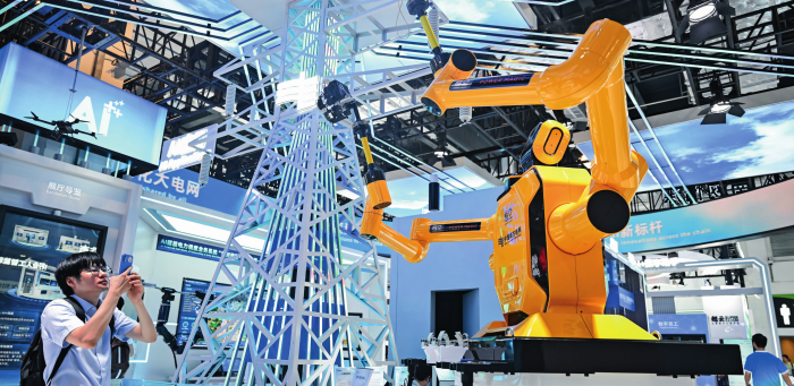
A visitor takes photos of the “Wukong” live-line operation robot at the China Southern Power Grid exhibition area during the 2025 World Artificial Intelligence Conference in Shanghai, July 28, 2025.
Photo by Chen Haoming/Outlook Weekly
Taking the Lead in AI Industrial Applications
At Yangshan Deep-Water Port, an automated terminal has set new records for operational efficiency. The industrial digital-intelligence public service platform Haizhi Online has helped 800,000 small and medium-sized enterprises across China improve their capacity to take orders globally. Companies such as XtalPi are using intelligent autonomous experimentation platforms to increase the efficiency of drug molecule screening and synthesis by dozens of times. At present, the rapid development of AI is historically converging with China’s efforts to cultivate new quality productive forces and promote economic and social transformation. Advancing the AI Plus initiative to raise the level of intelligence in economic and social development and strengthen public services and urban management capacity is both an urgent task and a strategic priority.
Shanghai is deeply implementing the AI Plus initiative, strengthening the integration of AI with industrial development, public services, and urban governance, aiming to take the lead in AI industrial applications and empower all sectors across the board.
Shanghai is strengthening mutual empowerment and using real-world scenarios to drive the development of new quality productive forces. Recently, Nengzai No. 1, SAIC Motor’s first embodied-intelligence humanoid robot employee, officially began work on the battery mass-production line for the Buick Electra E7, taking on core processes such as battery cell gripping and loading. This offers a vivid example of mutual empowerment between AI and industrial development: manufacturers introduce cutting-edge technologies to address pain points on production lines and improve intelligent manufacturing, while AI enterprises gain opportunities to test their technologies in real-world scenarios, accelerating technological maturation and commercialization.
Manufacturing is the foundation of Shanghai’s economy and also a vast stage for large-scale AI application. In 2025, the total output value of Shanghai’s strategic emerging industries in the industrial sector increased by 6.5 percent year on year, accounting for 45 percent of the total output value of above-designated-size industries and approaching half of the city’s industrial economy. Zhang Ying said Shanghai is working to deepen the integration of AI and manufacturing. Its efforts include supporting collaboration among industry, universities, research institutes and end users to tackle key challenges in industrial models, industrial agents and intelligent equipment. The city is also helping enterprises upgrade through intelligent transformation in areas such as R&D and design, production and manufacturing, and supply-chain management; exploring the use of humanoid robots in core manufacturing processes; and encouraging leading enterprises, including “industrial-empowerment chain leaders,” to work with professional service providers and upstream and downstream companies to form innovation consortia. These efforts aim to create a coordinated innovation pattern linking technology, application scenarios and industrial ecosystems.
Shanghai has so far developed more than 300 advanced smart factories. For many consecutive years, it has led all Chinese cities in the number of national-level smart factories, while its intelligent manufacturing development index has remained the highest in the Yangtze River Delta.
Shanghai is strengthening its digital foundation to improve megacity governance. With around 25 million permanent residents, Shanghai is one of the most densely populated megacities in the world. Oriented toward residents’ needs, the city has followed the trend of digital and intelligent transformation, updated its governance concepts, models and tools, strengthened technological support, and continued to make urban governance smarter and more precise.
By the end of 2025, Government Online-Offline Shanghai had integrated 3,827 service items, while the share of services actually handled online had risen from less than 20 percent six years earlier to more than 80 percent. Building on this foundation, Shanghai is comprehensively advancing AI Plus government services and AI-powered spatial governance, among other initiatives, integrating AI into the finer details of urban governance and forming a new model of digital governance for megacities that leads the country.
Xuhui District has used integrated data collection from satellites, drones and ground-based sources, together with generative AI-powered 3D reconstruction technology, to create a detailed digital map of 600,000 spatial units across the district, down to individual floors and households. It has built an urban governance hub that dynamically links data on people, housing, businesses, objects and events.
Pudong New Area has taken the lead in China in exploring digital airports for drones and intelligent supervision applications. These systems enable automatic patrols, automatic data transmission, intelligent identification of violations, and off-site law-enforcement supervision.
Putuo District has built its technological foundation on AI and large language models, focusing on high-frequency scenarios such as policy inquiries, service guidance and AI-powered Q&A. By creating a closed loop that links user inquiries, knowledge sharing and efficiency gains, the district is promoting a shift in grassroots governance from experience-driven to data-driven approaches.
Tang Wenkan said AI is helping modernize megacity governance in areas ranging from intelligent transportation and more efficient public services for residents to more precise urban management through AI-powered digital governance platforms and efforts to safeguard urban security. It will also support Shanghai’s efforts to become an international digital capital.
Shanghai is also expanding the use of AI in elderly-care services to improve public well-being. The city has more than 5.7 million residents aged 60 and above, accounting for 37.6 percent of its total population. Faced with enormous demand for elderly care and limited caregiving capacity, AI is becoming a key tool in addressing the challenges of population aging. Shanghai is strengthening technological R&D, product development and service-platform construction, while promoting the demonstration and wider application of innovative products. These efforts provide technological support to meet older residents’ growing demand for high-quality, multi-level and personalized elderly-care services.
In 2025, Shanghai’s first “AI Plus Elderly Care” experience center opened at the Shanghai Foundation Model Innovation Center, bringing together elderly-care technology products from multiple resident enterprises. It allows older residents nearby to experience cutting-edge applications such as AI companion robots, intelligent health management and remote medical consultations close to home.
Lou Guojian, deputy director of the Shanghai Municipal Bureau of Civil Affairs, said Shanghai has been comprehensively advancing the development of smart elderly-care institutions since 2023. As of February this year, the city had built 122 such institutions. By digitizing care plans and records and equipping facilities with automated medication dispensing systems and assistive transfer robots, these institutions have effectively reduced repetitive work for caregivers and improved the quality and efficiency of care services.
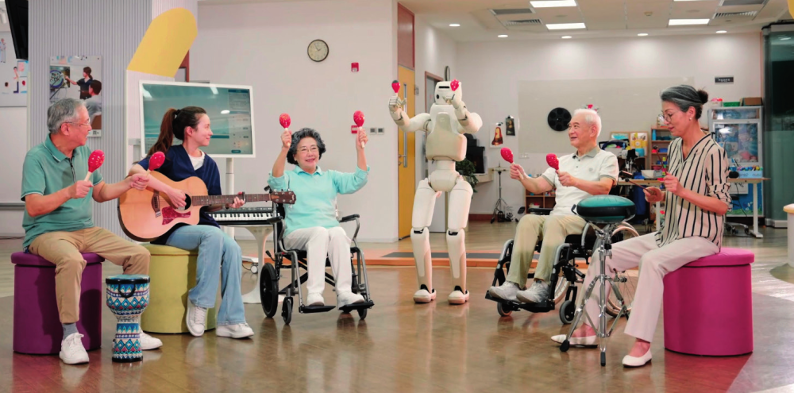
Robotic technologies provide rehabilitation and companionship services at an embodied rehabilitation and elderly-care application demonstration event held by Fourier, a Shanghai-based robotics company, November 2025.
Photo provided by Shanghai Fourier Intelligence Co., Ltd.
Contributing a “Shanghai Solution” to AI Governance
In 2024, in response to profit-seeking schemes involving malicious evidence collection and mass litigation based on AI hallucinations, a court in Qingpu District, Shanghai, traced the origins of 400 trademark infringement cases and uncovered how some individuals had used large AI models to fabricate evidence. The case set a benchmark for judicial fairness in the AI era.
Shanghai has consistently balanced innovation with regulation, strengthening rule-of-law safeguards, coordinated governance and open cooperation as it actively contributes a “Shanghai solution” to global AI governance.
Shanghai has moved first in legislation, adopting an inclusive and prudent approach to lay a solid foundation for development. As China’s first provincial-level local regulation in the field of AI, the Regulations of Shanghai Municipality on Promoting the Development of the Artificial Intelligence Sector not only clarifies industrial definitions, division of responsibilities and directions for support, but also reflects the governance philosophy of inclusiveness and prudence in its institutional design. It specifically encourages citizens, legal persons and other organizations to carry out innovative activities in the AI sector, and gives emerging business forms at the exploratory stage a certain degree of room for trial and error. In doing so, it both draws clear bottom lines and leaves ample space for technological innovation, sending a clear signal that legal certainty can inject stable confidence into industrial development.
Shanghai’s judicial authorities have continued to explore ways to improve the governance of AI-related crimes. In 2025, the Xuhui District People’s Procuratorate of Shanghai and the Xuhui Branch of the Shanghai Municipal Public Security Bureau jointly issued the Guidelines on Electronic Data Collection and Review in Criminal Cases Involving Generative Artificial Intelligence. It was the first systematic set of standards developed by Shanghai’s judicial authorities for electronic data collection and review in the field of generative-AI-related crimes. The guidelines not only filled a gap at the rule-making level, but also promoted a new model of judicial governance based on coordination between technology and law.
Shanghai is working to help enterprises translate regulatory requirements on safety and compliance into their own management systems, standard operating procedures and everyday practices. The city’s cyberspace authorities have completed filings for 157 large models and provided one-on-one compliance guidance to over 100 enterprises, embedding governance services throughout the entire process of industrial development. Under policy guidance, more and more companies have realized that safety and compliance are not only baseline requirements, but also a core source of competitiveness for winning market trust and achieving sustainable development.
Shanghai’s first offline large-model compliance guidance service center, established at the Shanghai Foundation Model Innovation Center, provides enterprises with one-stop professional guidance ranging from data security to algorithm filing. “We regularly invite regulators, legal experts and enterprise representatives to discuss compliance pathways for large models, helping companies accelerate development within a safe and compliant framework,”said Yang Jingjing, chairwoman of Shanghai Large Model Ecosystem Development Co., Ltd., the operator of the Shanghai Foundation Model Innovation Center.
Against the broader backdrop of strengthened AI governance, some leading technology companies have taken the lead in exploring a dual-driven path in which technological R&D and governance advance in parallel. For example, SenseTime has released the SenseTrust AI Governance Platform, which provides full-chain solutions from data governance to application governance. In the data preprocessing stage, the platform detects more than 95 percent of toxic data. During model training, it can effectively identify data bias. In application deployment, its “AI firewall” tool achieves a comprehensive detection rate of 98 percent for adversarial samples.
Other companies are starting from the technological source, embedding safety into model design from the outset. MiniMax begins with the underlying architecture of foundation models and insists on full-chain, in-depth self-developed technology to ensure full autonomy and control, significantly reducing hallucination rates. In addition, the company has adopted a safety governance approach of “using technology to govern technology and models to counter models,” developing dedicated safety review models for content filtering.
Shanghai is actively promoting the establishment of international cooperation mechanisms for global AI governance in the city. In January 2025, the operating base of the China-BRICS Artificial Intelligence Development and Cooperation Center was launched at the Shanghai Foundation Model Innovation Center. It will broadly connect AI innovation and industrial resources from BRICS countries and beyond, and promote interconnection across the global AI ecosystem. In July of the same year, the Global Alliance on AI for Industry and Manufacturing Centre of Excellence, the first specialized international institution under the UN framework focused on AI cooperation, formally entered a new stage of substantive operation. The center is expected to attract more international cooperation projects, technologies, resources and talent, and to promote industrial innovation and upgrading. In addition, the Center for Global AI Innovative Governance has set its secretariat at Fudan University and is committed to building a global network for AI capacity development.
“Drawing on China’s AI development practices, and working with the United Nations and relevant international organizations, we bring together resources from industry, academia and research institutions in China and abroad. Our goal is to advance international dialogue on AI governance, strengthen capacity building, provide public goods and cultivate young talent. Through these efforts, we aim to promote coordination and practical implementation in global AI governance,” said Yao Xu, secretary-general of the Center for Global AI Innovative Governance.
At present, Shanghai has established cooperation mechanisms in AI with 38 countries, promoting international industry partnerships and technological exchanges in the field. From the banks of the Huangpu River to the world stage, and from advocating open innovation to improving inclusive access to AI, Shanghai is taking concrete action to build bridges for global AI governance and serve as a prominent window for sharing Chinese wisdom with the world.
Reporters: Wang Yongqian, Yao Yujie, Gong Wen, Cheng Siqi
Outlook Weekly, Issue No. 17, 2026
Original URL:
https://www.news.cn/20260425/b84f6b1874b24bffa38cbece83c0219c/c.html