


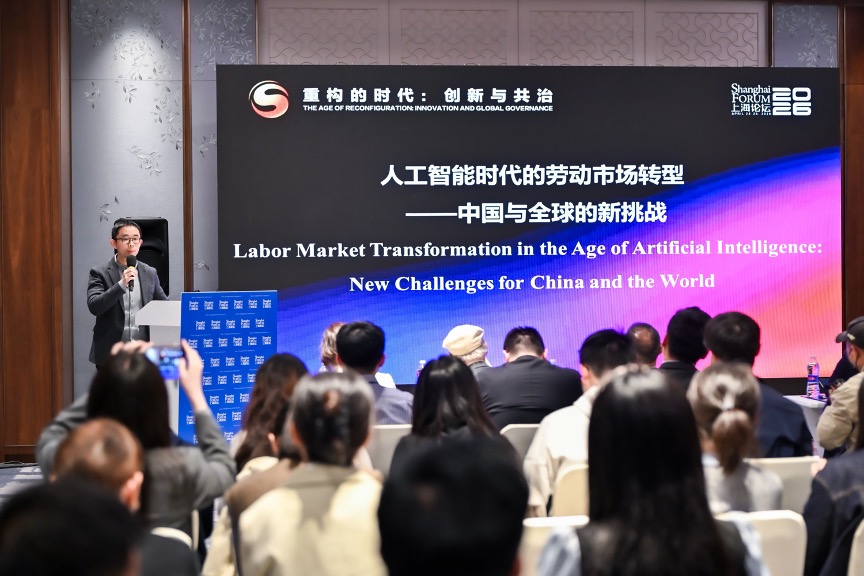
On April 24, 2026, the sub-forum “Labor Market Transformation in the Age of Artificial Intelligence: New Challenges for China and the World” was successfully held as part of the Shanghai Forum. Professor Zhang Jun, Senior Professor and Dean of the School of Economics at Fudan University, chaired the session. The event was organized by the university's China Center for Economic Studies and moderated by Associate Professor Hu Bo of the School of Economics.
The discussion focused on the profound transformations facing labor markets amid the rapid development of artificial intelligence (AI). Leading scholars from top universities and research institutions in China, the United States, South Korea, and Singapore engaged in in-depth discussions from multidisciplinary perspectives, including economics, management, and political economy. Drawing on big data and empirical industry analysis, participants examined the impact of AI on employment structures, skill demand, income distribution, and economic growth.
The forum attracted participation from more than 20 major media outlets and over 300 attendees. Combining theoretical analysis with empirical research, it provided an insightful academic platform and important policy implications for understanding labor market transformation in the AI era.
01 Opening Remarks: Why AI’s Impact on the Labor Market Matters
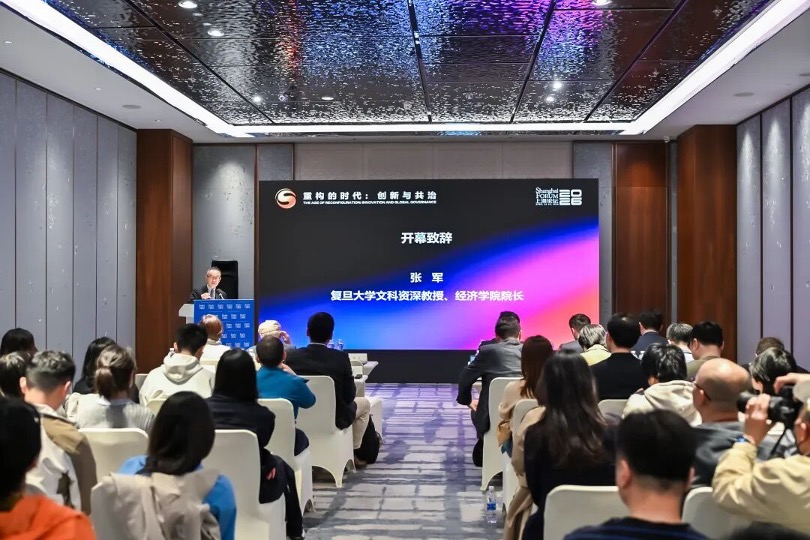
Zhang Jun
As the chair of the sub-forum, Professor Zhang Jun pointed out in his opening remarks that AI’s impact on labor markets has become one of the most critical global issues today, affecting not only China’s development but also the restructuring of the global economic system. He stressed that by bringing together top-tier scholars from China, the US, South Korea, and Singapore, the forum aims to explore how AI reshapes employment patterns, skill structures, and income distribution from multiple perspectives. While many key questions remain unresolved, ongoing academic dialogue and empirical research are essential to better understand AI’s far-reaching effects on labor markets and task structures across industries.
02 From Science Fiction to Reality: When AI Outperforms Humans

Richard B. Freeman
Starting from the perspective of “science fiction becoming reality,” Professor Richard B. Freeman, Herbert Ascherman Chair in Economics at Harvard University, highlighted how technologies once confined to science fiction are rapidly becoming reality. Advances in large language models and algorithms are fundamentally reshaping labor market structures. He stressed that AI is already surpassing human capabilities in various domains, redefining work and occupational boundaries.
Freeman argued that instead of focusing solely on job displacement, attention should be directed toward income distribution and institutional arrangements: “Those who own AI will capture a greater share of economic gains.” AI may reduce disparities between blue-collar and white-collar workers, but it could also exacerbate inequality between AI owners and workers, making policy intervention crucial.
03 Understanding Generative Models and AI Agents
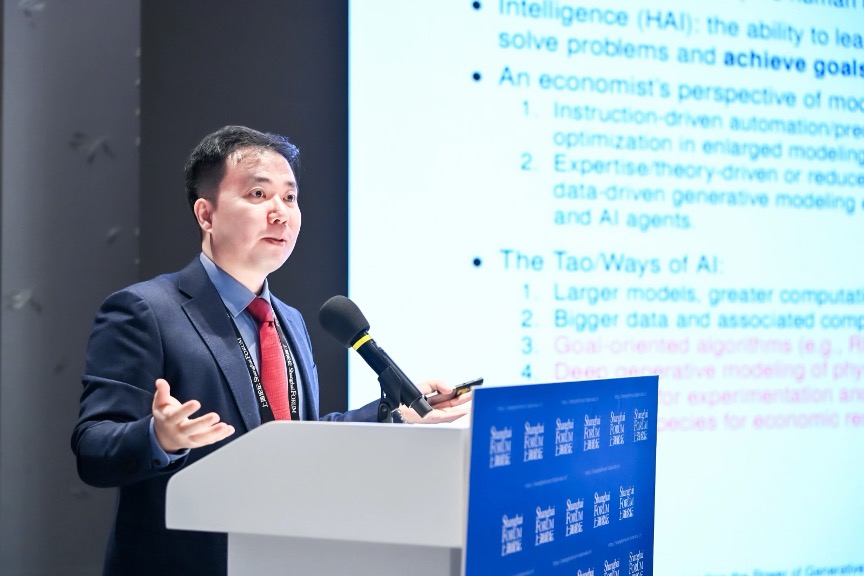
Cong Lin
Professor Cong Lin, President’s Chair Professor at Nanyang Technological University and Associate Dean at Nanyang Business School, discussed the paradigm shift from instruction-driven to data-driven AI. He explained how generative models and AI agents are enhancing the capacity to model complex economic systems.
He proposed the “economic world model,” framework, which integrates elements such as reinforcement learning and multi-agent simulations. This framework enables AI not only to support decision-making and reshape firm behavior and market mechanisms. He emphasized the need for interdisciplinary research combining economics and computational science to explore human-AI collaboration.
04 From Experience to Intelligent Assets: Rethinking Human Capital
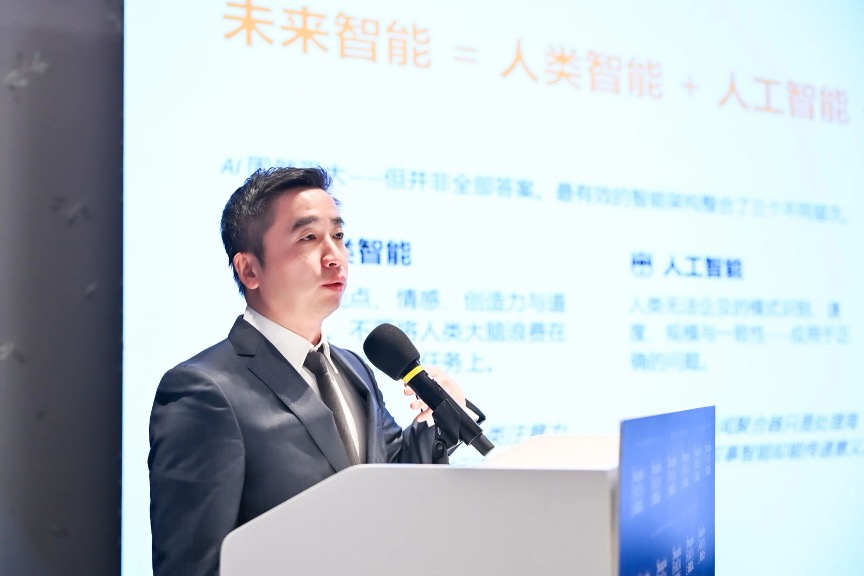
Zhu Feida
Professor Zhu Feida, Tenured Associate Professor at the School of Computing and Information Systems, Singapore Management University, explored how human experience and knowledge are being transformed into “intelligent assets.” As AI increasingly participates in cognitive and creative tasks, traditional human capital evaluation systems are being reshaped.
Organizational knowledge is becoming codified and modularized through data and algorithms, forming reusable systems. Future competitive advantage will depend on the synergy between human intelligence, artificial intelligence, and organizational intelligence.
05 Measuring AI’s Impact on Employment
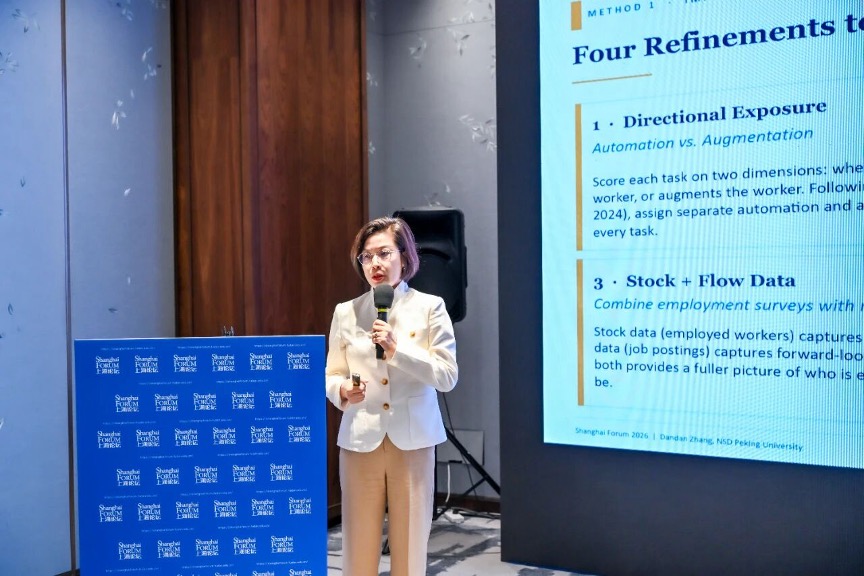
Zhang Dandan
Professor Zhang Dandan, Deputy Dean and Professor of Economics at the National School of Development, Peking University, delivered a keynote speech centered on “How to Measure the Impact of AI on Employment”. From a methodological perspective, she systematicallyoutlined three leading approaches to measuring AI’s employment impact: the task-based AI exposure index, firm-level AI adoption index, and real-world interaction-based exposure index. These three categories of indicators characterize the impact of AI on employment across three levels—theoretical feasibility, actual corporate adoption, and individual usage behavior—serving as mutual complements.
She identified a consistent trend: theoretical models tend to be pessimistic, while real-world impacts remain moderate. Although white-collar cognitive jobs show higher exposure, AI adoption at the firm level is still in early stages, keeping actual impacts below theoretical limits.. Occupational outcomes depend on whether AI complements or substitutes tasks. She warned that AI’s cognitive leaps and global spread create unprecedented shocks, compressing adjustment windows and necessitating proactive monitoring and social buffers.
06 Who Fears AI—and Why?
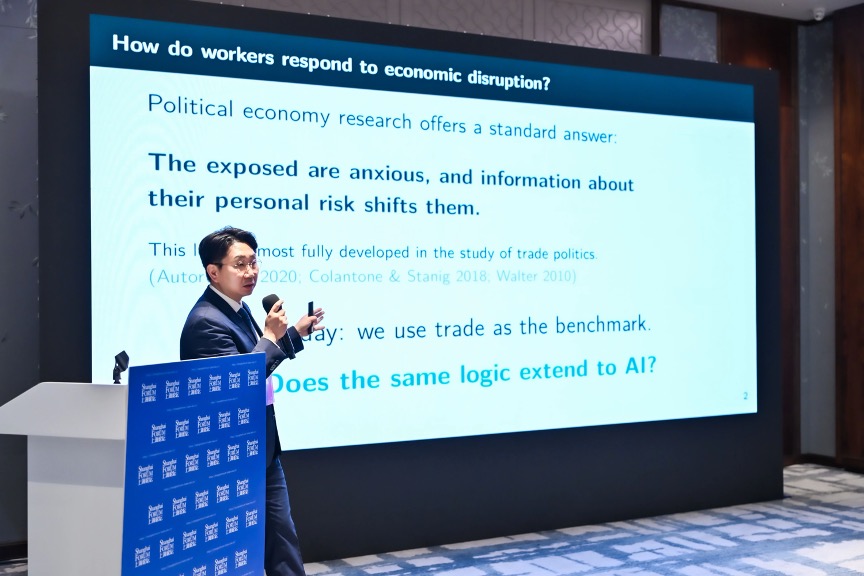
Joonseook Yang
Joonseook Yang, Assistant Professor in the Department of Political Science and International Relations at Yonsei University, explored the attitudes of different groups toward AI and their underlying mechanisms from a political economy perspective. His findings suggest that occupational risk alone does not fully explain anxiety about AI; perceptions are more strongly influenced by information access and subjective judgment.
The research found that information does not significantly alter public preferences for AI-related policies, with exhibiting a complex “worried yet expectant” mindset. Overall, AI is viewed as both a potential threat and a tool for enhancing efficiency and competitiveness. This “dual perception” serves as a vital clue for understanding contemporary social attitudes.
07 Economic Growth, Employment, and Demographics in the AI Era
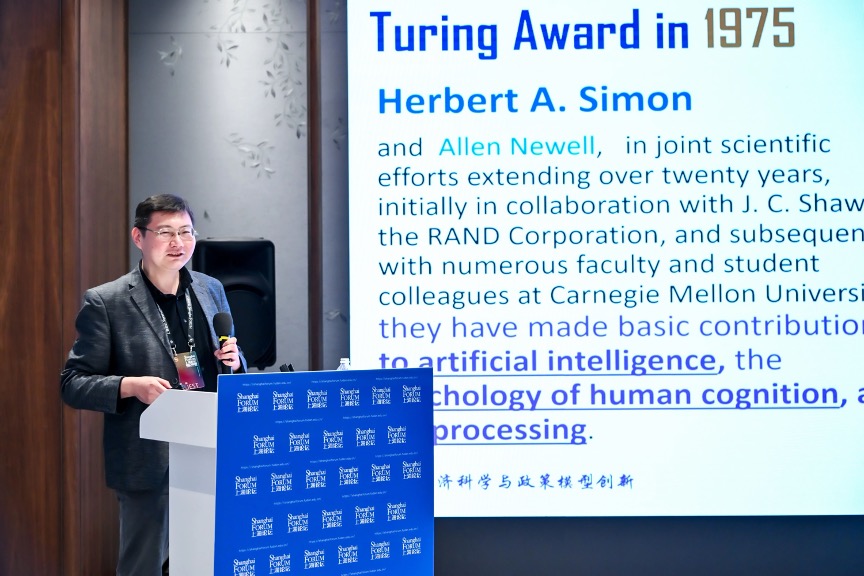
Xie Danxia
Professor Xie Danxia, Tenured Associate Professor at the School of Social Sciences, Tsinghua University, developed a macroeconomic framework for the “digital-intelligent economy,” incorporating data, computing power, algorithms, and storage.
He argued that in extreme scenarios, production and innovation may rely primarily on these elements, reducing dependence on traditional labor. AI may both displace jobs and create new opportunities by boosting innovation and lowering knowledge costs. Institutional adjustments, including working-time policies, will be key.
08 AI as a Partner: From Skills Competition to Human Values
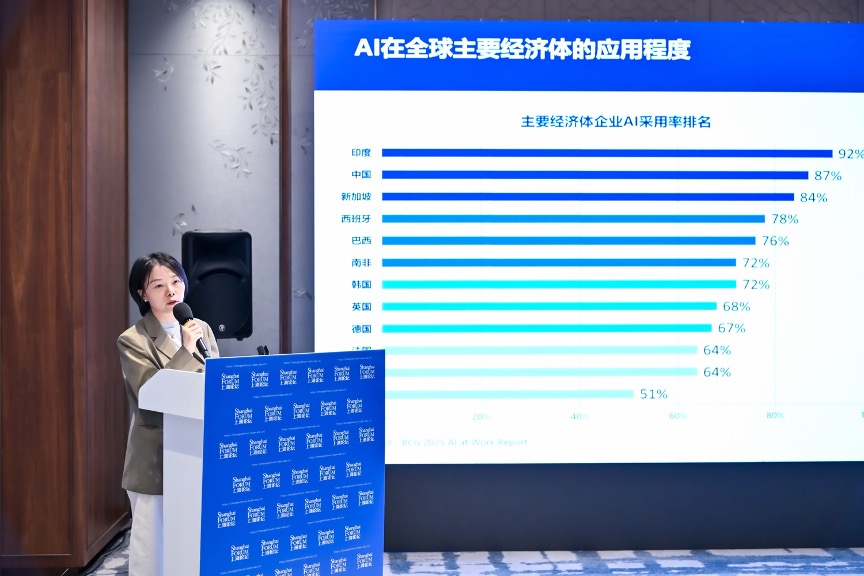
Liao Fangli
Research Fellow Liao Fangli of the China Development Institute (Shenzhen) emphasized that AI’s impact involves substitution, transformation, and job creation simultaneously. AI is becoming a “work partner,” enabling the rise of micro-enterprises and “super individuals.”
She stressed the growing importance of humanistic skills such as critical thinking, creativity, empathy, and ethical judgment, as technological progress commodifies technical skills while highlighting uniquely human value.
09 Traffic or Profit? The Impact of Subsidy Wars
Hu Bo, Li Rui
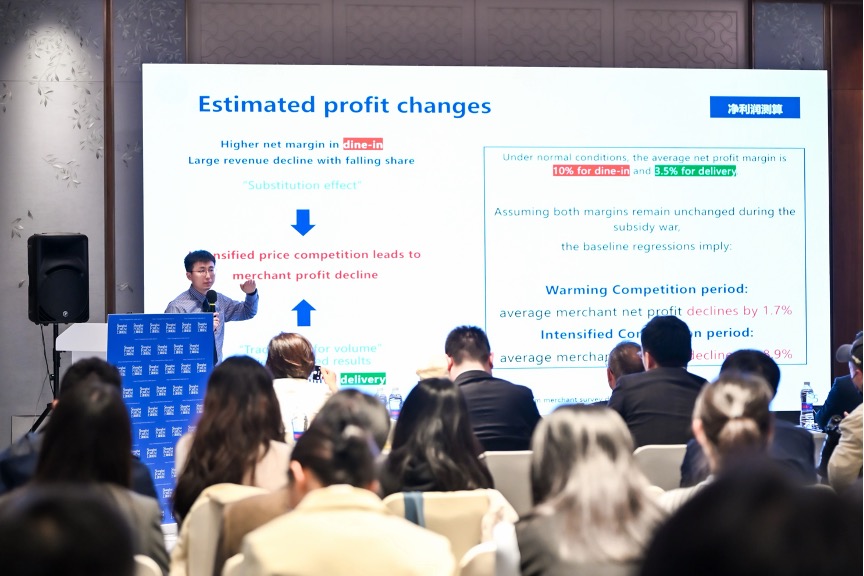
Associate Professor Hu Bo and Assistant Professor Li Rui of Fudan University analyzed the effects of platform subsidy competition in food delivery markets. While subsidies increase order volume, they reduce average transaction values and crowd out offline dining.
As a result, overall revenue gains are limited, and net profits may decline due to lower margins. Small and independent businesses are particularly affected, facing a dilemma between losing orders and losing profits.
10 Conclusion
During the Q&A, Associate Professor Liu Yu questioned if AI makes people “busier”. Professor Zhang Dandan noted that in programming and manufacturing, human-AI collaboration often increases task volume, meaning working hours haven't decreased and may even prolong. Regarding finance, Professor Cong Lin highlighted AI's potential to boost efficiency, predicting a shift from return-based competition to personalized services.
In his closing, Professor Zhang Jun stated the forum provided vital insights into labor market transformation by balancing academic depth with practical concern. He stressed that the relationship between AI and labor requires ongoing observation and research. Finally, he expressed gratitude to the Shanghai Forum for its essential support, hoping for further contributions to this evolving field in the future.