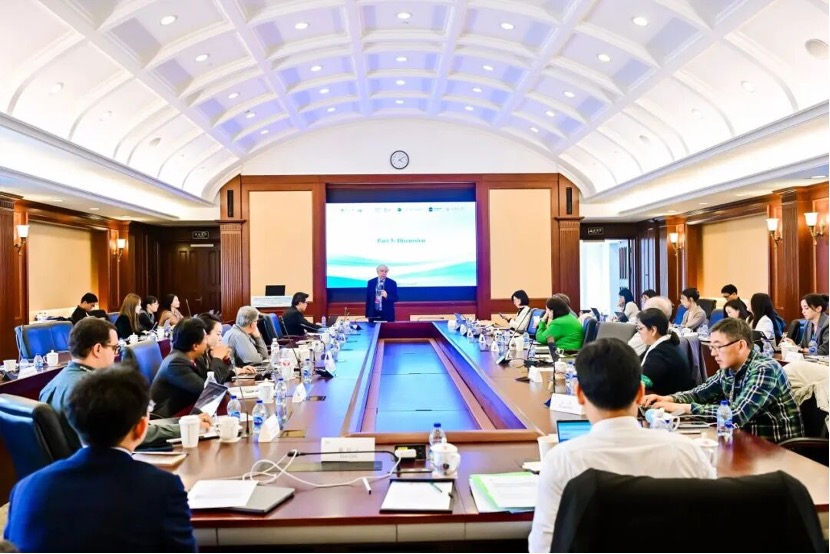


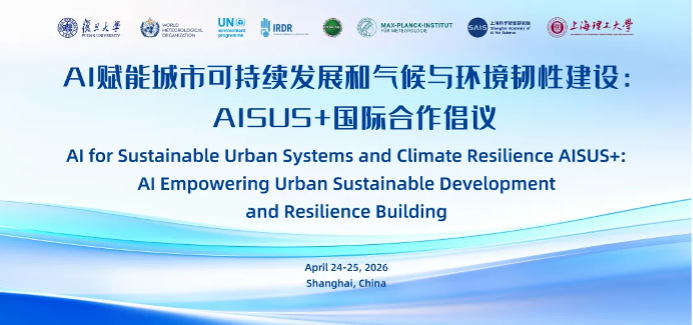
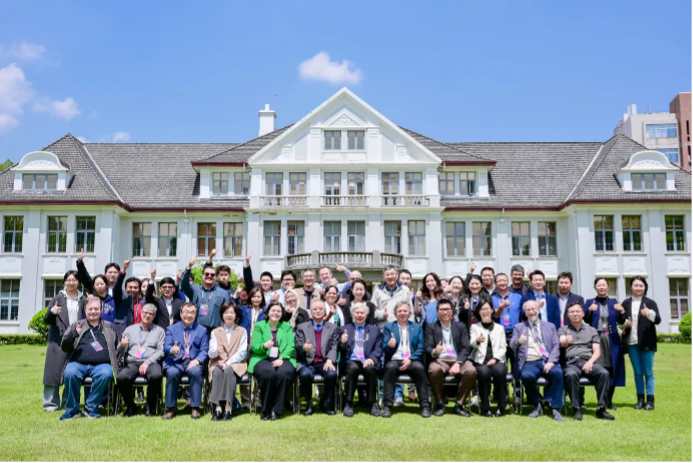
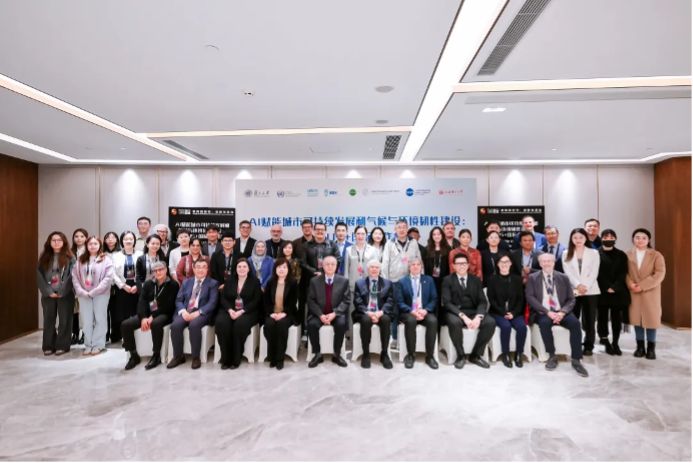
On April 24–25, the Shanghai Forum 2026 sub-forum entitled “AI for Sustainable Urban Systems and Climate Resilience AISUS+: AI Empowering Urban Sustainable Development and Resilience Building” was held in Shanghai, China. The conference was hosted by Fudan University, with support from the World Meteorological Organization (WMO), the United Nations Environment Programme (UNEP), the Integrated Research on Disaster Risk (IRDR), the Monitoring, Analysis and Prediction of Air Quality (MAP-AQ Initiative), the Max Planck Institute for Meteorology (MPI-M), the Shanghai Academy of AI for Science (SAIS), and the University of Shanghai for Science and Technology, among others. The event was jointly organized by the Department of Atmospheric and Oceanic Sciences / Institute of Atmospheric Sciences of Fudan University, the IRDR International Centre of Excellence, the MAP-AQ Asia Regional Office, and the Center for Global AI Innovative Governance (CGAIG).
The conference was co-chaired by Professor Zhang Renhe of Fudan University, Academician of the Chinese Academy of Sciences, and Professor Guy Brasseur, Member of Academia Europaea and former Director of the Max Planck Institute for Meteorology. More than 50 experts, scholars, and industry representatives from 13 countries participated in the meeting. Discussions focused on the deep integration of artificial intelligence with urban sustainable development, with particular attention to urban climate resilience, environmental governance, and green transition.
At the opening ceremony, speeches were delivered by Zhang Renhe of Fudan University, Zhou Yuanyuan, Deputy Director of the Shanghai Science and Technology Exchange Center, Liu Xin, representative of the Administrative Center for China’s Agenda 21 and the United Nations Commission on Science and Technology for Development (UNCSTD), Golestan Sally Radwan, Chief Digital Officer of the United Nations Environment Programme (UNEP), Paolo Laj, Head of the Global Atmosphere Watch (GAW) Programme of the World Meteorological Organization (WMO), and Chen Boping, East Asia Regional Director of the C40 Cities Climate Leadership Group, among others.
They highly commended the AISUS+ Initiative led by Fudan University, and expressed strong expectations for advancing innovative applications of artificial intelligence in urban sustainable development governance and climate resilience building.
In the keynote speech session, Professor Winston Chow, Co-Chair of Working Group II of the Intergovernmental Panel on Climate Change (IPCC), Professor Bjorn Stevens, Director of the Max Planck Institute for Meteorology, Researcher Qiu Yubao from the International Research Center of Big Data for Sustainable Development Goals, Assistant Professor Zhong Xiaohui of Fudan University, and Jeff Adie, Senior Engineer at NVIDIA, delivered presentations focusing respectively on “AI-Enabled Urban Risk Management,” “Trustworthiness of AI in Climate Prediction,” “Big Data and AI Supporting the Achievement of Sustainable Development Goals,” “Applications of the Fuxi Foundation Model,” and “Earth-2 Model and Generative AI in Climate and Weather Forecasting,” systematically showcasing the latest progress and international frontiers of artificial intelligence in advancing urban sustainable development.
Professor Tang Xu of Fudan University introduced A Short Handbook for Institutions Interested in Supporting or Joining the AISUS+ Initiative, providing a detailed explanation of the background, overarching objectives, implementation framework, and operational mechanisms of the AISUS+ international cooperation initiative. He noted that AISUS+ is an open and non-binding international cooperation network that seeks to use cities as platforms and, through the development of a City Lab network, to explore scientific pathways and practical models for AI-enabled urban sustainable development and climate–environmental resilience building. He further emphasized that the initiative aims to support global cities in navigating an increasingly uncertain world and in progressing toward a greener, healthier, and more resilient future.
In the progress report session, the six cities selected in the first batch of the AISUS+ pilot programme—Shanghai (China), Hong Kong (China), Konstanz (Germany), São Paulo (Brazil), Vienna (Austria), and Jakarta (Indonesia)—presented in turn their practical progress and future plans in applying artificial intelligence to urban governance. Representatives from cities across Africa (Marrakesh, Cairo, Nairobi, and Lagos), Asia (Kuala Lumpur, Malaysia; Chiang Mai; and Hanoi), Europe (Paris and Copenhagen), and North America (the Greater Boston Area), in reference to A Short Handbook for Institutions Interested in Supporting or Joining the AISUS+ Initiative, reported their intentions to join AISUS+, as well as their institutional readiness and subsequent work plans.
In the Session on AI Applications, Ms. Golestan Sally Radwan, Director of the United Nations Environment Programme (UNEP), introduced UNEP’s strategic approach to artificial intelligence within UNEP's development agenda. Research teams from Fudan University (Professor Zhang Feng, Researcher Yu Zhaowu, and Professor Zhao Zhuohui), Nankai University (Associate Professor Dai Qili), and Tsinghua University (Professor Xu Ming) respectively presented their research achievements and future prospects in applying artificial intelligence to cloud feature recognition, ecological and environmental monitoring, population health assessment, air pollution analysis, and typhoon forecasting.
In the enterprise segment, representatives from MeteoIA, Beijing Capital Eco Pro Group, ABT (Shanghai) Telecommunication Technology Co., Ltd., and Shanghai Zhengsheng Cloud Computing Co., Ltd. delivered presentations, expressing their support for the AISUS+ initiative and their intention to participate in its future development.
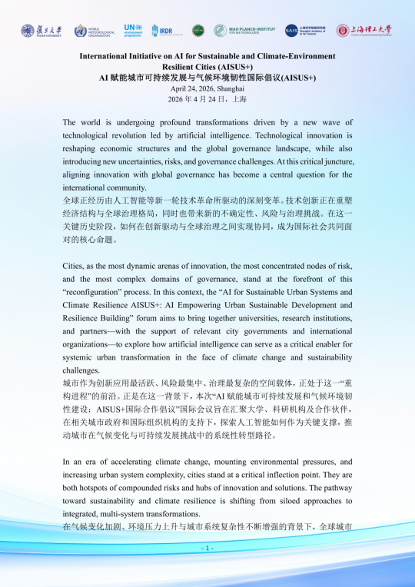
In the discussion and exchange session, experts held in-depth discussions on the positioning and implementation pathways of the AISUS+ international cooperation initiative. There was broad consensus on its overall direction and proposed implementation framework, as well as on the need to strengthen data sharing, technological collaboration, and capacity building. The meeting appointed Professor Tang Xu as Coordinator of the AISUS+ Initiative. Based at IRDR International Center of Excellence at Fudan University, he will lead the establishment of the Scientific Committee and relevant working groups, as well as the definition of the initiative’s governance structure. The meeting also unanimously endorsed and officially launched the “AI for Sustainable Urban Systems and Climate Resilience AISUS+: AI Empowering Urban Sustainable Development and Resilience Building” calling on more cities and partner institutions to join the network and jointly advance the implementation of the Sustainable Development Goals.