

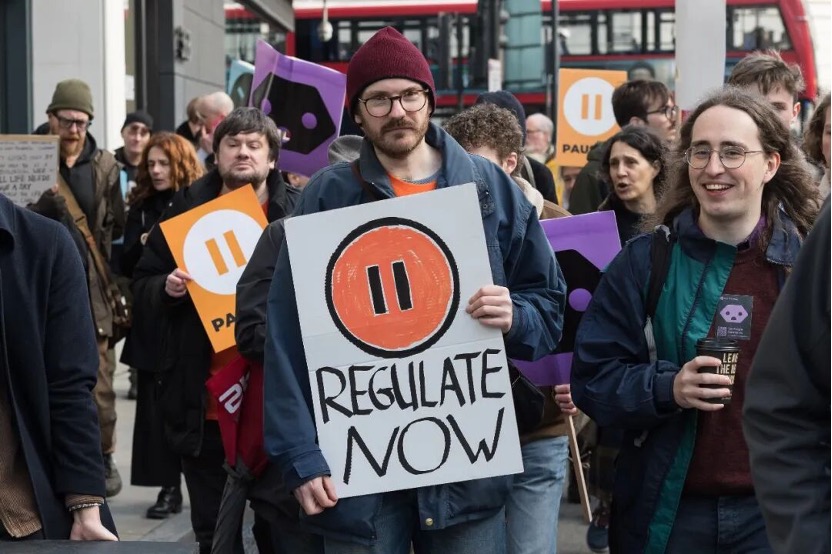
February 28, 2026, London, United Kingdom: protesters set off from OpenAI’s office and marched toward Meta’s headquarters and Google DeepMind’s headquarters to protest the rapid expansion of AI data centers in the UK and the environmental and social impacts of artificial intelligence. They called for a pause in AI development before legislative safeguards and democratic controls are put in place. Photo / VCG
Many new things require time to mature after they first emerge; only after a span of, say, ten years do their broader implications become visible. Once people have developed a deep understanding of the problems, and when the issue does not involve a highly technical background, there is usually little resistance to enacting a law, even one with real enforcement bite. But artificial intelligence is developing too quickly. In such circumstances, rushing to legislate may mean that the law fails to keep pace, and its actual effect may also be limited.
Security control over key AI technologies and core data is now a general consensus among the world’s major economies. Training large AI models depends on massive amounts of data. As a result, countries are requiring AI enterprises, when collecting, processing and using training data, to meet requirements for protecting domestic data security, review mechanisms and national sovereignty and regulatory compliance.
The EU’s Artificial Intelligence Act imposes what are currently the world’s strictest requirements on privacy, bias and copyright in training data. In 2025, however, the EU advanced the Digital Omnibus Regulation Proposal, relaxing restrictions on the processing and use of model-training data with the aim of improving the innovative vitality of the EU’s AI industry.
In March 2026, the White House released the National Policy Framework for Artificial Intelligence: Legislative Recommendations. Compared with the Biden administration’s October 2023 AI executive order, the core philosophy of this framework shifted from “safe, secure, and trustworthy” toward “innovation-led” and “winning the AI race.” It advocates improving efficiency through delegation and deregulation in order to ensure U.S. dominance in the global AI race. This has been viewed as an important legislative recommendation marking the United States’ shift from merely pursuing technological leadership to systematically constructing full-stack leadership across the AI ecosystem.
The debates triggered by this framework offer a window into the divergent pathways of today’s global AI governance. AI governance has already moved beyond a purely technological issue and has become a comprehensive strategic capability encompassing national security and the shaping of international rules.
Against this backdrop, Southern People Weekly spoke with Yao Xu, Secretary-General of The Center for Global AI Innovative Governance (CGAIG) and Associate Research Fellow at Fudan Development Institute. Dr. Yao analyzed the different circumstances and solutions of China, the United States and the European Union in AI regulation and governance, and stressed the need to pay attention to the risk that AI may further exacerbate global inequality and the digital divide.
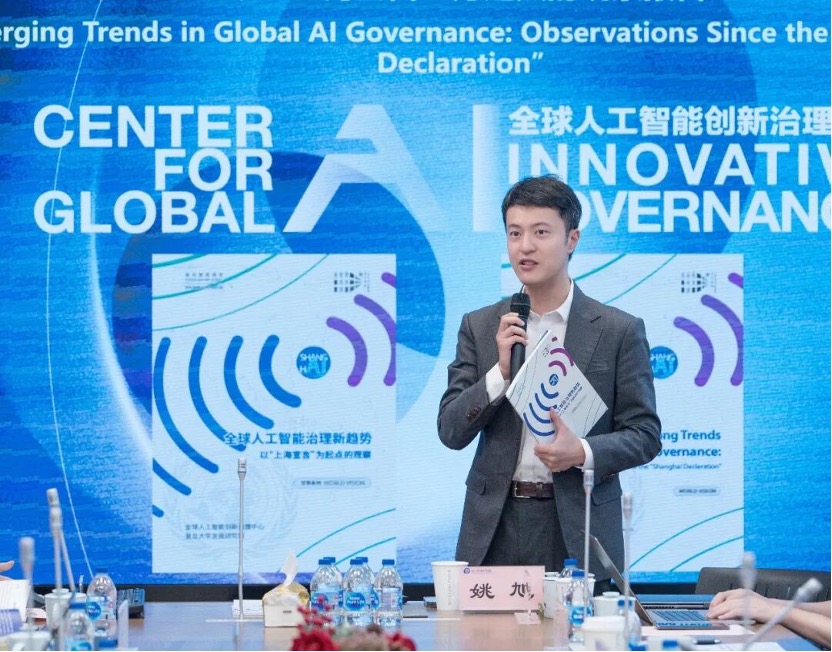
Yao Xu, Secretary-General of The Center for Global AI Innovative Governance and Associate Research Fellow at Fudan Development Institute. Photo / provided by interviewee
01 The U.S. AI Legislative Framework: No Domestic Consensus Yet, Global Export Still Far Away
Southern People Weekly: A few years ago, the core philosophy of the EU’s General Data Protection Regulation (GDPR) gained broad global recognition. Is it possible that the Trump administration’s National Policy Framework for Artificial Intelligence will establish a new consensus?
Yao Xu: That is unlikely. It is not even clear whether this framework can reach consensus within the United States. The framework advocates “federal preemption” and “preemption,” eliminating the regulatory authority of U.S. states in the field of artificial intelligence. This directly challenges the traditional allocation of powers under U.S. federalism and has triggered pushback from technology-frontier states such as California. Even within the Republican Party, it has caused serious divisions because it touches on state-rights conservatism. California, for example, had already enacted the California Consumer Privacy Act (CCPA) several years ago, which was a relatively advanced practice in digital legislation.
Second, this framework carries a strong partisan and ideological color. The trend toward deregulation under Trump and the Republican Party is seen by Democrats and the traditional left as highly heterodox. It runs counter to the Democratic administration’s earlier emphasis on “safe, secure, and trustworthy” AI and on antitrust regulation. It has been criticized for excessively favoring large technology capital,narrowing public protections for privacy and legal remedy, and failing to effectively respond to structural anxieties in the labor market over AI-driven job displacement.
Previously, although U.S.-China technological competition was extremely intense, Biden did not substantially loosen technology regulation during his term. This included a series of regulatory actions targeting major U.S. technology companies.
Very few countries in the world are similar to the United States: it has a very strong AI industry and R&D foundation, while also maintaining a federal-state division of powers in which different levels of government have their own advantages. Against this background, the possibility that this framework will be exported externally is not especially high.
Southern People Weekly: This U.S. framework advocates preempting state regulation of AI development and prohibiting states from penalizing developers for third-party misuse of AI. Is this meant to avoid imposing unbearable joint and several liability on foundation-model developers?
Yao Xu: In fact, in current regulatory and legislative practices around the world, no country makes foundation-model developers bear unlimited joint and several liability. The overwhelming majority of liability falls on the product or application layer. Otherwise, a very practical problem arises: many developers of open-source models publicly release their models, and anyone can download and use them at will. Problems that arise later are difficult to directly connect to the developers of the open-source models, and the boundary between rights and responsibilities is inherently difficult to define. Of course, there are also many voices calling for more ways to build safety valves into open-source models, but from both technical and policy perspectives, this remains difficult to implement.
I do not agree with viewing development and regulation as opposing dimensions. I have always believed that effective AI governance requires a coordinated balance between development and security. On one hand, regulation clarifies bottom lines and tells enterprises and developers what they must not do. On the other hand, clear policy rules also define the scope of compliance and indicate what can be done and what is worth doing.
I have repeatedly emphasized one point: regulation itself can also promote innovation. Once rule boundaries and entry thresholds are clarified, uncertainty is reduced, and the overall efficiency of innovation can be improved.
Southern People Weekly: Has U.S.-China competition in artificial intelligence affected the formulation of U.S. AI regulation?
Yao Xu: Competitive pressure from China is indeed an important factor. It has prompted the United States not only to consider domestic governance, but also to treat artificial intelligence as a strategic tool to ensure U.S. dominance in the global AI ecosystem.
Within the United States, there are also many constraints and many variables to consider. These include the contest between federal and state powers, ideological struggles between different parties, and tensions between the government and technology giants. The United States also needs to balance the development of technology giants, small and medium-sized enterprises, and the open-source community, while satisfying the interests of technology companies, chipmakers, energy developers and the defense sector. It must also consider energy permitting, transmission-line construction, the allocation of electricity costs, and so on.

April 14, 2026, Haikou, Hainan: visitors interact with a humanoid robot at the Technology Consumption Exhibition Area of the 6th China International Consumer Products Expo. Photo / Xinhua News Agency
02 The Global Divergence of AI Governance Pathways
Southern People Weekly: Is it possible for the EU’s Artificial Intelligence Act to replicate the global influence of the EU’s General Data Protection Regulation (GDPR)?
Yao Xu: From a regulatory perspective, GDPR is certainly unavoidable. Before GDPR was introduced, almost no country in the world had established mature rules for personal data protection. GDPR had a first-mover advantage and also occupied the moral high ground. The “Brussels Effect” was highly significant. Most personal data protection rules introduced around the world afterward were deeply influenced by GDPR.
But as other countries began to learn from or even copy GDPR, Europe itself began to reflect on the limitations of this set of rules. After GDPR formally took effect in 2016, competition between China and the United States in the digital economy became increasingly fierce. The platform economy iterated rapidly and disrupted industries around the world at a speed unimaginable in the early eras of Web 1.0 and Web 2.0.
From the moment GDPR took effect, the EU fell behind in global competition in the digital economy and even in digital technology. The EU subsequently developed a sense of crisis and began to adjust itself. This created a clear mismatch in timing between the EU’s self-adjustment and other countries’ efforts to learn from EU legislation. Many countries began to refer to GDPR in 2016 when advancing their own legislation, and legislative revision often takes three or four years. By the time those countries’ regulations formally took effect, the EU had already begun to reflect on itself and acknowledge problems in the original rules. Yet the new laws in other countries had already taken shape, leaving very limited room for adjustment.
Many new things require time to mature after they first emerge; only after a span of, say, ten years do their broader implications become visible. Once people have developed a deep understanding of the problems, and when the issue does not involve a highly technical background, there is usually little resistance to enacting a law, even one with real enforcement bite. But artificial intelligence is developing too quickly. In such circumstances, rushing to legislate may mean that the law fails to keep pace, and its actual effect may also be limited.
Therefore, I believe that after entering the AI era, countries will no longer simply, quickly, or wholesale copy the EU’s regulatory rules as they did in the GDPR period.
Southern People Weekly: Global AI regulation now seems to have formed three different pathways: the EU, which emphasizes human rights and strong regulation; the United States, which emphasizes the market and fragmented legislation; and China, which emphasizes agile governance and scenario-based implementation. How do you evaluate the differences among these three models?
Yao Xu: This China-U.S.-EU division exists in virtually every field, and artificial intelligence is no exception. But I have always personally opposed such overly rigid labeling.
As I mentioned when discussing the EU, if one looks at a specific piece of legislation in a static time slice, it may indeed appear to have strong regulatory characteristics. But the entire governance process is dynamic, long-term and formed through repeated bargaining among stakeholders. In AI regulation, this involves multiple layers of contestation: the contest between development rights and security interests at the national level; the power struggle between government regulators and the technology industry; the tension between demands for technological innovation and the bottom line of social ethics; the contest over rule-making discourse power among different countries and regions; enterprises’ internal trade-offs between compliance costs and commercial interests; and ordinary users’ demands for both rights protection and technological convenience. The underlying support for all of this is the actual capabilities of each country or actor and how those capabilities change. That is why I believe we should try to break this kind of stereotype.
Southern People Weekly: Will regulatory trends across countries converge in the future, or will their differences become even greater?
Yao Xu: Judging from current realities, no country will declare that it does not want AI development, and no country will say that it wants strong regulation even if that means imposing excessively restrictive regulation on enterprises. But the strength of legal regulation over AI differs from country to country. I think this is directly related to several factors.
First is a country’s own capacity, including its level of industrial and technological development, its relative strength, and the degree of policy influence held by industry and technology communities. Second is the traditional governance pathway on which policymaking depends. Take the EU, for example. From the European Community to the present, all forms of cooperation have required very clear unified rules to constrain member states; otherwise, things can easily fall into disorder. Therefore, the EU relies more on law and rigid regulatory measures, and the core function of law is often to define what cannot be done. Naturally, it will appear to have a stronger regulatory character.
The EU’s regulatory history shows that it has continuously patched and revised rules across different fields. From digital technology regulation to data and privacy protection frameworks represented by GDPR, Europe attaches far greater importance to fundamental personal rights than other countries and regions. There are complex historical reasons behind this. On one hand, Europe emphasizes normative power and needs to use higher moral standards to demonstrate its value advantage. On the other hand, for a long period of history, Europe stood at the forefront of human technological civilization, so it did not fear using regulatory measures that might temporarily slow development.
But Europe is now highly anxious. This can be seen particularly clearly in the 2024 Draghi Report, which identified a large number of problems. Yet the EU lacks strong resource support and system-wide integration capacity to solve them.
Europe now urgently wants to shed the label of “strong regulation that stifles innovation” and shift toward a pathway more focused on development. On one hand, the adjustments to the Artificial Intelligence Act (AIA) are intended to take innovation more into account. On the other hand, Europe is also actively working on standard-setting and alignment with international rules.
Turning to the United States, for a long period in the past, especially under Democratic administrations, the U.S. internet, digital technology and AI industries developed at their fastest pace. During the Obama era, the internet entered a period of extremely rapid growth. During the Biden era, large models exploded, and the Democratic Party’s inclination toward strong antitrust enforcement and big government did not fundamentally change the course of industrial development. But the internal feelings and demands of enterprises had already diverged, and different companies had very different voices.
This is closely related to each company’s business attributes, development model and ecosystem position. In the past, almost all major technology enterprises, especially the Silicon Valley technology companies, were staunch supporters of the Democratic Party. At that time, when faced with strong antitrust enforcement, government regulatory constraints and the expansion of big government, why did they have relatively few complaints? And in this new wave of artificial intelligence, why has the so-called “the emerging tech libertarian camp” collectively turned toward the position of small government and deregulation, becoming advocates of relaxed regulation? This is a phenomenon very much worth observing.
Overall, there is no fixed and immutable governance model; there are only governance trends at particular stages. In the long term, global AI governance trends will converge. But in the short term, the trend of governance fragmentation is difficult to change. The fundamental reason is that the core interests of countries are naturally different. Each country prioritizes safeguarding its own national interests. When this is combined with intensifying U.S.-China technology competition and the global trend toward bloc-based fragmentation, this kind of fragmentation will be difficult to bridge in the short term.
Southern People Weekly: If the global AI regulatory landscape continues to fragment, what situations will Chinese AI enterprises face when “going global”?
Yao Xu: Chinese enterprises going global will continue to face pressure and disruption. This is especially true after the Trump administration took office, as the United States began to implement more comprehensively a so-called “full-stack” global AI development strategy. This “full stack” covers software to hardware, people to applications, and the entire ecosystem.
This is not only a problem for Chinese enterprises. All enterprises, in this round of globalization—or rather in the process of going global under this wave of deglobalization—will encounter a difficult problem: how to achieve local adaptation. Divisions between countries may become more pronounced. Gaps in policy, law and other areas may continue to widen, and corresponding compliance costs will also rise. In particular, different countries and regions may each require dedicated collection, organization and training of corpora and datasets. This will pose a major challenge for cost control across the entire project.
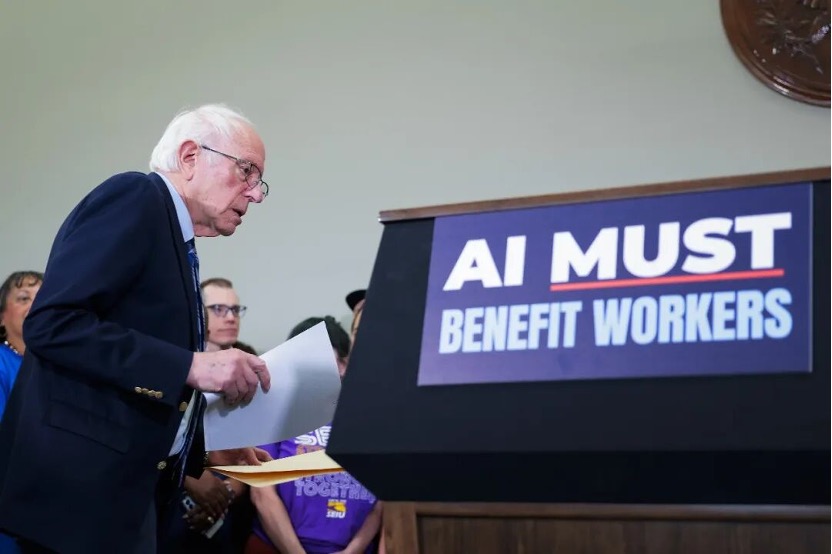
April 16, 2026, Washington, D.C., United States: U.S. Senator Bernie Sanders holds a press conference to express his concerns about artificial intelligence replacing American workers’ jobs. Photo / VCG
03 Enacting a Comprehensive, All-Encompassing Law Is by No Means the Best Path
Southern People Weekly: In your view, when China introduces comprehensive AI legislation in the future, what aspects will require the greatest attention?
Yao Xu: In AI governance, China already has a considerable regulatory toolbox. The regulatory tools in this toolbox are already able to provide guidance across different fields, and they have also achieved fairly good results in various scenario-specific governance projects. For example, the Interim Measures for the Management of Generative Artificial Intelligence Services set out clear filing requirements before deployment. Our ethics review also has clear measures. These regulations can all be iteratively improved. For example, the Cyberspace Administration of China and five other departments recently issued the Interim Measures for the Management of Anthropomorphic AI Interactive Services.
This wave of AI development represented by generative artificial intelligence is only the beginning. Whether newer technological routes will emerge later, whether new problems will arise, and how to respond effectively to those problems all require governance solutions capable of rapid adaptation. In this process, enacting a comprehensive, all-encompassing law is by no means the best path. Even though the EU moved relatively quickly in advancing AI legislation, the current discussions on implementation and adaptation in high-risk areas still involve many problems, and subsequent adjustments will be extremely difficult. This can be regarded as a cautionary example.
But learning from the EU’s experience through practical experimentation is feasible. The risk-tiering and classification approach in the EU’s Artificial Intelligence Act is worth trying, and we can also draw experience and lessons from concrete practice. Rather than enacting a comprehensive super-law, what we need more is rapid adjustment within existing regulatory tracks. For example, it has been nearly three years since the Interim Measures for the Management of Generative Artificial Intelligence Services were introduced. According to data from the Ministry of Industry and Information Technology and related investment reports, nearly 800 models have already completed filing. Whether this review-and-filing method needs to be reformed is worth discussing.
In this process, we should pay more attention to the policy constraints that still exist in the domestic-international linkage of AI development. We need an iterative approach of “moving fast in small steps.” For example, in the system for international deployment of computing power, cross-border data flows remain a prominent issue. Another example is that although the Provisions on Promoting and Regulating Cross-Border Data Flows—were issued in 2024, and although many localities have achieved notable results in implementation over the past two years, targeted consideration and rapid iteration are still needed on how to adapt to the global layout of the AI era, how to provide AI-related international public goods externally, and how to carry out international cooperation and deployment of computing power.
Southern People Weekly: In the fields of AI regulation and governance, what concerns you most?
Yao Xu: In this new stage of rapid AI development, countries in the Global South generally face a severe AI divide, and their overall development capacity is constrained. The most direct manifestation is that various key resources required for AI development and governance are difficult to rapidly aggregate. The most prominent problem is the serious insufficiency of underlying AI infrastructure. These countries not only lack data centers and computing facilities, but also have generally weak energy systems and supporting infrastructure. This directly constrains the foundation for AI development. At the same time, countries in the Global South face a huge gap in technical talent reserves and are unable, during this phase of explosive AI growth, to provide sufficient and stable talent support for industrial development.
In previous generations of technological change, countries in the Global South had already encountered digital and information divides to varying degrees. This round of the AI divide is even more irreversible, and the Matthew effect will continue to intensify. Countries with resource advantages will be more efficient in aggregating and transforming resources, while the gap with disadvantaged countries will continue to widen. It may even give rise to new forms of resource monopoly and predation.
For this reason, targeted strengthening of AI capacity-building in countries of the Global South is a direction that China has long called for and actively practiced, and a large number of practical initiatives and cooperative projects have already been implemented. At the same time, international organizations such as the United Nations also need to play a better role in coordinating global resources.
Reporters: Yang Nan
Original URL:
https://mp.weixin.qq.com/s/RoYtidT2AcnQcMGmgs4ckg?scene=1&click_id=13