

The rapid development of artificial intelligence (AI) is profoundly reshaping the global industrial landscape, international economic and trade rules, and governance systems. As global AI governance becomes increasingly fragmented, regionalized, and multipolar, identifying more inclusive and actionable governance pathways within existing international institutional frameworks has become an important issue of shared concern for the international community.
On the afternoon of May 11, 2026, Dr. Antonio Postigo, Senior Fellow at the Barcelona Institute for International Studies (IBEI) and Visiting Scholar at the Center for Global AI Innovative Governance (CGAIG) and the Fudan Development Institute (FDDI), delivered an academic lecture at Fudan University titled “Free Trade Agreements: From Trade Liberalization to Building Blocks for Inclusive AI Governance in a Multipolar World?” The lecture was moderated by Xue Song, Associate Professor at the Institute of International Studies, Fudan University. Yao Xu, Secretary-General of CGAIG and Associate Professor at FDDI, and Xin Yanyan, Deputy Secretary-General of CGAIG and Assistant Professor at FDDI, served as discussants.

Dr. Postigo shares his academic insights during the lecture.
Dr. Postigo noted that global AI governance is currently facing the practical challenge of fragmentation. While AI is generating significant economic value, it also brings multiple challenges, including labor market disruption, data privacy protection, and systemic safety risks. A growing number of countries and regions have introduced AI strategies or governance frameworks, while multilateral mechanisms such as the United Nations and the World Trade Organization have also advanced relevant governance initiatives. However, most of these initiatives lack strong binding force in practice. Due to differences in countries’ development levels and strategic priorities, AI governance pathways have diverged significantly. Taking China and the United States as examples, Dr. Postigo observed that China has actively advocated cooperative multilateral governance and inclusive participation by the Global South, and has proposed the establishment of the World AI Cooperation Organization (WAICO). By contrast, the United States places greater emphasis on competitive advantage and technological dominance in its strategic planning, with its governance approach showing certain features of incremental unilateralism.

Dr. Postigo
In building a more inclusive governance system, free trade agreements (FTAs) and digital economy agreements (DEAs) demonstrate distinct institutional value. Dr. Postigo pointed out that, as international trade shifts from traditional trade in goods toward digital trade, digital economy provisions are increasingly being incorporated into FTAs that cover services, investment, and intellectual property, while more specialized DEAs have also emerged. Together, they form an important foundation of contemporary international economic and trade rules. When AI is treated as an issue of economic integration or regulatory coordination, FTAs can align economic incentives with institution-building through binding commitments on cross-border data flows, data localization, source code and algorithm protection and transparency, regulatory interoperability, and technical cooperation with the Global South. Although FTAs have limits in addressing extreme security risks, their role in promoting regulatory coordination and capacity building for Global South countries makes them important institutional building blocks for effective and inclusive global AI governance.
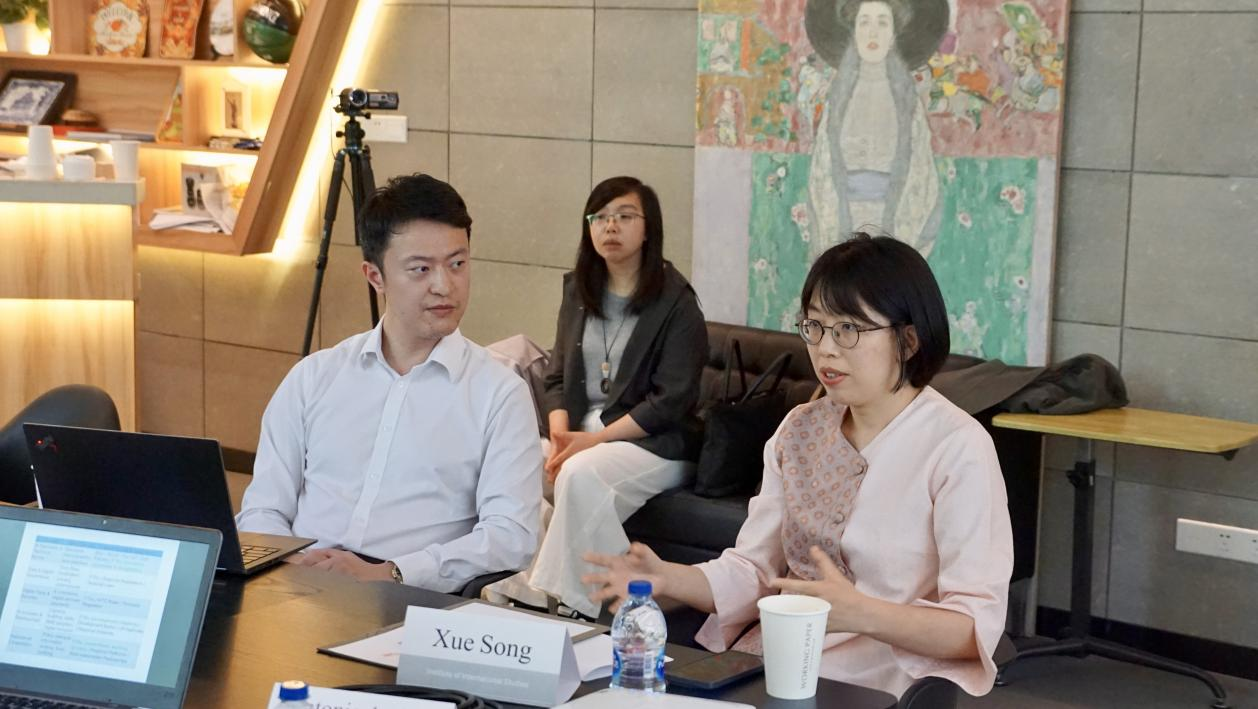
Xue Song, Associate Professor at the Institute of International Studies, Fudan University, moderates the lecture.
Dr. Postigo further argued that building an inclusive global AI governance system requires diversified institutional pathways. Given strong geopolitical constraints, a single unified multilateral AI governance framework is unlikely to emerge in the near term. Future governance is more likely to evolve through multiple overlapping and coordinated frameworks. By continuously improving the institutional design of FTAs and DEAs in terms of binding force, inclusiveness, and capacity building, the international community can gradually build the institutional foundations for effective, inclusive, and sustainable global AI governance amid fragmentation.

Participants exchange views with Dr. Postigo on the lecture topic.
During the discussion session, participants engaged in an in-depth exchange with Dr. Postigo on issues including the balance between development and security in AI governance, the spillover effects of international economic and trade rules, Global South capacity building, and multilateral cooperation mechanisms.
At the end of the lecture, Dr. Xue Song presented Dr. Postigo with the Visiting Scholar Certificate of the Fudan Development Institute.
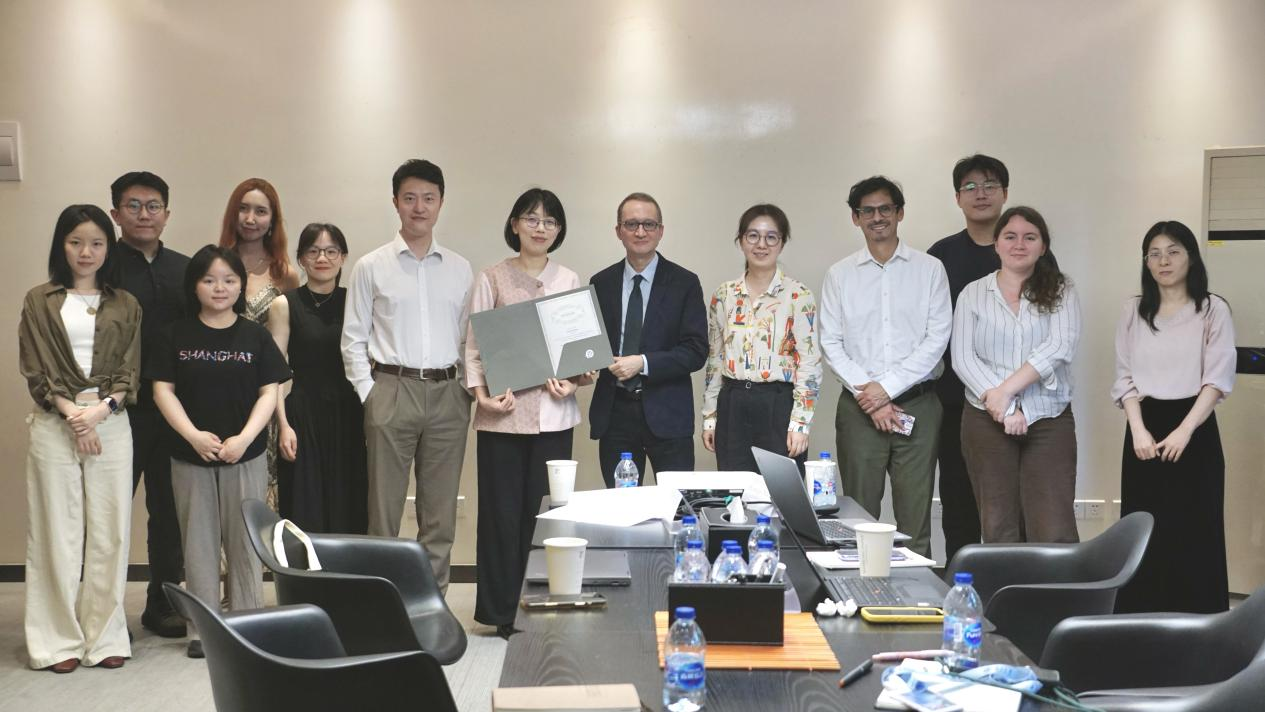
Dr. Postigo receives the Visiting Scholar Certificate and takes a group photo with participants.