

US President Donald Trump will pay a state visit to China from May 13 to 15. This marks the first meeting between the two leaders since the Busan summit in October, and the first US presidential visit to China in nine years. Trump's visit will launch a new round of high-level engagements this year. Artificial Intelligence (AI) is a major focus of this summit. Whether this meeting can make progress in moving from “procedural breakthrough” to practical cooperation, risk management, and long-term dialogue, and have such progress confirmed and extended in subsequent presidential meetings and bilateral diplomatic occasions this year, will profoundly shape China-US AI competition and cooperation, as well as the evolution of global AI governance.
01 Review and Prospects: AI on the agenda
Presidential diplomacy plays an irreplaceable strategic guiding role in China U.S. relations. Previously, due to external factors such as the international situation, the date of Trump’s visit to China was repeatedly postponed. Now, with the official announcement of Trump’s visit, the meeting arrangements, communication progress, expected outcomes, and especially the specific topics to be discussed, have attracted global attention.
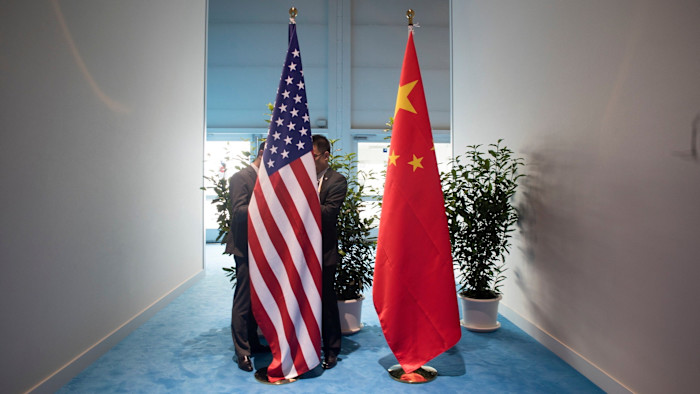
Photo: U.S. President Donald Trump will pay a state visit to China from May 13 to 15.
Source: Financial Times
Although China and the U.S. have not officially released the full agenda before the meeting, AI is expected to be on the agenda as a shared concern of the international community and both countries.
On the one hand, authoritative international media and think tanks have disclosed relevant developments. On May 6, The Wall Street Journal noted that Washington and Beijing are evaluating an official AI dialogue, led by U.S. Treasury Secretary Scott Bessent. Reuters quoted sources within the Trump administration as stating that Trump’s diplomatic team believes China and the U.S. need communication channels to avoid accidental conflicts, and hopes to take the opportunity of the meeting to launch dialogue and establish a formal communication mechanism on AI issues.
On the other hand, when responding at a regular press conference to reports that China and the U.S. plan to launch an official AI dialogue during the presidential meeting next, a spokesperson for the Chinese Foreign Ministry, said that the two sides are maintaining communication on arrangements for Trump’s visit to China, and there is no specific information available for release at present. While restrained, the statement implies that AI is a key item being advanced by the diplomatic teams of both countries.
The intergovernmental dialogue and cooperation on AI between China and the U.S. can be traced back to the presidential meeting held in San Francisco in November 2023. During that summit, the two heads of state reached a consensus on launching an intergovernmental AI dialogue mechanism, pioneering formal communication between the two countries in this emerging strategic field. In May 2024, the two teams held the first round of intergovernmental AI dialogue in Geneva, Switzerland, conducting in-depth discussions on AI related risks and global governance mechanisms. After Trump returned to the White House, the originally scheduled second round of intergovernmental AI dialogue was not launched as planned, but the high-level consensus remains.
On October 30, 2025, the two heads of state held their first face-to-face meeting in Busan during Trump’s second term. AI was listed as one of the areas with good prospects for cooperation between two countries, and both sides expressed their commitment to further promoting mutually beneficial cooperation in the AI sector. This course reflects the delicate state of China-U.S. relations on cutting‑edge technology issues: strategic competition continues, but pragmatic engagement persists. Despite no easing of rivalry in competitive dimensions such as chip controls, frontier models, and AI compute infrastructure, both sides still regard maintaining communication and coordination in the AI field as practically significant.
From a broader perspective, AI is rapidly reshaping the global geo-technological landscape. Whether China and the U.S. can resume and advance official AI dialogue mechanisms will not only affect the direction of technological competition and governance coordination between the two countries, but also influence the evolution of the global AI governance order.
02 Prospects for the AI agenda: dialogue, risk, and security
Compared to the San Francisco summit, the “restart” of the AI agenda has three main highlights.
First, the coordination track and advancement logic are adapted to new circumstances. The first round of China-U.S. AI dialogue followed a diplomacy science and technology communication logic. Although the coordination mechanism and team composition for the current round of AI dialogue have not been finalized, Reuters reports that AI issues are now mainly coordinated by the trade negotiation teams of both sides. This adjustment is based on practical considerations: after multiple rounds of trade consultations, the coordination and communication mechanism of trade teams represents a relatively frequent and stable channel. It also signals that after the summit, bilateral AI dialogue will lean toward trade related issues and advance pragmatically around export controls and model governance.
Notably, according to multiple sources including Bloomberg and Reuters, the list of business leaders accompanying Trump to China includes Tim Cook, Elon Musk, Kelly Ortberg, and executives from Qualcomm, Blackstone, Citigroup, and Visa. Notably absent is Jensen Huang, CEO of NVIDIA, a figure closely watched by all parties, which indirectly reflects that chip export control issues will remain complex in trade negotiations.
Second, the agenda is more focused. According to The Wall Street Journal, the core topics under consideration by both sides have narrowed to three specific risks: unexpected failures or loss of control of frontier models (model failure), uncontrolled behavior of autonomous weapons systems in military scenarios, and large‑scale attacks using open‑source frontier models by non‑state actors (such as terrorist organizations or cybercrime groups). Behind this focused agenda lie shared interests and concerns of China and the U.S. in AI cooperation.
Photo Source: The Diplomat
Third, progress may be driven by AI risks and security that transcend geopolitical conflicts. AI is becoming a foundational technology with major economic, military, and geopolitical implications, yet it also carries systemic risks. The international community widely recognizes the existence of AI risks; these are not distant concerns but could become reality without proper management, and no country can remain immune.
Therefore, preventing and defusing AI risks has become a key topic for future China‑U.S. AI dialogue and cooperation, even a shared issue that may transcend bilateral geopolitical interests. Since 2024, Thomas Friedman, columnist for The New York Times, has discussed the necessity of China‑U.S. AI cooperation in multiple articles. He argues that against the backdrop of possible artificial general intelligence (AGI), China and the U.S. should draw on historical experience to promote pragmatic cooperation and ensure effective human control over rapidly evolving AI systems. Encouragingly, both sides have begun to recognize the need to govern frontier-model AI risks, and have each gained experience and governance approaches in their respective AI governance practices. This convergence in technological understanding provides a foundation for bilateral cooperation.
In a public speech after leaving office, former U.S. National Security Advisor Jake Sullivan reviewed the first round of China U.S. intergovernmental AI dialogue. He admitted that while both sides strive to lead in the AI race, the accelerated development and deployment of AI in civilian and military fields require continued high level diplomatic consultations between China and the U.S. on AI risks to jointly address potential dangers.
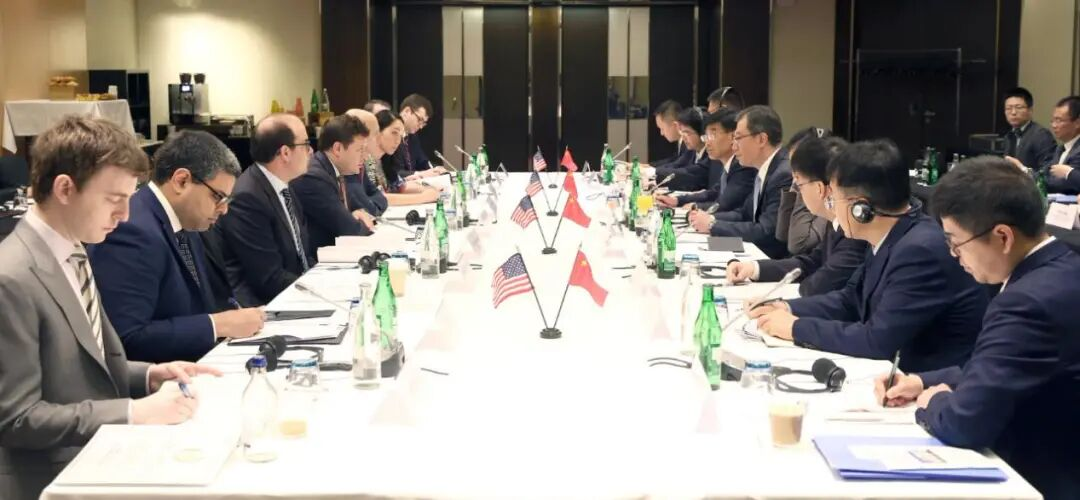
Photo: The first China‑U.S. Intergovernmental Dialogue on AI held on May 14, 2024
Source: CCTV
In addition, the autonomy, complexity, and opacity of decision making in AI systems make it increasingly difficult for governments to distinguish whether an incident is a technical malfunction, accidental escalation, or deliberate attack. This ambiguity poses no direct problem under normal conditions but increases the risk of strategic miscalculation in crisis situations.
The military sector is the most prominent arena for this challenge. During the APEC summit in Lima in November 2024, the two heads of state confirmed that human control should be maintained over decisions on the use of nuclear weapons. This statement represents an important and public bilateral consensus between China and the U.S. on the militarization of AI. The international community is widely watching whether the two sides will uphold or expand this consensus at the upcoming summit.
According to discussions in U.S. strategic circles, establishing a communication mechanism for military AI is regarded as a limited but feasible arrangement at this stage. A recent analysis by the Brookings Institution on China U.S. AI cooperation notes that advancing AI model capabilities poses new national security risks. As major AI developers and military users, China and the U.S., even if unwilling to accept hard limits on capability development, still need to set up working channels for incident notification, risk categorization, crisis communication, and limited transparency arrangements.
03 Three logics within the U.S.: “pressure” or “management”?
The latest data from Stanford’s 2026 AI Index Report and Chatbot Arena show that the single‑point performance gap between top Chinese and U.S. models has narrowed to a marginal range: as of March 2026, the U.S. led by only 2.7%. More importantly, global AI competition has long moved beyond pure algorithmic contests to a multi‑dimensional game spanning computing infrastructure, industrial deployment, and integration with the real economy. The structural advantages of the U.S. in AI are shrinking faster than expected. This objective trend underpins the policy debate within the U.S. on China‑U.S. AI dialogue.
Against this backdrop, three policy positions with distinct stances yet shared underlying logic have emerged in U.S. strategic circles.
The first is the pressure‑bundling logic of the establishment hawks. Institutions such as the Council on Foreign Relations (CFR) argue that China’s fundamental goal in participating in AI dialogue is to delay technological decoupling, narrow the gap, and buy time for catching up. They therefore advocate that any form of bilateral dialogue must run in parallel with a strategy of maximum pressure on China. Chris McGuire, former Deputy Senior Director for Technology and National Security at the U.S. National Security Council, believes that while China‑U.S. AI security dialogue helps build relations, the U.S. should still tighten export controls to maximize its technological lead over China. The Foundation for Defense of Democracies (FDD) judges that China‑U.S. technological dialogues have long been process‑heavy and substance‑light. It views AI as a secondary issue in current strategic rivalry, describing it as “at best a political endorsement to dress up diplomatic achievements at bilateral summits, lacking a substantive basis for cooperation.”

Photo: Chris McGuire, Former Deputy Senior Director for Technology and National Security, U.S. National Security Council
Source: Council on Foreign Relations (CFR)
The second is the bottom‑line risk management logic of the pragmatic moderates. China and the U.S. share concrete national security interests in preventing the misuse of AI by non‑state actors such as terrorist organizations or transnational criminal networks. Such cooperation relies not on strategic trust but on practical needs for risk control. In an earlier article titled China and the U.S. Can Make AI Safer published in Foreign Affairs, the author argues that as key players shaping the global AI landscape, China-U.S. cooperation is both necessary and possible. Without communication, competition between the two sides cannot yield long‑term stable benefits. The two countries can anchor cooperation in governing major AI risks with broad consensus, holding substantive discussions on core issues such as algorithmic safety and existential risks. This logic of transforming shared risks into opportunities for cooperation helps both sides identify common interests in emerging technological trajectories, transform security standards from technological barriers into bridges for cooperation, and shift from defensive confrontation to consensus‑based governance.
The third is the structural realist perspective that transcends the first two camps. A recent article in Foreign Affairs characterizes current China‑U.S. relations as a period of Strategic Calm—a state where both sides use a relatively stable window to strengthen internal capabilities. Stability here is a product of competitive pressure, not a sign of improved relations. This structural judgment is supported by data: according to a 2026 CSIS expert survey cited by The Diplomat, 57% of U.S. experts surveyed believe China‑U.S. relations have not truly stabilized.
04 A Critical Node in Global AI Governance
Overall, the upcoming summit can be seen as the first step for high‑level China‑U.S. AI engagement, setting a baseline for regular communication and launching the 2026 bilateral diplomatic agenda. Whether tangible outcomes in the short term can be reached on potential AI topics remains to be seen. From a global perspective, bilateral and multilateral channels should serve different functions in global AI governance.
Bilateral China‑U.S. channels primarily address risk management, including crisis communication, miscalculation avoidance, military AI risks, model misuse, and emergency response. Achieving inclusive and beneficial global AI governance requires multilateral processes to pool global efforts. Moreover, China‑U.S. AI dialogue and cooperation face clear constraints in moving from procedural opening of windows to substantive norms.
On the one hand, political fragmentation in the U.S., a hardline consensus on China policy, and policy divergences among executive agencies may continue to narrow the space for implementing dialogue outcomes. On the other hand, AI issues span national security, industrial competition, export controls, education and training, ethical governance, and multilateral rule making. Thus, for high level China U.S. interactions in 2026., this meeting is a starting point, not an endpoint. Whether continuous engagement takes place at multilateral events such as the APEC summit in Shenzhen and the G20 summit in Miami will largely determine whether consensus from this meeting can be translated from political agreement into practical working mechanisms.
Meanwhile, the meeting demonstrates a positive dimension of global AI governance: amid deepening China U.S. strategic competition, overlapping technological controls, and security concerns, if the two sides can establish some form of regular risk communication channel, its symbolic value should not be underestimated. Maintaining face to face communication and dialogue, jointly preventing and defusing risks, and managing competition are in themselves meaningful and practical achievements.
Authors
Yao Xu, Secretary-General of CGAIG and Associate Professor at FDDI
Xin Yanyan, Deputy Secretary-General of CGAIG and Assistant Research Fellow at FDDI
Zhang Ao, Research Assistant of CGAIG
Yuan Luming, Research Assistant of CGAIG