


People’s Daily Overseas Edition, May 2, 2026, Page 6
AI-powered disaster warning systems, robots capable of playing musical instruments and performing dances, and AI-enabled smart glasses offering real-time translation were among more than 20 cutting-edge digital technologies showcased at the recent Third High-Level Conference of the Forum on Global Action for Shared Development (hereafter “the Forum”). A companion exhibition platform, branded “Digital South”, was also launched during the event.
Five years ago, China proposed the Global Development Initiative, advocating a development-first approach that has played an important role in advancing shared development. In 2025, China established a dedicated “Digital Capacity-Building Fund” under the Global Development and South-South Cooperation Fund to support the “Digital South” initiative. Efforts to narrow the digital divide are widely viewed as reflecting the “innovation-driven” principle of the Global Development Initiative. Recently, a number of projects under the “Digital South” brand within the Global Development Project Pool have made new progress.
01 Teaching Digital Skills and How to Use Them
At Phiawath Complete Secondary School in Vientiane, Laos, a 3D printer hums inside a newly established technology classroom, while local teachers confidently guide students in adjusting printing parameters. 3D printers, robotic dogs, woodworking equipment and biochemical models have appeared in the school’s classrooms for the first time.
In October 2023, the Shenzhen Foundation for International Exchange and Cooperation partnered with Shenzhen-based companies and charitable organizations to donate educational materials to the school. Technology products including drones and a model of the Tiangong-1 space station drew strong interest from local students. Following field research into teaching conditions, the foundation launched the “Shenzhen–Lancang-Mekong Youth Excellence Initiative” technology classroom donation project for Laos, aiming to build a dedicated technology classroom at Phiawath Complete Secondary School and provide demonstration science and technology courses. In July 2024, the school’s first technology classroom officially opened.
“After the classroom was completed, we realized that training was even more important than the equipment itself,” Li Dan, executive secretary-general of the Shenzhen Foundation for International Exchange and Cooperation, told the newspaper. “The goal was to ensure the classroom could continue operating independently after the external team had left.” Chinese volunteers trained local teachers at the school on equipment operation, science lesson design and troubleshooting, while also leaving behind teaching materials and lesson plans. The program additionally facilitated an exchange mechanism between Shenzhen Hongling High School and Phiawath Complete Secondary School.
“To bridge the digital divide, an important step is to expand development cooperation beyond traditional material assistance towards building institutional, human and ecosystem capacities suited to the digital era,” Yao Xu, Secretary-General of the Center for Global AI Innovative Governance and Associate Professor at the Fudan Development Institute, Fudan University, told People’s Daily Overseas Edition. He argued that countries in the Global South should gradually shift from being passive recipients of digital technology to becoming co-shapers of the digital development agenda.
Many Global South countries are currently at what is seen as a critical stage of digital transformation. Deepening digital cooperation, strengthening talent cultivation and expanding inclusive access to technology are increasingly viewed as important pathways towards sustainable development. Sayasone, Executive Vice Chairman of China-Laos Cooperation Committee, said digital empowerment represented not only technological upgrading for Laos, but also a strategic choice tied to the country’s future development.
Yao noted that some training initiatives struggle to move beyond the classroom because they lack follow-up scenarios, funding, mentors and industrial linkages. He added that countries in the Global South differ significantly in digital infrastructure, administrative capacity and talent reserves, making standardized approaches difficult to apply universally. In his view, the “Digital South” initiative therefore needs tailored cooperation mechanisms featuring long-term monitoring and joint evaluation.
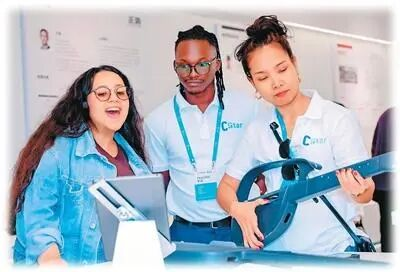
C Star participants experience an AI-powered guitar at the Robot Sharing Base in Dongguan, Guangdong Province
Source: Provided by the interviewee
02 Beyond Technology Transfer: Connecting Entrepreneurs to Markets
At Shenzhen’s Nanyou garment market, Makena, a Kenyan participant in the C Star Youth Innovation and Entrepreneurship Program under the Global Development Project Pool, moved between wholesale stalls searching for diversified and reliable Chinese suppliers for her fashion business back home.
“We accompanied her from stall to stall and helped compile a supplier directory,” Zhao Dongqing, senior business director of China Merchants Shekou Industrial Zone Holdings’ overseas development division, explained. The C Star initiative is funded by the China Merchants Foundation and implemented by China Merchants Shekou. It has established the African Youth Innovation and Entrepreneur Center in Djibouti while developing entrepreneurship training programs and tailored learning, exchange and practical activities.
Since 2012, China Merchants Group has invested in infrastructure projects in Djibouti, including the Doraleh Multipurpose Port and the Djibouti International Free Trade Zone. According to Zhao, these industrial and spatial resources helped provide practical settings for entrepreneurship training. “Narrowing the digital development gap requires young people to play a leading role,” Zhao said. Given Djibouti’s relatively young population and challenges around employment and business experience, the group launched a program specifically aimed at supporting African youth entrepreneurship.
Yao argued that traditional technical assistance often focuses on individual projects, equipment delivery or short-term training, while commercial exports tend to prioritize market exchange and corporate profits. By contrast, he described “Digital South” as relying on combinations of application scenarios, governance experience and partnership networks, with “capacity-building” serving as the central concept.
Nigerian entrepreneur Oluwatoyin, for example, hoped to procure heavy-duty trucks for a logistics business. C Star arranged supplier contacts and accompanied her to Henan province to inspect manufacturing facilities and negotiate procurement. Another participant, Kidist from Ethiopia, focused on women’s health products and was matched with manufacturers through the program. “Industrial matchmaking requires precision,” Zhao explained. “We create profiles for both African participants and Chinese companies to map business needs and technical gaps.”
By the end of 2025, C Star covered 27 African countries and involved more than 1,500 young entrepreneurs. Participants have travelled to China for study programs covering 15 sectors including artificial intelligence and e-commerce.
“‘Digital South’ is not simply about exporting existing Chinese technologies and solutions,” Yao argued. “It treats digital development capacity itself as a form of international public good.” Countries capable of supplying such digital public goods, he said, should focus not only on technological tools, but also on digital economy policy design, AI governance, data security, digital infrastructure applications and youth entrepreneurship, thereby providing a comprehensive capacity-building framework.

Students from Phiawath Complete Secondary School in Laos learn to operate a 3D printer and observe biological models during a demonstration class
Source: Provided by the interviewee
03 Building Long-Term Cooperation Systems to Help Digital Seeds Take Root
During the Forum, the Beijing Academy of Artificial Intelligence and the African Union–African Scientific Research and Innovation Council signed a memorandum of understanding on digital talent cultivation. The agreement formally launched a China–Africa AI Compute Faculty Development Initiative, which is expected to rely on open computing platforms to support training, joint research and practical applications across Africa.
“Digital cooperation projects can easily face the risk of ‘strong training but weak implementation’,” Yao observed. Without sufficient local ecosystem support, local talent may also migrate elsewhere. In his view, the question of how to ensure projects achieve long-term sustainability is one the “Digital South” initiative must address.
Recently, the C Star program was selected as a flagship activity for the 2026 China–Africa Year of People-to-People Exchanges. It has also established a dedicated youth entrepreneurship fund, in cooperation with organizations including the China-Africa Development Fund, to provide rewards for outstanding participants, subsidies for cross-border exchanges and support for financing costs.
Zhao explained that C Star participants are recruited openly from across society and supported through entrepreneurship networks built over many years in Africa. Even after graduation, participants continue receiving follow-up support and resource connections. “Throughout this process, we pay particular attention to aligning industrial demand on both the Chinese and African sides,” Zhao said. “The aim is both to help overseas businesses enter China and to help Chinese enterprises expand abroad, creating mutually beneficial opportunities.”
Over the past two years, the Shenzhen Foundation for International Exchange and Cooperation has partnered with companies, social organizations, universities and youth volunteers from Shenzhen and the Greater Bay Area to establish “technology classrooms” in countries including Papua New Guinea, Malaysia and Togo, while deepening long-term educational cooperation.
Yao noted that global digital rules, AI standards and mechanisms governing cross-border data flows are currently showing signs of fragmentation into competing blocs. In addition, Global South countries differ substantially in institutional foundations relating to privacy protection, cybersecurity and platform regulation, meaning project implementation requires extensive consultation and the establishment of evaluation and development frameworks.
“For ‘Digital South’ to achieve lasting impact, efforts need to deepen in three areas,” Yao said. “First, training programs should evolve into long-term capacity-building networks involving alumni, experts, enterprises and international organizations. Second, the model should shift from ‘Chinese supply’ towards ‘joint design’, allowing partner countries to participate deeply in agenda-setting and project evaluation. Third, technical cooperation should be extended into governance cooperation, integrating AI safety, data governance, open-source inclusiveness and the provision of digital public goods.”
“What we are doing is not the kind of hard infrastructure project associated with roads, bridges or skyscrapers,” Zhao said. “Our focus is people. By helping individual young entrepreneurs achieve tangible success, we hope they can go on to influence many others. These projects are like seeds — once they take root and grow, they can help drive broader entrepreneurship and employment.”
Original Link: https://mp.weixin.qq.com/s/WZkBWCqR0xX6l7b7ax3vHA