


Musk’s lawsuit against OpenAI took several turns before reaching trial in federal court. On April 28, 2026, the case formally went to trial in federal court in Oakland, California, with Musk alleging that OpenAI and its leadership had departed from the organization’s original non-profit mission. Musk contended that after accepting massive investment from Microsoft and gradually shifting toward a for-profit structure, OpenAI had transformed from an open research institution founded to benefit humanity as a whole into a closed-source commercial platform under deep Microsoft control, which he argued constituted a breach of contract and fraud against early donors, as well as a betrayal of OpenAI’s founding principles. Musk sought not only the removal of senior executives including Sam Altman, but also $150 billion in damages from OpenAI and co-defendant Microsoft, while attempting to force OpenAI to return to an open-source, non-profit model through litigation. After pretrial proceedings, Musk voluntarily withdrew some fraud-related claims, and the court ultimately allowed only two core disputes—breach of charitable trust and unjust enrichment—to proceed to the jury.
OpenAI, for its part, countered that Musk’s lawsuit was “nothing more than a harassment campaign” stemming from his earlier failure to gain control of OpenAI, and that its true purpose was not to uphold open-source ideals but to use litigation to disrupt OpenAI’s anticipated IPO, which could value the company at up to $1 trillion.
This article argues that while this lawsuit superficially revolves around a legal dispute over OpenAI’s organizational nature and founding agreements, at its core, it is a systemic contest over valuation frameworks, IPO windows, infrastructure control, and future global AI dominance in the era of mega-capital competition. The technical and legal consequences of this litigation may continue to spill over into the domains of digital infrastructure, model standards, and capital governance, with far-reaching implications for the overall development of global artificial intelligence.
01 Competitive Analysis: From “Co-Founders” to “Direct Rivals”
In 2015, Musk co-founded OpenAI with Sam Altman and others, with the original intent of advancing “safe and beneficial” AI development in a non-profit format. However, as generative AI competition rapidly escalated, the AI industry shifted from technological idealism toward a mega-capital-driven model. The two parties evolved from initial co-founders into direct competitors vying for AI dominance and global capital control.

Elon Musk and Sam Altman / Bloomberg
AI industry competition in 2026 has escalated from a contest of technological approaches into a systemic battle over capital scale, IPO valuations, and global industrial control. Currently, OpenAI’s valuation has climbed to $852 billion, and at the end of March 2026 it completed a record-breaking $122 billion private funding round, setting a new global record for a single private placement. After completing this round, OpenAI is targeting an IPO at an even higher valuation, and its development logic has clearly departed from its early non-profit model, pivoting toward a path of a super tech company centered on capital expansion, computing resource stockpiling, and global infrastructure deployment. Meanwhile, Musk is pursuing a vertically integrated model that combines AI with his existing aerospace business, ultimately aiming to deploy AI data centers in space and seeking to outcompete OpenAI in technology, scale, and valuation. In February 2026, SpaceX acquired xAI through an all-stock transaction, making xAI a wholly-owned subsidiary of SpaceX. The combined entity was valued at $1.25 trillion after the acquisition and is reportedly targeting an IPO valuation of $1.5 trillion to $1.75 trillion. If achieved, this target would not only cement SpaceX’s place among the world’s top-ten companies by market cap, but could also make Musk the world’s first trillionaire. On May 7, 2026, Musk announced on social media that xAI would cease to exist as an independent company and would be fully integrated into SpaceX as an internal division, SpaceXAI. This move allows SpaceX’s stable, steadily growing high-margin revenues to offset xAI’s enormous compute and R&D expenditures, greatly alleviating the financing pressure that xAI faced as an independent AI company and making its valuation significantly more stable than OpenAI’s.
02 Litigation Motivations: Legal Pressure on IPO Valuation
Against this backdrop, the immediate motivation behind Musk’s lawsuit is no longer merely ideological, but a strategic move targeting IPO valuation, capital market expectations, and industrial dominance.
First, this legal strategy could disrupt IPO audits and the listing timeline. Musk’s decision to file the lawsuit during the 2026 IPO window is essentially exploiting legal uncertainty to disrupt OpenAI’s listing schedule. IPOs require extremely rigorous compliance audits, and the allegations in the lawsuit will subject OpenAI’s corporate governance, profit structure, and historical agreements to far more complex scrutiny. Once the relevant disputes enter a prolonged judicial process, OpenAI’s IPO may be delayed, or the company may even need to restructure its valuation logic and disclosure materials.
At the same time, the litigation itself also creates psychological pressure on investors. Musk’s demand for the removal of Sam Altman from the board introduces leadership uncertainty that could undermine potential investors’ confidence in OpenAI’s long-term stability. As global tech IPOs cluster in 2026, capital market funds and risk appetite are already limited. If OpenAI’s listing is delayed or its valuation lowered due to the lawsuit, this would in turn open a critical financing and market window for SpaceXAI’s summer IPO.
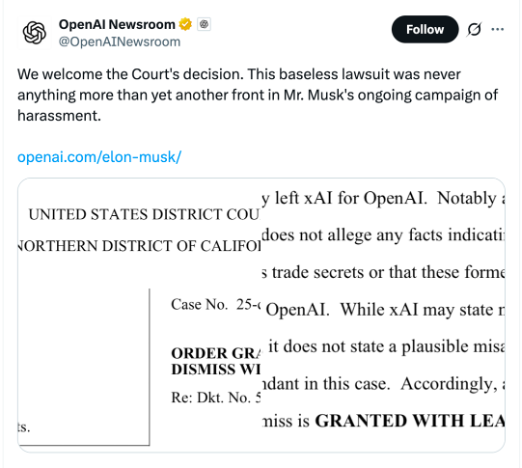
OpenAI’s post showing they welcome the Court’s decision / X
Second, this strategy could suppress OpenAI’s long-term value expectations. AI companies’ current core valuations derive not from current profitability but from the capital markets’ long-term expectation of future “AI winners.” Goldman Sachs analysis shows that 84% of tech stock value comes from long-term cash flows ten years out—the so-called “terminal value”—and that a mere 1% fluctuation in long-term growth rates can cause a 29% decline in total enterprise value. Musk’s lawsuit is aimed precisely at eroding the certainty of OpenAI’s future value. Even if the lawsuit ultimately fails to overturn OpenAI’s existing structure, any market uncertainty over its IPO path, governance legitimacy, and future AI dominance could be enough to trigger a meaningful valuation contraction. According to the Financial Times, three major fund managers invited to participate in OpenAI’s latest fundraising round declined to do so because OpenAI’s revenue-based valuation significantly exceeded that of comparable publicly listed companies. Under this logic, litigation has effectively become a tool for reshaping valuations in capital markets; its purpose is not merely to win the case, but to weaken the competitor’s long-term capital premium by generating sustained uncertainty.
Third, the lawsuit could attack the infrastructure alliance behind OpenAI. Beyond the competition at the IPO and valuation levels, another core target of Musk’s attack lies in the deeply integrated relationship between OpenAI and Microsoft. Musk has repeatedly accused OpenAI of having become a “closed-source de facto subsidiary” of Microsoft, contending that its current profit structure violates its original non-profit organizational positioning. This allegation, beyond moral criticism, also legally challenges the exclusive partnership between OpenAI and Microsoft. If a court ultimately finds that OpenAI’s current profit model has legitimacy problems, then the technological, capital, and cloud-computing ties between OpenAI and Microsoft could be weakened, or even face a breakup risk. If Microsoft can no longer provide OpenAI with exclusive computing resources, cloud-platform access, and commercial ecosystem support, the technological barriers OpenAI has built over the long term will be severely undermined. The deeper goal of the lawsuit, therefore, is to weaken the AI infrastructure alliance behind OpenAI through legal means.
03 Structural Contradictions: The Clash Between the Non-Profit Model and the Mega-Capital Race
If the conflict between the two parties appears on the surface to stem from a divergence in founding philosophies, the deeper reason lies in the fact that the AI industry has entered a new era driven by capital and profit, in which the non-profit model can no longer be sustained.
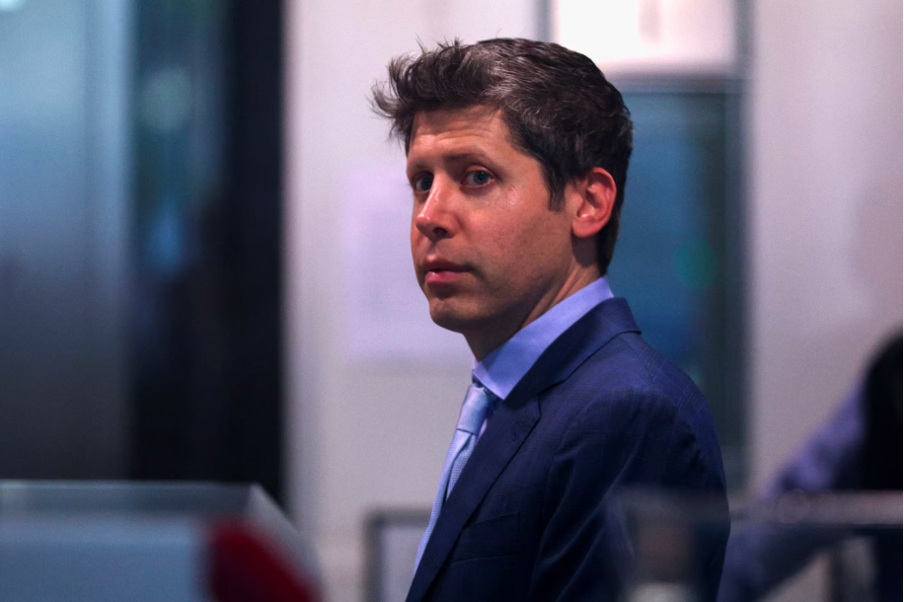
On May 14, 2026, Sam Altman, the CEO of OpenAI, arrived at a federal court in Oakland, California, USA. / Reuters
First, as generative AI competition has fully escalated, costs have soared due to computing resource stockpiling, large model training, and competition for top talent.
According to McKinsey’s April 2025 research report, global data centers are projected to require $6.7 trillion by 2030 to meet computing demand. Data centers capable of handling AI workloads are expected to require $5.2 trillion in capital expenditure, while data centers for traditional IT applications are expected to require $1.5 trillion. Overall, by 2030, this amounts to nearly $7 trillion in capital expenditure—a staggering level of computing spending by any measure.
On the cost of training large models, according to data published by research institution Epoch AI in September 2024, the development costs for OpenAI’s ChatGPT-4 and Google’s Gemini were extremely high. The cost of training Gemini has been reported as between $30 million and $191 million, with Epoch AI noting that these figures may represent 29% to 49% of the final cost. Sources indicate that the technical development cost of ChatGPT-4 ranged from $41 million to $78 million. OpenAI CEO Sam Altman has stated that the model cost over $100 million to build, a figure broadly consistent with this estimate. Additionally, according to Bloomberg on May 6, OpenAI co-founder and president Greg Brockman indicated that the company planned to allocate $50 billion to computing investments in 2026.
Against this backdrop, if OpenAI cannot continue to secure external capital support, it will struggle to sustain the pace of AGI research and model iteration. Under the realistic constraints of R&D demands and cost dynamics, OpenAI’s original path centered on openness, sharing, and non-profit principles can no longer sustain the capital-intensive development logic of today’s AI industry.
Second, while OpenAI’s commercialization transition has addressed its funding needs, it has also given rise to new technology governance controversies. Starting in 2019, OpenAI established a “capped-profit” structure, setting a maximum 100x return cap for initial investors so as to attract external capital while maintaining non-profit control. In October 2025, OpenAI completed a further structural reorganization, dividing its corporate architecture between a non-profit entity, the OpenAI Foundation, and a for-profit entity, OpenAI Group PBC, a public benefit corporation (PBC). This structure remains legally controlled by the OpenAI Foundation, but the hybrid architecture jointly shaped by non-profit and for-profit entities has given OpenAI financing capabilities and a potential path to public listing much closer to those of a traditional tech company.
However, this hybrid structure has not resolved the contradiction between its public interest origins and profit imperatives. Taking the OpenAI-Microsoft cooperation as an example: given OpenAI’s early claims about AGI safety red lines, AGI has long been a sensitive area in the partnership. In an earlier revision to the partnership terms, in exchange for Microsoft’s agreement to allow multi-cloud distribution, OpenAI changed the process for determining AGI so that it would no longer rest solely on an internal board decision, but would require verification by an independent expert panel. In addition, Microsoft obtained rights to continue licensing OpenAI technology through 2032, including certain post-AGI model rights, regardless of when AGI is declared. From an operational perspective, OpenAI’s commercial decisions may well serve its development, yet the series of corporate restructurings and the revised terms with Microsoft have undeniably moved it away from its original non-profit intent.
Musk seized on this point to file the lawsuit, alleging that OpenAI had violated its original agreement, betrayed its non-profit mission, and become a commercialized platform dominated by Microsoft.
From a governance perspective, the OpenAI Foundation holds only approximately 26% of shares, yet simultaneously holds special voting and governance rights, allowing it to appoint all board members of OpenAI Group and to replace directors at any time. In terms of actual economic effects, however, the economic interests held by the non-profit entity have been substantively diluted, with external investors, employees, and commercial partners having gained a more important position in company operations. Meanwhile, seven of the eight directors on the OpenAI Foundation board are also formal voting members of the for-profit OpenAI Group PBC board. OpenAI uses this highly overlapping leadership structure to signal to the outside world that it remains committed to its non-profit founding principles, but as Northwestern University law professor Jill Horwitz has noted, such a highly overlapping structure makes it very difficult for the Foundation to exercise truly independent oversight and veto power over the for-profit entity. In 2023, although the board dismissed Sam Altman over concerns about safety and integrity, strong pressure from capital players such as Microsoft quickly reversed the situation, leading the original board to collectively resign while Altman was reinstated—a development that exposed the weakness of non-profit oversight. Meanwhile, OpenAI also disbanded its alignment team despite facing allegations over model safety and began pursuing purely commercially oriented decisions such as introducing advertising and age-verified adult-oriented features, further emphasizing its commercial operating logic while seemingly drifting further from its proclaimed founding values for AI.
In recent trial records from the third week of court proceedings, OpenAI’s defense argument has been that this series of commercial operations does not represent a departure from its founding principles; on the contrary, they constitute necessary adjustments to uphold those principles in the era of mega-capital.
In terms of financial substance, OpenAI argues that its commercialization is merely a means to sustain research, not an end in itself. Board chairman Bret Taylor emphasized during the trial that despite its enormous valuation, OpenAI had not yet turned a profit or achieved positive cash flow.
Moreover, OpenAI has sought to deflect the controversy over non-profit versus commercialization by undermining Musk’s moral standing. In response to Musk’s claim that he was defending OpenAI’s founding principles, testimony from individuals such as Sutskever revealed that Musk had in earlier years sought absolute control over OpenAI and attempted to incorporate it into Tesla’s commercial ecosystem. Through this counter-allegation, OpenAI reframed the dispute from public interest versus commercialization to a lawsuit that was “nothing more than a harassment campaign” driven by “ego, jealousy and a desire to slow down a competitor.”
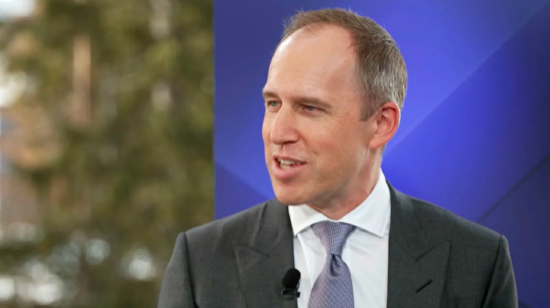
On January 22, 2026, Brett Taylor, co-founder and CEO of Sierra, was interviewed by CNBC at the World Economic Forum in Davos, Switzerland. / CNBC
In sum, OpenAI’s architectural evolution reflects the fundamental conflict between its non-profit founding mission and mega-capital demands. Each adjustment OpenAI has made, though intended to address its R&D funding needs, has objectively and continuously eroded its governance foundation as a non-profit organization. Subsequent choices by OpenAI have also demonstrated that in the face of core interest conflicts, the supervisory authority of a non-profit entity is highly susceptible to being dominated by capital logic. At the same time, OpenAI’s defense reveals the real dilemma: in the mega-capital race, the non-profit model can no longer sustain frontier AI R&D. OpenAI characterizes its transition as a sustainable form of development, attempting to demonstrate that its mission remains intact before actual profitability has been achieved.
Musk’s lawsuit has thrust the contradiction between non-profit founding principles and mega-capital demands into the public spotlight. It also prompts us to consider: when frontier technological R&D must rely on enormous capital, can public interest and commercial returns ever be truly reconciled?
The OpenAI case demonstrates that attempts to reconcile the two through sophisticated governance structure design tend, in practice, to yield to capital pressures. This is not merely a legitimacy crisis for OpenAI; it also marks a common predicament facing the entire AI industry. If existing non-profit governance structures cannot constrain mega-capital, then the promise of ensuring that AGI benefits all of humanity will face the risk of institutional safeguard failure. Thus, the OpenAI case is not merely a legal dispute; it is a warning about the coming transformation of AI governance.
04 Future Outlook: Potential Impacts of the Litigation on the Global AI Industry and Governance Rules
From the perspective of industry access and governance rules, one of the core issues in the litigation is whether the founding non-profit commitments carry continuing legal force. If Musk prevails, this would establish a legal precedent for breach of charitable in the United States, meaning that any American AI lab that started with a public interest mission and later sought to transition to for-profit status would face extremely high legal barriers. This would compel startups to define the boundaries between for-profit activity and public interest more explicitly from day one, and to pre-establish a transition path.
Additionally, the ruling in this case could affect AI technology distribution pathways. Musk’s demand for the open-sourcing of core algorithms provides moral and legal support for the open-source ecosystem. The ruling may influence the industry landscape in two directions: if OpenAI is ordered to return substantial unjust enrichment, this would effectively raise the legal and operational costs of closed-source commercialization, compelling AI giants to make greater concessions on transparency, third-party auditing, and public interest commitments; conversely, if OpenAI prevails, it would imply judicial acceptance of the inevitability of the claim that closed-source commercialization is necessary for model safety and sustained investment, which would further consolidate the industrial trend toward capitalization, closed-source development, and oligopolization.
Given the global standing of OpenAI, SpaceXAI, and the American AI industry, the impact is no longer confined to Silicon Valley or the U.S. judicial system; through the spillover mechanisms of AI infrastructure, model standards, and capital governance rules, it is profoundly shaping the global AI order and will also affect countries in the Global South. In this process, judicial rulings themselves are influencing the formation of global AI governance rules.
First, the definition of AI public interest is becoming Western-centric. This case involves a more fundamental question: who has the authority to define what it means to act for the benefit of all humanity? Musk stated in the lawsuit that the founding agreement of OpenAI explicitly committed it to a mission of ensuring that AGI benefits all of humanity, and that this commitment carried legally binding force, meaning that OpenAI had to remain non-profit, open-source, and decentralized. Once transformed into a for-profit model with exclusive licensing to Microsoft, this would constitute a betrayal of its charitable trust obligations. The court’s ruling will determine whether a founder’s original intent can permanently lock in an institution’s authority to define the public interest.
More broadly, if the court affirms the legitimacy of OpenAI’s current commercialization path, public interest could be redefined as an economic indicator measurable by capital expenditure, computing investment, and return on investment. This means AI would slide further from a quasi-public good toward a highly commercialized class of technology assets, thereby widening the global digital divide and gradually locking countries in the Global South into the role of high-cost consumers of AI technologies, rather than participants in rule-making or beneficiaries of value distribution. More importantly, attention should be paid to the very mechanism by which defining authority is generated. Regardless of the direction of the ruling, the boundaries of AI public interest are, in practice, being shaped by the corporate, judicial, and regulatory frameworks of technologically advanced Western nations. While the litigation is an internal judicial matter, it still carries a powerful spillover effect. If AGI is achieved, its safety and inclusivity may face the risk of excessive unilateralism, and the ultimate technological outcomes may not necessarily align with international interests, particularly the development rights and interests of Global South nations.
Second, AI issues are becoming further politicized and securitized. Although safety issues per se are not the core issue for the court to decide in this case, the trial records and judgment reasoning will enter public discourse, providing a precedential basis for future U.S. AI safety legislation, export control expansion, and third-party audit systems. If the court finds merit in Musk’s argument that “commercialization harms AI safety,” the United States may in the future strengthen export controls on advanced models under the guise of safety audits. The U.S. has already imposed export restrictions on frontier AI chips and certain model weights targeting China; such restrictions could be further refined to the level of model safety auditing itself, raising compliance costs and access thresholds for Global South nations accordingly.
Third, this case’s ruling could have complex implications for the global open-source AI ecosystem. While open-source versus closed-source is a technical and commercial choice, the judicial determination of the legitimacy of for-profit transition in this case could be transmitted through capital markets and institutional environments, thereby shaping the technological ecosystem. If the court ultimately confirms the full legitimacy of the for-profit transition, this may create pressure on open-source startups that rely on external funding. That said, the fate of the open-source ecosystem is not entirely determined by the ruling in this case. China’s DeepSeek and Alibaba’s Qwen have continued to release open-source models comparable to frontier closed-source models from 2025 to 2026. In April of this year, following the release of DeepSeek V4 Preview, V4-Pro with 1.6 trillion parameters became one of the world’s largest open-source weight models by scale, with API output pricing of only $3.48 per million tokens, significantly lower than comparable frontier products from OpenAI, Anthropic, Google, and others, offering distinctive advantages in performance, cost, and technology. This means the ruling in this case would at most affect the domestic U.S. open-source versus closed-source capital allocation landscape, rather than the long-term trajectory of the global open-source ecosystem.
Overall, this lawsuit is not only about corporate ownership; it points to the concrete dilemmas of AI governance in the current era, marking a new stage in which governance is increasingly driven by law, capital, and geopolitics simultaneously. Its influence will continue to spill over into the reshaping of global digital sovereignty and the technological order.
Author
Hu Xiangyu, Research Assistant of CGAIG
Zhang Ao, Research Assistant of CGAIG
Original URL: https://mp.weixin.qq.com/s/jMuYIxKecTTCvPzu-Ci6lA