

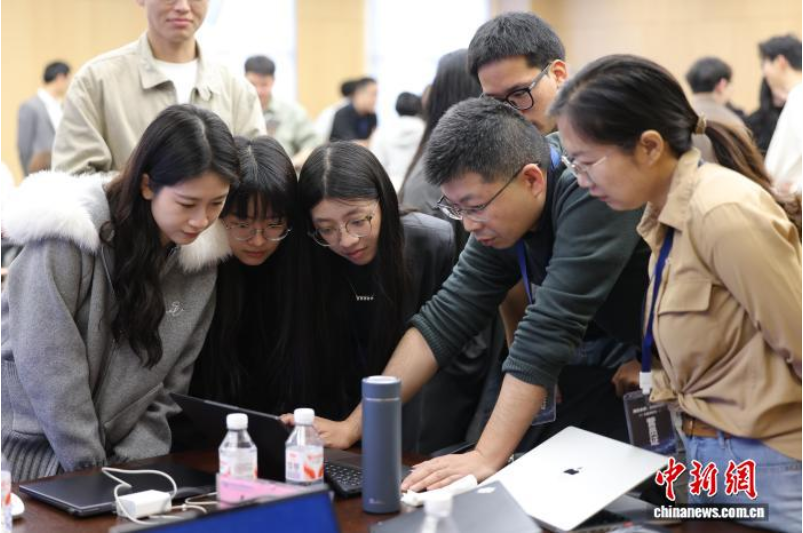
On April 11, the “Meeting the Future: AI Applications in Social Sciences” Public-Interest Training Camp was held at the Shanghai Social Science Hall. Over 50 campers divided into 11 teams from institutions including Shanghai Jiao Tong University, Fudan University, Tongji University, Donghua University, and the Shanghai Theatre Academy participated in the event. They immersed themselves in the cross-disciplinary integration and end-to-end development workflows of “AI + Social Sciences”, exploring the infinite possibilities of turning “ideas into reality”.
The event was co-hosted by the Shanghai Research Center for Social Science Development (hereinafter referred to as “Shanghai Social Science Center”) and the Shanghai Society of Big Data Social Application. It was co-organized by several institutions, including the Center for Global AI Innovative Governance (CGAIG). The initiative aims to implement the requirements of the “15th Five-Year Plan” on strengthening the synergy between science and technology education and humanities education, while advancing the deep integration of artificial intelligence and social sciences.
Source: chinanews.com.cn
Currently, the accelerating iteration of AI technology intersects and resonates with the paradigm shift in social sciences. Responding to the profound question of “How are humanities and social sciences possible in the AI era?”, this event highlighted a humanistic foundation and social science characteristics. With a strong emphasis on AI application, it explored a model of mutual empowerment - using cross-disciplinary collaboration in “AI + Social Sciences” to drive synergy in “Tech + Humanities” education. By infusing the humanistic perspectives into AI products and driving growth through AI applications, the event fostered a virtuous spiral from innovation to application and back to innovation, injecting new momentum into development. University scholars and industry representatives were invited as expert judges to provide professional guidance and help from ideas to implementation.
Upholding the public welfare principles of openness, sharing, and inclusivity, the trainng camp strives to offer more people the opportunity to stand at the forefront of the cross-integration of AI and social sciences. The inaugural session was primarily open to students from Shanghai universities. Within just a few days of releasing the recruitment call, it attracted an enthusiastic response with a massive influx of applicants.
As a one-day intensive training event, the training camp operated under the philosophy of “Maximum Potential + Intensive Development + High-Intensity Hands-on Practice”. Utilizing the OPC “Super Individual” development model, it compressed high-density practice into nearly eight hours to fully showcase cutting-edge explorations of AI-empowered social science applications. Working in teams, campers focused on real-world social science issues. Utilizing AI tools, they completed the full workflow from scratch—spanning creative planning, logical modeling, and program development to final application results. This “learning by doing, innovating while learning” approach broke the traditional, one-way output model of AI education, allowing participants to bring their ideas to fruition under time pressure.
During the training camp, campers from diverse academic backgrounds and different growth stages gathered to fully explore the intersection of AI and social sciences. The products developed covered multiple fields, including politics, economics, culture, and law. These included research-assisting tools like “AI Governance Radar” and “Zhihui Scientific Research,” applications tailored to livelihood needs, as well as humanistic works like “Gesture Artist” and “Guofeng (Chinese Style) Personality Profiling.” These projects fully demonstrated young people's imagination in solving social problems.
The campers expressed that the event broke down disciplinary barriers. While helping them transform into “programmers” with the aid of AI, it also allowed them to deeply experience the charm of “AI + Social Sciences”, leaving them highly optimistic about future applications. Attending experts noted that AI applications help break the traditional boundaries of humanities, serving as a driving force in empowering educational transformation and guiding the public to maintain continuous self-learning capabilities.
In recent years, the Shanghai Social Science Center has focused heavily on promoting the deep integration of AI and social sciences, and has continuously organized the Social Sciences Forum of the World Artificial Intelligence Conference (WAIC). This training camp serves not only as the first warm-up event for the upcoming forum but also as a practical exploration of merging AI social science applications with public education, building a platform for exchanges and mutual learning across sectors. Moving forward, this series of activities will continue to roll out, aiming to lower the barrier to AI application, expand the coverage of AI literacy education, and empower more people to observe society while approaching the intelligent era through the lens of social science thinking.
Original Link: https://mp.weixin.qq.com/s/dWaB2XVrPdBEnc2Ko88muw?scene=1