


On May 15, 2026, Pope Leo XIV signed Magnifica Humanitas, his first encyclical since assuming the papacy. Released at the Vatican ten days later, the document was launched in the Pope’s presence—an event that, according to Vatican accounts, marked the first time in the history of the Holy See that a pope had attended the release of his own encyclical. By choosing May 15 as the date of signature, Leo XIV marked the 135th anniversary of Rerum Novarum, the 1891 encyclical issued by Pope Leo XIII, and invited a clear historical comparison between today’s AI revolution and the Industrial Revolution. Whereas Rerum Novarum addressed the social changes brought by industrial capitalism, including labor alienation, capital expansion, and widening social imbalance, Magnifica Humanitas examines AI alongside changes in work, social organization, and ethical life. The encyclical thus suggests that global AI governance is moving beyond technical regulation and becoming a public debate about human dignity, industrial ethics, and social trust.
01 Magnifica Humanitas: The Holy See’s First “AI Encyclical”
Magnifica Humanitas opens with a religious metaphor: “Humanity, created by God in all its grandeur, is today facing a pivotal choice: either to construct a new Tower of Babel or to build the city in which God and humanity dwell together.” It asks how human beings can retain their status as moral agents as algorithmic systems become increasingly involved in judgment, decision-making, and social organization. The encyclical warns against “dehumanization” in current technological development. Technology, it makes clear, should not reduce human beings to resources, mere data points, or measures of efficiency, still less allow automated decision-making to replace human ethical judgment and responsibility.
First, at the ethical level, Magnifica Humanitas stresses that human dignity must not be reduced to function. It takes issue with an AI-driven tendency to translate the value of the person into calculable indicators. As the encyclical states, human dignity “does not depend on a person’s abilities, wealth or position in life,” but is “a gift that precedes and transcends each person.” The worth of the human person therefore derives from this inherent dignity, independent of wealth, capacity, productivity, or social recognition. This is why the encyclical is particularly wary of a technological culture driven by performance and optimization. Once systems begin to treat efficiency as a measure of human worth, dignity is gradually compressed into quantifiable indicators. AI may then move beyond serving as a tool for supporting decisions and become an institutional filter, shaping who is deemed trustworthy, employable, or entitled to protection. This concern echoes the encyclical’s insistence that decisions shaped by data and algorithms remain “understandable, contestable and subject to oversight,” so that individuals are not “reduced to mere profiles.”
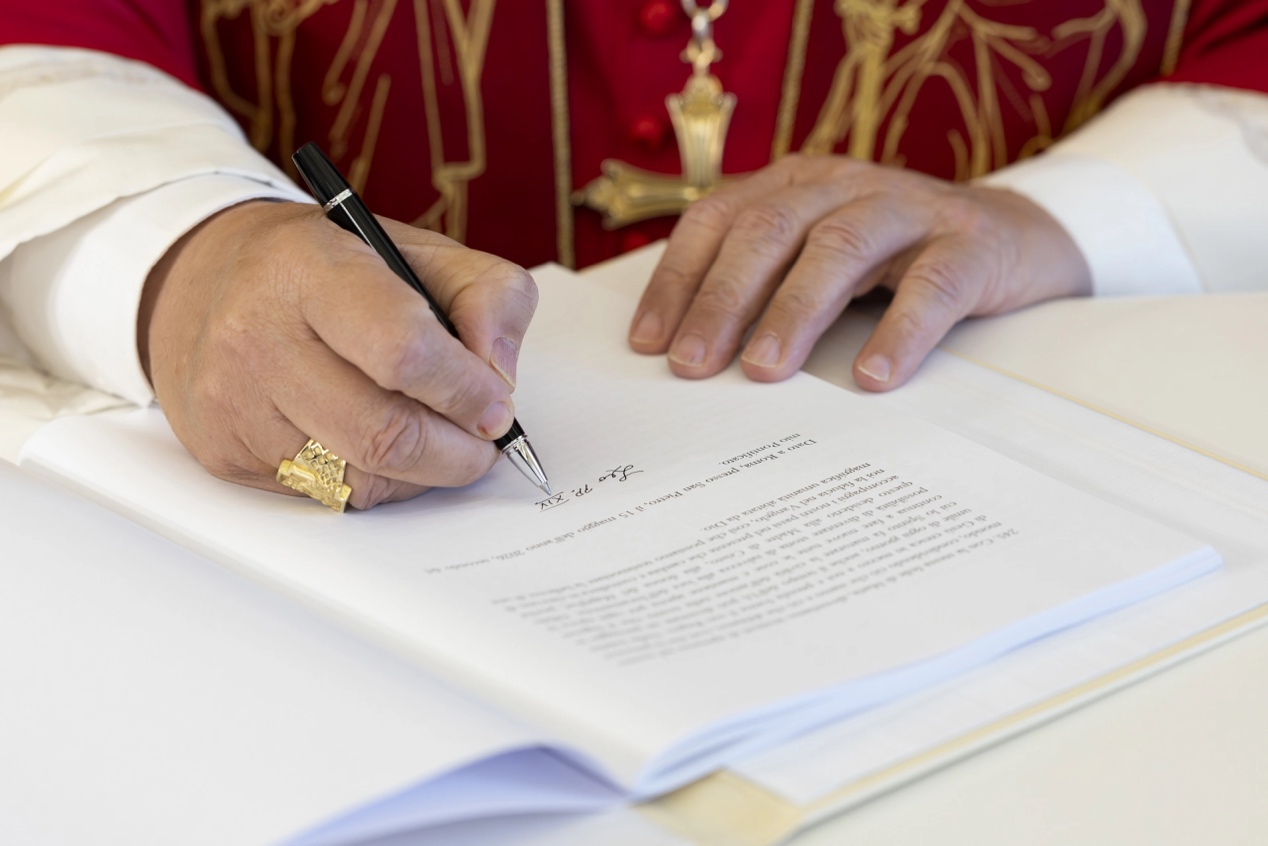
Pope Leo XIV signs Magnifica Humanitas, his first encyclical since assuming the papacy.
Source: POLITICO
Second, at the technical level, Magnifica Humanitas rejects the idea that AI is a value-neutral tool, arguing that its design already embodies social choices. The encyclical states plainly that, “in practice, however, technology is never neutral,” because it takes on the characteristics of those who “devise, finance, regulate and use it.” In the case of AI systems, training objectives, data sources, optimization methods, and deployment settings all reflect the values of their designers, funders, and managers. AI governance, therefore, cannot be limited to how technology is used; it must also ask why technology has been designed in a particular way. When algorithmic systems are used in public governance, social selection, and risk assessment, the values embedded in them may be presented as “objectivity” and thus become difficult to detect. Certain groups may, as a result, be placed at a persistent disadvantage without this being immediately visible. The encyclical thus suggests that the real risk of AI systems lies not only in their capacity to make errors, but also in their capacity to institutionalize and automate particular standards of value, turning them into the default rules by which society operates.
Third, at the governance level, Magnifica Humanitas addresses the concentration of AI power and cautions against an outlook that promises a purely technical form of “salvation,” while insisting that human agency remain central to global governance. Today, global data, computing power, capital, and standard-setting capacity are concentrated in the hands of a small number of countries and major technology companies. This asymmetry may further widen development gaps between countries and turn technological capacity into a new source of institutional influence. The encyclical is therefore concerned that AI governance should not be dominated only by those at the technological frontier. It should also give full weight to the interests and voices of developing countries and vulnerable groups.
More fundamentally, the encyclical rejects the assumption that technological advance can determine the course of human development. When society equates technical innovation with human progress, technology is no longer treated merely as a tool. It may instead acquire an authority that exceeds its instrumental role. Efficiency, speed, and scale are then increasingly prioritized, while human moral judgment, responsibility, and public deliberation may be pushed to the margins. The Holy See’s concern is not that machines will acquire personhood, but that human society may gradually relinquish its own role as a moral agent amid technological expansion. Magnifica Humanitas therefore does not oppose the development of AI as such. Rather, it challenges the tendency to replace value judgment with the pursuit of efficiency and to treat technological capability as a sufficient basis for governance legitimacy.
02 Leo XIV and the Holy See: The Rationale Behind the “AI Encyclical”
I. The Pope’s AI Agenda
The release of Magnifica Humanitas as Pope Leo XIV’s “AI encyclical” reflects both the recent papacy’s sustained engagement with technology ethics and Leo XIV’s own background and experience. Under Pope Francis, AI ethics had already become a visible part of the Holy See’s public and diplomatic agenda. Through major documents and high-level international engagements, the Francis papacy laid both the institutional groundwork and the intellectual foundation for Leo XIV’s agenda. In 2020, the Pontifical Academy for Life, together with Microsoft, IBM, the Food and Agriculture Organization of the United Nations (FAO), and other partners, launched the Rome Call for AI Ethics. The document introduced the concept of “algor-ethics,” referring to the ethical use of AI from the earliest stages of design and development, and set out six principles: transparency, inclusion, accountability, impartiality, reliability, and security and privacy. It called for AI that serves “every person and humanity as a whole,” and is not developed solely for “greater profit or the gradual replacement of people in the workplace.” In January 2024, Francis issued his message for the 57th World Day of Peace, devoted to “Artificial Intelligence and Peace,” in which he urged the international community to adopt a binding global treaty regulating the development and use of AI. In June that year, he attended the G7 session on AI in Puglia, Italy, and delivered a dedicated address on AI ethics, warning in particular against delegating fundamental human decisions to machines. In January 2025, the Dicastery for the Doctrine of the Faith and the Dicastery for Culture and Education jointly issued Antiqua et Nova, a note on AI and human intelligence. The document further developed the Holy See’s position on AI by distinguishing machine-based computation from human reason and by setting out principles intended to ensure that AI development upholds human dignity and promotes integral human development.
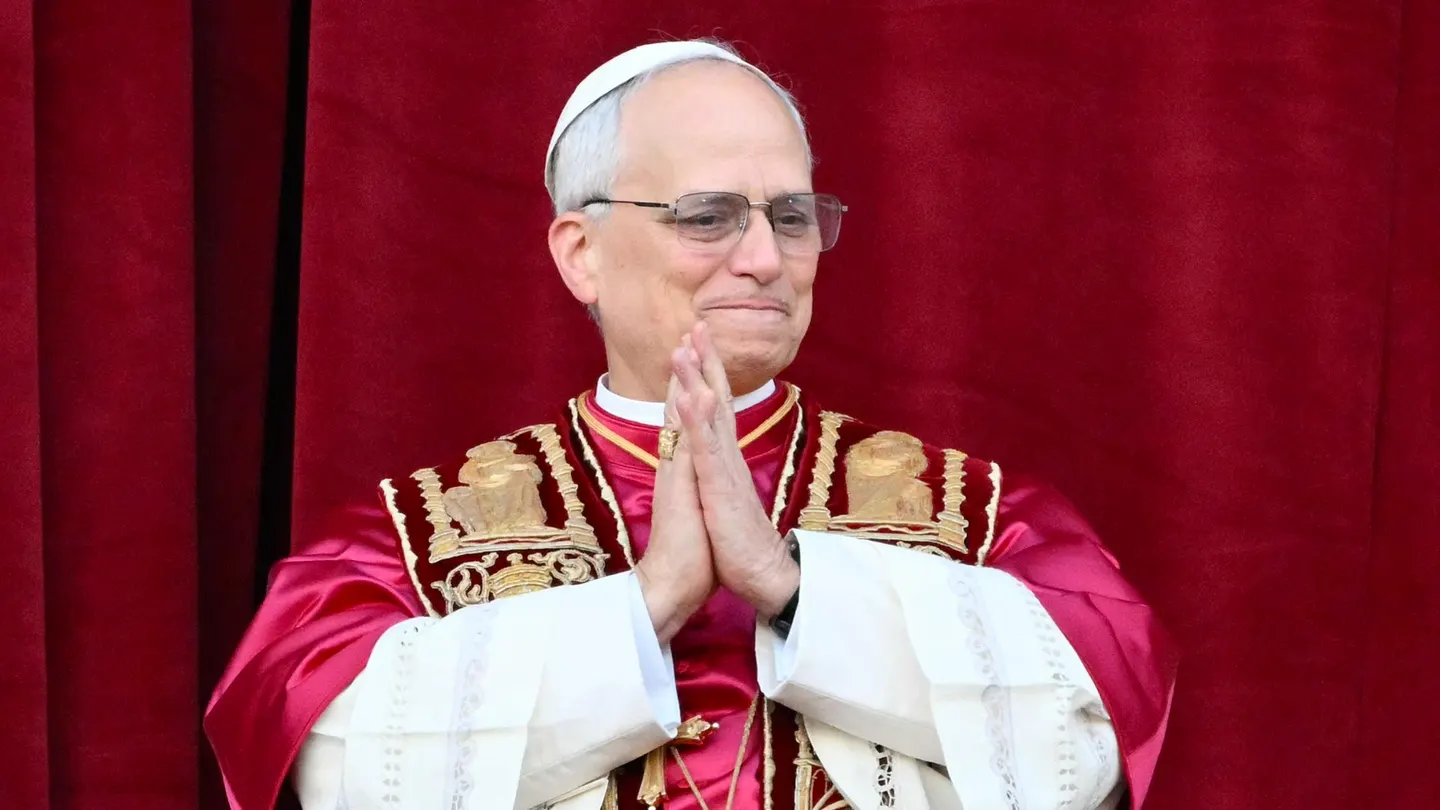
Pope Leo XIV greets the faithful from the central balcony of St. Peter’s Basilica in the Vatican after his election on May 8, 2025.
Source: AFP
Leo XIV inherited this line of work on technology ethics from his predecessor. Soon after his election in May 2025, he signaled that AI would be a priority of his pontificate. The one-year interval between his election and the release of the encyclical suggests a deliberate process of planning, coordination, and institutional preparation within the Vatican. Compared with earlier documents on technology ethics, Magnifica Humanitas represents a step up in scale, level of authority, external collaboration, and supporting mechanisms, indicating that the Vatican now sees AI ethics as central to shaping its global role. Its implementation is likely to become an important channel for the Holy See’s participation in global governance in the coming years.
Leo XIV’s academic training and pastoral experience also help explain the practical concerns running through the “AI encyclical.” To begin with, he was trained in mathematics, receiving a degree in the subject from Villanova University in 1977 and becoming one of the few popes in Catholic history with a background in science or engineering. Rather than approaching AI only as an abstract ethical question, Leo XIV focuses on how algorithms, data, and technical systems affect social life. His years of pastoral work and community engagement in Latin America also gave him a close view of social inequality, capital expansion, and the risks that accompany the spread of technology. Since the 1980s, Leo XIV had spent many years in Chulucanas and Trujillo in Peru, where he was involved in church affairs, education, and community work. These areas have long faced poverty, unemployment, limited public resources, and social marginalization. In the encyclical, Leo XIV repeatedly argues that AI should not deepen wealth disparities, labor alienation, or social exclusion. He also cautions against allowing a small number of technology companies and technical elites to dominate the direction of AI development. These points are consistent with his long-standing emphasis on social justice and the protection of vulnerable groups.
II. Why the Holy See Is Turning to AI
The release of the “AI encyclical” follows a long tradition in Catholic social teaching. At major moments of technological and social change, the Catholic Church has often responded through its highest form of doctrinal teaching. In 1891, Pope Leo XIII issued the landmark encyclical Rerum Novarum, which addressed the labor exploitation, expansion of capital, and social divisions brought by the Industrial Revolution and marked the beginning of modern Catholic social teaching. In the decades that followed, the Holy See issued a series of major documents on capitalism, labor protection, human rights, and technology ethics, including Quadragesimo Anno in 1931, Laborem Exercens in 1981, Centesimus Annus in 1991, and Caritas in Veritate in 2009. Together, these documents helped develop a body of teaching built around human dignity, the common good, and solidarity. The “AI encyclical” extends this tradition by treating AI as another transformative technology, comparable in significance to the Industrial Revolution, with the capacity to reshape production relations, social organization, and the underlying structures of civilization. The encyclical can therefore be read as a restatement of the same social teaching: any force capable of reorganizing social order, altering human agency, or changing the structure of values must be measured against the ethical demands of that tradition.
Yet the encyclical also reveals a form of historical unease within the Holy See, as it seeks to renew its global ethical influence and public appeal in the age of AI. On the one hand, the rapid development of AI is changing how societies operate and how values are shaped and spread, prompting the Holy See to shift part of its global governance engagement from ecological and climate issues toward AI governance. Over the past decade, Pope Francis built considerable international visibility and moral influence on climate change. His 2015 encyclical Laudato si’ and his 2023 apostolic exhortation Laudate Deum went beyond abstract theological reflection and addressed the structural tensions among global climate justice, environmental degradation, and unequal development. Francis also spoke on the climate crisis on several multilateral occasions, including the United Nations Climate Change Conferences, known as COP. Through the interaction of textual advocacy and institutional engagement, the Holy See gradually built public moral authority on climate governance that extended beyond the religious sphere.
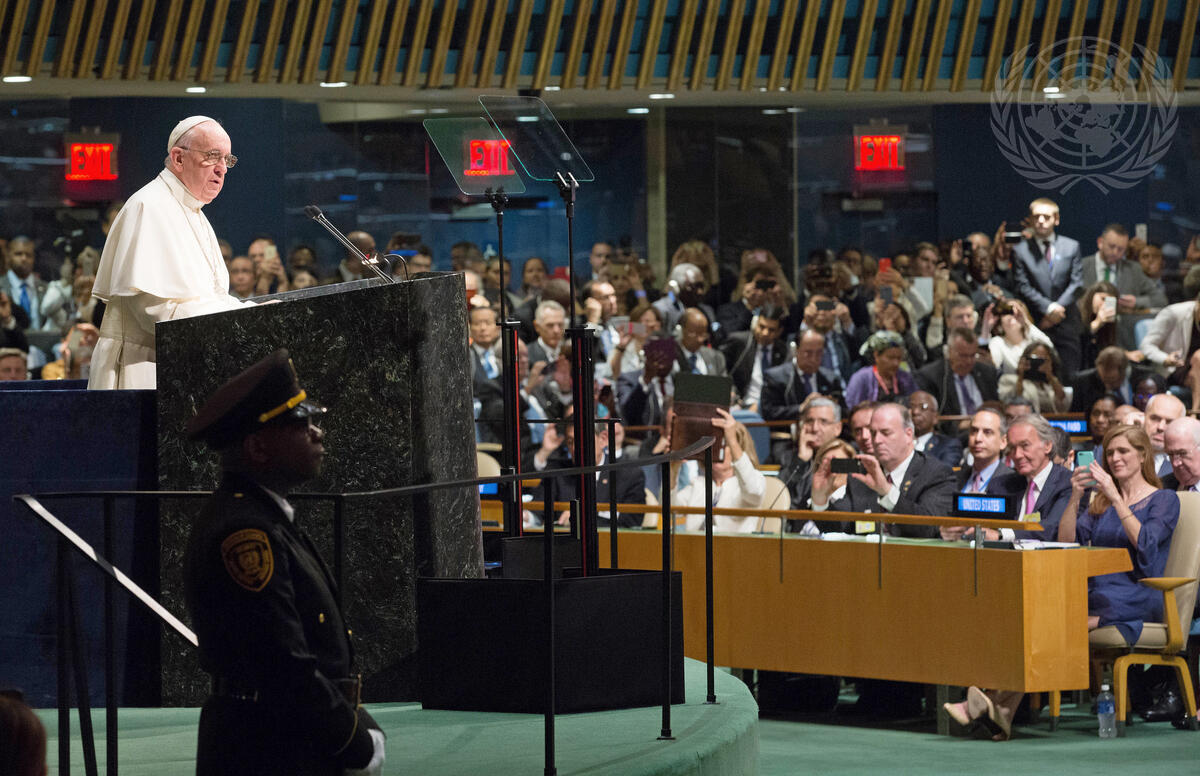
Former Pope Francis addresses the United Nations General Assembly in 2015.
Source: UN Photo
As generative AI and algorithm-driven economic systems gain influence, climate change and other physically grounded geopolitical issues may be losing some of their effectiveness in building new global consensus. The Holy See’s growing emphasis on AI ethics is reflected in the “AI encyclical,” which reaffirms the inalienable “ontological dignity” of the human person and rejects the reduction of human worth to computable data indicators. This shift may help guard against the exclusion of marginalized groups under forms of technological authoritarianism, while enabling the Holy See to preserve and renew its transnational spiritual authority and social appeal in the age of AI.
On the other hand, the Holy See also appears to be using AI as a way to manage the pressures created by demographic changes in the global Catholic population, while sustaining its social credibility and cultural cohesion. In recent years, secularization has continued to affect Catholic communities in Europe and North America, with younger generations participating less in religious life. At the same time, the Global South, especially Latin America and Africa, has become increasingly important to the future of the Catholic Church. The labor displacement, social fragmentation, algorithmic discrimination, and technological concentration associated with AI overlap closely with issues that have long mattered to the Global South, including fair development, social justice, and the protection of vulnerable groups. By reaffirming “the dignity of the human person,” insisting that technology remain “at the service of the human person,” and warning against “the risk of dehumanization,” the Holy See is seeking to rebuild a value consensus across regions and cultures. In Magnifica Humanitas, calls to keep “the human person at the center of our choices” and resist measuring human worth by efficiency, data, or performance are not only ethical claims. They also reflect the Holy See’s practical concern with maintaining cultural appeal and moral authority in the digital age.
03 The Holy See and Industry: Cooperation and Divergence Over Responsible AI
At the launch of Magnifica Humanitas, Christopher Olah, co-founder of Anthropic, was invited to speak alongside the Pope, cardinals, and theologians, bringing an unprecedented Silicon Valley presence to the presentation of a papal encyclical. During the event, Pope Leo XIV thanked Olah for accepting the invitation and said he was willing to work with Anthropic “to find a way for humanity in this time of artificial intelligence.” Olah expressed his gratitude, saying that he had come to the Vatican because the questions raised by AI now extend beyond technical research itself. In his remarks, he acknowledged that every frontier AI lab, including Anthropic, “operates inside a set of incentives and constraints that can sometimes conflict with doing the right thing.” He called on religious communities, civil society, scholars, and governments to become “moral voices that the incentives cannot bend.” He also noted that AI development is now concentrated in “a handful of wealthy nations” and that ensuring the gains of AI are shared globally is precisely the kind of question the Church has long refused to let the world ignore.
Behind this statement are the ethical pressures now facing frontier AI companies. Anthropic has long positioned itself around safety, interpretability, and responsible AI, differentiating itself from companies such as OpenAI and Google DeepMind. For AI companies, the Holy See can serve as a source of moral legitimacy, drawing on its transnational religious network, its tradition of social teaching, and its ethical language centered on human dignity. Their joint appearance at the encyclical’s launch was therefore less a formal alliance than a public gesture toward building responsible AI together. Anthropic is not alone in seeking engagement with the Holy See. Other Silicon Valley companies have also shown interest in working with the Vatican. According to POLITICO, representatives from several major technology companies, including Meta, Google, and Amazon, briefly met with Pope Leo at an event focused on child protection in the age of AI. Afterward, the participants moved to the French Embassy to the Holy See, where a closed-door discussion with Vatican officials lasted for several hours and focused on how the Holy See was preparing to address AI in the encyclical. As POLITICO put it, “Silicon Valley has spent years trying to convince governments and the public that AI can be developed responsibly. Now, the industry has been making that case inside the Vatican.”
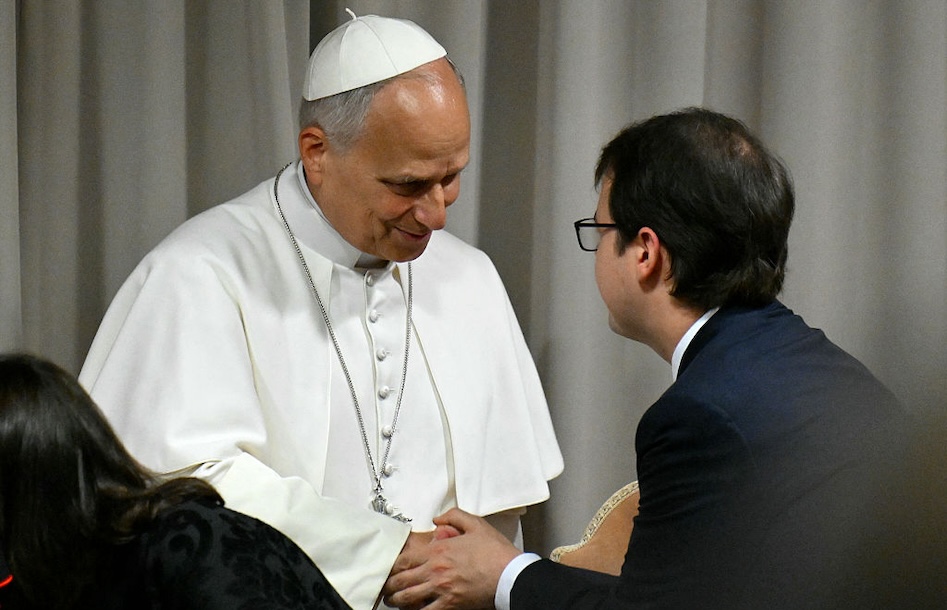
Pope Leo XIV shakes hands with Christopher Olah, co-founder of Anthropic, at the launch of Magnifica Humanitas.
Source: PRWeek
Yet the common language of responsible AI does not erase the differences between the two sides: they operate under different constraints, follow different logics, and answer to different interests. The Holy See emphasizes integral human development, the dignity of work, the protection of the vulnerable, and the common good. Companies, by contrast, face the combined pressures of capital returns, rapid product cycles, and market competition. Even if they acknowledge the risks, they may still find it difficult to slow the pace of expansion. The interaction between the Holy See and Anthropic thus shows both why frontier AI companies seek moral resources and external scrutiny, and how limited ethical authority can be when it confronts the realities of technological development.
04 Outlook: Civilizational Visions for Global AI Governance
The release of the “AI encyclical” suggests that global AI governance is no longer confined to technical rules. Its agenda is expanding toward deeper questions of value and the civilizational visions behind them. Much of the international discussion has so far focused on technical questions such as model safety, lawful data use, algorithmic transparency, and output control. Yet as AI becomes embedded in employment, social organization, information flows, and public decision-making, the debate increasingly turns to how individuals and societies can retain agency amid rapid technological change and orient themselves in the face of such transformation. In the years ahead, actors able to build trust and consensus around the purpose of AI development, the distribution of its benefits, and the safeguards needed to manage its risks will be better positioned in rule-making, standard-setting, and international cooperation.
The “AI encyclical” is significant for two reasons: it offers a human-centered value statement and records the Pope’s direct observations on the development of the AI industry and its social impact. By endorsing global AI governance that is inclusive, open, shared, and centered on the human person, the encyclical sets out a distinctly human-centered position. It also suggests that AI governance is no longer shaped only by industry, government, and academia, but increasingly by traditional cultural authorities and other cultural actors. Over the longer term, healthier global AI governance will require a more cohesive civilizational vision. In practice, this means countering uncritical faith in technology with AI for good, and addressing technological divides and monopolies through inclusion and shared benefit. It also calls for openness and cooperation to resist the formation of rival blocs, along with a balanced approach to development and security to counter a disorderly race for profit. Together, these principles could help steer global AI governance toward the broader goal of advancing human well-being.
Author
Yao Xu, Xin Yanyan, Zhang Ao, Yuan Luming and Lyu Chengle from the Research Office of CGAIG
Original URL: https://mp.weixin.qq.com/s/bhqpIbIP_qtv7gB0KrBQAA?scene=1