

On June 2, 2026, U.S. President Donald Trump signed the executive order Promoting Advanced Artificial Intelligence Innovation and Security. Unlike the public signing arrangement that had reportedly been postponed in late May, the document was ultimately issued in a relatively low-profile manner. According to media reports, earlier drafts had provided for a longer pre-deployment review period, raising concerns among some in the technology sector that it could slow the development of U.S. frontier models. The final text limited the review period to no more than 30 days and emphasized voluntary participation, while making clear that it would not constitute mandatory licensing or pre-release approval. The order seeks to preserve the vitality of the U.S. artificial intelligence (AI) innovation ecosystem and give greater priority to national AI capacity-building. It also reflects a recalibration toward security considerations within the loosening of regulatory constraints in recent U.S. AI governance.
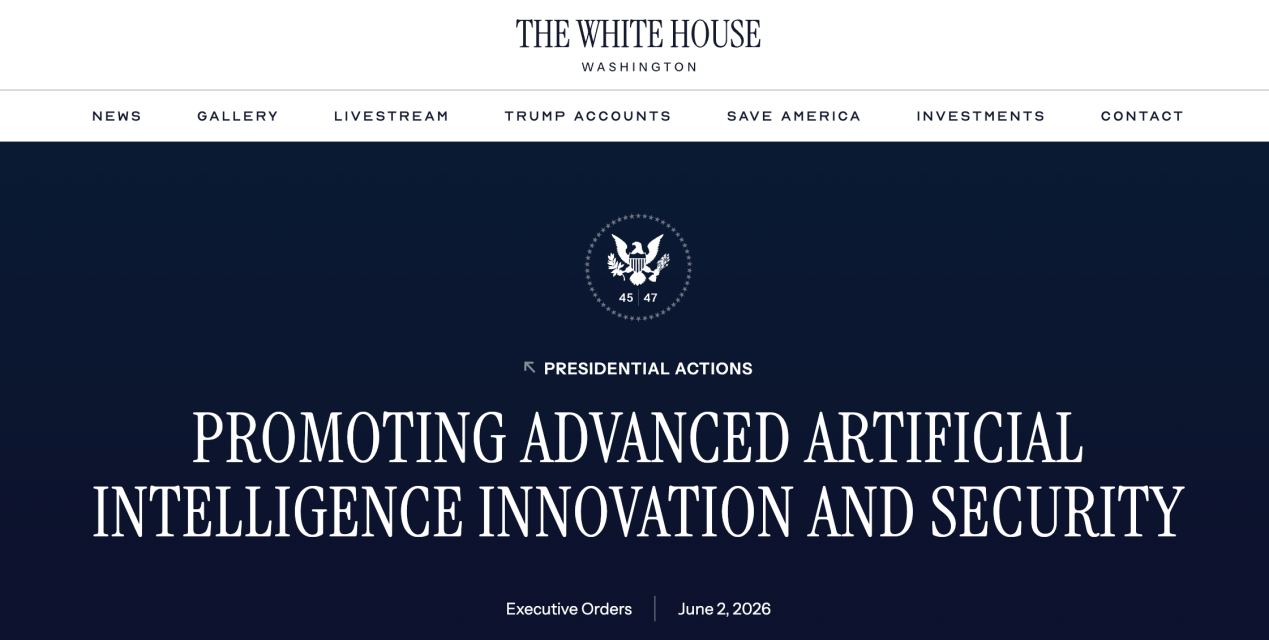
White House webpage for the executive order Promoting Advanced Artificial Intelligence Innovation and Security
Source: The White House
01 Core Provisions: Introducing Federal Security Assessments Within a Voluntary Framework
The executive order focuses mainly on three areas: protection of government systems, assessment of frontier models, and enforcement against AI-enabled cybercrime. Rather than creating a mandatory licensing requirement for all models, the order establishes a narrowly defined mechanism for federal involvement in cybersecurity and critical infrastructure, limited to frontier models with the most advanced cyber offensive and defensive capabilities.
First, the executive order requires stronger cyber defenses for U.S. government systems and critical infrastructure. It provides that, within 30 days of the date of the order, the Committee on National Security Systems shall prioritize the cyber defense of National Security Systems; the Secretary of War shall prioritize the cyber defense of Department of War information systems; and the Department of Homeland Security, through the Cybersecurity and Infrastructure Security Agency (CISA), shall issue “Binding Operational Directives and other guidance as appropriate” to accelerate the protection of civilian federal information systems and, where appropriate, provide cybersecurity tools and services to federal agencies, state and local authorities, and operators of critical infrastructure, including rural hospitals, community banks, and local utilities. These tools and services explicitly include covered frontier models where appropriate. At the same time, the Treasury Department is required to take the lead in forming an AI cybersecurity clearinghouse within 30 days. In voluntary collaboration with the AI industry and operators of critical infrastructure, the clearinghouse will coordinate the scanning, discovery, validation, remediation, prioritization, and patch distribution of software vulnerabilities.
Second, Section 3 of the executive order establishes the mechanism for Secure Frontier Model Deployment, which has drawn the most attention outside the government. The order requires that, within 60 days, the Secretary of the Treasury, the Secretary of War through the Director of the National Security Agency (NSA), and the Secretary of Homeland Security through the Director of CISA, in consultation with the White House Chief of Staff through the National Cyber Director, the Assistant to the President for Science and Technology (APST), and the Secretary of Commerce through the Director of the National Institute of Standards and Technology (NIST), establish a classified benchmarking process to assess the advanced cyber capabilities of AI models and determine the threshold at which an AI model should be designated a “covered frontier model.” The designation will be made by the Director of NSA in consultation with the National Cyber Director, the APST, the Director of CISA, and other representatives of the Department of War, as appropriate. As part of this arrangement, the government will design a “voluntary framework” for AI developers. Developers would be able to engage the Federal Government to determine whether models under development meet the threshold for designation as covered frontier models; provide the Federal Government with access to covered frontier models for up to 30 days before they plan to release such models to other trusted partners, subject to appropriate confidentiality, cybersecurity, insider-risk, and intellectual-property protection, use, and nondisclosure requirements; and collaborate with the Federal Government to select trusted partners that will have early access to these models.
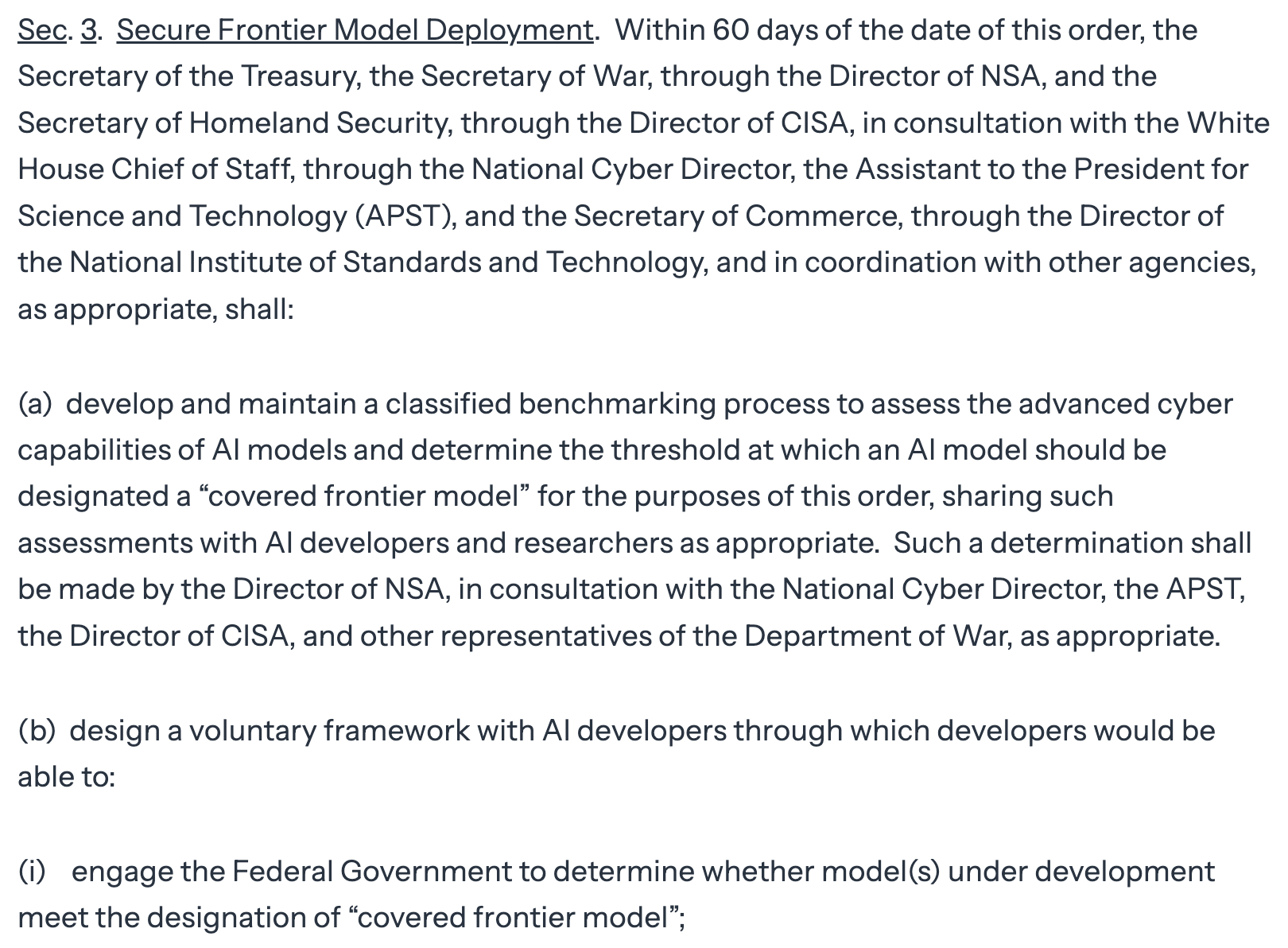
Section 3 of the executive order Promoting Advanced Artificial Intelligence Innovation and Security establishes the Secure Frontier Model Deployment mechanism
Source: The White House
Third, the executive order sets clear limits on federal involvement under this mechanism. Section 3(c) specifically provides that “Nothing in this section shall be construed to authorize the creation of a mandatory governmental licensing, preclearance, or permitting requirement for the development, publication, release, or distribution of new AI models, including frontier models.” This provision sets the outer limits of the mechanism. In other words, the Trump administration seeks early visibility into, and coordination over, the most powerful models, but does not intend to bear the political and industrial costs of establishing a formal licensing system for model releases. It therefore defines the above arrangements as voluntary. In terms of law enforcement, Section 4 requires the Attorney General to prioritize the enforcement of existing federal criminal statutes on identity theft, computer fraud, and wire fraud, including 18 U.S.C. 1028, 18 U.S.C. 1030, and 18 U.S.C. 1343, against anyone who “utilizes AI to illegally access or damage a computer without authorization,” or “utilizes AI while engaged in such illegal access to further any other crime.” The order therefore does not establish a new AI-specific criminal liability framework, but instead raises the priority of AI-related cybercrime under existing legal tools.
The immediate context for the order was the rapid growth of cyber capabilities in frontier models. In April 2026, Anthropic introduced its unreleased Claude Mythos Preview model, which it said could autonomously discover and exploit hidden vulnerabilities in real-world open-source software. The company also launched Project Glasswing for about 50 initial partners, including large technology companies, financial institutions, and critical infrastructure-related entities, giving them access to the model so that they could address high-priority vulnerabilities in advance. According to a preliminary report released by Anthropic in late May, participants identified more than 10,000 high-risk or critical vulnerabilities within about a month. On June 2, the project was expanded to about 150 organizations in more than 15 countries. It should be noted that the descriptions of these capabilities and the reported vulnerabilities mainly come from Anthropic’s own disclosures and feedback from its partners, with limited independent third-party verification. They should therefore be treated with caution, but they did change the intensity of Washington’s discussion of cybersecurity risks associated with frontier models.

Anthropic’s Project Glasswing uses AI to help secure critical software
Source: Anthropic
02 A Compromise in Practice: From a Last-Minute Delay to Final Adoption
Multiple media outlets had reported that the AI executive order was originally scheduled for release in late May, with executives from several frontier AI companies expected to attend the signing ceremony. Trump, however, called off the signing shortly before it was to take place, amid concerns that an earlier version of the order could weaken the U.S. lead over China in AI. Trump himself told reporters that he “didn’t like certain aspects of it” and that he “didn’t want to do anything to get in the way of that lead.”
A comparison between public reporting and the final text shows that the most significant changes between the May draft and the formal June version concerned the review window and whether the mechanism would be binding or voluntary. Earlier versions were reported to have allowed the government to obtain access to models for up to 90 days before release. The final text shortened that window to no more than 30 days and explicitly included limiting provisions on voluntary participation and the absence of mandatory licensing or pre-release approval. This adjustment suggests that the White House did not abandon its security concerns over the cyber capabilities of frontier models, but sought to avoid turning the security assessment mechanism into a de facto model-release licensing system. According to Axios, David Sacks, Trump’s former AI and crypto czar who had recently left office but remained influential as co-chair of the President’s Council of Advisors on Science and Technology, worked with National Economic Council Deputy Director Ryan Baasch to secure the shorter window, the voluntary framework, and provisions prohibiting mandatory licensing. Axios and Fortune also reported that, before the order was signed, technology figures including Sacks, Elon Musk, and Mark Zuckerberg were said to have expressed opposition to, or concerns about, the relevant mechanism. Musk later denied on X that he had lobbied before Trump’s decision, while Meta and representatives for Sacks did not respond to Reuters requests for comment.
The AI executive order can therefore be understood as a scaled-back version of the earlier policy approach, rather than an entirely new regulatory plan. It preserves the government’s interest in early assessment of the cyber risks posed by frontier models, while removing or softening arrangements that could be read as mandatory review. Through this adjustment, the Trump administration signaled to security agencies and Congress that it was responding to risks, while assuring industry that it would not return to a path of heavy regulation. Industry reactions reflected this balance. According to Reuters and other outlets, OpenAI CEO Sam Altman said the order “gets the balance right”; Google’s global affairs chief Kent Walker called it “an important step forward”; and Microsoft President Brad Smith described it as “an important step toward advancing innovation while protecting the security of the American public.” At the same time, industry views were not uniform. Semafor reported that OpenAI was relatively supportive of an earlier version, while Musk, Zuckerberg, and other technology figures were described by several media outlets as more wary of the government testing mechanism, concerned that a voluntary process could eventually become de facto pre-release review.
This compromise also explains the internal trade-off in the executive order. On the one hand, the government aims to gain limited capacity to assess and coordinate around frontier models before they are widely disseminated, so as to prevent critical infrastructure from being passively exposed to new cyber capabilities. On the other hand, the order establishes neither a formal licensing system nor a requirement that all models undergo review. It also avoids making the government the final gatekeeper for model releases. The result is a security posture, not a comprehensive regulatory system.
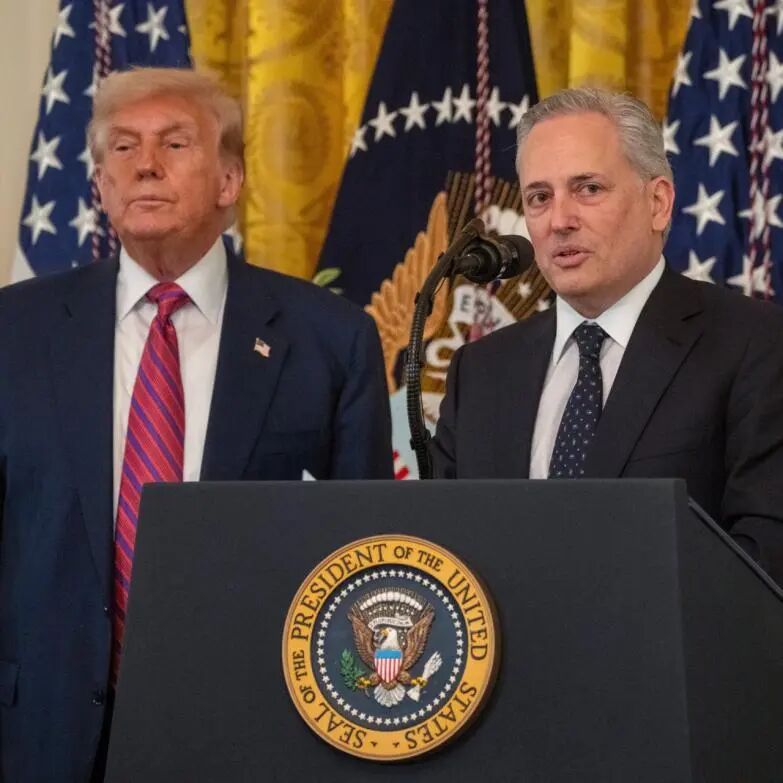
David Sacks, a Trump adviser described by media outlets as the White House AI and crypto czar, speaks at a White House event in 2025 as Trump listens
Source: The Wall Street Journal
03 AI Policy Under Trump 2.0: A Security Recalibration Amid Regulatory Loosening
This AI executive order continues the emphasis on innovation that has shaped Trump’s second-term AI policy, while marking a security adjustment within that framework. It therefore shows clear elements of both continuity and change.
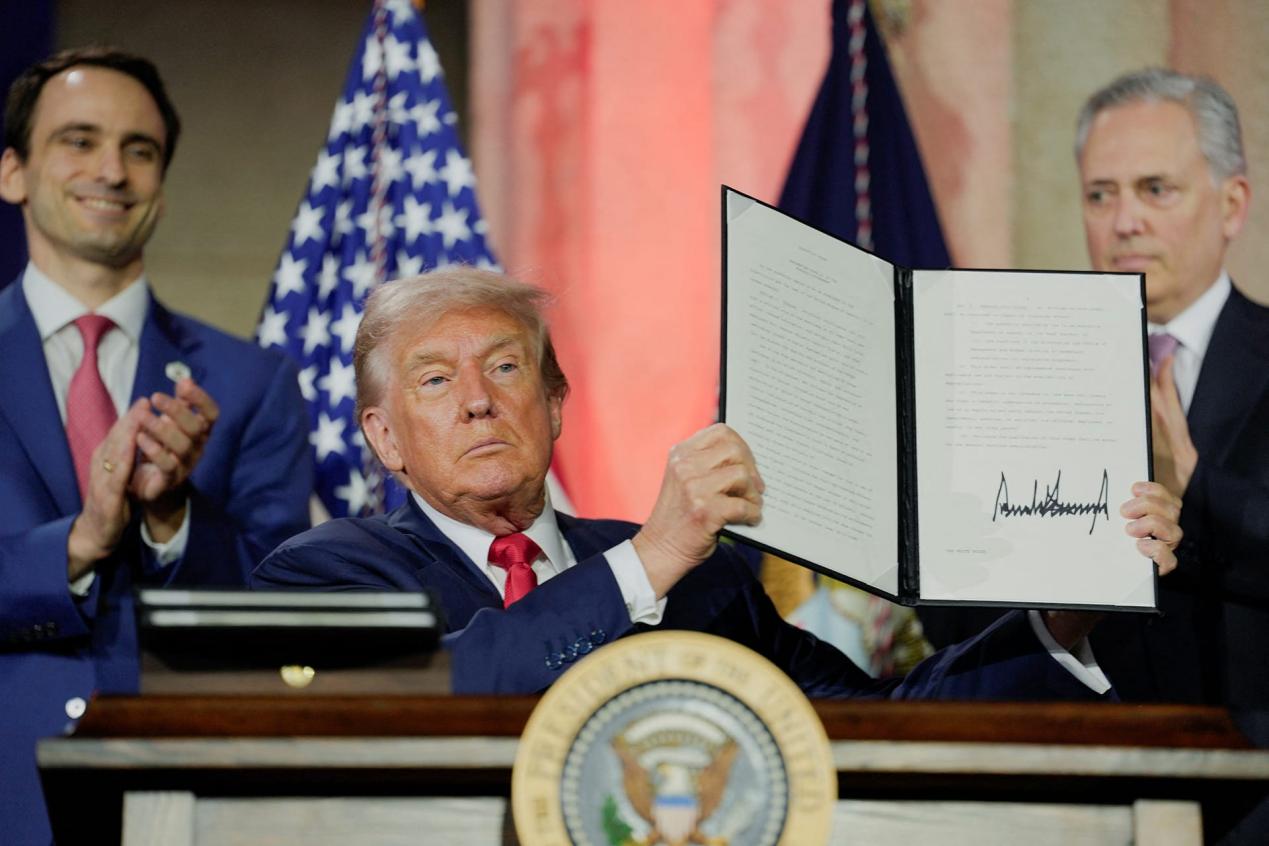
According to official White House materials, after returning to office, Trump first revoked the relevant framework of the Biden administration’s 2023 AI safety executive order. On January 23, 2025, he signed Executive Order 14179, Removing Barriers to American Leadership in Artificial Intelligence, which called for the removal of regulatory measures deemed to hinder innovation and directed the development, within 180 days, of an action plan to sustain U.S. leadership in AI. On July 23, 2025, the White House released Winning the Race: America’s AI Action Plan, which set out more than 90 federal policy actions organized around three policy pillars: accelerating innovation, building AI infrastructure, and leading in international diplomacy and security. On the same day, Trump signed three supporting executive orders, respectively focused on accelerating federal permitting for data center infrastructure, promoting the export of the American AI technology stack, and requiring large language models procured by the federal government to adhere to principles of truthfulness and ideological neutrality. The emphasis at this stage was to reinforce U.S. industrial advantages through regulatory rollback, infrastructure expansion, export promotion, and opposition to what the administration called “woke AI.”
By late 2025, the Trump administration had further concentrated AI governance authority under federal control. In November 2025, the White House launched the Genesis Mission, a national effort to combine the Department of Energy’s national laboratories, federal scientific datasets, and AI models in support of scientific discovery and national strategic objectives. On December 11, 2025, Trump signed Executive Order 14365, Ensuring a National Policy Framework for Artificial Intelligence, targeting state-level AI legislation and directing the Department of Justice to establish an AI Litigation Task Force to challenge state AI laws inconsistent with federal policy. The following March, the White House released a National Policy Framework for Artificial Intelligence, urging Congress to preempt state-level rules in several areas through federal legislation.
Seen in this light, the AI executive order follows the basic direction of the second Trump administration. It continues to emphasize America First, industrial leadership, opposition to excessive regulation, and the preservation of the U.S. competitive advantage over China. Voluntary mechanisms, rather than statutory mandates, also remain central to its approach. At the same time, the order points to a notable shift back toward security considerations. As cyber capabilities in frontier models have grown rapidly, the Trump administration has begun to acknowledge that regulatory loosening and corporate self-governance alone are insufficient to address national security risks. The federal government therefore needs earlier visibility and coordination authority at critical stages.
This recalibration toward security, however, does not mean that the United States has established a stable regulatory system for frontier models. The executive order depends on voluntary cooperation from companies, while leaving several issues unresolved: the consequences of non-participation, the threshold for designating covered frontier models, oversight of the classified testing process, and safeguards against politicized use of test results. An assessment by the Council on Foreign Relations notes that the designation of covered frontier models is the most consequential part of the mechanism, as well as the hardest to implement. The capabilities of frontier systems reflect not only the model itself, but also tool use, data pipelines, deployment settings, and autonomous operation. If the threshold is too narrow, genuinely dangerous capabilities may avoid assessment; if it is too broad, the government’s limited technical and cybersecurity workforce could be quickly exhausted. The Council on Foreign Relations also cautions that the government cannot assess capabilities that remain outside its view. Frontier capabilities often become visible first to the labs that develop them. A voluntary mechanism does not automatically translate the information held inside companies into security insights the government can use. In fact, genuine cooperation between the two sides will be necessary for that information flow to work. Another complication lies in the Pentagon’s relationship with Anthropic. Shortly before the release of Mythos, the Pentagon had designated Anthropic as a supply-chain risk as the company refused to abandon restrictions on the use of its models for mass surveillance and fully autonomous weapons. Nevertheless, with few alternatives available, the Pentagon continued to use Claude models. This contradiction between caution and reliance adds to the complex backdrop to the executive order.
Trump displays signed AI-related executive orders at the "Winning the AI Race" Summit on July 23, 2025
Source: Reuters
04 Conclusion
Overall, the executive order reflects three policy signals.
First, U.S. AI governance is shifting from regulatory loosening alone toward a greater emphasis on secure innovation. The Trump administration still opposes heavy regulation and has not restored the Biden-era framework of mandatory reporting, standardized safety testing, and broader risk governance. Yet it has begun to treat frontier models as a national security variable that the government needs to understand in advance. AI is no longer only an industrial advantage to be cultivated with minimal intervention; it is also a dual-use tool that could amplify cyberattacks, affect the security of critical infrastructure, and reshape military competition. WilmerHale noted that the executive order marks a significant departure from the administration’s earlier hands-off approach, although it remains far less prescriptive than the regulatory systems already adopted by the European Union and China.
Second, the voluntary framework is both the defining policy feature of the executive order and its greatest source of uncertainty. A voluntary arrangement reduces industry resistance, helps prevent an overly long review process from slowing model iteration, and fits the Trump administration’s political need to avoid the label of heavy regulation. Yet without clear incentives or consequences, questions remain about whether frontier labs will cooperate fully on their most sensitive models. Cato Institute policy analyst Juan Londoño said the order was imperfect but “a step in the right direction.” He also worried that the vague standards for allowing the NSA director to decide which AI models qualify for scrutiny and which “trusted partners” receive early access could set a “dangerous precedent” for targeting companies at odds with the government. Democratic Senator Mark Warner welcomed the policy but criticized it as a “belated” recognition by the Trump administration of “the need to redo something it hastily dismantled in its first year.” Beyond the political debate, implementation will also pose practical challenges: even if companies are willing to cooperate, the government’s ability to conduct technically meaningful cyber-capability assessments within 30 days will depend on its testing procedures, expert personnel, and capacity for interagency coordination.
Third, U.S.-China AI competition remains a key factor behind this policy turn. Trump’s concern that an earlier draft could damage the U.S. lead, and the final decision to shorten the review window from 90 days to 30 days, indicate that security review must operate within the political constraints of speed competition and industrial leadership. The United States is not willing to significantly slow the release of frontier models for the sake of risk governance, nor does it want to set an excessively high threshold for itself as it competes with China in open-source models, low-cost inference, and application ecosystems. In this sense, the executive order is best understood as an attempt to find an acceptable balance between security concerns and the pressure to maintain the U.S. lead in AI competition.
Overall, this AI executive order is a limited but important security adjustment in the Trump administration’s AI policy. It does not move away from deregulation or America First, but it acknowledges that frontier model capabilities have reached a level of risk requiring earlier federal involvement. For the United States, the real test lies not in the order’s stated emphasis on security, but in its implementation: the effectiveness of the voluntary framework in securing genuine corporate cooperation, the ability of classified testing to keep pace with evolving model capabilities, and the government’s capacity to avoid turning security assessments into a new tool of political selection. For the world, the document further clarifies the central dilemma of AI governance: countries all seek the development benefits brought by the most powerful technologies, yet they also have to confront the systemic security costs that may arise once those capabilities spread. For all major actors, the central question will be how to find a sustainable balance between innovation and security, and between speed and control.
Author
Yao Xu, Xin Yanyan, Zhang Ao and Yuan Luming
References
1.https://www.whitehouse.gov/presidential-actions/2026/06/promoting-advanced-artificial-intelligence-innovation-and-security/
2.https://www.whitehouse.gov/fact-sheets/2026/06/fact-sheet-president-donald-j-trump-promotes-advanced-artificial-intelligence-innovation-and-security/
3.https://www.cfr.org/articles/assessing-trumps-executive-order-on-ai-oversight
4.https://www.npr.org/2026/06/02/nx-s1-5844347/ai-safety-trump-executive-order
5.https://www.cnn.com/2026/06/02/tech/executive-order-trump-ai
6.https://www.pbs.org/newshour/nation/trump-signs-executive-order-that-allows-voluntary-federal-vetting-of-top-ai-models-for-national-security-risks
7.https://www.usnews.com/news/business/articles/2026-06-02/trump-signs-an-executive-order-to-vet-top-ai-models-for-national-security-risks
8.https://www.jurist.org/news/2026/06/trump-signs-executive-order-calling-for-government-access-to-frontier-ai-models/
9.https://www.axios.com/2026/05/21/trump-ai-executive-order-postponed-why
10.https://www.axios.com/2026/06/02/trump-signs-new-ai-executive-order
11.https://fortune.com/2026/05/22/tech-billionaires-convince-trump-to-back-off-ai-executive-order/
12. https://www.businesstoday.in/technology/artificial-intelligence/story/trumps-new-ai-order-could-change-how-openai-google-and-anthropic-launch-models-534614-2026-06-03
13.https://www.techtimes.com/articles/317626/20260602/trump-ai-executive-order-signed-musk-zuckerberg-lobbied-review-down-30-days.htm
14.https://www.anthropic.com/news/expanding-project-glasswing
15.https://www.helpnetsecurity.com/2026/05/26/anthropic-project-glasswing-update/
16.https://www.engadget.com/2180028/anthropic-claude-mythos-preview-project-glasswing-update/
17.https://techcrunch.com/2026/06/02/anthropic-scales-claude-mythos-to-critical-infrastructure-in-15-countries/
18.https://cyberscoop.com/anthropic-project-glasswing-expansion-critical-infrastructure-claude-mythos/
19.https://www.govinfo.gov/content/pkg/DCPD-202500170/pdf/DCPD-202500170.pdf
Original URL: https://mp.weixin.qq.com/s/rm__iwNnSevEkRjRaHUQXw