


In May 2026, Elon Musk’s lawsuit against OpenAI was dismissed in its entirety by a federal court in California, temporarily bringing to a close the legal dispute over OpenAI’s early nonprofit commitments, corporate governance structure and path toward commercialization. Although subsequent appeals may prolong the litigation, from the perspective of capital markets, this ruling has in effect weakened one of the most significant sources of legal uncertainty facing OpenAI before a potential public listing. Almost at the same time, a series of moves by frontier technology companies such as OpenAI, Anthropic and SpaceX pointed to possible IPOs, suggesting that the generative AI industry is moving from a venture-capital-led phase of private-market expansion into a new stage in which it will be subject to public-market scrutiny over valuation, profitability and governance transparency. Facing the capital advantages and terrestrial compute infrastructure built by OpenAI and Microsoft, Musk has gradually adjusted his corporate strategy this year, integrating xAI’s assets and operations more deeply into SpaceX and forming what may be described as SpaceXAI, SpaceX’s AI division. This defeat may therefore matter less for what it means inside the courtroom than for what it reveals beyond it and in space: Musk is using the aerospace infrastructure under his control as leverage to launch an AI-sector contest centered on orbital edge computing and space-based compute.
01 Musk’s Defeat and the IPO Push: A New Phase of AI Competition
The weeks-long trial in Musk’s lawsuit against OpenAI reached a provisional conclusion in federal court in Oakland, California. After deliberating for less than two hours, a nine-member federal jury dismissed all claims brought by the plaintiff, Elon Musk. The jury’s swift verdict indirectly underscored that, when measured against statutory law and hard commercial facts, Musk’s more morally charged allegations—that OpenAI had betrayed its original commitment to open source and abandoned its founding purpose of benefiting humanity—could not secure substantive legal support from the court. Although Musk’s side immediately indicated that it planned to appeal and accused the defendants of being consumed by commercial profit-seeking, the trial judge made clear that such an appeal would face considerable obstacles under the existing legal framework. The disclosed judicial details suggest that Musk ultimately lost because he had filed the lawsuit too late under the applicable statute of limitations. The jury unanimously found that both the alleged harm to his interests and OpenAI’s substantive transformation from a nonprofit structure into a commercially oriented entity had occurred before 2021, placing the lawsuit clearly outside the statutory three-year limitation period.
The outcome of the ruling also indicates that informal understandings reached by founders in the early stages of a startup around mission, vision and governance principles will not necessarily be adopted or enforced as legal obligations. Courts are more inclined to decide such disputes on the basis of clearer legal and factual benchmarks, such as written contracts, statutes of limitations and demonstrable harm. Over the past year, moreover, OpenAI has cleared a number of important hurdles amid competition and restructuring. On the one hand, it has recalibrated its relationship with Microsoft, easing governance pressures arising from external capital and technological dependence. On the other hand, it has secured regulatory recognition for its transition toward a for-profit structure, paving the way for subsequent financing and a potential listing. At the same time, the rapid rise of competitors such as Anthropic has forced OpenAI to accelerate its commercialization and push toward the capital markets. In late March this year, OpenAI completed a $122 billion funding round at a valuation exceeding $850 billion, setting a record for the largest financing round in Silicon Valley history. The company disclosed that, in 2025, its annualized revenue from subscriptions, licensing and advertising had surpassed $20 billion. In this sense, the provisional conclusion of this landmark lawsuit represents a critical legal and regulatory victory for OpenAI.
Around the same time, both the plaintiff and the defendant are accelerating toward potential IPOs. The courtroom confrontation and the market race beyond it echo each other, making the case one of the most revealing illustrations in recent years of competing paths to public-market valuation in the technology sector. The stories each side is telling the capital markets represent two fundamentally different valuation logics for the AI industry.

Elon Musk and Sam Altman
Image source: The Information
OpenAI’s IPO narrative follows an institutionalized capital-market route. Backed by Microsoft’s exclusive cloud-computing support and the underwriting strength of top-tier investment banks, it is pursuing a standard compliance-based listing process. The core of its valuation lies in model capability: the scale of ChatGPT’s consumer subscriptions, the enterprise penetration of its API, and investors’ long-term expectations about the eventual winner in the race toward artificial general intelligence. OpenAI’s annualized revenue has surpassed $25 billion, and ChatGPT has more than 50 million paying consumers. Yet it has few hard assets on its balance sheet; what it is essentially selling to investors is software and models.
The IPO narrative promoted by Musk is one of full-chain ecosystem construction built around a heavy-asset portfolio. What he is presenting to investors is an engineering roadmap that runs from the concrete capabilities of Starship and Starlink to the more visionary prospect of space-based compute. This roadmap is also supported by demand from U.S. defense contracts. Accordingly, moves such as the integration of xAI into SpaceX are intended to signal to the market that future AI competition will depend not only on which company has the stronger model, but also on who controls the underlying infrastructure for compute, energy, communications and deployment.
The side-by-side emergence of these two capital-market narratives reflects a growing divergence in the valuation logic of AI companies. One path places greater emphasis on model capability, user scale and software revenue, assuming that infrastructure can be obtained through cloud-service providers and external partnerships. The other places greater weight on underlying conditions such as compute, communications and energy, seeking to combine model development with control over infrastructure. OpenAI still holds clear advantages in model capability, user scale and enterprise applications, while SpaceXAI is attempting to deepen its asset base through aerospace capabilities, satellite networks and the concept of orbital compute. Their respective performance after going public will offer an important window into how capital markets reassess the value structure of AI companies.
02 Expansion and Control: SpaceX’s IPO Path and Integration Logic
In February this year, SpaceX completed an all-stock acquisition of xAI, a transaction that valued SpaceX at approximately $1 trillion and xAI at around $250 billion, bringing the combined entity’s valuation to roughly $1.25 trillion. SpaceX subsequently filed a confidential S-1 registration statement with the U.S. Securities and Exchange Commission on April 1 and released its public prospectus on May 20, proposing a dual listing on Nasdaq and Nasdaq Texas under the ticker “SPCX.” According to current market disclosures, SpaceX plans to begin its IPO roadshow on June 4 and could complete its listing as early as mid-June, targeting a valuation of about $1.75 trillion. In addition, speculation about a possible merger between SpaceX and Tesla has recently intensified,with Forbes reporting that Musk has discussed with colleagues the possibility of combining two of his core companies.
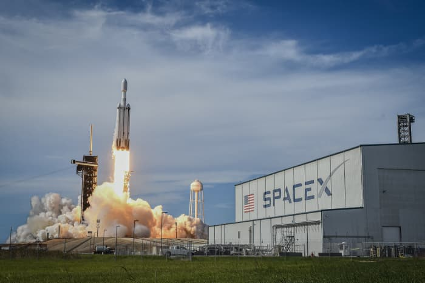
SpaceX’s Starship launch
Image source: Barron’s
In terms of the new entity’s corporate structure, SpaceX’s IPO structure continues Musk’s long-standing emphasis on concentrated control in corporate governance. Through its prospectus, SpaceX has established a dual-class share structure that gives Musk approximately 85.1 percent of the company’s aggregate voting power through his holdings of Class B shares. Retail investors must hold shares continuously for six months and maintain a market value of at least $1 million before becoming eligible to submit proposals, while resolutions require 67 percent shareholder approval. This institutional design protects founder control, making it difficult for external investors to materially alter the company’s strategic direction even if they participate in its public financing. It also reflects lessons drawn from Tesla’s 2024 compensation case and the 2023 OpenAI boardroom “coup”: in a public-market environment, founder compensation arrangements and board decisions may be subject to shareholder litigation and judicial review, while an unstable corporate structure can easily produce divisions between the board and management. Even leading AI companies may find it difficult to bear the costs of such internal discord.
It is worth noting that long-term goals such as establishing a civilization on Mars have also been incorporated into the executive compensation framework disclosed in the prospectus. For investors, subscribing to SpaceX shares is therefore not merely a purchase of equity in an aerospace company; it also entails acceptance of a technology roadmap and high-risk capital-expenditure structure shaped by Musk’s personal vision. Unlike typical public companies, SpaceX may not prioritize short-term dividends and stable returns. Instead, it is likely to continue channeling capital into high-risk projects such as Starship, Starlink, AI compute and space development, underscoring Musk’s control over the company’s operating strategy.
SpaceX and xAI
Image source: SpaceX
From an operational perspective, SpaceX’s acquisition of xAI also reflects the logic of integrating resources and spreading costs in order to build a full-chain ecosystem. For AI companies, innovation and R&D are also processes of mounting cost pressure. The faster models iterate, the more dependent companies become on chips, compute, electricity and data centers, and the harder it becomes to cover cash burn through near-term revenue alone. As long as private capital remains willing to provide funding, this model can still be sustained. Once the pace of financing slows, however, companies seeking to broaden their sources of capital must confront public-market supervision and scrutiny of their operations at an earlier stage. In terms of its revenue and cost structure, SpaceX also faces high capital-expenditure pressure from rocket development, Starship testing and data-center construction. Yet its commercial foundation is more substantial: Starlink provides a growing and recurring source of revenue, while partnerships with external institutions such as Anthropic have expanded both business relationships and financing channels. In addition, after being folded into SpaceX, xAI has gained a longer R&D horizon and greater room for resource coordination. By drawing on the group’s synergies in hardware transport, engineering deployment and energy supply, xAI can strengthen its autonomy in supply-chain management and infrastructure construction, thereby easing cost constraints in compute buildout and model training. More fundamentally, bringing xAI into SpaceX provides a foundation for Musk’s broader vision of moving AI infrastructure from Earth into space.
03 From Earth to Orbit: The Technical Advantages and Industrial Vision of Space-Based Compute
Space-based compute refers to low-Earth-orbit satellites equipped with AI chips, solar arrays and inter-satellite laser links, thereby forming orbital infrastructure capable of computation, storage and data transmission. Starlink has long been understood primarily as an extension of the terrestrial internet into space, providing global broadband services through a large-scale satellite constellation. However, a SpaceX application filed with the U.S. Federal Communications Commission (FCC) on January 30, 2026 marked a fundamental shift in what low-Earth-orbit satellites are expected to do: orbital data centers are moving from a technical vision onto the industrial agenda.
In its prospectus, SpaceX identifies Orbital AI Compute as a new growth area and plans to begin deploying AI compute satellites equipped with GPUs and powered by solar energy as early as 2028. These satellites would operate in sun-synchronous orbit, using solar energy and the space environment’s cooling conditions to support AI compute workloads. Under this vision, SpaceX plans to deploy 100 gigawatts of compute resources into orbit each year, turning low-Earth orbit into a new hosting environment for AI infrastructure. At the same time, space-based compute is not an idea exclusive to SpaceX. In November 2025, Starcloud placed an experimental satellite carrying an NVIDIA H100 GPU into orbit and later trained the small language model NanoGPT and ran inference tests using Google’s open-source large language model Gemma, thereby demonstrating the basic feasibility of operating AI chips in an orbital environment. Space-based compute has thus moved beyond proof of concept and entered the stage of engineering validation and capital-market pricing.
The strategic logic of space-based compute does not rest solely on SpaceX’s vertical integration capabilities or on technical feasibility. Within Musk’s industrial architecture, orbital data centers offer SpaceXAI three asymmetric advantages that terrestrial infrastructure would struggle to replicate.
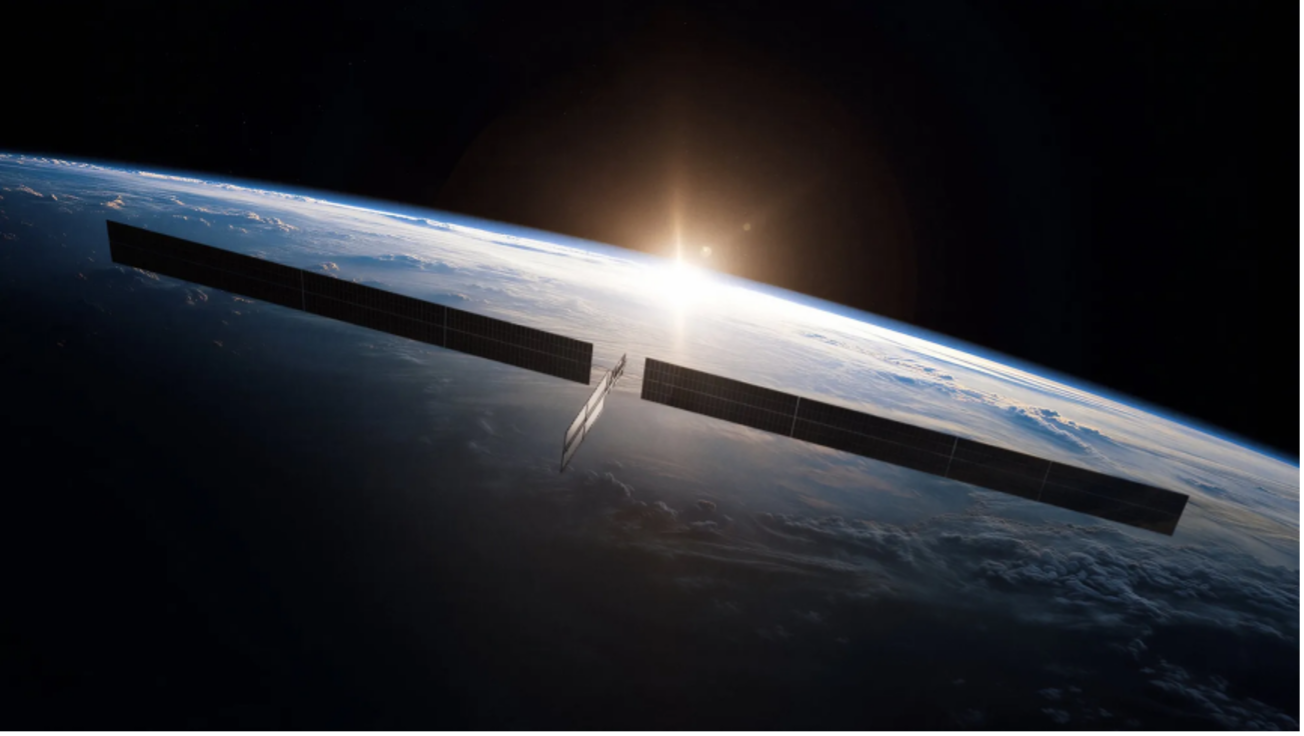
Concept image of SpaceX’s proposed orbital data-center satellite
Image source: SpaceX
First, space-based compute could help overcome the energy and environmental constraints facing terrestrial data centers. The training and inference of large AI models are driving electricity consumption at an unprecedented rate, while xAI’s expansion of terrestrial compute is constrained by energy supply, supply chains and regulatory compliance. xAI’s Colossus supercomputing cluster in Memphis provides a case in point. In April 2026, the National Association for the Advancement of Colored People (NAACP) filed a federal lawsuit against xAI, alleging that it had operated 27 methane gas turbines without authorization to power its data center, in violation of the Clean Air Act. Against this backdrop, SpaceX sees orbital compute as a possible alternative path. In orbit, solar arrays can access more stable and longer-duration solar irradiance than on Earth. In dawn–dusk sun-synchronous orbit in particular, satellites can receive near-continuous sunlight, allowing arrays of comparable scale to achieve longer power-generation hours and potentially higher energy output than terrestrial systems; the space environment also offers a radiative-cooling pathway. Although these conditions do not mean that orbital data centers can fully escape engineering and regulatory constraints, they do provide an energy and deployment logic for AI compute infrastructure that differs from that of terrestrial data centers.
Second, it may help mitigate regulatory pressure. Orbital data centers would operate in low-Earth orbit hundreds of kilometers above the surface, making direct regulation by terrestrial jurisdictions more difficult. Although the 1967 Outer Space Treaty provides that launching states retain jurisdiction and control over their space objects, once large-scale orbital data centers become operational, the overlapping application of data protection law, antitrust law, export control law and space law will become highly complex and largely without precedent. For Musk, this jurisdictional ambiguity is itself a potential advantage, allowing his commercial deployment and technological ambitions to remain beyond the reach of existing regulatory frameworks.
Third, inter-satellite laser links suggest the potential for distributed computing. Each of SpaceX’s third-generation Starlink satellites, known as V3 satellites, can reportedly provide more than 20 times the network capacity of the previous generation. A single Starship launch could deploy 60 V3 satellites and add 60 Tbps of network capacity. If combined with orbital AI compute nodes, such a system could in theory carry out part of the data transmission, inference and edge-computing workload within the satellite constellation itself, reducing dependence on terrestrial data centers and ground relay stations. This could help address inference tasks requiring global coverage as well as requirements related to sovereign-data processing and data masking.
04 AI in the Space Age: New Frontiers for AI Governance
As the commercialization and engineering pathways for space-based compute become more mature, AI industrial competition may also extend from terrestrial infrastructure into outer space, opening a new frontier for global AI governance. Over the past decade, the core issues in global AI governance have centered on model safety, data protection and platform antitrust, with regulatory disputes playing out mainly in terrestrial courts, national legislatures and data-center permitting regimes. In the future, however, AI governance controversies will not be limited to terrestrial legal rulings or regional digital legislation. They will increasingly involve a series of emerging institutional challenges, including spectrum allocation for low-Earth-orbit satellites, the security of space assets, jurisdiction over orbital data centers and antitrust review of space-based compute infrastructure.
First, the applicability of existing data-protection and digital regulatory frameworks in orbital-space scenarios will become a pressing issue. The European Parliamentary Research Service has noted that space data centers “may require updating or clarifying existing digital and space treaties and legislation.” When AI inference and data processing are completed within low-Earth-orbit constellation networks, the data may never be stored on servers located in any single country. This poses enforcement challenges for the EU’s General Data Protection Regulation (GDPR), state-level data privacy laws in the United States and national rules governing cross-border data flows.
Second, antitrust and competition policy will face new questions of applicability. Terrestrial data centers are constrained by environmental regulation, electricity supply and permitting review. These constraints objectively create a form of balancing mechanism for market entry. Once compute capacity migrates to low-Earth orbit, firms that possess launch capacity and orbital spectrum resources will gain competitive advantages that are difficult for traditional antitrust tools to address. SpaceX already holds an overwhelming share of the global commercial launch market and the low-Earth-orbit broadband market. If its orbital data-center plans proceed, they will further strengthen this structural advantage.
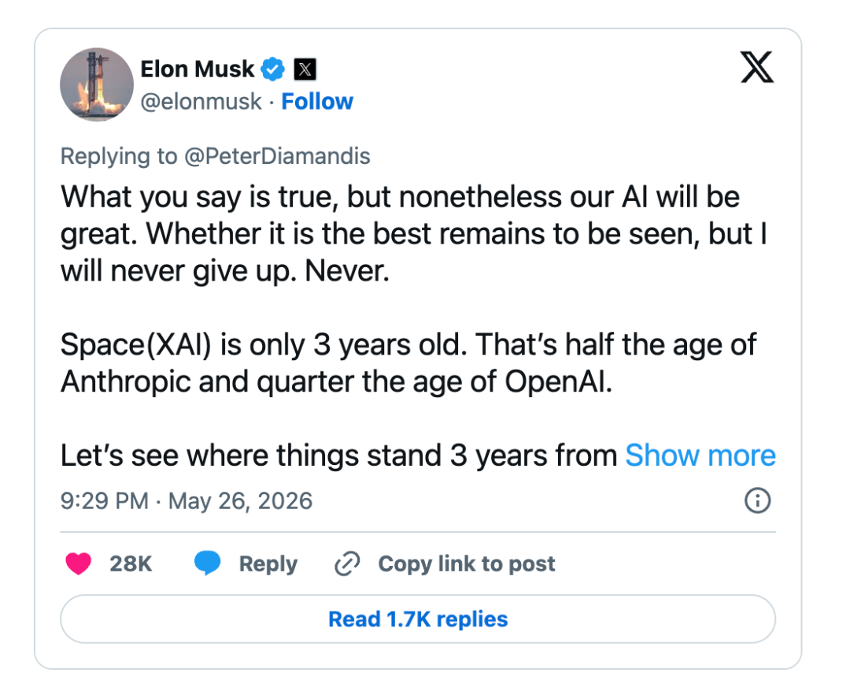
Elon Musk’s public remarks on xAI
Image source: X
Third, the asymmetric distribution of control over global AI infrastructure may become more pronounced. In a February 2026 report, Rest of World cited a warning from Colin Thakur, a scholar at the University of South Africa, that in the absence of a new multilateral governance framework, orbital compute could become a space-based extension of existing terrestrial monopoly structures. For countries in the Global South, if low-Earth-orbit compute infrastructure comes to be controlled by a small number of U.S. technology giants and defense contractors backed by capital markets, the rise of space-based compute would mean that they risk moving from being high-cost technology consumers in the age of terrestrial data centers to becoming rule-takers in the age of orbital compute. They would be unable to participate meaningfully in ownership competition over space infrastructure and would struggle to secure an equal voice in negotiations over frequency allocation and data sovereignty. As a result, they could face long-term risks of technological dependence in models, compute capacity, rules and pricing.
The provisional conclusion of Musk’s lawsuit against OpenAI is not merely a confrontation between two technology giants over commercial compliance. It also reflects a deeper divergence in the valuation logic and competitive dimensions of the global AI industry. As space-based compute moves gradually from proof of concept toward commercial deployment, the boundaries of global AI governance are also being crossed in a physical sense. Future regulatory challenges will no longer be confined to rulings issued by terrestrial courts or regional digital legislation. Instead, they will involve a series of emerging issues, including jurisdiction over orbital assets, spectrum allocation, cross-border data flows and the balancing of multilateral interests. In the face of a potentially asymmetric distribution of infrastructure control, clarifying the rules of space competition and building an inclusive and adaptable multilateral governance framework will become a new frontier for global AI governance. As terrestrial needs and space-based ambitions become increasingly intertwined, the future evolution of global AI governance will require greater foresight—and perhaps also a stronger capacity for imagination.
Authors
Yao Xu, Xin Yanyan, Zhang Ao, Li Ziyi and Zhong Yifei from the Research Office of CGAIG
Original URL: