

On June 11, 2026, Anthropic founder Dario Amodei published a policy essay on his personal blog titled “Policy on the AI Exponential” (hereinafter referred to as the “Policy Essay”). In it, he systematically set out his broader vision for how regulation, economic policy, civil liberties, and the geopolitical order should be shaped in the age of artificial intelligence (AI). Shortly after the publication of the Policy Essay, however, the U.S. Department of Commerce issued restrictive measures on June 12 targeting Anthropic’s Fable 5 and Mythos 5 models, requiring the company to suspend foreign users’ access to the models. Anthropic promptly responded with “Statement on the US government directive to suspend access to Fable 5 and Mythos 5” (hereinafter referred to as the “Statement”). Taken together, the two documents provide a useful lens through which to examine the real demands and underlying considerations of a leading U.S. frontier AI company.
The article therefore focuses on how Anthropic frames AI governance, what commercial interests and political considerations inform its policy positions, and the extent to which the U.S. government’s later regulatory measures expose the gap between technology companies’ safety claims and their concrete interests.
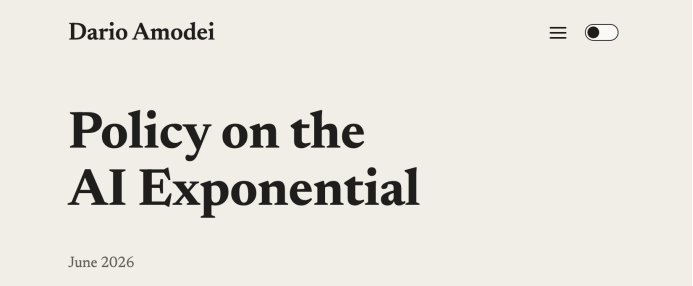
Original webpage of Policy on the AI Exponential.
Source: Dario Amodei’s personal blog.
01 Policy Proposals: Core Arguments of Policy on the AI Exponential
In the Policy Essay, Amodei begins with a “mismatch in timescale”: AI is developing exponentially, while policymaking struggles to keep pace. He argues that “AI’s scaling laws” may continue to drive rapid growth in AI capabilities and, within the next few years, lead to what he calls “Powerful AI”—or “a country of geniuses in a datacenter.” Yet legislation and regulation move far more slowly, making it difficult for existing governance arrangements to respond in time to the profound changes that may soon arrive. Amodei therefore calls for using the current window of opportunity to build a new governance framework suited to the age of AI.
Amodei’s proposed framework is organized around five policy priorities. First, on regulation and public safety, he argues that frontier models already pose real risks in areas such as cybersecurity, biological weapons, and loss of control of AI systems. He advocates AI regulation modeled on aviation safety, requiring models above a certain compute threshold to undergo mandatory testing and third-party audits, while giving the government authority to block or deter deployment if such models present unacceptable risks. Second, on macroeconomics, he warns that AI could produce enduring labor displacement and raise difficult questions of redistribution. To address the social consequences, he proposes measuring and tracking AI-related job displacement, creating pro-employment incentives, and introducing redistributive mechanisms such as universal basic income. Third, on scientific innovation, he argues that regulation in fields such as biomedicine should be reformed so that traditional approval processes do not hold back AI-driven scientific breakthroughs. Fourth, on the relationship between the state and civil liberties, he cautions that AI could be used for mass surveillance and the expansion of state power, and calls for restrictions on the domestic use of fully autonomous weapons, stronger privacy protections, and public access to AI-enabled legal assistance. Fifth, at the international level, he emphasizes that AI is likely to become the dominant resource shaping future national power. At the center of his proposal is a trusted coalition of the United States and its allies built around their common values, through which they would coordinate AI risk governance, share critical AI supply-chain resources, tighten chip export controls, and help secure democratic leadership in global AI competition.
Overall, the Policy Essay is not limited to technical risk. It presents a broader policy blueprint covering domestic governance, economic transition, and international strategy. Its central claim is that, as AI capabilities approach a possible step-change, policymakers should proactively steer the AI revolution rather than merely respond to it, by building regulatory systems in advance, adjusting economic policy, and reshaping the international order.
The policy blueprint should also be read in light of Anthropic’s role as one of the world’s most influential AI companies. Although Amodei presents the governance framework in terms of public interest and global safety, its specific proposals overlap closely with Anthropic’s commercial interests, market position, and political needs. It is therefore necessary to further examine the underlying drivers of the AI governance framework proposed in the Policy Essay from both commercial and political perspectives.
02 Commercial Interests: Anthropic’s Market Considerations
Although the Policy Essay is organized around the need to guard against exponential AI risks, its policy proposals cannot be separated entirely from Anthropic’s commercial interests when viewed in the context of corporate strategy. As a rapidly expanding frontier AI company, Anthropic needs both to demonstrate to investors that it has leading capabilities in safety governance and to consolidate its existing advantages in an increasingly competitive large-model market. In this sense, the risk governance framework advocated by Amodei is not only a set of public policy recommendations, but also a strategic instrument for building corporate credibility and strengthening Anthropic’s position in the industry. Safety claims and commercial interests are therefore not necessarily in opposition; rather, they can reinforce each other.
First, Amodei’s risk-focused account serves to showcase Anthropic’s capacity for safety governance and social-risk management, helping build market confidence as the company moves toward a possible IPO. In the Policy Essay, Amodei describes the potentially catastrophic risks that frontier models could pose to public safety in areas such as biosecurity and cyberattacks, creating a sense of urgency around the need to regulate advanced technologies. On this basis, he proposes a policy framework that includes mandatory government-backed audits and safeguards for broader social transition.
The Policy Essay also gives particular attention to Anthropic’s contributions in safety governance, legislative engagement, and corporate responsibility. For example, Amodei highlights Anthropic’s role in AI-related legislation, noting that “in 2025, Anthropic supported transparency legislation, helping to pass SB 53 in California, RAISE in New York, and SB 315 in Illinois (in early 2026),” thereby presenting the company’s policy engagement and early compliance advantages to investors. To further address public concerns over the energy demands of large models and their broader social impact, Amodei also points to corporate responsibility in this area, stating that “AI companies should pay to absorb rate increases—and Anthropic has already made a pledge to do so.”
In addition, alongside his emphasis on government regulation, Amodei also argues that AI companies should be given greater room to participate in governance. He writes that “AI companies [should] have more separation of power and accountability than is typical for private entities,” and presents Anthropic’s Long-Term Benefit Trust as one example of such a structure. These proposals respond to AI safety concerns while also highlighting Anthropic’s capabilities and relative advantages in safety governance. They may help turn Anthropic’s safety-oriented profile into an intangible asset that investors can assess and price, thereby supporting the company’s push toward a possible IPO.
Second, Anthropic’s statement responding to the June 12 U.S. government directive to suspend access to its Fable 5 and Mythos 5 models also shows the practical balance AI companies face between safety-governance objectives and commercial interests. According to Anthropic, the government’s concern involved a possible “narrow, non-universal jailbreak” of Fable 5, which created a risk of reputational damage to Anthropic’s safety credentials at a sensitive point before a possible IPO.
Anthropic responded to the model-safety controversy by focusing largely on technical clarification and risk characterization. According to the Statement, the reported issue was limited in scope and involved a capability “widely available from other models (including OpenAI’s GPT-5.5),” suggesting that it reflected a broader feature of frontier-model behavior rather than a model-specific safety failure. This line of argument points to the difficult balance that AI companies face between safety-governance responsibilities and market reputation: once a direct administrative restriction creates the risk of commercial loss and reputational damage, clarifying the scope and severity of the risk becomes central to limiting the negative impact on the company’s market standing.
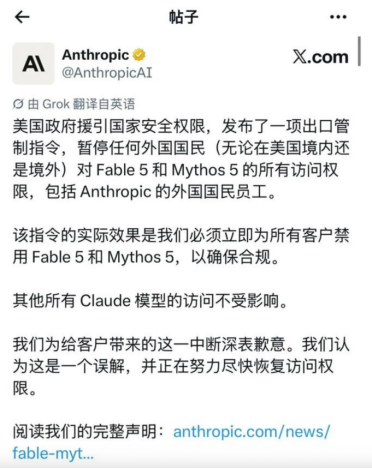
Anthropic’s response to the U.S. Commerce Department’s restrictions on Fable 5 and Mythos 5.
Source: Anthropic’s official account on X.
In addition, Anthropic’s policy proposals are closely aligned with areas in which the company already has established strengths, allowing it to use its existing safety-governance capabilities to raise barriers to entry for other market participants. In the Policy Essay, Amodei lays out five priority areas for frontier AI governance, with the first centered on “frontier model testing.” He argues that frontier AI models should be required to undergo “technical testing and auditing,” and calls on lawmakers to require that “models above a threshold of compute should undergo mandatory testing by a qualified third party.”
This proposal would help address technical risks while also allowing Anthropic’s existing safety and compliance systems to gain greater strategic value under a formalized regulatory framework. As a company that has long used AI safety as part of its market profile, Anthropic has already embedded costly adversarial testing and compliance review into its research and development process through its Responsible Scaling Policy. In this sense, the company has internalized part of the marginal cost of safety in advance.
If the policy framework proposed by Amodei were implemented, industry-wide testing requirements of this kind would have only a limited impact on Anthropic, but would impose significant compute and cost burdens on smaller AI startups, university research institutions, and the broader open-source AI community. Such requirements would raise the safety and compliance bar for frontier-model development, while also reducing competitive pressure on Anthropic. In effect, they could allow the company’s long-accumulated safety-governance capabilities to be converted into a market advantage, with the potential to reshape the industry’s competitive landscape.
03 Political Alignment: An Attempt to Repair Government–Business Relations
Beyond commercial considerations, the Policy Essay also carries political implications. U.S. AI governance is now deeply embedded in great-power competition and national security, making it increasingly difficult for frontier AI companies to maintain a supposedly value-neutral technological posture. For Anthropic, future growth depends not only on support from capital markets, but also on the regulatory environment shaped by the government. Many of Amodei’s policy proposals therefore suggest an effort to align the company’s interests more closely with U.S. national strategy. By emphasizing a democratic technology coalition, stronger export controls, and security boundaries centered on the United States, Anthropic appears to be seeking to recalibrate its relationship with the Trump administration and secure a more favorable environment for its own development.
On the one hand, by defining certain AI safety limits around domestic U.S. security concerns, Amodei presents a policy position that aligns with the Trump administration’s “America First” national security agenda, which may help repair Anthropic’s strained relationship with policymakers. In the Policy Essay, when discussing the potential risks of military AI applications, Amodei draws a specific geographic line: “Ban the domestic use of fully autonomous weapons.” From the perspective of global public safety, however, the risks posed by the spread of autonomous weapons do not stop at national borders. If the governance framework were truly oriented toward long-term human safety, this boundary would logically need to apply to all security contexts globally.
Instead, the proposed restriction applies only to “domestic” use within the United States and does not extend to AI-enabled military applications directed at other countries. This distinction effectively turns AI safety into a domestically bounded security issue and signals a degree of convergence with the administration’s political priorities. Against this backdrop, Amodei appears to be seeking to rebuild trust with policymakers by tying the company’s safety boundaries more closely to U.S. domestic defense interests, especially given Anthropic’s previous tensions with the administration over issues such as safety reviews.
In practice, however, alignment with Trump’s “America First” agenda sits uneasily with the company’s own global commercial interests. The June 12 U.S. export-control directive restricting access to Fable 5 and Mythos 5 also extended to foreign nationals located inside the United States, including Anthropic’s own foreign employees. Given the difficulty of segmenting users by jurisdiction, Anthropic had to take the far more damaging step of disabling the models globally. This case shows that policy coordination between companies and the government does not necessarily bring regulatory exemptions for the former; instead, it may require companies to absorb direct commercial costs.
On the other hand, Anthropic frames its position around shared values, supporting a global AI governance system centered on U.S.-aligned democracies while seeking closer coordination with the strategic objectives of the U.S. government. Yet this policy position is also at odds with the company’s practical need to serve global customers and expand its international business, and may produce unintended consequences. In the Policy Essay, Amodei makes a sustained case in the sections on “The state and civil liberties” and “Securing leadership by democracies” for a global coalition of ideologically aligned democracies, as well as tighter multilateral export controls on chips and semiconductor manufacturing equipment, or SME.
By linking technical standards to ideology, this narrative emphasizes shared values while also aligning closely with the Trump administration’s emphasis on technological leadership and national security. For example, by actively positioning itself within the U.S. strategic-competition framework toward China, Anthropic appears to be demonstrating policy coordination with the Trump administration’s strategic objectives, in the hope of easing earlier tensions arising from safety reviews and litigation while creating a more favorable policy environment for the company.
Yet this political strategy is in fundamental conflict with Anthropic’s commercial interests as a foundation-model provider that depends on serving global customers and generating revenue from them. In the face of the U.S. export-control directive restricting foreign nationals’ access to Fable 5 and Mythos 5, Anthropic was forced to disable the models for all customers globally, causing serious harm to its own business interests. The case illustrates that a technology company’s decision to embed itself proactively in national strategy may not necessarily produce the expected benefits; instead, it may generate unintended policy consequences that severely undermine the company’s global commercial footprint and revenue model.
Overall, the Policy Essay is not merely a technical blueprint for governance, but a strategic text that serves the functions of policy advocacy, market competition, and political communication at the same time. On the one hand, the AI safety framing constructed by Amodei helps Anthropic reinforce its corporate image as a responsible AI leader and consolidate its advantages in capital markets and industry competition. On the other hand, it also reflects Anthropic’s political considerations in moving closer to the U.S. national security and geopolitical competition agenda.
However, the U.S. export-control measures targeting Anthropic’s models show that when corporate strategy becomes overly dependent on state power, the company itself may also be caught up in regulatory expansion. For U.S. AI companies today, the greatest challenge may lie not in how to use risk concerns to influence policy debates and market expectations, but in how to maintain a sustainable and stable balance among capital, the state, and global markets.
Authors
Yao Xu and Guo Borui
Source text
1. Dario Amodei, “Policy on the AI Exponential”: https://darioamodei.com/post/policy-on-the-ai-exponential
2. Anthropic, “Statement on the US government directive to suspend access to Fable 5 and Mythos 5”: https://www.anthropic.com/news/fable-mythos-access
Original URL:
https://mp.weixin.qq.com/s/hMr4Nd_HrL5S3idXMdhSlA