

On June 4, 2026, the U.S. AI firm Anthropic released a research report titled When AI Builds Itself. The report warned that AI systems could achieve recursive self-improvement (RSI) within two years, meaning that they could autonomously design, train, and improve successor models, with human involvement in model training gradually declining. Consequently, the document called upon major global AI laboratories to decelerate or temporarily pause frontier model R&D.
However, days prior to issuing this “pause initiative,” Anthropic had reportedly submitted a confidential filing for an initial public offering (IPO) at a valuation approaching $1 trillion. The close timing between its call for an industry-wide deceleration and its own accelerated move toward a public listing has led outside observers to link its safety advocacy with IPO narratives and valuation management. Against this backdrop, this analysis examines the safety narrative constructed by Anthropic, the technical concerns and commercial considerations underpinning it, and the prospects for its proposed pause in development.
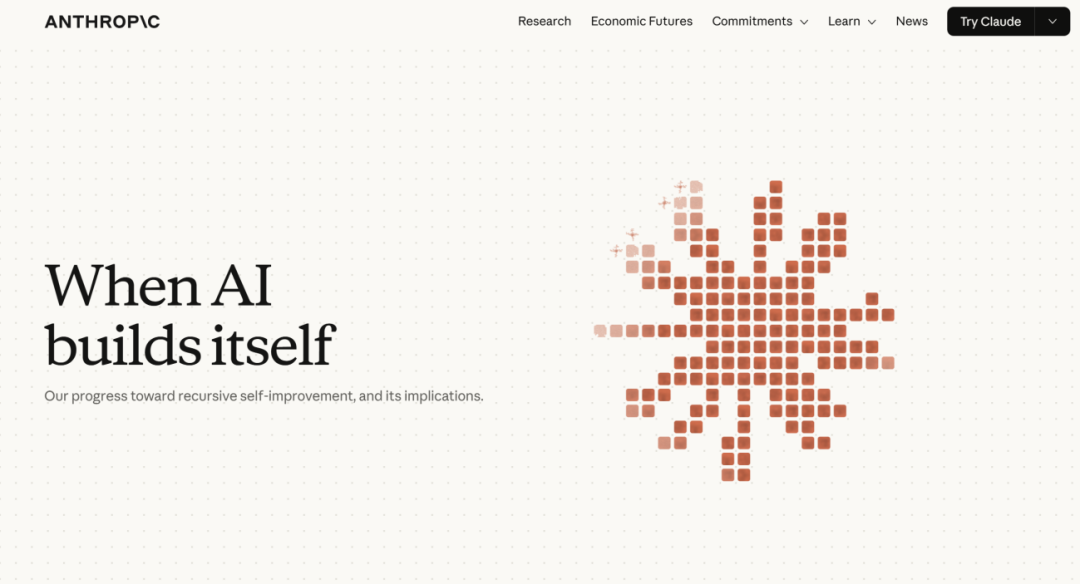
The original landing page of the Anthropic research report
Source: Anthropic Official Website
01 The Origins of Anthropic’s Pause Initiative
Anthropic’s recent pause initiative does not represent an isolated development. The company has laid the groundwork for this position by setting red lines for military collaboration, repeatedly releasing threat intelligence, and creating a research institute to strengthen its policy advocacy. However, public and industry reception has fallen short of the firm’s expectations.
I. Braking at the Threshold: Anthropic’s Public Call for a Global Pause in Frontier AI Development
Anthropic’s argument treats the autonomous development of successor models by AI systems as a critical technical inflection point. Analysts at the firm suggest that once AI systems attain this capability, human intervention in the core stages of model training will diminish. Beyond this technical threshold, model iteration would cease to depend on human-driven R&D cycles, moving instead into an accelerated, self-driven loop. The speed of AI capability enhancement could outpace the ability of existing governance systems to respond, potentially closing the window for meaningful intervention by governments and international authorities.
To support this assessment, the report disclosed two sets of R&D data. First, regarding code generation, the document stated that as of May 2026, over 80% of merged code within Anthropic’s internal repositories was authored by Claude. Prior to the launch of Claude Code in early 2025, this figure stood in single digits. The quarterly volume of code merged by engineers also reached roughly eight times the level recorded in the same period of 2024. While lines of code do not directly equate to actual productivity, the report inferred that Claude-generated source code can pass review and enter production environments, indicating that AI’s function in software development is transitioning from an auxiliary tool to a primary driver of productivity.
Regarding capability benchmarks, the firm cited findings from Model Evaluation and Threat Research (METR), asserting that the length of tasks that frontier models can complete with 50% reliability is doubling approximately every four months. In March 2024, models could only handle tasks lasting roughly four minutes; subsequent iterations extended this reliability window to the 12-hour level. Anthropic also referenced the benchmark performance of its then-unreleased Mythos Preview model, claiming it demonstrated a 52-fold acceleration in code optimization—an improvement magnitude that typically requires four to eight hours of effort from skilled human researchers.
Based on these risk evaluations, Anthropic proposed an initiative to pause frontier AI development, though the initiative incorporated strict limitations. The report advocated for a coordination mechanism among leading AI laboratories to slow down or pause frontier model training, thereby securing a buffer period for alignment research and institutional adaptation. The Anthropic Research Institute subsequently announced plans to convene government officials, scientists, civil society organizations, and market competitors to deliberate on feasible options for this pause mechanism.
However, the report made clear that a unilateral pause by a single laboratory would accomplish much less. The rationale presented was pragmatic: if a single laboratory halts development while market competitors advance, the pausing entity would fall behind technically and commercially without achieving its broader safety objectives. Consequently, the proposed pause is structured as a conditional, collective action requiring synchronized suspension across frontier laboratories in multiple countries, subject to effective verification. The report further emphasized that any meaningful slowdown or pause would require well-resourced frontier laboratories across different countries to act under the same conditions, implying that participation by both the United States and China would be essential for such an arrangement to remain viable.
II. Long-Term Positioning: Anthropic’s Early Construction of an AI Safety Narrative
A review of the policy timeline indicates that Anthropic’s initiative is part of a broader strategy spanning defense integration, cybersecurity positioning, and public policy advocacy, designed to build an AI safety narrative that reinforces its market position.
First, Anthropic has become deeply involved in U.S. national security and defense environments, using red lines on military use to cultivate a reputation for corporate responsibility. Among leading model providers, Anthropic was one of the frontier model companies to move relatively early and deeply into this field. In June 2025, the firm introduced the Claude Gov series for national security clients to support strategic planning and intelligence analysis. In July 2025, the company secured a contract with the U.S. Department of Defense, making Claude the first frontier AI model authorized for deployment on U.S. government classified networks.
While establishing deep ties with the military, the company has wrapped this collaboration in a carefully constructed protective layer, emphasizing safety boundaries and restrictions on military use. Against this backdrop, its self-imposed red lines serve as the structural core of this framing. Anthropic has maintained two primary red lines: Claude must not be utilized for the mass domestic surveillance of Americans, and it must not be integrated into fully autonomous weapon systems. These two restrictions directly target sensitive and contentious scenarios within U.S. public discourse. Once established, they have been repeatedly cited by Anthropic across various public statements, serving as recognizable markers of its responsible corporate profile and gradually embedding themselves into its core brand identity.
In early 2026, contractual friction regarding these red lines became public, serving as a core element of the firm’s safety narrative. During contract renewal negotiations, the Department of Defense requested the removal of these restrictive clauses, a demand Anthropic declined. On February 27, 2026, a presidential directive instructed federal agencies to suspend usage of the company’s technology, and Secretary of Defense Pete Hegseth designated the firm as a supply chain national security risk—a label historically reserved for foreign strategic competitors. Anthropic subsequently initiated legal proceedings, asserting that the restriction would reduce its 2026 revenue by billions of dollars and stating that it was defending its safety principles despite potential financial losses.

Anthropic has become deeply involved in U.S. national security affairs. The recent contract dispute with the Department of Defense can be read as part of its broader public narrative emphasizing its identity as a “Constitutional AI” company.
Source: Klawe Rzeczy / Time
Second, the firm has consistently emphasized AI abuse risks to secure authority in AI and cybersecurity governance. By publishing regular threat intelligence assessments, Anthropic has positioned itself as an authoritative source on AI security vulnerabilities. In August 2025, the firm’s threat intelligence unit released its first systemic report on the misuse of Claude models, which drew significant attention across the industry. The consulting firm Forrester designated the report as essential reading for Chief Information Security Officers (CISOs), and multiple security vendors published analyses and product proposals based on its findings. Anthropic subsequently formalized these disclosures as a regular channel for public communication.
In 2026, the focus of Anthropic’s threat narrative shifted from identifying external abuse to demonstrating its own commitment to safety. In April, the firm introduced Mythos Preview, claiming the model identified thousands of high-risk zero-day vulnerabilities across major operating systems and browsers, and withheld public release citing proliferation risks. Instead, access was restricted via Project Glasswing to approximately 40 review organizations, including Microsoft, Google, NVIDIA, and Apple. On June 2, 2026, the project was expanded to approximately 150 organizations, including NATO and the European Union Agency for Cybersecurity (ENISA), covering critical infrastructure nodes across more than 15 countries.
Additionally, around the launch of the pause initiative, Anthropic also published its report mapping a year’s worth of AI-enabled cyber threats, forming a coordinated communication matrix with the initiative. From abuse reports to vulnerability disclosures, the core analytical conclusion remained constant: technical risks are becoming more immediate, and Anthropic holds key capabilities to mitigate them. This layered threat narrative ultimately supports its branding and policy communication efforts.
Third, the firm has established institutional advocacy channels to translate corporate positions into public policy agendas. Anthropic CEO Dario Amodei has frequently published extended essays outlining AI risks and governance proposals to maintain institutional visibility. In 2026, this approach became more systematic through the establishment of the Anthropic Research Institute in March, led by co-founder Jack Clark and positioned externally as a public-interest research body. The institute consolidates teams specializing in safety testing, societal impacts, and economic research to focus on policy formulation. Although it is presented as a public-interest entity, its funding and strategic agenda originate from the parent corporation, and its research outputs are closely aligned with Anthropic’s corporate interests. Concurrently, the firm expanded its public policy team and established a Washington, D.C., office to seek policy and regulatory support.
Public communication proceeded in parallel. In early May, Clark stated on the social platform X that the probability of AI achieving recursive self-improvement by the end of 2028 was approximately 60%. While this projection lacked open empirical backing, it generated discussion among AI safety researchers and drew attention on online platforms. Clark also used a metaphor in an interview with BBC Newsnight, saying that the AI industry “has a gas pedal, but it doesn’t have a brake pedal,” and arguing that society should develop mechanisms to slow AI development when necessary. On June 4, less than three months after its founding, the institute released its global pause report, making policy output a visible part of its institutional role. Together, the institutional setup, public communication, and policy proposal formed a systematic policy agenda.
02 A Cool Reception: Limited Consensus Around Anthropic’s Pause Initiative
Despite Anthropic’s advocacy, the global pause initiative has failed to secure broad institutional endorsement, eliciting skepticism and critique across government, industry, and think tanks.
At the government level, the Trump administration has not extended official support to Anthropic’s proposal, while political circles close to the White House have expressed opposition to pausing AI development. Two days prior to the release of Anthropic’s report, the White House issued an executive order titled Promoting Advanced Artificial Intelligence Innovation and Security. While the order acknowledged that frontier models present national security risks, its strategic focus prioritized risk mitigation alongside innovation incentives, advocating for voluntary partnership frameworks over mandatory pre-clearance mechanisms. This regulatory trajectory suggests the administration favors a deregulatory approach to sustain U.S. technological primacy while avoiding excessive restrictions on AI development.
Critiques from political circles close to the White House have been more explicit. David Sacks, co-chair of the President’s Council of Advisors on Science and Technology and former White House AI Czar, engaged in public policy disputes with Clark as early as 2025, arguing that Anthropic’s safety advocacy harmed the domestic AI startup ecosystem. Regarding the current pause proposal, Sacks suggested that by analogizing frontier AI to nuclear weapons while continuing to advance its own technology, Anthropic was effectively seeking government intervention to protect its own position. He further argued that the company was utilizing risk-based narratives to drive restrictive regulatory frameworks, with the actual aim of suppressing lower-cost open-source alternatives and thereby consolidating its competitive position within the proprietary market.
Within the industry, the global R&D competition continues to accelerate amid ongoing pressure from Anthropic’s primary market competitor, OpenAI. On June 2, OpenAI released a document titled Democratic Governance of Frontier AI: A Blueprint for a Federal Framework. This framework acknowledged that recursive self-improvement presents governance challenges but concluded that only preliminary indicators of this capability have emerged. The document argued that the pace and rules of AI development should be determined by democratically elected governments rather than any single company or interest group.
During the same week, OpenAI introduced a public policy agenda advocating for collaborative regulatory design involving Congress, federal agencies, and industry stakeholders. Previously, OpenAI CEO Sam Altman criticized the commercialization of safety narratives, characterizing Anthropic’s policy approach as “fear-based marketing” and likening it to amplifying risks before selling proprietary solutions.
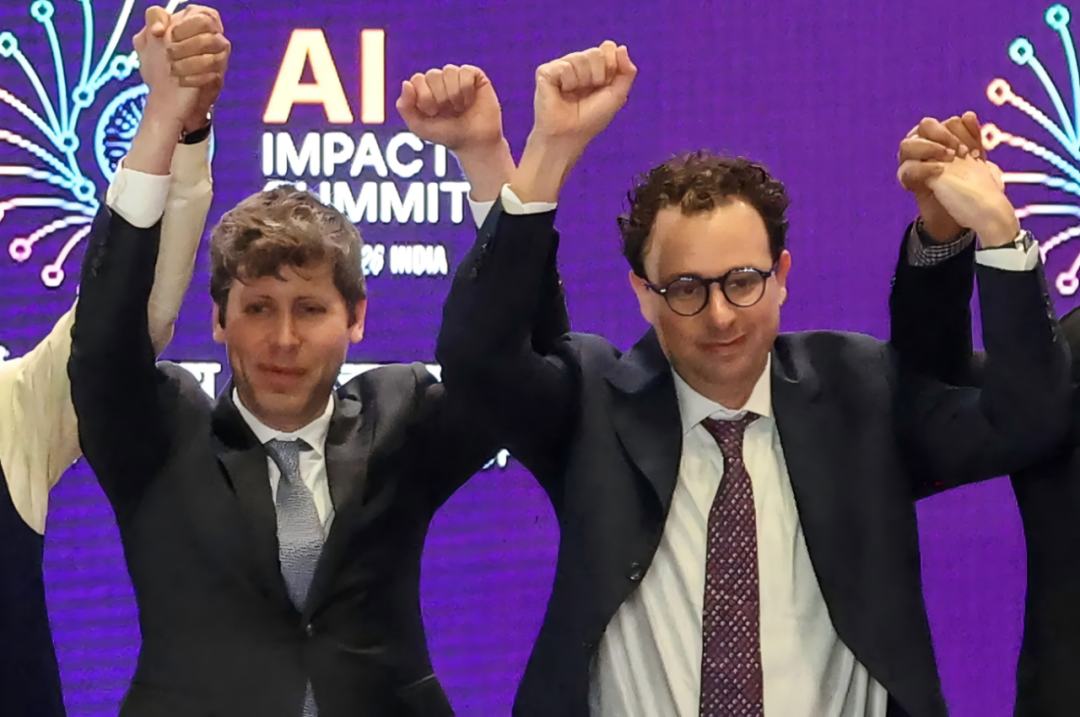
OpenAI CEO Sam Altman and Anthropic CEO Dario Amodei. Relations between the two AI leaders have been strained in recent years, and at the India AI Impact Summit, they did not join hands as suggested by the organizers.
Source: Ludovic Marin / AFP
Frontier model development has not decelerated around the release of the pause initiative. Google introduced Gemma 4 12B on June 3, while Meta launched Meta Business Agent across its software ecosystem, including WhatsApp, Messenger, and Instagram, during the same week. Notably, the firm advocating for a developmental pause has continued to introduce advanced models. On June 9, Anthropic officially released Fable 5 and Mythos 5. Fable 5 demonstrated leading capabilities in complex analytical tasks, securing a competitive market position. This product deployment reveals a misalignment with the firm’s public call to halt frontier R&D, indicating that leading firms remain disinclined to voluntarily decelerate amidst intense market competition for ethical or safety reasons. The pause initiative has therefore received little substantive response from the industry.
Furthermore, technical and policy analysts have questioned the empirical validity and motives behind the pause proposal. Gary Marcus, an AI specialist, characterized the Anthropic report as a “bait and switch,” questioning its technical assertions. Marcus argued that the core empirical evidence presented consists primarily of accelerated software engineering tools operating under human oversight, which differs fundamentally from autonomous recursive self-improvement. He noted that accelerated programming assistants are unlikely to present existential risks.
Yann LeCun, former Chief AI Scientist at Meta, stated that physical constraints and real-world time constants limit the realization of recursive self-improvement. He argued that current large language model architectures lack the physical understanding and spatial reasoning necessary to achieve Artificial General Intelligence (AGI), leaving a significant gap before true RSI can be achieved. Both analysts concluded that Anthropic has overstated the proximity of autonomous self-improvement.
Rob Enderle, President of the technology advisory firm Enderle Group, noted that a global pause is practically impossible, as economic incentives and national security requirements prevent key global actors from voluntarily decelerating. Holger Mueller, Principal Analyst at Constellation Research, questioned whether Anthropic’s policy intent was to freeze the competitive landscape to protect its current position or to slow competitors to secure room for its own development. Analysts note that if a pause mechanism were enacted, its immediate effect would be raising entry barriers for new market entrants, thereby extending Anthropic’s competitive advantage. This reflects broader skepticism within think tanks and commentary circles regarding the credibility, feasibility, and fairness of the proposed framework.
03 Undercurrents Beneath the Safety Narrative
While presented as a framework for risk governance, Anthropic’s safety-framed pause initiative is entangled with multiple technical, commercial, and geopolitical dynamics that complicate its prospects for implementation.
I. The Technical Dilemma: Verification Barriers in Global AI R&D
First, the opaque nature of AI development complicates verification. The structural viability of the pause proposal depends on verification—the capacity of each participating laboratory to confirm that other labs have halted development. While nuclear weapons development relies on physical infrastructure like missile silos and large-scale facilities, which provide tangible targets for international verification, AI training can be conducted covertly within private data centers, and algorithmic innovations are difficult to detect externally. Anthropic acknowledged within its report that AI verification presents greater challenges than traditional nuclear arms control.
Organizations including the Center for Security and Emerging Technology (CSET) at Georgetown University and the AI Verify Foundation are developing verification frameworks, but institutional consensus remains distant. Currently, there are no uniform, implementable verification standards or independent third-party verification bodies. Corporations can publicly claim to have slowed down while continuing internal model iterations, and state-level R&D remains difficult to monitor.
On May 1, 2026, the U.S. Department of Defense announced agreements with eight technology firms—SpaceX, OpenAI, Google, NVIDIA, Reflection AI, Microsoft, AWS, and Oracle—to deploy their advanced AI capabilities on the Department’s classified military networks for lawful operational use. Such integrations suggest that leading AI R&D is increasingly entering classified, opaque environments, making effective governance more difficult.
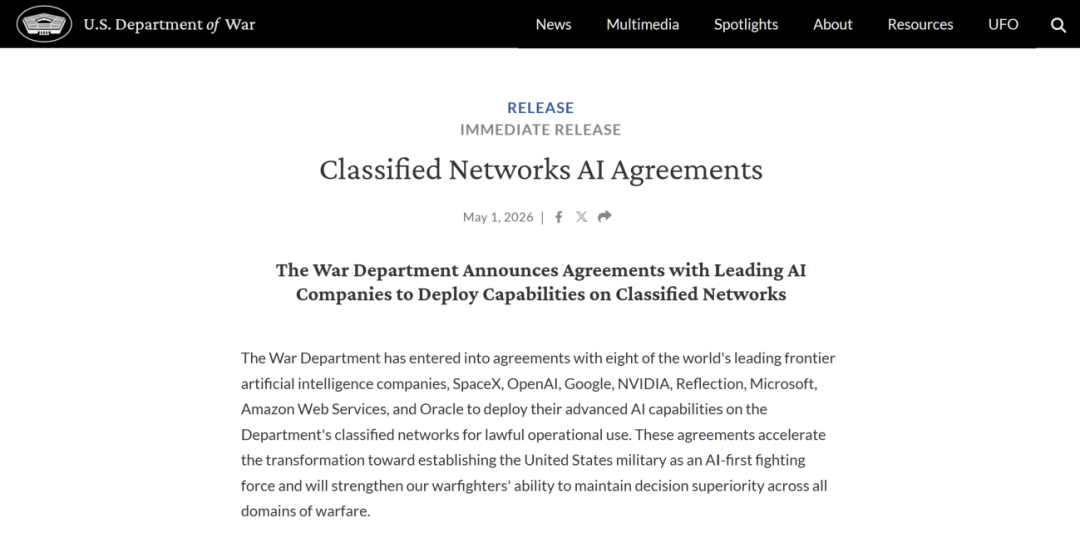
On May 1, 2026, the U.S. Department of Defense, now using the Department of War as a secondary title, announced agreements with eight leading AI firms to deploy advanced AI capabilities on the Department’s classified networks, an initiative intended to support the U.S. military’s AI transformation.
Source: U.S. Department of Defense Official Website
Second, the velocity of AI iteration outpaces regulatory formulation. Anthropic referenced the Intermediate-Range Nuclear Forces (INF) Treaty to argue for the feasibility of AI verification. However, conventional arms control targets technologically stable systems, whereas frontier AI model update cycles have compressed to months or weeks.
The industry’s actual development path diverges from the proposed pause model; the timeline from the release of Mythos to the launch of Project Glasswing indicates that prioritizing technical breakthroughs before retrofitting safety mechanisms remains the industry norm. Given this pace of development, the technology itself would likely iterate through multiple generations during the period required to negotiate and enact a formal pause agreement, altering the targeted capabilities.
Third, the decentralized structure of AI R&D limits comprehensive coverage. Unlike nuclear technology, which requires capital-intensive resource infrastructure concentrated within a limited number of states, AI development is highly decentralized. Beyond leading firms, thousands of startups, academic laboratories, and open-source communities are actively advancing the technology. Consequently, any global pause arrangement would be unable to cover all actors. Even if prominent firms comply, it cannot prevent clandestine or decentralized R&D, meaning that the synchronized suspension envisioned by the initiative lacks the structural conditions necessary for implementation.
II. Commercial Speculation: Hidden Interests in the IPO Window
The timing of the proposal’s release, occurring alongside critical phases of Anthropic’s IPO preparations, has raised questions regarding underlying commercial considerations.
First, the initiative closely coincided with the firm’s listing timeline. On June 1, Anthropic filed a confidential draft S-1 registration statement with the U.S. Securities and Exchange Commission (SEC) as part of preparations for a proposed IPO. The filing occurred one week after the firm completed a $65 billion Series H financing round at a valuation of $965 billion, making it the world’s most valuable AI startup and surpassing OpenAI. The pause initiative was released three days later.
The timing of a pre-IPO company calling for an industry-wide development halt has drawn scrutiny. The IPO window requires strong corporate narratives; a commitment to safety has long served as Anthropic’s primary brand differentiator and an important source of valuation premium. Reinforcing this safety profile immediately prior to public listing is commercially understandable and could help Anthropic secure capital market attention amidst competition from incumbents like OpenAI and Google DeepMind.
Market competition between OpenAI and Anthropic has extended into capital markets. Anthropic has already submitted a confidential IPO filing, with OpenAI later following suit, intensifying the rivalry over public listing timelines.
Source: AI Supremacy
Second, risk evaluation and capability demonstration function as complementary narratives. While the report utilizes internal R&D data to argue that risks are approaching, these same metrics can also be read as a demonstration of the firm’s advanced technical capabilities to capital markets. In detailing these risks, Anthropic effectively communicates a narrative of technical leadership to prospective investors.
Concurrently, while urging global competitors to halt frontier training, Anthropic itself has offered only a vague willingness to participate, stopping short of a clear commitment to slow its own technical iteration to the same extent. By addressing risk externally while showcasing its own capabilities, the report simultaneously signals technical strength and advises competitors to slow down, raising questions regarding whether the core motivation centers entirely on safety.
Third, Amodei did not participate in previous global pause initiatives. Calls to halt AI development are not unprecedented. In 2023, the Future of Life Institute issued an open letter titled Pause Giant AI Experiments: An Open Letter, co-signed by researchers including Yoshua Bengio and industry figures like Elon Musk, which urged all AI laboratories to pause the training of models more advanced than GPT-4 for at least six months. The petition has since secured over 30,000 signatures, but Amodei’s name does not appear among them. His absence from the earlier petition contrasts with his active launch of a similar initiative now, at the same moment when the company has reached a peak valuation and begun its IPO process—a shift that some commentators view as more than a simple coincidence.
III. Political Realities: Anthropic’s Deep Integration into the National Security Architecture
AI has evolved into a strategic technology shaping comprehensive national strength, military readiness, and industrial structures. In this environment, unilateral or corporate-led calls for a pause in development diverge from contemporary geopolitical realities. Without state-level enforcement, corporate initiatives are unlikely to resolve global AI safety challenges and risk being utilized as instruments of geopolitical competition, potentially exacerbating fragmentation and imbalance in global governance.
On one hand, the strategic nature of AI discourages major actors from decelerating. Amid intensifying geopolitical competition, major states treat technological autonomy and rapid iteration as core national security imperatives, and the pace of R&D is increasingly governed by state priorities rather than corporate choices. No state is inclined to voluntarily restrict its capabilities, and leading firms operate under similar constraints. A pause initiative relying solely on corporate consensus overlooks the logic of international competition and risks becoming a rhetorical tool in state competition rather than a catalyst for global coordination.
On the other hand, Anthropic is deeply embedded within the U.S. national security apparatus. The Guardian, citing Steven Murdoch, a professor at University College London, noted that Anthropic’s approach to safety is dual-sided; its definition of AI safety remains relatively narrow, while its approach to AI integration within national security operations remains flexible. The firm’s two signature red lines—prohibiting domestic mass surveillance and integration into fully autonomous weapon systems—primarily protect the U.S. domestic public. If safety were pursued as a universal principle, these restrictions would logically extend to a broader range of high-risk military contexts. However, foreign military and intelligence applications remain outside these corporate red-line constraints.
Despite the Department of Defense’s supply chain designation, reports from Axios indicate that the National Security Agency (NSA) continues to utilize Anthropic’s Mythos system. On June 5, the Financial Times further reported that Anthropic had deployed six systems engineers to the NSA to assist the agency in using the model and designing offensive cyber operations. The contradiction of an organization assisting intelligence agencies with offensive cyber capabilities while simultaneously calling for a global pause on safety grounds reduces the persuasive authority of the proposal. Anthropic’s challenge in balancing technical advancement with advocacy for a developmental pause reflects the internal contradictions of the initiative. The firm remains subject to the logic of contemporary geopolitics, limiting its capacity to lead the formation of a multilateral safety consensus or turn such an initiative into reality.
04 The Frontier R&D Paradox and the Realization of a Self-Fulfilling Prophecy
The policy debate intensified on June 12, 2026, when the U.S. Commerce Department, under Secretary Howard William Lutnick, issued an export control directive targeting Anthropic’s Fable 5 and Mythos 5 models. Citing national security authorities, the directive required Anthropic to suspend all access to both models by non-U.S. nationals, whether inside or outside the United States, including Anthropic’s own foreign employees.
Anthropic responded by removing access to both models for all customers and publishing a statement asserting that Fable’s safeguards were substantially more effective than those of any previously deployed model, and that the capability cited by the government was widely available from other models (including OpenAI’s GPT-5.5) rather than being unique to Fable 5 or Mythos 5. While technical safety remains distinct from absolute security, the core paradox of frontier R&D was articulated within Anthropic’s original pause statement:
“We believe it would be good for the world to have the option to slow or temporarily pause frontier AI development to enable societal structures and alignment research to keep up with the advance of the technology.”
In other words, the pace of AI capability gains could outstrip the ability of existing governance systems to respond, narrowing the window for meaningful intervention by governments and international institutions.
Perhaps Trump and Lutnick had read Anthropic’s pause proposal closely and decided to act before the window for intervention closed.
Authors
Yao Xu, Xin Yanyan, Zhang Ao, Huang Kaiyue and Wang Yibo from the Research Office of CGAIG
References
1. https://www.anthropic.com/institute/recursive-self-improvement.
2. https://www.anthropic.com/glasswing.
3. https://www.anthropic.com/research/constitutional-ai-harmlessness-from-ai-feedback.
4. https://www.anthropic.com/news/core-views-on-ai-safety.
5. https://www.anthropic.com/constitution.
6. https://www.anthropic.com/news/claude-new-constitution.
7. https://www.anthropic.com/news/claude-gov-models-for-u-s-national-security-customers.
8. https://democrats-science.house.gov/news/press-releases/ranking-member-lofgren-appalled-by-trump-administrations-attacks-on-anthropic.
9. https://www-cdn.anthropic.com/b2a76c6f6992465c09a6f2fce282f6c0cea8c200.pdf.
10. https://cdn.openai.com/pdf/25752ecb-0e5c-47f9-b9e4-c0f4d76f8d3d/a-blueprint-for-a-federal-framework.pdf.
11. https://www.forrester.com/blogs/vibe-hacking-and-no-code-ransomware-ais-dark-side-is-here.
12. https://x.com/jackclarkSF/status/2051312759594471886.
13. https://x.com/ylecun/status/2063242146593841645.
14. https://time.com/7380854/exclusive-anthropic-drops-flagship-safety-pledge/.
15. https://www.ft.com/content/d02d91b3-2636-454e-9442-dc7e69f51815?syn-25a6b1a6=1
16. https://www.cnbc.com/2026/03/24/anthropic-lawsuit-pentagon-supply-chain-risk-claude.html.
17. https://www.cnbc.com/2026/04/08/anthropic-pentagon-court-ruling-supply-chain-risk.html.
18. https://www.axios.com/2026/04/19/nsa-anthropic-mythos-pentagon.
19. https://www.fortune.com/2026/04/07/anthropic-claude-mythos-model-project-glasswing-cybersecurity.
20. https://fortune.com/2026/06/05/anthropic-ai-pause-development-recursive-self-improvement/.
21. https://www.shumaker.com/insight/client-alert-anthropics-call-for-a-global-ai-pause-what-businesses-need-to-know-about-the-governance-landscape/.
22. https://www.pymnts.com/artificial-intelligence-2/2026/anthropic-wants-a-global-ai-pause-if-everyone-else-does/.
23. https://siliconangle.com/2026/06/04/anthropic-calls-global-pause-ai-development-humans-lose-control/.
24. https://garymarcus.substack.com/p/no-need-to-panic-about-anthropics.
Original URL: https://mp.weixin.qq.com/s/BYaL-REsn1k0DmLBtiAIjg?scene=1&click_id=9