


On June 11, an academic salon on “AI Safety and Youth Protection” was held at Modelers Space in Shanghai’s Xuhui District. The event brought together policymakers, educators, researchers, and industry representatives to discuss the challenges and opportunities that artificial intelligence presents for youth development, digital literacy, and online safety.
Representatives from the Shanghai Federation of Social Science Associations, the Shanghai Youth Working Committee, the Shanghai Women’s Federation, academic institutions, and AI enterprises attended the event.


I. Navigating with Intelligence: Gathering Synergy for Education
At the start of the event, attending leaders delivered speeches focusing on the healthy growth of youth in the AI era, the enhancement of educators’ literacy, and collaborative multi-party protection.
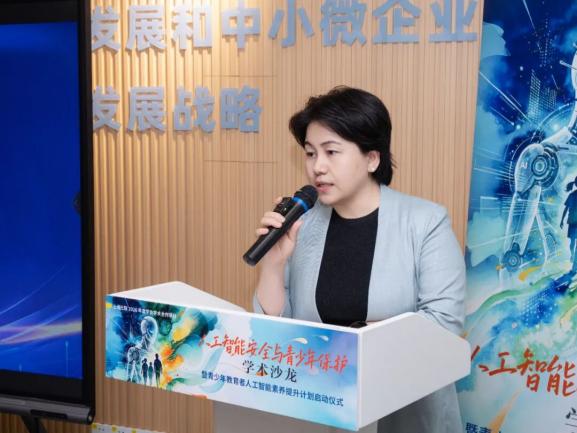
Ma Yingjuan, Member of the Party Leadership Group and Full-time Vice Chairperson of the Shanghai Federation of Social Science Associations (SSSA), stated that this salon is one of the SSSA’s 2026 Academic Cooperation Projects. It also represents a vital practice of cross-disciplinary cooperation tackling real-world issues by the Shanghai Big Data Social Application Research Association, the Shanghai Marriage and Family Research Association, and the Shanghai Association of Women’s Studies. With AI fully integrated into daily life, a single discipline or field can no longer address the complex challenges brought by new technologies. It is of great practical significance that the three associations broke down sectoral boundaries to combine AI governance with youth protection, family education, and the protection of women and children’s rights.
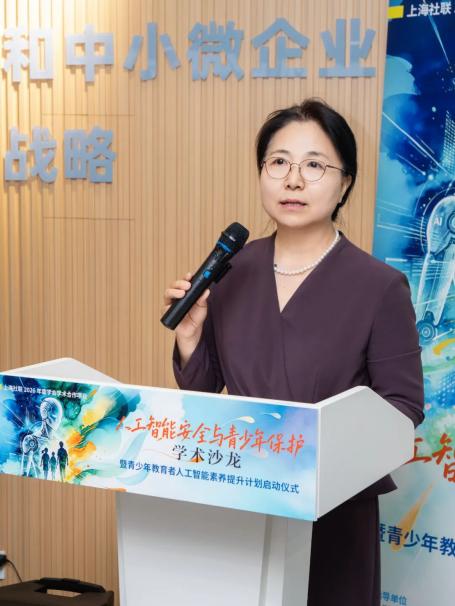
Zhao Guoqiang, Director of the Shanghai Youth Working Committee and Chief Inspector of the Shanghai Young Pioneers, pointed out that this event is a concrete measure to implement the spirit of Secretary-General Xi Jinping’s important instructions regarding AI development and the growth of children. AI is a youthful endeavor, a career for young people, and, moreover, a crucial contemporary subject that youth must confront as they grow up. Educators must continuously improve their own AI literacy and guide children to learn, utilize, and embrace AI, thereby fostering mutual learning and shared growth for both generations in the era of artificial intelligence.
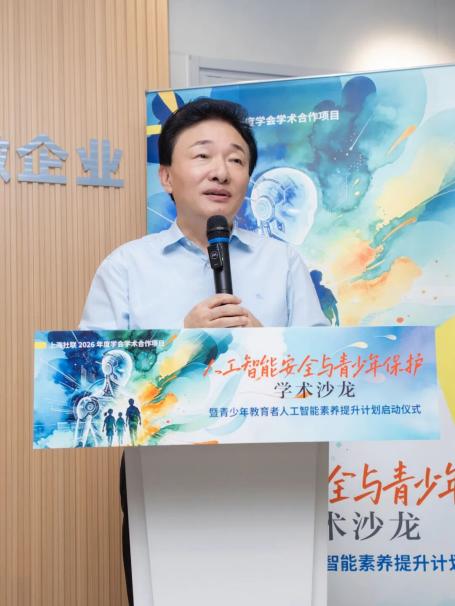
Jin Pei, Member of the Party Leadership Group and Vice Chairperson of the Shanghai Women’s Federation, expressed her gratitude on behalf of the Federation to people from all walks of life who have long cared for and supported the healthy growth of youth. She pointed out that the Shanghai Women's Federation has long adhered to a “children-first” philosophy, continuously optimizing the environment for children’s development. Facing the opportunities and challenges brought by the rapid evolution of artificial intelligence, it is crucial to strengthen the synergistic education among schools, families, and society. Technology should serve growth and learning rather than replace companionship or induce anxiety. Grounded in being child-friendly, we must advocate for tech-for-good and jointly build a safe, clean, and friendly intelligent environment for youth development.
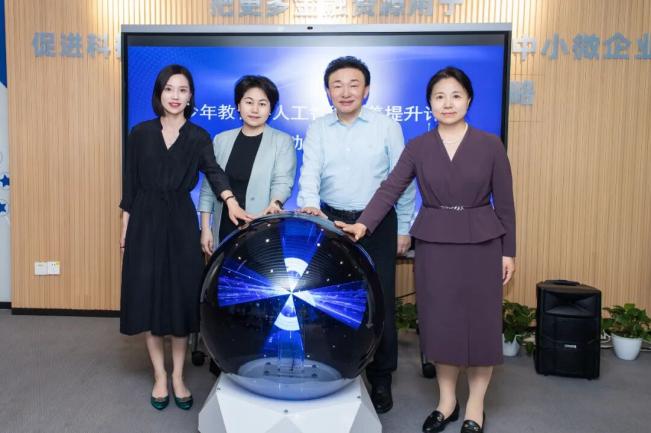
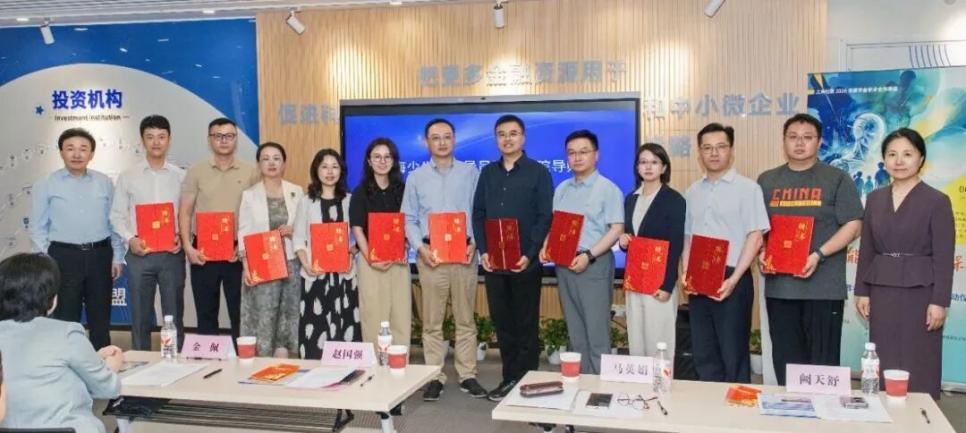
Following the speeches, the attending leaders jointly launched the “AI Literacy Enhancement Program for Youth Educators” project and presented letters of appointment for “Mentors of the Shanghai Young Pioneer Counselor Training Program” to selected member representatives of the Youth AI Education Special Committee of the Shanghai Big Data Social Application Research Association. Yao Xu, Secretary-General of the Center for Global AI Innovation Governance, and Deputy Secretary-General Xin Yanyan were among those appointed as mentors.
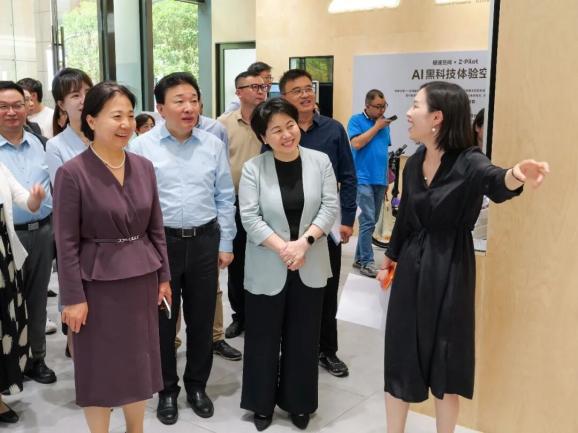
After the launch ceremony, the attending leaders, experts, and guests visited the Modelers Space AI Tech Experience Center. This provided them with a first-hand look at the large model innovation ecosystem and cutting-edge AI technology applications, offering real-world scenario support for the subsequent academic discussions.
II. Exploring Pathways for Youth Protection in the AI Era
During the keynote speech session, expert members of the Youth AI Education Special Committee of the Shanghai Big Data Social Application Research Association exchanged insights from multiple perspectives, including digital literacy, anthropomorphic interaction, risk governance, university empowerment, and cyberbullying emergency management.
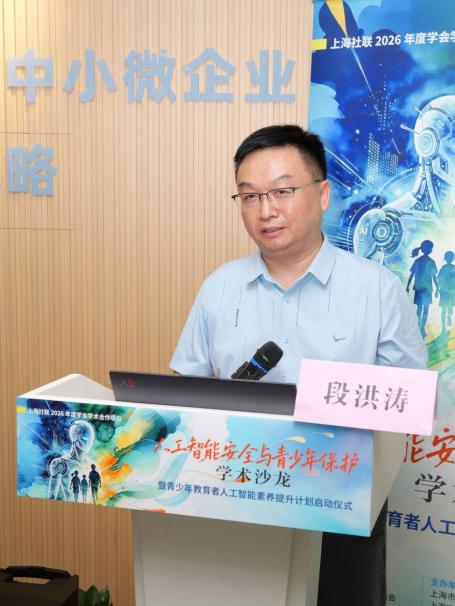
Duan Hongtao, Deputy Director of the Shanghai Education System Cyber Culture Development Research Center, delivered a speech titled “From ‘Passive Protection’ to ‘Active Self-Protection’: Reconstructing Youth Digital Literacy and Ethical Education in the AI Era.” He pointed out that traditional internet protection for minors primarily relies on passive methods such as “blocking, defending, and deleting” alongside youth modes. However, with the rapid iteration of technologies like generative artificial intelligence and deepfakes, simply constructing an “information greenhouse” for youth is no longer sufficient to counter real-world risks. The genuine breakthrough lies in shifting cyber protection for minors from passive defense to active empowerment, making young people the primary stakeholders in their own cybersecurity. To achieve this, it is essential to cultivate critical information literacy in youth to help them identify AI-generated content, deepfakes, and misinformation. We must also reshape the ethical boundaries of human-AI collaboration, adhering to a “human-centric, AI-assisted” principle, and establish a multi-party collaborative co-parenting ecosystem that allows youth to enhance their active self-protection capabilities through discussion, research, feedback, and co-creating rules.
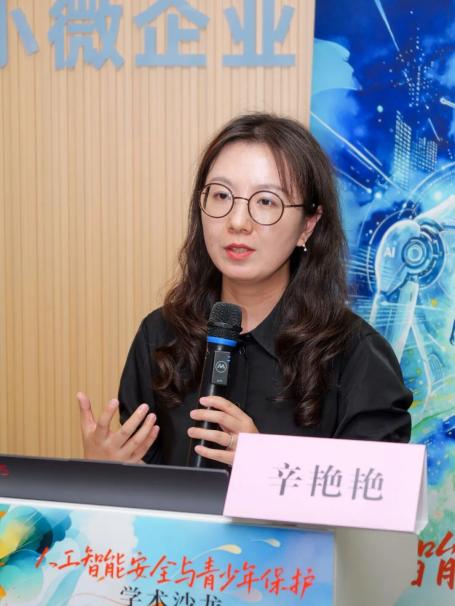
Dr. Xin Yanyan, Deputy Secretary-General of the Global AI Innovation Governance Center and Assistant Research Fellow at the Fudan Development Institute, gave a speech titled Algorithmic Companionship: Youth Addiction Risks and Governance Challenges in Human–AI Interaction” Drawing on cases such as Garcia v. Character.AI and Lane v. OpenAI in the United States, she noted that relevant lawsuits have exposed design flaws in platforms developing anthropomorphic AI interaction products, alongside issues where safety considerations have taken a backseat to commercial competition. Relying on variable rewards, people-pleasing designs, and inductive dialogue modes, these applications easily induce dependency in youth. Compared to the social media era, AI addiction is more relational, interactive, and cumulative; relying solely on screen-time reminders and information disclosures makes it difficult to prevent effectively. In the current governance context, we should further refine the identification criteria for “over-dependency” and “emotional boundaries” regarding AI, strengthen professional pipelines for psychological crisis intervention and referral, and explore the establishment of addiction recognition and safety testing adapted to human-computer interaction scenarios.
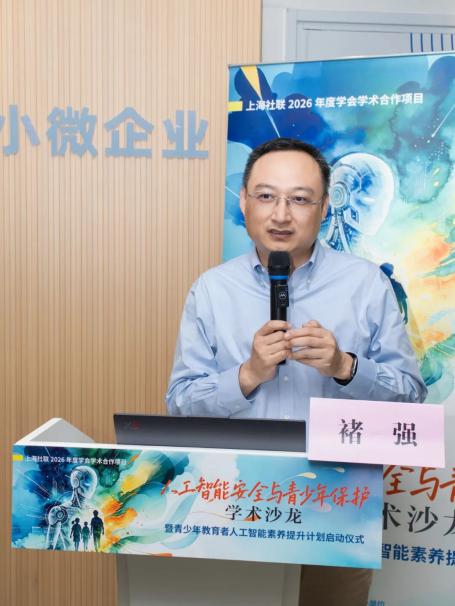
Chu Qiang, Professor and Head of the Public Security Department at the Shanghai Police College, spoke on “Reflections on Youth Protection under the Background of AI Safety—A Preliminary Analysis Based on General Situations.” He pointed out that generative AI has comprehensively penetrated the learning, living, and social scenarios of young people, with its usage form shifting from a singular tool into deeply interactive companionship. Since youth are not yet fully mature mentally, they are highly susceptible to AI safety risks, whereas existing legal frameworks, platform mechanisms, and parental guidance still lag behind technological iterations. He outlined four major categories of risks faced by youth using AI—mental health, cognitive capability, privacy security, and behavioral alienation. To combat this, he proposed a “three-tier protection mechanism” comprising “institutional tiered defense, technical safety defense, and family-school-society educational guidance.” This would drive the deep integration of risk classification, age-appropriate design, legal red lines, identity verification, real-time monitoring, traceability and anti-counterfeiting, and layered AI literacy education.
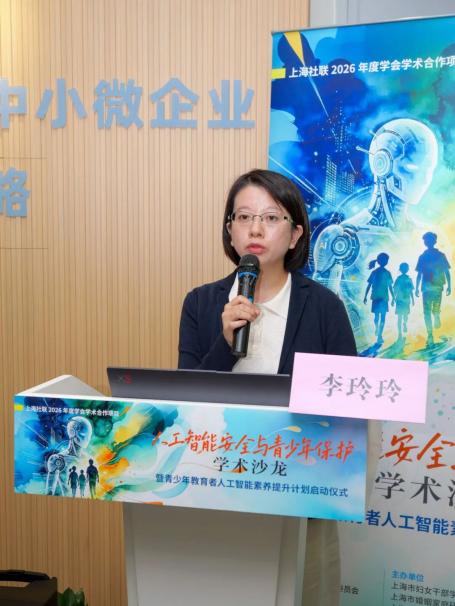
Li Lingling, Deputy Professor and Director of the Center for Comparative Studies of Chinese and Foreign Education at Tongji University, delivered a speech titled “University Empowerment Mechanisms for Youth Protection in the AI Era: Reflections Based on the Cultivation of AI Safety Literacy.” She pointed out that youth protection in the AI era is not merely a technical governance issue or an individual family education issue. Rather, it is a comprehensive problem encompassing a continuous educational pipeline through primary, secondary, and higher education, the cultivation of AI safety literacy, and multi-agent collaborative governance. Currently, while youth are already widely using AI in real learning and expression scenarios, formal curricula and teacher support still lag behind, leaving a capability gap between students “perceiving risks" and being "able to handle risks.” Universities can empower youth protection across five dimensions: curriculum, practice, teaching staff, evaluation, and governance. This involves transforming AI safety literacy into learnable, understandable, and evaluable course content, helping teachers build technical comprehension, ethical judgment, and instructional design capabilities, and driving the expansion of “technical safety” into a developmental, relational, and contextual framework for youth safety.
Wei Hongbo, Director of the Digital Security Law Research Center at East China University of Political Science and Law and Deputy Secretary-General of the Youth AI Education Special Committee of the Shanghai Big Data Social Application Research Association, spoke on the topic “Collaborative Dilemmas and Responses in the Emergency Management of Youth Cyberbullying in the Era of Artificial Intelligence.” She noted that the advancement of AI technologies has caused youth cyberbullying to manifest in more covert, complex, and viral forms—where text, images, audio, video, and deepfake technologies can all be weaponized for insults, rumors, defamation, coercion, and privacy infringement. Current governance faces collaborative dilemmas, including difficulties in identification and handling by educational departments; challenges in recognition, processing, and eradication by technical departments; and hurdles in legal characterization, evidence collection, and litigation for youth by legal departments. To resolve this, she proposed constructing a “three-in-one” collaborative network tying together “education, technology, and law.” This would involve building cross-departmental command platforms and data-sharing mechanisms, cultivating youth cyber literacy and internal immunity through forward-looking educational leadership, advocating for tech-for-good, clarifying the primary responsibilities of platforms, and improving laws, regulations, and one-stop evidence-collection and rights-protection mechanisms to foster an evolving, collaborative governance ecosystem.

III. Perspectives from Educators and Practitioners
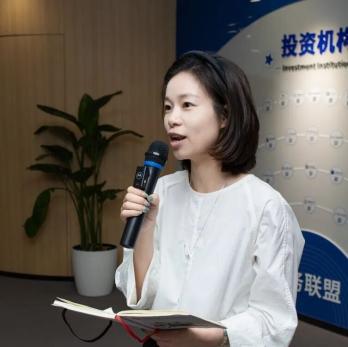
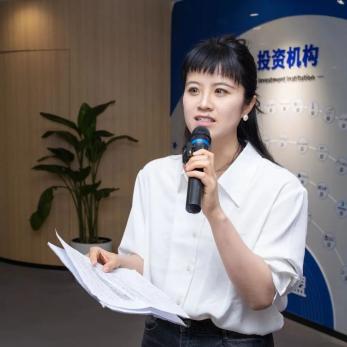
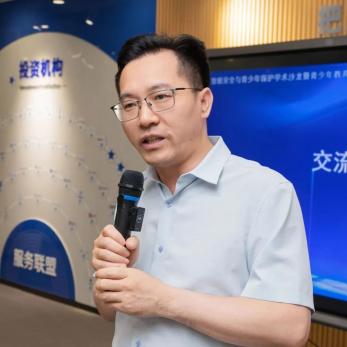
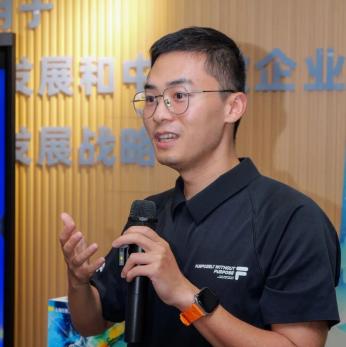
During the interactive exchange session, representatives from various fields—including Young Pioneer work, basic education management, social science and technology services, and AI enterprises—shared insights on the practical difficulties of youth protection in the AI era, drawing from their respective operational scenarios.
Ma Shicheng, Deputy Secretary of the Youth League Committee and Young Pioneer Taskmaster at the Qiantan School Affiliated to Second High School of East China Normal University, spoke from the perspective of front-line Young Pioneer work. She emphasized that front-line educators in the AI era cannot just be onlookers; they must become navigators. Given the reality that youth are already extensively exposed to and utilizing AI, it is crucial to guide students to understand AI ethics, tech-for-good, and responsible usage in real-world scenarios, helping young people “button the first button of their digital lives.”
Xia Sisi, a Young Pioneer Taskmaster at the School Affiliated to Shanghai Caoyang High School, addressed the front-line primary and secondary education scene. She noted that AI has genuinely entered students’ study and daily lives, presenting new challenges to teachers’ work. Some students use AI-generated content heavily in their writing and directly question teachers with inquiries like, “Where is the boundary for using AI?” and “Does this constitute plagiarism?” This highlights an urgent need for teachers to enhance their capabilities in technical identification, risk judgment, and value guidance.
Sun Min, Vice Principal of Shanghai Jing’an Zhabei No.1 Central Primary School, focused on AI applications in home-school co-parenting. She shared her school's exploration of digital parent academies and AI parent Q&A platforms. She pointed out that while AI can provide new tools for home-school communication, family education guidance, and the provision of educational resources, education is inherently a warm and empathetic endeavor. Schools must leverage technology to improve service efficiency while strictly preserving the humanistic essence of education.
Xiao Rong, Executive Secretary-General of the World Rehabilitation Robotics Conference and Chairman and General Manager of Shanghai Xuankang Robotics Co., Ltd., combined technical practices in robotics, brain-computer interfaces, and emotion recognition to share potential avenues for tech-for-good in youth psychological support.
Tang Zongxing, CEO of Shanghai Makeris Intelligent Technology Co., Ltd., spoke from the perspective of AI content production. He remarked that while AI has lowered the barrier to creative expression, it has not lowered the professional barrier to education. When companies develop content products tailored to children and youth, they require more support from professional disciplines such as pedagogy, psychology, and law to effectively fulfill their corporate social responsibilities.
Throughout the exchange, representatives from different sectors reached a consensus: youth protection in the AI era is not a task that can be accomplished by a single stakeholder. Instead, it requires the active participation of schools, families, social organizations, university experts, and corporate platforms. Only by effectively linking front-line educational experience, professional research findings, technical application capabilities, and corporate social responsibility can we drive AI safety and youth protection from a conceptual advocacy into concrete action.


IV. From Research to Action
During the review and summary session, Que Tianshu, Director of the Youth AI Education Special Committee of the Shanghai Big Data Social Application Research Association and Tenured Professor at the School of Political Science and International Relations at Tongji University, delivered the concluding remarks.
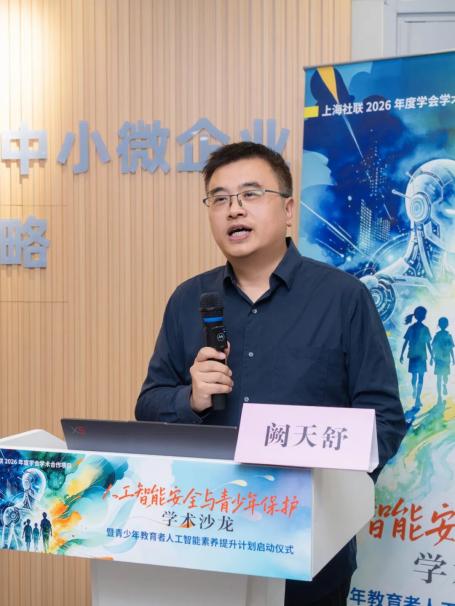
He pointed out that this event was both a cross-disciplinary academic symposium and the launch of an initiative dedicated to youth AI education and protection. Today’s youth are becoming the “AI Generation” in the truest sense. The shift brought by AI is not just about what to learn, but rather moving from “what do I want to learn” to “what problem do I want to solve”; it is not just about “looking up information,” but shifting toward “deconstructing problems.” Educators must act as the gatekeepers, navigators, and researchers who ensure that children coexist safely with AI.
Centering on the consensus formed during this seminar, Que Tianshu noted that artificial intelligence has triggered a large-scale reorganization of social relations, causing structural cracks in traditional protection systems. In reality, issues such as the absence of household rules, inadequate technical defenses, complex regulatory scenarios, and insufficient identification capabilities among teachers exist simultaneously. The way forward does not lie in building higher and thicker digital walls, but in steering youth from passive protection toward active self-protection, transforming AI safety into teachable, measurable, and iterative curricula and capabilities.
He emphasized that while the Modelers Space showcases the speed of technological iteration, the growth of youth requires the slowness of educational companionship—and the bridge connecting this speed and slowness is precisely the cohort of educators capable of safeguarding children's safe coexistence with AI. At the crossroads of AI and youth, protection relies not merely on higher walls, but on clearer observations, a more solid professional foundation, and more streamlined institutional channels provided by educators.
He recommended three next steps:
Introduce interactive design auditing into youth protection: Extend the evaluation of AI products beyond content compliance and data privacy to examine whether the interaction models themselves possess addictive or manipulative traits.
Establish an AI safety literacy framework for educators: Develop lightweight classroom toolkits to help front-line teachers identify anomalous behavioral signals in students and gain actionable, empowering tools.
Launch a longitudinal tracking study on Chinese youth’s AI usage: Accumulate localized evidence regarding AI usage behaviors, psychological states, social relationships, and cognitive development to provide a data foundation for policy formulation and educational practices.
Participants agreed that youth protection in the AI era requires collaboration among schools, families, policymakers, researchers, and technology companies. Discussions highlighted the importance of strengthening AI literacy, addressing emerging risks associated with human–AI interaction, and developing evidence-based governance approaches. The launch of the AI Literacy Enhancement Program for Youth Educators marked an important step toward building a safer and more supportive environment for young people in the age of AI.