

Artificial intelligence is profoundly reshaping the global economic landscape, security environment, and geopolitical competition. As competition between the AI ecosystems of China and the United States intensifies, their regulatory frameworks and governance standards are exerting growing influence on the global diffusion and application of AI. Against this backdrop, whether the AI development and governance practices of China and the United States can align with the developmental needs and capacity constraints of Global South countries has become an issue of broad concern.
On the morning of June 22, 2026, Dr. Megha Shrivastava, Visiting Scholar at the Center for Global AI Innovative Governance (CGAIG) and Fudan Development Institute (FDDI), and Assistant Professor at PES University, India, delivered a lecture titled “Evaluating US and Chinese AI Development Models from a Global South Perspective.” The lecture was chaired by Dr. JIANG Tianjiao, Research Fellow at CGAIG and Deputy Director of the Center for BRICS Studies, FDDI. Dr. YAO Xu, Secretary-General of CGAIG and Associate Professor at FDDI, participated as discussant.

Dr. Megha Shrivastava delivering the keynote presentation
Dr. Shrivastava pointed out that today’s mainstream global AI technological systems and governance rules are largely designed and promulgated by developed countries, while Global South countries have long remained passive recipients of these rules. She therefore raised a central concern: how Global South countries can safeguard their development rights and interests under the two differentiated technological governance frameworks of China and the United States, and how they can chart AI development pathways suited to their own national conditions.
To address this question, Dr. Shrivastava developed a four-dimensional comprehensive analytical framework covering AI infrastructure access, digital sovereignty, governance capacity, and developmental outcomes. Based on this framework, she systematically examined official policy texts, legal documents, and industry norms issued by China and the United States from 2016 to 2026, and conducted a horizontal comparative analysis.
Dr. Shrivastava then reviewed the policy discourse, governance pathways, and legal mechanisms of the two countries. China regards digital sovereignty as an integral part of national sovereignty, emphasizes autonomous control over the direction of AI development, and has built a relatively complete governance and compliance architecture. The United States, by contrast, views AI as a core tool for maintaining national technological competitiveness and global strategic advantage. Its overall approach prioritizes innovation, and it has yet to enact a unified and comprehensive AI law. Instead, AI governance in the United States mainly relies on executive orders, industry technical standards, and sector-specific enforcement actions, resulting in a relatively fragmented risk-control mechanism.
In comparing the governance practices of the two countries, Dr. Shrivastava summarized both areas of convergence and points of divergence. On the one hand, both countries regard AI as critical national infrastructure and link technological development with security and competitiveness. On the other hand, they differ fundamentally in their understanding of “digital sovereignty” and in the standards through which this concept is implemented.
Taking India’s AI development as an example, Dr. Shrivastava argued that India’s approach displays distinct domestic characteristics and may provide useful insights for other Global South countries as they formulate their own AI development strategies.
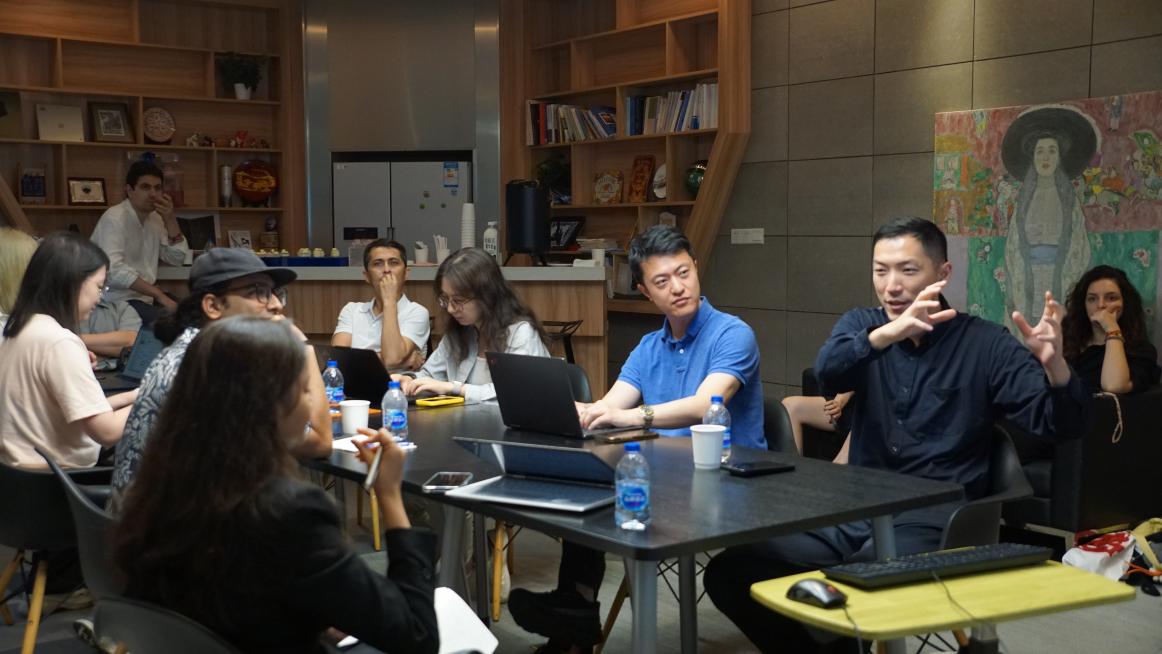
Chair Dr. JIANG Tianjiao and discussant Dr. YAO Xu participate in the discussion
During the discussion and Q&A session, participating scholars and audience members engaged in an in-depth exchange with Dr. Shrivastava on a range of issues, including the different meanings of “digital sovereignty” in the Chinese and Indian contexts, the resource costs associated with U.S. data-center investment in India, whether military AI should be incorporated into the analytical framework, and the potential and industrial foundation for China-India cooperation on AI standards under the BRICS framework.
At the end of the lecture, the Center for Global AI Innovative Governance presented Dr. Shrivastava with a Certificate of Visiting Scholarship.
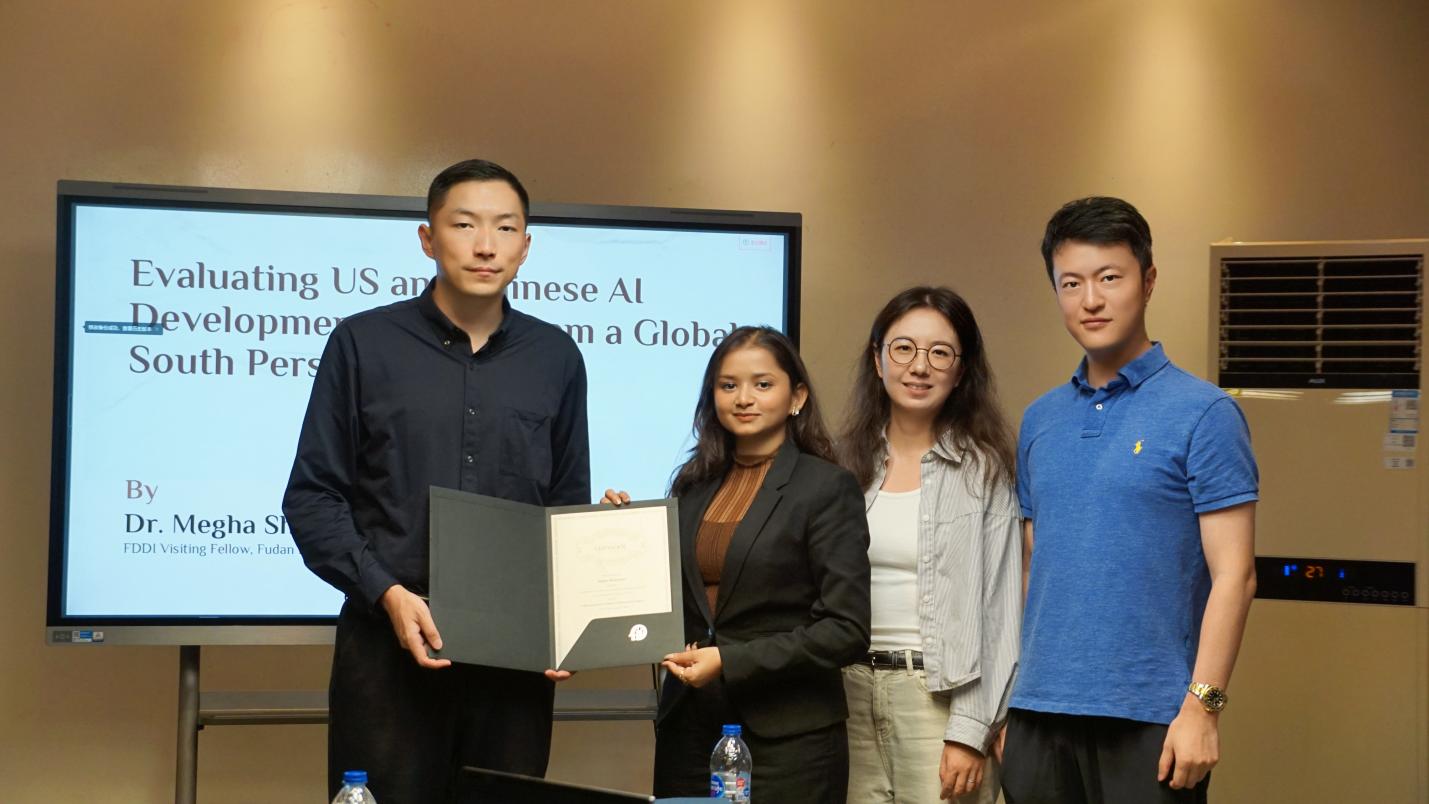
The Center for Global AI Innovative Governance presented Dr. Shrivastava with a Certificate of Visiting Scholarship
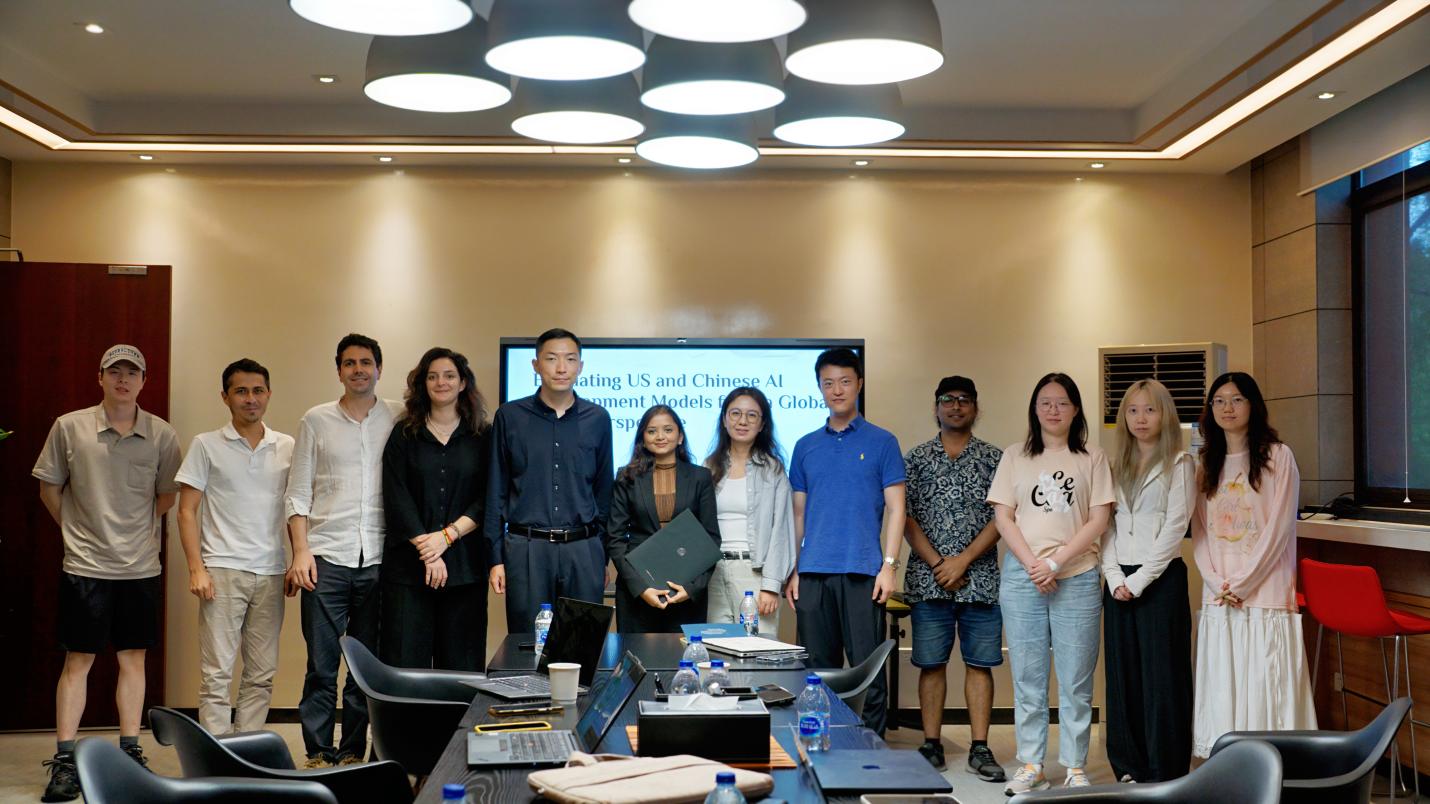
Group photo of participants