

On July 1, 2026, the United Nations Independent International Scientific Panel on Artificial Intelligence released its first output, the “Preliminary Report: Evidence-based assessment of opportunities, risks and impacts of artificial intelligence.” This is the first assessment document officially released by this high-level collaboration mechanism.
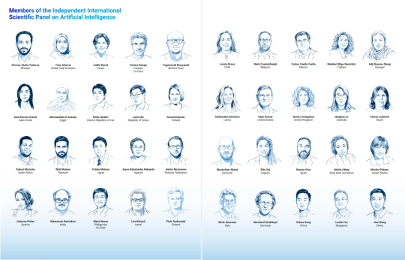
The 40 members of the UN Independent International Scientific Panel on Artificial Intelligence released in the report
Source: Original report
The report was co-authored by 40 panel members from all five UN regional groups, covering core technologies, applications, security, and policy ethics, while striving for gender and geographic balance. Among them are two scientists from China: Jian Wang, an academician of the Chinese Academy of Engineering, founder of Alibaba Cloud, and current director of the ZJ Lab, who has long been deeply involved in cloud computing and its industrial applications; and Haitao Song, president of the Shanghai Artificial Intelligence Institute, who has for years been dedicated to combining frontier technological innovation with policy making and industrial transformation. Their participation not only reflects China's active engagement in UN multilateral AI governance but also makes this assessment more comprehensive from a Global South perspective. In particular, the various open-source models launched by Chinese developers have become an important force in the global open-weights ecosystem, and these contributions are reflected in the report.
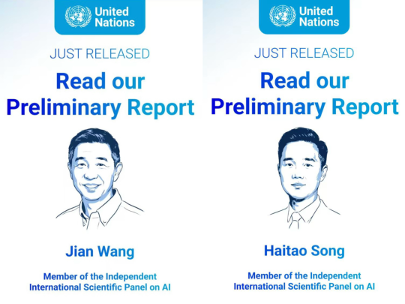
Two scientists from China, Jian Wang (left) and Haitao Song (right).
Source: UN official website
01 Addressing the Pain Points of Global AI Governance
Facing the rapid spread of artificial intelligence, the UN realized early on that the data, deployment, and spillover effects of this technology cross national borders, making it difficult for any single country to address it alone, while existing international cooperation remains highly fragmented. According to UN statistics, as many as 118 countries have not participated in any influential international AI governance processes. To change this, Secretary-General Guterres established the High-Level Advisory Body on Artificial Intelligence in October 2023. In its September 2024 report, “Governing AI for Humanity,” the body recommended establishing an independent international AI scientific panel within the UN and launching a new policy dialogue on AI governance. That same month, member states adopted the “Global Digital Compact” at the Summit of the Future, formally incorporating these two recommendations into their commitments. In August 2025, the UN General Assembly formally established both mechanisms through resolution A/RES/79/325; specific arrangements, such as the periodic holding of dialogues and rotating between Geneva and New York, were also primarily determined in this resolution. In September of the same year, the Global Dialogue was politically launched at a high-level informal meeting during the UN General Assembly's high-level week, and its first official session was set for July 6–7, 2026, in Geneva.
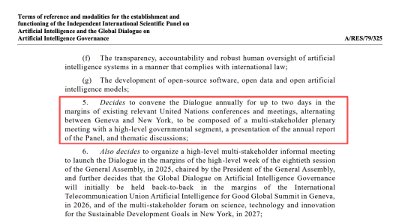
United Nations General Assembly resolution A/RES/79/325.
Source: UN official website
The two mechanisms complement each other, with one providing scientific evidence and the other providing policy dialogue. The scientific panel is responsible for synthesizing research scattered across various sources into a factual baseline that all countries can refer to, while the Global Dialogue provides a platform for 193 member states, as well as industry, academia, and social organizations, to speak on equal footing. Their role is to build a bridge between frontier research and policy making.
By mid-2026, both mechanisms have entered the operational phase and are about to proceed to the next stage of work. Following the first meeting of the Global Dialogue on AI Governance in Geneva, the second session is scheduled for May 2027 in New York. This preliminary report is to be formally submitted at the Geneva meeting, where the scientific panel will present it in person to national representatives. This dialogue is also held back-to-back with the ITU’s “AI for Good” Global Summit and the World Summit on the Information Society Forum, together forming the most concentrated set of global AI governance meetings this year. The delivery of this report at such a juncture marks a step from advocacy to implementation.
The report also sends a positive signal. Facing the complex changes brought by artificial intelligence, the international community does not have to remain in a state of talking past each other or acting in silos, but can establish a more stable, open, and representative discussion mechanism through the UN platform. This is especially important for countries in the Global South. In a situation where computing power, data, talent, and assessment capabilities are generally insufficient, a scientific assessment promoted by the UN can, to a certain extent, alleviate information asymmetry and allow more countries to participate in discussions based on the same set of evidence.
At the same time, the report reflects unity and cohesion. It neither simplistically describes AI as a threat nor unilaterally promotes technological optimism; instead, it acknowledges its enormous potential in health, education, agriculture, scientific discovery, and sustainable development, while pointing out that risk management, capacity building, rights protection, and international coordination must move forward in parallel. Its true value lies in the fact that, in a very short time, experts from different countries and disciplines have reached a high degree of scientific consensus on a number of core issues, providing a template that can be continuously expanded, revised, and deepened for the upcoming global dialogue.
02 The Report Aims to Propose a Preliminary Framework Based on Common Evidence
Structurally, the report consists of an executive summary, as well as sections on the current moment for AI, main issues revealed by evidence, findings by domain, and evidence gaps and next steps. It clearly defines its own positioning: an independent, scientific, and non-politicized preliminary assessment that is highly relevant to policy. The panel’s task is to record the consensus and divergences of the international scientific community to provide a basis for policy discussion, rather than directly prescribing specific policy solutions.
The executive summary first points out that the potential benefits of AI are significant. If deployed properly, it can help advance the Sustainable Development Goals, promote health sciences, improve accessibility to education, and enhance efficiency in fields such as agriculture, accessibility services, knowledge work, and information technology. The report cites as an example a protein structure prediction tool that has already predicted more than 200 million protein structures, serving over three million researchers. At the same time, rapid and inadequately governed large-scale deployment may also bring risks to mental health, cybersecurity, information ecosystems, socio-economic systems, the environment, and technological controllability. The report particularly emphasizes that the adoption of AI is rapid but highly uneven across countries and industries: while over one billion people worldwide use conversational AI every week, technical capabilities are highly concentrated in the hands of a few companies and countries, and many nations still lack the capacity for assessment, auditing, and localized application.
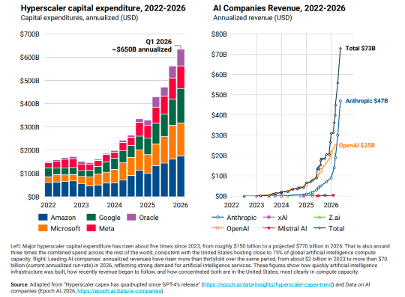
Major hyperscaler capital expenditure has risen about five times since 2023.
Source: Original report
The first part of the report answers why such an assessment is needed at this moment. It argues that AI is different from typical emerging technologies because it spreads extremely rapidly and affects cognitive and creative work on a massive scale. While past automation mainly transformed physical labor, AI is impacting mental activities such as writing, programming, legal analysis, medical diagnosis, scientific discovery, forecasting, and image generation. At the same time, foundation models and general-purpose systems bring economies of scale, further concentrating capabilities, computing power, and data in the hands of a few entities. The report also warns that while today’s language models can generate fluent content, fluency does not equal truth; in high-risk scenarios such as medical care, the consequences of errors from the same systems could be very serious if they lack regulation and assessment.
The second part of the report focuses on what the evidence shows, which can be broadly summarized into six main themes.
First, the pace of improvement in AI capabilities is already faster than the pace at which humans can measure and govern them. Existing assessments face multiple challenges, including information asymmetry between companies and society, the possibility that public test questions have been memorized by models, the increasing ease of traditional tests, the potential for deceptive behavior by models, models potentially recognizing they are being tested, and autonomous agents making assessments more complex. The report therefore suggests that future needs include dynamic testing, interpretability research, continuous monitoring, incident reporting, and more independent third-party assessments.
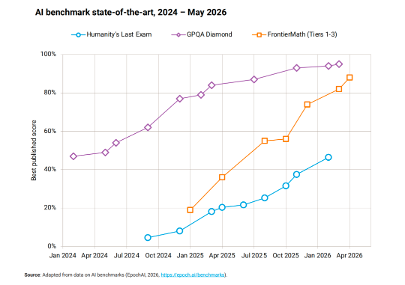
Since 2024, the performance of top AI models has increased significantly.
Source: Original report
Second, the ability to train frontier AI is concentrated in the hands of very few participants. Computing power, data, engineering talent, advanced chip supply chains, cloud services, and foundation model development all exhibit a trend of high concentration. In 2025, the vast majority of significant models came from the private sector; in terms of computing power, the United States accounted for about three-quarters of the world's top compute clusters; in terms of models, the U.S. produced about 59 significant models that year, more than half of the global total. This concentration could lead to market monopoly rents, difficulties in coordinating public interests, excessive reliance by the Global South, and cultural and linguistic homogenization. The report also compares the trade-offs between different paths—such as closed-source models, open-weights models, and open-source models—in terms of access, transparency, control, and abuse prevention, and specifically mentions that models launched by Chinese developers, such as Qwen and DeepSeek, have become an important force in promoting the global open-weights ecosystem.
Third, AI inputs and outputs are highly uneven in terms of geography and language. There are over 7,000 languages in the world, yet current models and evaluation infrastructure cover only a tiny fraction, with many low-resource languages and local cultures neglected in datasets, tests, and applications. The report points out that this is not just an issue of user experience but directly impacts high-risk areas like healthcare, education, and public services. The report further suggests that the AI divide lies not only in whether tools are available, but also in whether a country has the capability to influence the direction of technological development, standards, and governance rules.
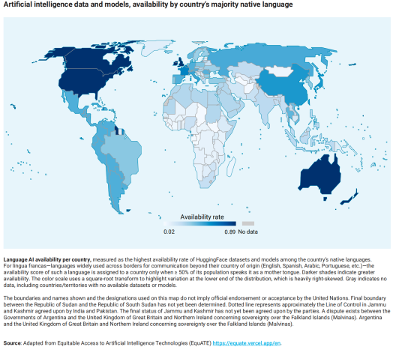
By measuring the highest availability rate of a country's native language, the significant imbalance in the global distribution of AI resources is intuitively displayed.
Source: Original report
Fourth, for AI to be truly useful, it requires supporting conditions. Technological availability does not automatically bring social benefits. In healthcare, AI tools need to be integrated with local medical networks, referral mechanisms, clinical capabilities, and linguistic environments; in education, whether teachers can understand and appropriately use AI directly affects students’ learning outcomes; in agriculture, it can help predict weather, pests and diseases, food security, and market risks, but it must be embedded in local institutions and public services. The report uses a chain from technology to access, adoption, diffusion, and economic outcomes to illustrate that only when organizations, skills, data, and institutions are aligned can AI truly be converted into development gains.
Fifth, the report views autonomous agents as an important shift in governance. Unlike systems that only generate answers, agents can browse the web, use software, execute code, call tools, coordinate with other agents, and complete tasks with minimal human supervision. While this could accelerate scientific research, cyber defense, and production processes, it could also bring problems such as loss of control, cyberattacks, manipulation of public opinion, difficulty in assigning responsibility, and failure of human oversight. The report argues that governance methods designed for static software or ordinary chatbots are difficult to apply to agents capable of taking action in the real world.
Sixth, the report discusses issues such as the information ecosystem. AI-generated content, deepfakes, and highly personalized persuasion may weaken the public's ability to distinguish truth from falsehood, thereby affecting public trust, social cohesion, and democratic discourse. The report also identifies privacy, non-discrimination, children’s rights, the harm of deepfakes to women and children, as well as AI companions and mental health risks, as key issues. It emphasizes that governance cannot just focus on whether individual pieces of content violate rules, but must also pay attention to system design, recommendation mechanisms, interaction methods, and the underlying commercial incentives.
The third part of the report unfolds by domain, discussing in turn scientific progress and trends in AI, social applications, economic impact, security, system and environmental impacts, human rights, information and democracy, culture and individual development, autonomy and child safety, and management, governance, and reliability. The overall judgment is that AI is a general-purpose technology, but its benefits will not occur automatically, nor are its risks unmanageable; the key lies in supporting investments, scientific assessment, capacity building, reliable governance, and continuous international cooperation. The fourth part of the report frankly lists evidence gaps, including macro-productivity, labor market impacts, risks of chemical and biological abuse, environmental and resource consumption, global supply chains, the practical effectiveness of governance tools, and how individual-level interactions accumulate into social-level consequences. The report also notes that military AI and lethal autonomous weapons systems are outside the scope of this mandate, and that follow-up thematic briefs will be issued, incorporating the results of the Global Dialogue.
03 A Positive and Pragmatic Start
Overall, the most prominent contribution of this report is moving AI governance from a competition of opinions to a consensus based on evidence. In recent years, discussions about AI have been scattered across corporate security reports, national regulatory documents, technical standards organizations, academic papers, and public opinion. Different countries, industries, and groups have different focuses and differing judgments on risks and opportunities. Through this preliminary report, the scientific panel has placed capability progress, application value, sources of risk, governance gaps, and evidence gaps into the same framework, lowering the threshold for global discussion.
The second commendable point of the report is that it does not simplify AI governance into a binary choice between restricting technology and encouraging innovation. It acknowledges that AI can provide tangible help for health, education, agriculture, scientific research, accessibility services, and sustainable development, while emphasizing that these benefits require the coordination of institutions, talent, data, infrastructure, and accountability mechanisms. Not only is this closer to reality, but it is also easier for the public to understand: AI itself is neither automatically good nor automatically bad; the key lies in how it is designed and deployed, and who can use, supervise, and share in the benefits.
The third value of the report is placing the Global South at the center of governance, rather than just treating it as a recipient of technology. The report repeatedly points out that the AI divide is not just a question of whether tools are available, but a question of whether there is computing power, data, talent, assessment capability, the right to participate, and influence over standards. If the Global South can only use models trained by others but cannot participate in training data, language coverage, security assessments, and rule-making, then AI is likely to further widen existing development gaps. Clearly laying out this issue is in itself a step toward fairer governance.
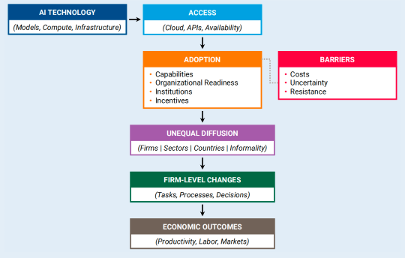
Diffusion mechanism of artificial intelligence technology.
Source: Original report
Of course, the report itself frankly admits its existing shortcomings. The panel had only a few months from its first meeting to the production of the report, and data on many issues remain insufficient, especially regarding macro-economic impacts, long-term changes in the labor market, environmental footprints, global supply chains, the practical effectiveness of governance tools, and long-term individual and social-level impacts. On these issues, the report does not provide overly definitive conclusions but instead candidly lists them as evidence gaps. This is a responsible scientific attitude and leaves space for deepening in the next phase.
Behind the report, another point worth noting is the funding and resource support mechanism. The donors listed in the report include the governments of Germany, Japan, and Spain, and the Omidyar Network foundation. This reflects a common reality in current international governance: many mechanisms aimed at the Global South and the public interest are still primarily funded by developed countries and a few foundations.
To some extent, this can be seen as a realistic path for future North-South cooperation. It is precisely because computing power, data, talent, and funds are highly concentrated in Northern countries that they have a greater responsibility and capability to provide more support to the Global South in terms of funding, technology, computing power, expert networks, and institutional platforms. What is truly important is that this support must not only bring the input of agendas but also bring capacity sharing, governance transparency, and shared ownership. Only when more countries are truly capable of participating in, assessing, and adapting AI will the evidence base the report relies on be more representative, and only then can global governance truly benefit everyone, rather than just reflecting the concerns of the most advanced players. Enabling the Global South to move from being the object of assessment to a joint builder should be an important goal for the next phase.
On this basis, there are some issues that the report does not cover much but which will have far-reaching impacts on future governance, worthy of being brought into focus early.
First is the capacity building of global public computing power and public data, as well as independent assessment and incident reporting mechanisms. Without computing power, data, and testing platforms, it is difficult for many countries to move from using AI to influencing AI; as agents enter real-world scenarios, relying solely on corporate self-assessment is far from enough, and more independent, transparent third-party assessments and unified incident reporting channels are needed. Related to this is the governance of open-source and open-weights models. Open models are beneficial for local innovation and capacity building in the Global South, but require stronger, institutionalized security safeguards.
Second are the material foundations and distribution issues that are easily overlooked. AI is not intangible; it relies on real electricity, water, chips, critical minerals, and data centers, and the impacts of its energy consumption, water consumption, and electronic waste are growing rapidly. Parallel to this are labor, income distribution, and social security: while AI increases efficiency, it may also change the bargaining power of workers and the structure of wealth distribution. How to adjust tax and social security systems to cope with potential shocks is a problem that countries will have to face sooner or later.
Third are areas that the report has touched upon but still need deeper exploration. The geopolitics and export controls behind chip and critical mineral supply chains, the determination of liability and international verification mechanisms after damage caused by agents, how the Secretary-General’s proposed Global Fund on AI can truly be funded and operated, intellectual property, copyright and creator rights, and the ripple effects caused by a potential market fluctuation due to the gap between huge infrastructure investment and actual revenue, are all worthy of early study. Regarding children, education, and mental health, the report has already pointed out the risks; next, it will be necessary to more clearly delineate the boundaries between educational assistants, companion products, mental health tools, and medical devices.

The “AI for Good Global Summit,” to be held in Geneva from July 7 to 10, 2026, will serve as the first meeting of the UN Independent International Scientific Panel on Artificial Intelligence.
Source: ITU official website
In summary, this report is a positive, robust, and starting document suitable for public communication. Its importance lies not in providing final conclusions but in providing a common starting point for discussion for the international community: recognizing the enormous opportunities of AI while facing its risks; respecting scientific evidence while serving public decision-making; and acknowledging the technological reality of developed countries and large enterprises while striving to include the Global South, children, workers, minority languages, and the public interest in the vision of governance.
As the global AI governance dialogue is about to be held, the core message conveyed by this report can actually be summarized in one sentence: governing AI requires neither waiting until problems are fully exposed before acting, nor acting hastily in the absence of common evidence. The international community needs to combine scientific assessment, policy dialogue, capacity building, and resource support under the UN framework to make this technology truly serve the common interests of all humanity.